Quick bite – Recent interesting evolution papers in PLoS Journals

There have been a slew of interesting evolution papers recently in PLoS journals. Here are some

RNA based metagenomics – bee CCD study suggests a way to survey all microbes at once

After being reprimanded justifiably by one of the authors of the recent paper on bee colony collapse disorder (for a blog I posted and then removed) I have come to realize they used a very interesting approach to metagenomics that I have not seen used extensively before.

Their paper can be found here.

Here is the problem they were faced with – how to survey an sample for ALL the microbes present including both viruses and cellular microbes. The challenge to this is that some viruses have RNA genomes and thus if one simply extracts DNA and sequences it one will not sample any of the RNA viruses. One approach to such a challenge would be to isolate RNA and make cDNA and sequence to sample the RNA viruses. And then to separately isolate DNA and then sequence it either directly (using shotgun sequencing) or indirectly by first amplifying genes with PCR.

They chose a different approach – to isolate RNA and make cDNA and then sequence it. In doing this they in fact do get a sample of both RNA viruses AND cellular organisms. For cellular organisms, since most of the RNA in a cell is ribosomal RNA they get a sample of that organisms rRNA which can be used to say what type of organisms are present. Thus in one fell swoop they in essence sample ALL the microbes present in a sample. I had blogged about this and criticized them because they did not explain in the paper or in the press releases all of this logic, but one of the authors set me straight so I deleted my blog. Then I started thinking about it and realized that this seemed to be a relatively novel approach to metagenomics.

Now – I am not sure if this method is quantitative or exactly how robust it is, but it does provide an alternative to rRNA PCR (which has all the biases of PCR) and also provides an alternative to separately sequencing RNA and DNA from a sample. Certainly many have used RNA to cDNA and then sequencing to survey RNA viruses before. But usually they do this in material in which the cellular organisms have been first removed so that one does not get overwhelmed by the RNA from those organisms. But here, they used the power of massively high throughput sequencing and turned this “problem” of getting RNA from cellular organisms on its head and used it to sample RNA viruses and cellular organisms at the same time.

I do not know if this has been done before — maybe other out there know of examples. But whether or not it has been done before, it is an important approach that should be considered in metagenomic surveys and it also suggests that ANYONE doing metagenomic surveys of microbes might want to purify RNA and save it form samples even if one is going to first focus on DNA.

Retraction – I was buzzing off about bees before my time

Recently I wrote a post about the recent study on bees associated with colony collapse disorder. After receiving a well thought out email from one of the authors on the study I have decided to retract my blog and apologize to the authors of the bee study. I rushed out my blog without really considering the evidence and the data very carefully and accept that I screwed this one up big time. The study is much more complex and comprehensive that I led people to believe. In part this was due to lack of detail in the actual manuscript but alas most of the fault lies with me – in not trying to contact the authors for more detail before mouthing off.

So I am giving myself a new award – the genomic jerk award. Hopefully there will be no more recipients.

Quality Genomic Reporting Award – Seeking Nominations

Well, Genome Technology magazine got on my case for being a bit too snarky with my “awards” saying

If Jonathan Eisen Offers You an Award, You Probably Want to Decline

Fair enough. I can be both passive aggressive and just plain aggressive about my opinions on how things should be done out there. And yes I have ended up focusing frequently on the negative (which is the case for both the awards I have begun dishing out here – the Adaptationomics Award and the Overselling Genomics Award). Plus, my giving out the latest award has taken away a bit from what should be an enormous positive vibe for the latest Wolbachia paper by Julie Dunning Hotopp and Jack Werren and colleagues, which is a spectacular piece of science.

So I have decided to try and be positive (occasionally) and have created a new award to give out – the Quality Genomic Reporting Award.

This award will be given to news articles (or blogs occasionally) written for the general public (e.g., in newspapers or news magazines) that do a good job of covering a scientific study involving genomic data.

At first, I wanted to give the award to HENRY FOUNTAIN for his article in the NY Times on September 4, 2007 entitled: “When Bacteria Transfer Genes to Invertebrates and Spread From There.” This would have been ironic since this story is about the same scientific study that led me to give out the first Adaptationomics Award a few days ago (also see Larry Moran’s discussion on his Sandwalk blog and Evolgen‘s).

I confess, when I saw the NY Times had an article in this Tuesday’s Science Times about this Wolbachia story, I expected to find the same stuff that I went after in the Adaptationomics award and I was expecting an easy blog topic. But on first glance, Fountain seemed to do a pretty good job. For example he reports:

The researchers looked for Wolbachia genes in the genomes of more than 24 invertebrates, including wasps and nematodes, and found it in 8.

Thus providing a level of detail normally missing from genomic reporting. In addition, he does a good job of setting up the story:

But lateral gene transfer between bacteria and multicellular organisms has been assumed to be exceedingly rare, for the reason that most cells in a higher organism are somatic; their genetic material does not get passed on.

Alas though the story is good, it does contain some bits I am not keen on. For example, he reports that

This genome-within-a-genome involves Wolbachia pipientis, a bacterial parasite that is one of the most prevalent in the world, infecting close to three-quarters of all invertebrate species, typically in the reproductive cells

This is a bit misleading. The statement that Wolbachia infect 3/4 of all inverts is not really accurate. It would be better to say “some researchers estimate that Wolbachia infects up to 3/4 of all inverts.” The research that I know of on Wolbachia prevalence in different species has focused on surveys of insects and arthropods (which are only a subset of invertebrates). And these studies have given conflicting results with some showing 20% of species surveyed being infected and others showing up to 70%.

But this is a minor quibble. And I was still getting ready to give Fountain the award. But then it ends the article with a quote by Jack Werren that fits into the Adaptationomics paradigm for the award I gave a few days ago:

“It’s happening frequently enough,” he added, “that it’s inevitably going to be leading to the evolution of new genes.”

Sure Werren might be right. And, in case people thought I was saying otherwise – he is more than welcome to state his opinion about things and give his insight even when evidence is not there. That is after all part of what makes science fun and interesting. And I should make clear, this is NOT meant to disparage the science in the Wolbachia paper. But when a scientist makes such a statement, it would be good for reporters to at least say specifically the speaker is predicting something that is not yet known. That is, just try to clarify what was supported by evidence and what was more of a jump.

So alas – this article is not going to get my Quality Genomic Reporting Award, even though overall it is pretty good. But pretty good is not good enough. So if anyone out there has good candidates for the award, let me know and I will keep looking too.

Metagenomics 2007 presentations available

For those interested in metagenomics, the Metagenomics 2007 meeting (also see Konrad’s blog) has posted video and pdf’s of most of the presentations. You can get everything at the CAMERA web site here. I have posted links and titles below:

Larry Smarr [video] [PDF]

Masahira Hattori, Tokyo University/RIKEN
Length: 56:30 [video] [PDF]

Paul Gilna, UCSD
Length: 5:55 [video]

Jed Fuhrman, University of Southern California
Length: 1:04:01 [video] [PDF]

Dawn Field, Oxford Centre for Ecology and Hydrology

Length: 27:05 [video] <!–[video]–> [PDF]

Janet Jansson, Swedish Univ of Agricultural Sciences
[PDF]

James M. Tiedje, Michigan State University
Length: 27:09 [video] [PDF]

Breakouts:

Medical Metagenomics
Human Biology
Chair: Trevor G. Marshall, Autoimmunity Research Foundation
Speaker: Peter J. Turnbaough, Washington University
Length: 49:32 [video] [PDF]

Computational Metagenomics
Ontology and Standardization
Chair: Jonathan Eisen UC Davis
Length: 44:18 [video]

Discovering opportunity for Bioenergy
Chair: Phil Hugenholtz, JGI
Speaker: Yuri Gorby, JCVI

Length: 50:45 [video] [PDF]

Modeling the natural world
Chair: Trina McMahon, Univ. of Wisconsin-Madison
Speaker: Patrick Schloss, UMass Amherst

Length: 1:00:36 [video] [PDF]

Evolution and population
Chair: Francisco Rodriguez-Valera, Universidad Miguel Hernández in Alicante

Length: 1:00:36 [video]

John Wooley, UCSD (Moderator); various speakers
Length: 40:47 [video]

Metagenomic analyses of corals
Forest Rohwer, San Diego State University
Length: 21:15 [video] [PDF]

Population structure of microbial communities in the world’s oceans
Mitchell Sogin, Marine Biological Lab, Woods Hole
Length: 41:20 [video] [PDF]

Structural metagenomics: Lessons from the first experimentally characterized GOS proteins
Adam Godzik, Burnham Institute
Length: 46:35 [video]

Detailed view of the architecture and implementation of a metagenomics server
Philip Papadopoulos, UC San Diego/SDSC
Length: 24:27 [video] [PDF

Metagenome sequence data management and analysis
Victor M. Markowitz, Lawrence Berkeley National Lab
Length: 34:25 [video] [PDF]

Developing a software workbench for marine ecological genomics
Frank Oliver Gloeckner, Max Planck Institute for Marine Microbiology
Length: 32:39 [video] [PDF]

The Metagenomics RAST server: Automated analysis of Sanger and 454-type metagenomes
Folker Meyer, Argonne National Laboratory
Length: 17:00 [video] [PDF]

Technologies for metagenomics selection and sequencing
Gautam Dantas, Harvard University
Length: 33:30 [video] [PDF]

Micro-Mar: A database for dynamic representation of marine microbial diversity
Ravindra Pushker, University College Dublin
Length: 32:00 [video]

Conclusion
Kayo Arima, UC San Diego
Length: 2:16 [video]

Too eager for ethanol?

Just a quick one here along the lines of my biofools series. Anyone interested in biofuels should take a look at the LA Times Editorial from Aug 20 titles “Drunk on Ethanol” which discusses many of the negatives of growing corn for ethanol and of other aspects of the crop to ethanol pipeline. Also check out the letters to the editor following up on the piece (one of them by my sister, Lisa Coffman, Executive Director of the California Water Impact Network). My personal biggest concern is the environmental damage that could come from increased use of plants to produce ethanol. Such damage includes the conversion of rainforests into sugar cane plantations, the use of more and more pesticides and herbicides and fertilizers to go onto less useful land, and the excessive use of an already limited resource – water. Yes, if you do the calculations in certain ways, ethanol seems like a great idea. And it is certainly true that if we are going to make ethanol from crops we could do it more efficiently. But the way it is being done now – with corn sucking up water like their is not tomorrow we are heading down a bad path.

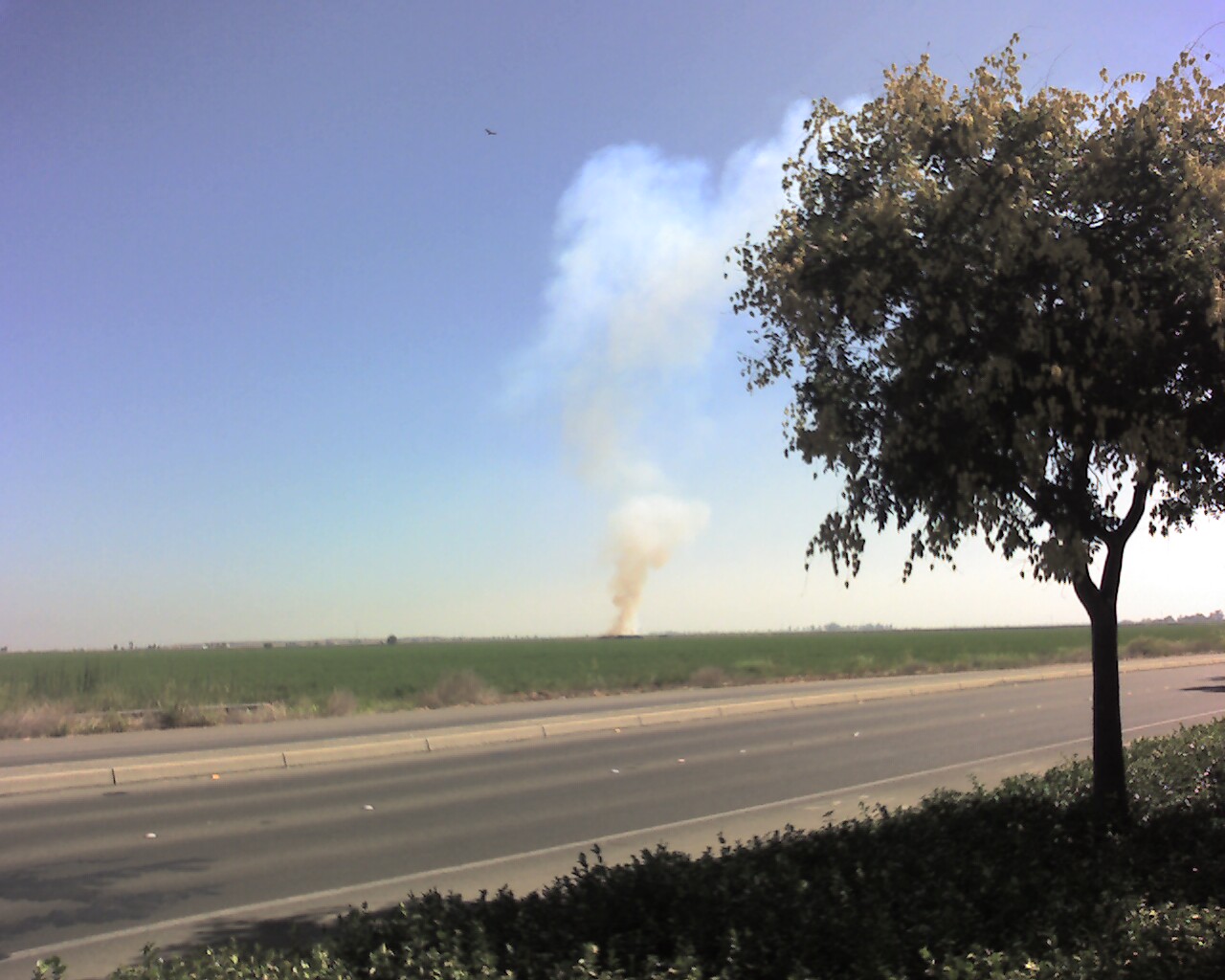
What would make more sense is to first make better use of all the wasted biomass from various agricultural systems and from solid waste. Lots of material is still being burned on farms for example (see pictures below of a fire near Davis — these are going all the time, even on “spare the air” days). Sure – one can make lots of money from corn to fuel right now. But that does not make it the right thing to do when there are plenty of sources of biomass being wasted all around us. Lets hope that more of the biofuels projects work on converting leftovers not new crops.