Fun at Novozymes in Davis

Normally, I hate marketing slogans.  But I must say I was pretty happy with the way Novozymes portrayed its “Rethink Tomorrow” branding.  Yesterday, I went over to Novozymes in Davis for the opening of a new building (Novozymes has an R&D branch in Davis).  It was a short and nice ceremony that included presentations by honchos from their HQ, some local Novozymes employees, as well as folks from the community including the Mayor Pro Tem of Davis Don Saylor and the head of the UC Davis Genome Center where I work, Richard Michelmore (who also happens to be the Novozymes Chair of Genomics).

What I liked about the marketing/branding discussion was how Novozymes is focused on making enzymes that can reduce the environmental impact of various industrial, agricultural, and personal processes like the making of biofuels.  Sure, everyone is going green these days or attempting to in some way.  But their argument that custom designed enzymes can reduce waste, allow for lower environmental impacts, etc, made sense to me.  In addition, they made significant efforts to make their building a low impact building.  Sure, nobody is perfect, but Novozymes seems to be making significant efforts towards the greater good even when they do not have to.  
Of course, perhaps I am a little biased since I live off Novolog from NovoNordisk, a “sister” company of Novozymes (see picture at the end of my slide show on my Novolog pen …).  

http://picasaweb.google.com/s/c/bin/slideshow.swf

See also

Got phylogeny?

For an obsessed evolutionary biologist, it is always good to see “Need phylogeny” on the blackboard while sitting through a faculty meeting.

Very strange "permission" form to use my name in a story

I just got a request from a fact checker for a publication who wanted to reference my April 1 joke on Brain Doping in a story (I was not interviewed for the story).  And they wanted me to sign over some rights associated with them using my name.  The text of the form is below.  I have been quoted and written about and even had my picture in places like the Scientific American, the New Yorker, US News and World Report, USA Today, PLoS Biology, Nature, Science, blogs, etc and not once has anyone sent me such a form.  Anyone seen anything like this?  

For good and valuable consideration, the receipt of which is hereby 

acknowledged, I, ___________________________ (“Subject”), hereby irrevocably grant 

to XXXXXXXXXXXX, and YYYYYYYYYYYYYY , the absolute right 

and permission to publish my name and/or photograph or likeness and/or statements 

(either in part or in their entirety) in: (a) the publication, ZZZZZZZZZZZZZZ, that ,

 (including all print and digital versions), (b) reprints of the article, including excerpts thereof, 

in which Subject’s name and/or photograph or likeness 

and/or statements originally appeared (including all print or digital versions) and (c) 

promotional materials relating to ZZZZ, YYYY, XXXXX, in any and all media. 


In the event this Consent & Release cannot by signed by the Subject, the undersigned represents that 

he/she is fully authorized by Subject to grant the rights herein.  


Subject agrees that electronic signatures shall have the same force and effect as original signatures. 


________________________________________________ 

Print Name 

________________________________________________ 

Signature 

________________________________________________ 

Address 

________________________________________________ 

City/State/Zip Code 

________________________________________________ 

Telephone 

________________________________________________ 

Email 

________________________________________________ 

Date 


he/she is fully authorized by Subject to grant the rights herein.  


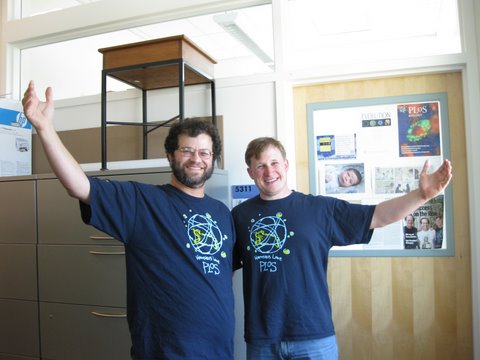
Is it a faux pas to wear the same T-shirt as another professor when you like the shirt?

No plans to wear the same shirt as Marc Facciotti who is another faculty in the UC Davis Genome Center (who by the way does brilliant stuff on gene regulatory networks in yeast and halophilic archaea). But there we were in our Hamsters Love PLoS shirts. And rather than run away in shame, I begged Lizzy Wilbanks, a grad. student, to take this picture (and note the picture of Harold Varmus, Pat Brown and my brother Michael Eisen from the Genome Technology cover in the background …)

New Web Resource on Evolution … EvolverZone

Looks like T. Ryan Gregory, who writes the GenoMicron blog has evolved … he has released a new web resource on evolution – Evolver Zone. Clearly still a work in progress, it has some good collections of links to videos, journals, books and other materials about evolution. Worth checking out.

Must reading for those interested in Open Science – Michael Nielsen on "Doing Science in the Open"

Not much for me to add here other than to tell everyone interested in Open Science that you should look at Michael Nielsen’s article: Doing science in the open – physicsworld.com. It covers a wide range of topics from secrecy to journals to the internet to online commenting to wikipedia to collaboration to FriendFeed. It has lots of interesting points in there. Hat tip toDavie Bacon / The Quantum Pontiff.

Open Access Pioneer Award: Bob Shafer HIV DB

Bob Shafer, an Associate Professor at Stanford, is fighting to make information about HIV freely available. He runs a database called HIVDB that aims to make information about HIV drug resistance available to the broader community. And he has been doing this for years (note – I worked with Bob when I was a PhD student and he was getting HIVDB started – we even wrote a paper together where I helped him do some phylogenetic analysis of HIV). For that alone, Bob deserves an Open Access Pioneer award. But I am giving him one here for a fight he has taken on recently.

You see, a company called Advanced Biological Laboratories, S.A has been suing Shafer and Stanford over a patent dispute. The company seems to be trying to claim to have rights over many (or maybe they think all) uses of using computers to help doctors make medical decisions. And they have been trying to get people to license their IP/software for doing this and one way they appear to be trying to get “users” is by suing them. And Bob is one of the people they have sued.

Sadly, Stanford University appears to have given in to the lawsuits even though their validity is debatable (see The Fight of His Life which provides some of the details – Hat Tip to Bill Hooker and FriendFeed for highlighting this article) and Bob has been left hanging on his own. Instead of caving to the lawsuit and shutting down HIVDB or making it less openly available or requiring people to say they will give commercial rights to Advanced Biological Laboratories for anything they develop using the DB. And rather than cave to the lawsuits Bob is fighting back – with a website called harmfulpatents.org and with a set of letters and communications. Mind you, I know little about IP/patent laws or the legal issues behind this dispute. But if this lawsuit leads to the shutting down or restriction of HIVDB that would be proof enough to me that Advanced Biological Laboratories and the legal system that supports them is doing a disservice to the progress of science.

For his efforts in keeping HIVDB open I am giving Bob Shafer a Open Access Pioneer Award.

For more on this story see

Elsevier, fake medical journals, and yet another reason for #openaccess

For those of you not in the loop on this there is a bubbling story going around the web and in some news sources about Elsevier publishing fake science/medical journals for hire. First reported by The Scientist (as far as I can tell), the story just seems to get worse and worse. Basically, it seems one branch of Elsevier published a series of journals that were little more than advertisements for Merck products while pretending to be independent journals.

The whole thing is pretty sad. The head of Elsevier as well as multiple people that have worked at Elsevier seem to have not been aware of that these were being used to pretend they were real journals. But I think one this is abundantly clear – we can cross of the list of criticisms of Open Access publishing that the costly non open access journals and publishers are protecting the world from bad science. Instead, it seems like they are in fact explicitly and purposefully pushing bad science and medicine in order to make extra money. Lovely.

For more informaiton on the story see for example, Kate McDonald in the Australian Life Scientist (see Elsevier published fake medical journals – Elsevier Australia, Merck, Vioxx – Australian Life Scientist). In this article she reports:

The CEO of Elsevier’s Health Sciences division in the US, Michael Hansen, has now issued a statement admitting the company’s Australian office published six journals paid for by pharmaceutical companies.

Also see for example Forbes (via AP). The best source on this has been the Bloggosphere where there were a large number of discussions including

My favorite source so far has been Bill Hooker at Open Reading Frame who did some really useful digging into the details of what was being published. After his posting there has been an interesting discussion on FriendFeed (see embed below)

http://friendfeed.com/billhooker/6907bac6/no-bottom-to-worse-at-elsevier?embed=1

There also has been some other discussion on FriendFeed including the following from a Graham Steel posting:

http://friendfeed.com/mcdawg/9b919af7/statement-from-michael-hansen-ceo-of-elsevier?embed=1

Tour of California moving to May for 2010

The Tour of California has announced it will be held May 16-23 next year (see e.g., Velonews –  Amgen Tour of California May 16-23 ).  Good and bad news in this.  The good news is the weather will likely be a lot better than the February time slot.  Bad news is this competes with the Giro and it is unclear what riders/teams will come. 

Research council of UK gives additional thumbs up for open access publishing

The RCUK (Research Councils of the UK) has published a new report on open access (see RCUK publishes report on open access study):

The purpose of the study was to identify the effects and impacts of open access on publishing models and institutional repositories in light of national and international trends. This included the impact of open access on the quality and efficiency of scholarly outputs, specifically journal articles. The report presents options for the Research Councils to consider, such as maintaining the current variation in Research Councils’ mandates, or moving towards increased open access, eventually leading to Gold Standard.

In response to the study, the Chief Executives of the Research Councils have agreed that over time the UK Research Councils will support increased open access, by:

  • building on their mandates on grant-holders to deposit research papers in suitable repositories within an agreed time period, and;
  • extending their support for publishing in open access journals, including through the pay-to-publish model.

Hat tip to Karla Heidelberg for pointing this out.