Obama indicates his clear support for science with Chu as Secretary of Energy

Well, say what you will about Steve Chu, but the fact that Obama has nominated him to be the Secretary of Energy is only a good sign for science and society as far as I am concerned.

It is a good sign for science because it shows explicitly Obama’s respect and support for science. Most recent Secretaries of Energy have been non scientists (the #s depends on whether you count an engineer as a scientist – I do – but some don’t) and Bush (who I want to say is out previous president but we still have him for another month) does not believe in evidence in any way, let alone science.

It is a good sign for society because it is important for the president to understand and respect science. So – some may criticize Chu for some issues – but none of the criticisms I have seen really hit home with me. Sure, I would like a Biologist in their in the Cabinet, but Chu seems to actually understand that the biological diversity of the planet is under threat from global change and he wants to do something about it. I cannot really ask for much more from a Physicist/Administrator. For full disclosure – I have an Adjunct position at LAwrence Berkeley Lab where Chu just happens to be the Director. So maybe I am not completely objective, but anyway, I think this is a good day all around.

Creative Commons- New Video and Fundraising Campaign

http://blip.tv/play/goY60Pgig9ky.m4v

Everyone interested in Open Access and the open spread of information should check out the new video from the Creative Commons folks. This is being released as part of a fundraising campaign for Creative Commons  and I recommend that people consider donating to this great organization.  As a side note, the video was directed by Jesse Dylan, the director of the Emmy- award winning “Yes We Can” Barack Obama campaign video and features musical artist will.i.am from the Black Eyed Peas. 

Outdoor Art at Robbins Hall

There is some relatively outdoor art at Robbins Hall at UC Davis. The art features plants, evolution and DNA — things I dig. Here are some pics.

Robbins Hall Outdoor Art

The only issue I have is that they did not highlight the bacteria that should be present on the bean roots (legumes fix nitrogen via nitrogen fixing bacteria that hang out in nodules in the roots). But if we take an artistic interpretation of the bean roots, some of the little black triangles there can be considered root nodules.

Anyway, just thought I would share the pics. The art is worth checking out if you are in the area.

http://picasaweb.google.com/s/c/bin/slideshow.swf

New Dope on "Cognitive Enhancement"

Well, the world works in mysterious ways. April 1 this year, I coordinated a blogosphere hoax regarding the NIH cracking down on brain doping. See Confessions of an April Fool and the Dope on Brain Doping for more detail. And then Nature and many other publications wrote about brain doping when Nature published the results of a survey suggesting many academics take cognitive enhancing drugs. And now, perhpas most interestingly, a group has written a letter to Nature has published a commentary arguing for more research into ” responsible use of cognitive-enhancing drugs by the healthy”

From their conclusion:

Like all new technologies, cognitive enhancement can be used well or poorly. We should welcome new methods of improving our brain function. In a world in which human workspans and lifespans are increasing, cognitive enhancement tools — including the pharmacological — will be increasingly useful for improved quality of life and extended work productivity, as well as to stave off normal and pathological age-related cognitive declines. Safe and effective cognitive enhancers will benefit both the individual and society.

But it would also be foolish to ignore problems that such use of drugs could create or exacerbate. With this, as with other technologies, we need to think and work hard to maximize its benefits and minimize its harms

On the one hand I agree that more work in this area is good. On the other hand, people compete all the time based upon cognitive performance. The article discusses thesae and other issues and is worth looking at. As I am on Campus right now I am not sure if the letter is Open Access or not, but I hope it is.

See also

Hat tip to Bora for pointing this out.

Aphid-bacterial symbiosis in more detail, and in the New York Times

Nice little bit in the New York Times tomorrow about aphids and their symbionts. Henry Fountain writes (Observatory – How Tiny Insects, With a Little Help, Survive on Plant Sap – NYTimes.com) about a new article by Angela Douglas, one of the true pioneers of endosymbiont research. In her study she dissects in fine scale detail which essential amino acids are missing from the aphid sap only diet and which ones are made by the symbionts. Interestingly, the research apparently shows that the aphids may have figured out how to make methionine by themselves. I say apparently since I have been unable to track down the paper which I assume is coming out soon.

I should note, in one of the symbioses like this that I have studied with Nancy Moran we found that there were two symbionts contributing to the nutrition of the host. We found that one of the symbionts was likely making amino acids for the host (an insect called the glassy winged sharpshooter which eats only xylem sap) and the other symbiont was likley making vitamins. Nancy showed later with John McCutcheon that the symbiont that was making vitamins also was predicted to be making methionine for the host. So it seems possible there might be a missing symbiont in the aphid study? Although it would be cool if the aphid has figured out how to make an amino acid most animals are not able to make.

Hat tip to Max Lambert for pointing this out.

Tree of Life Gift Recommendation – Climate Kits

Just a quick recommendations for a gift for this holiday seasons that seems cool (metaphorically and literally). It is the climate kit. It comes from a friend of mine from college, Kathy Washienko and this is some of their text:

Kits are convenient collections of tools and tips that will help your family and friends reduce your environmental impact. By grouping what you need in one handy package, a kit makes it easy and fun to take energy-saving steps. Each kit is ultimately a gift to our environment, but will also save you money in reduced energy costs.* And every kit comes with our innovative “rebate.” Check them out!

Sounds good to me. And given that I am trying here to promote trees (albeit phylogenetic ones, not real ones) I like that they are planting a tree and trying to be green.

Congrats to Pamela Ronald et al. for Award for Flood Resistant Rice

Congrats to Pam Ronald, colleague, Davis faculty member, and fellow science blogger for receiving a USDA Discovery Award for helping develop a flood resistant rice variety. For more on this see

"Free" large scale sequencing for Department of Energy related projects …

Interested in Department of Energy-related missions such as global carbon cycling, alternative energy production, and biogeochemistry? And want some genomes, metagenomes, or other things sequenced that are relevant to these topic areas? All you have to do is write a proposal to the Joint Genome Institute (JGI) Community Sequencing Program, get it selected by the review committee, and then the JGI will do the sequencing and some analysis for you.

Go to this web site to learn more ….JGI – CSP Overview.

UC Davis giving further props to blogs (mine that is)


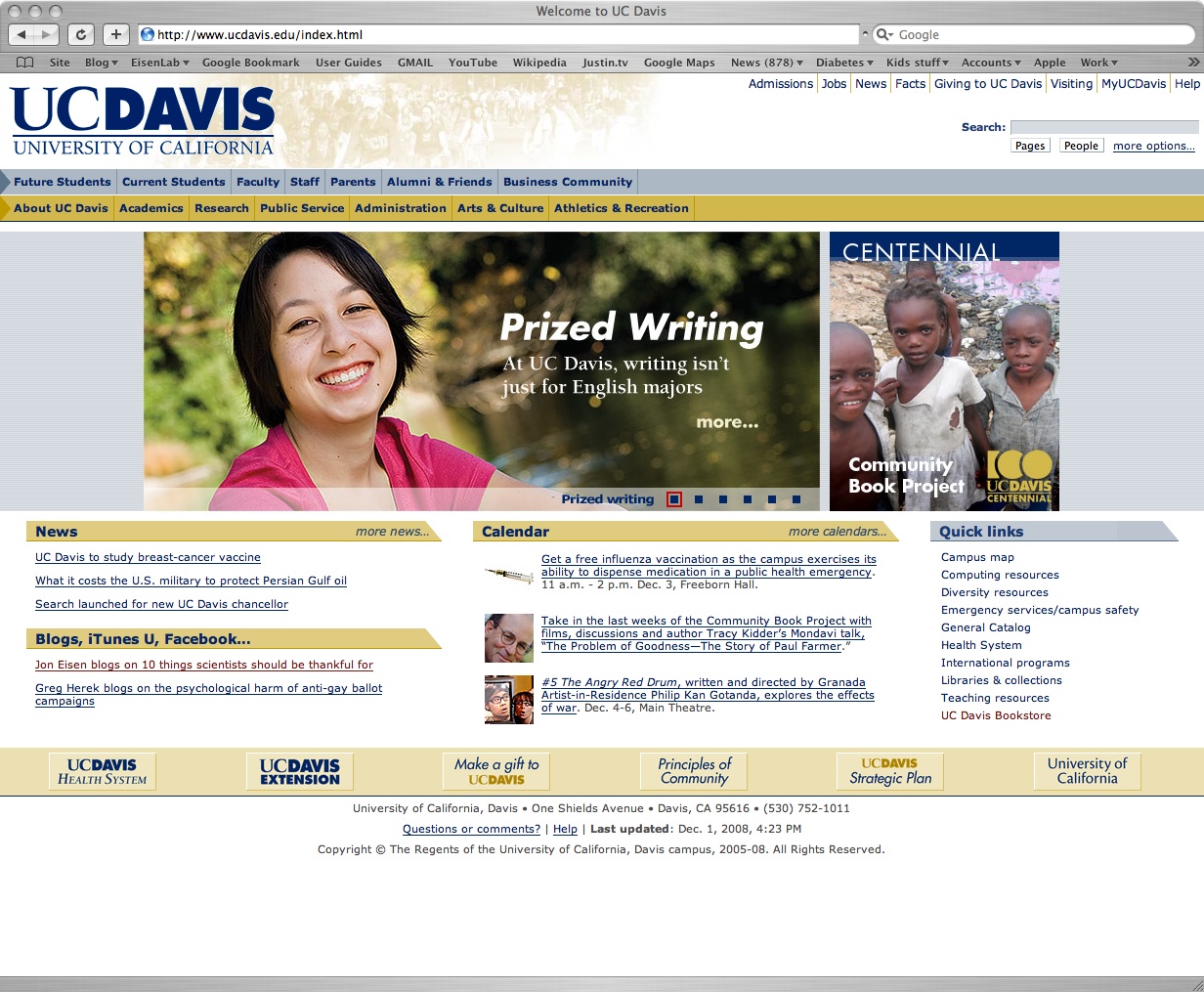
Hey – thanks UC Davis.  Thanks for promoting blogs on your front page (under the Blogs, iTunes and Facebook section) and thanks for promoting my “Things Scientists should be thankful for”posting.  

What scientists should be thankful for …

Well, it is Thanksgiving. I am up late as usual catching up on email. On this day, there is something I have been meaning to post for a few years. I think scientists should take a breath today and give thanks to those who have helped them along the way. I have some specific postings about this in terms of who I want to thanks, but I wanted to make a list here of the types of things scientists should be thankful for. So here goes.

10 things scientists should be thankful for

  1. Teachers. Scientists had to learn science at some point. And most of us have had some stellar science teachers, or teachers of science-related things like math, along the way. We should give thanks to these people.
  2. Inspirers. Similar to #1 except in many cases we have been inspired to become scientists by someone who may not have been a teacher of ours. Perhaps it was a famous scientist, or even a fictional one. Or even someone we knew. It is that inspiration that frequently gets one through the tough times.
  3. Benefactors In general, scientists have a pretty nice life. We get paid (sometimes well, sometimes poorly) and are given research funds, to unlock the secrets of the universe. How cool is that? We should therefore be very thankful for the immediate source of our funds – such as the institutes where we work and the agencies that provide us funds.
  4. Taxpayers. Unless one is funded by private foundations, taxpayers are the ultimate source of those funds mentioned in #3. This source of funds is frequently overlooked but should never be forgotten. Don’t forget – we take money people from people that in theory they could have gotten to keep if their taxes were lower. We should thank these taxpayers..
  5. Research personnel (including student researchers, post docs, technicians, etc). Most of the time, scientists get credit for some work that was in a large part actually done by people in our labs. They deserve our eternal gratitude.
  6. Students we teach. Overall, for those scientists who teach, though it may be a required part of our jobs, it is also a great way to learn and to become a better scientist.
  7. Staff at publishers. An important part of communicating science is of course publishing. And though I am a big fan of new ways to disseminate information, let us not forget that there are many many people who aid and abet this dissemination by working for publishers. These folks deserve our thanks.
  8. Study subjects or objects. Whether one studies organisms, rocks, molecules, planets, forces, or whatever, we should all be thankful that there is interesting stuff out there to study. And for those who study living things, if one disturbs them along the way, we should
  9. Librarians and library staff. Access to information is critical for both learning to become a scientist and being a scientist. And libraries play a key role in providing this access.
  10. Family and friends. Late nights at the lab? Working on a grant over the weekend? Writing papers all the time? In school for years and years? All of this takes a toll on friends and family. And we owe them some props.

I am sure there are more categories. But these are some that came to me on this Thanksgiving. Any categories I missed?