Open Microbial Diversity: PLoS papers on using 454-Roche pyrosequencing for rRNA studies

ResearchBlogging.org

Two new papers that just came out in PLoS Journals are definitely worth checking out. They are

Of course I am a bit biased I suppose as I am heavily involved in PLoS and also served as Academic Editor for these papers. But with that being said, I encourage people to check them out. In the PLoS Genetics paper from the labs of Mitch Sogin and David Relman labs discusses continued development of the use of 454-Roche pyrosequencing technology to carry out deep rRNA sampling. Anybody interested in characterizing a microbial community deeply in terms of what organisms are there should consider this approach.

And in the second paper, the same two labs present an in depth study using the 454-Roche rRNA sequencing to characterize the response of microbes in the human gut to antibiotic treatment. Though there have been a few other such studies this is the one that has the deepest characterization of the microbes present.

Note – one thing I find kind of humorous is that one of the authors is listed as Susan M. Huse in one of the papers (she is the first author on the PLoS Genetics paper) and Sue Huse in the other.

Huse, S., Dethlefsen, L., Huber, J., Welch, D., Relman, D., & Sogin, M. (2008). Exploring Microbial Diversity and Taxonomy Using SSU rRNA Hypervariable Tag Sequencing PLoS Genetics, 4 (11) DOI: 10.1371/journal.pgen.1000255

Dethlefsen, L., Huse, S., Sogin, M., & Relman, D. (2008). The Pervasive Effects of an Antibiotic on the Human Gut Microbiota, as Revealed by Deep 16S rRNA Sequencing PLoS Biology, 6 (11) DOI: 10.1371/journal.pbio.0060280

Open Genomics: Genome Evolution Simulator

Quick post here.   Cool new paper (and the software could be cool too but have not tried it yet) on simulating genome evolution.  The paper is from Ian Holmes and others at Berkeley (see his lab page on BioWiki here) and the paper can be found here in Genome Biology. Here is the abstract:

Controlled simulations of genome evolution are useful for benchmarking tools. However, many simulators lack extensibility and cannot measure parameters directly from data. These issues are addressed by three new open-source programs: GSIMULATOR (for neutrally evolving DNA), SIMGRAM (for generic structured features) and SIMGENOME (for syntenic genome blocks). Each offers algorithms for parameter measurement and reconstruction of ancestral sequence. All three tools out-perform the leading neutral DNA simulator (DAWG) in benchmarks. The programs are available at http://biowiki.org/SimulationTools.

Genomicron on Science by press release.

Just a quick one here. Ryan Gregory is going on against science by press release – one of my biggest pet peeves. Check it out at:

Genomicron: Science by press release.

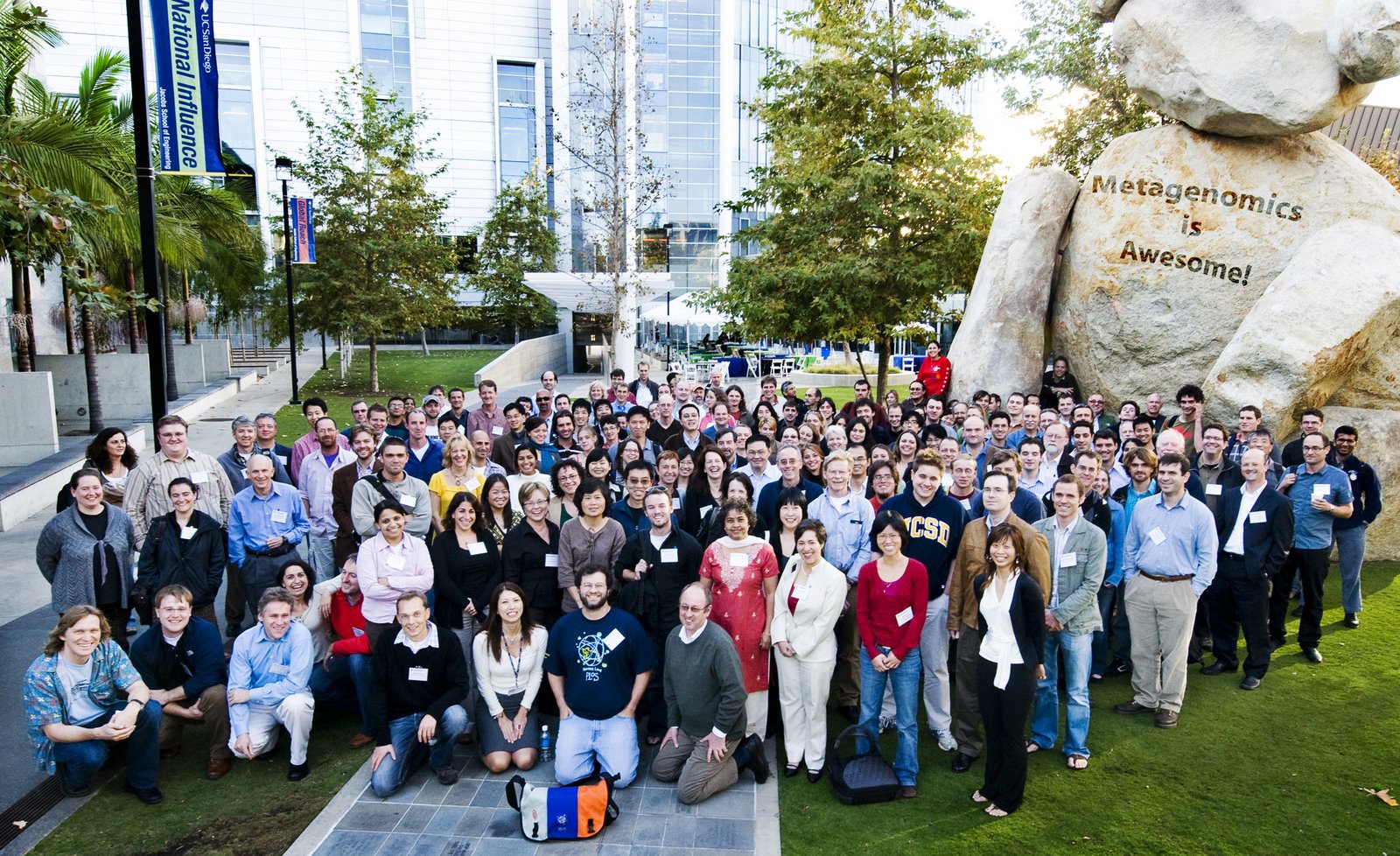
I see PLoS in everything IV: PLoS at Metagenomics 2008 meeting

I may see PLoS even when it is not there, but in this picture, which was the group photo for the Metagenomics 2008 meeting at CalIT2, I weaseled my way to the front hoping to get my PLoS bag and PLoS shirt into the picture. And looky there – it worked.

Visit to the Raptor Center and Putah Creek

Just thought I would share some pics from a nice outing we had yesterday. We went to the UC Davis Raptor Center for their open house and then went for a walk along Putah Creek.

http://picasaweb.google.com/s/c/bin/slideshow.swf

Microbiology in the news: How bleach kills germs

I am starting a new thread here – microbiology in the news. And my first posting is about bleach. Everyone probably has used it at one time or another to clean something. And some people use it to kill “germs” (aka microbes) too. Well, MSNBC is reporting (Mystery solved: How bleach kills germs – Science- msnbc.com) on a Cell article that presents evidence regarding how the active ingredient in bleach (hypochlorous acid) kills bacteria. Apparently, it works in a similar way to heat in destabilizing protein structures. Anyway, the researchers claim that this is relevant to killing of microbes inside of people because

“Hypochlorous acid is an important part of host defense,” Jakob said. “It’s not just something we use on our countertops.”

Whether this is true or not, I do not know. But what I do know is that microbes are in the news. And that is good.

For more on the bleach story see

ERIC, E. coli, and you

Just a little posting here. I have been playing around with a website called ERIC and thought I would post about it since it seems pretty useful. ERIC – Enteropathogen Resource Integration Center is

one of eight Bioinformatics Resource Centers (BRC) for Biodefense and Emerging/Re-Emerging Infectious Diseases. Funded by the National Institute of Allergy and Infectious Diseases (NIAID), ERIC serves as an information resource for five members of the bacterial family Enterobacteriaceae.

So if you want to learn more about E. coli and its relatives and their genomes, this is a good place to start

Suggestions for Obama’s CTO

Want to suggest priorities for Obama’s CTO? Go to http://www.obamacto.org.

Plug of the week – Extreme 2008: A Deep-Sea Adventure: University of Delaware

Just a little plug here to suggest people might want to check out the web site for a Deep Sea Research Cruise going on right now (Extreme 2008: A Deep-Sea Adventure: University of Delaware). The focus of the cruise is summarized as follows:

The scientists will focus on marine viruses and other tiny life called protists and their roles in the food chain. These organisms prey on bacteria, a primary food that sustains the vent ecosystem.

Some friends/colleagues of mine are involved in this adventure and it sounds like some cool stuff could come out of it. Also you might want to check out the blog of Lisa Z (ExtremeVirus), who is posting about the cruise.

This press release deserves some sort of award …

Just got pointed by Ruchira Datta to a new press release from Princeton (Princeton University – Evolution’s new wrinkle: Proteins with cruise control provide new perspective) that makes some interesting claims about evolution. Ruchira asked if the press release made sense to me. And alas, it does not. It has all sorts of bizarre evolution claims in it including the following

A team of Princeton University scientists has discovered that chains of proteins found in most living organisms act like adaptive machines, possessing the ability to control their own evolution.
…

“Our new theory extends Darwin’s model, demonstrating how organisms can subtly direct aspects of their own evolution to create order out of randomness.”

“What we have found is that certain kinds of biological structures exist that are able to steer the process of evolution toward improved fitness,”
….
Unlike Darwin, Wallace conjectured that species themselves may develop the capacity to respond optimally to evolutionary stresses. Until this work, evidence for the conjecture was lacking.
….
“In this paper, we present what is ostensibly the first quantitative experimental evidence, since Wallace’s original proposal, that nature employs evolutionary control strategies to maximize the fitness of biological networks,”

It sounds like complete nonsense to me. But I am not sure. Anyone else out there know more?