USDA email on Preparing for Possible Findings of Highly Pathogenic Avian Influenza

Just got this by email .. not sure why … but seems like it could e of interest

aphis_stakeholder_registry_usdalogo_banner.jpg

USDA Continues to Prepare for Any Possible Findings of Highly Pathogenic Avian Influenza

Washington, December 4, 2015 – The United States Department of Agriculture’s (USDA) Animal and Plant Health Inspection Service (APHIS) continues to prepare for any potential findings of highly pathogenic avian influenza (HPAI). An outbreak of HPAI during spring and summer 2015 was the largest animal health emergency in the country’s history. APHIS and its partners worked throughout the fall to put plans in place to address the disease should it reappear.

The United States has the strongest AI surveillance program in the world, and USDA is working with its partners to actively look for the disease in commercial poultry operations, live bird markets and in migratory wild bird populations. As part of the wild bird surveillance effort, APHIS and its wildlife agency partners will be sampling more than 40,000 wild birds between July 1, 2015 and July 1, 2016 – with more than 24,000 samples already tested. Samples are being collected from both hunter-harvested birds and from wild bird mortalities.

As part of these surveillance efforts, Eurasian H5 avian influenza was recently found in genetic material collected from a wild duck, but testing was unable to determine the exact strain of the viruses or whether they were high pathogenic or low pathogenic. This recent finding of Eurasian H5 was in a wild, hunter-harvested mallard duck in Morrow County, Oregon in November. No HPAI has been identified in any commercial or backyard poultry since June 17, 2015.

On November 18, USDA reported to the World Organization for Animal Health (OIE) that all cases of HPAI in commercial poultry have been resolved and that the US is again free of HPAI.

Producers and the industry are working to enhance their biosecurity on farms to help provide even better protection against the virus should a reappearance of HPAI occur. Anyone involved with poultry production from the small backyard to the large commercial producer should review their biosecurity activities to assure the health of their birds. To facilitate such a review, a biosecurity self-assessment and educational materials can be found at http://www.uspoultry.org/animal_husbandry/intro.cfm

In addition to practicing good biosecurity, all bird owners should prevent contact between their birds and wild birds and report sick birds or unusual bird deaths to State/Federal officials, either through their state veterinarian or through USDA’s toll-free number at 1-866-536-7593. Additional information on biosecurity for backyard flocks can be found at http://healthybirds.aphis.usda.gov.

Additional background

Avian influenza (AI) is caused by an influenza type A virus which can infect poultry (such as chickens, turkeys, pheasants, quail, domestic ducks, geese and guinea fowl) and is carried by free flying waterfowl such as ducks, geese and shorebirds. AI viruses are classified by a combination of two groups of proteins: hemagglutinin or “H” proteins, of which there are 16 (H1–H16), and neuraminidase or “N” proteins, of which there are 9 (N1–N9). Many different combinations of “H” and “N” proteins are possible. Each combination is considered a different subtype, and can be further broken down into different strains. AI viruses are further classified by their pathogenicity (low or high)—the ability of a particular virus strain to produce disease in domestic chickens.

#

At #UCDavis today Nancy Chen on”Genomics of population decline in the Florida Scrub-Jay”

***** CPB Seminar Reminder for Tuesday, December 8, 4:10pm in 1022 Life Sciences *****

Last CPB Seminar of Fall Quarter!

Speaker: Nancy Chen

Postdoctoral Scholar, Department of Evolution and Ecology, UC Davis
Title: “Genomics of population decline in the Florida Scrub-Jay”
Host: Graham Coop

The entire CPB Fall Quarter 2015 Seminar schedule is available here.

#UCDavis iGEM 2016 Applications are Open

Just got this announcement and am posting here:

Apply to join the 2016 UCD iGEM team to participate in a synthetic biology project to address real world problems using cutting edge techniques in chemistry, molecular biology, and computer science.

You will gain valuable interdisciplinary training in computatonal and experimental biology, including laboratory skills!

You will have the opportunity to travel to Boston in November 2016 to meet and compete with teams from around the world!

The UC Davis iGEM team has received an iGEM Gold Medal six years in a row. Be part of the next generation of award winners!

No previous biology experience is needed. All majors are welcome to apply—Computer Science, Biology, Engineering, Art, English, Communications, and more!

Apply here: https://www.surveymonkey.com/r/UCD_2016_iGEM Applications Due February 1st 2016

2016_flyer_final.pdf

Postdoctoral Position, Evolutionary Genomics, University of California, Davis.

Postdoctoral Position, Evolutionary Genomics, University of California, Davis.

Post-doctoral position available in the area of Evolutionary Genomics applied to mosquito vectors of human malaria, starting January 2016. Qualifications include expertise in comparative evolutionary and population genetics approaches for the study of genome architecture and its consequences for adaptive evolution. Candidate should be capable of engaging in the study of genomes to tackle key problems in the genetics and evolution of fundamental biological processes, such as insecticide resistance, pathogen susceptibility, physiological adaption, symbiosis, response to a changing environment, invasiveness, behavior, signaling, stress tolerance and/or speciation/extinction. Ideally, the candidate will be proficient at developing novel bioinformatics approaches to the comparative study of genomes. Researchers that utilize techniques such as advanced statistical methods and computer-programming skills are desired. The successful candidate will join a vibrant research group in the Vector Genetics Laboratory, Department of Pathology, Microbiology and Immunology, School of Veterinary Medicine, University of California, Davis. The VGL has links to multiple Graduate Groups and Centers on the UC Davis campus, including the Center for Population Biology, Department of Evolution and Ecology and One Health Institute. The successful candidate will also have access to modern campus facilities in genomics/bioinformatics, proteomics and microscopy. Opportunities for conducting field work at sites in sub-Saharan Africa are available. Consult http://popi.ucdavis.edu/vgl/ for details about the VGL. Applicants will be assisted in the pursuit of extramural funding and will be expected to contribute to mentoring select undergraduate students. A Ph.D. and demonstrated excellence in research are required.

Applicants should send material by e-mail to: Gregory Lanzaro, gclanzaro Please include: a curriculum vitae and separate statements of research interests. Evaluation of applications will begin immediately, but the position will remain open until filled.

Today at 4:10pm Andrew Sierfert Intraspecific trait variation, soil microbial communities, and plant community assembly

Tuesday, November 17, 4:10pm in 1022 Life Sciences *****

November 17, 2015: Andrew Siefert
Postdoctoral Scholar, Department of Evolution and Ecology, UC Davis
Title: “Intraspecific trait variation, soil microbial communities, and plant community assembly”
Host: Sharon Strauss

UCSC Genome Browser Workshop: Next Month at #UCDavis!

There are just a few seats left. Don’t miss out!

UCSC Genome Browser Workshop, December 7-8, 2015

This workshop is co-hosted by the UC Davis Bioinformatics Training Program and the Data Intensive Biology Training Program.

Instructors: Dr. Robert Kuhn and Angie Hinrichs, UCSC

General Information … The UCSC Genome Browser (http://genome.ucsc.edu/) is a powerful tool for interacting with genome assemblies of many organisms. This workshop will introduce you to the wealth of data contained in the browser and related databases, and will allow you to integrate and compare results of your genomic and transcriptomic experiments.

Who should attend? … Prior workshop participants have included faculty, post docs, grad students, staff, and industry researchers. There are no prerequisites.

Where is the workshop? … It will be held in Gladys Valley Hall on the UC Davis campus and will run from 9am to 5pm on Monday Dec. 7 and Tuesday Dec. 8.

What do I need to bring? … A laptop! The UCSC Browser works best on recent versions of Firefox, Chrome, Safari and Internet Explorer (in that order).

How much does it cost? … The registration fee is $75 and includes all workshop materials, coffee, lunch, beverages and snacks, but does not include dinner, lodging or parking fees.

How do I apply? … Registration is “first-come, first-served”. There is no application process. More information and the direct link to the registration site can be found at: http://training.bioinformatics.ucdavis.edu/2015/07/14/ucsc-genome-browser-workshop-december-7-8-2015/

Questions? … email us at bioinformatics.core

We hope to see you in December!

The UC Davis Bioinformatics Core Team

http://training.bioinformatics.ucdavis.edu

http://bioinformatics.ucdavis.edu/

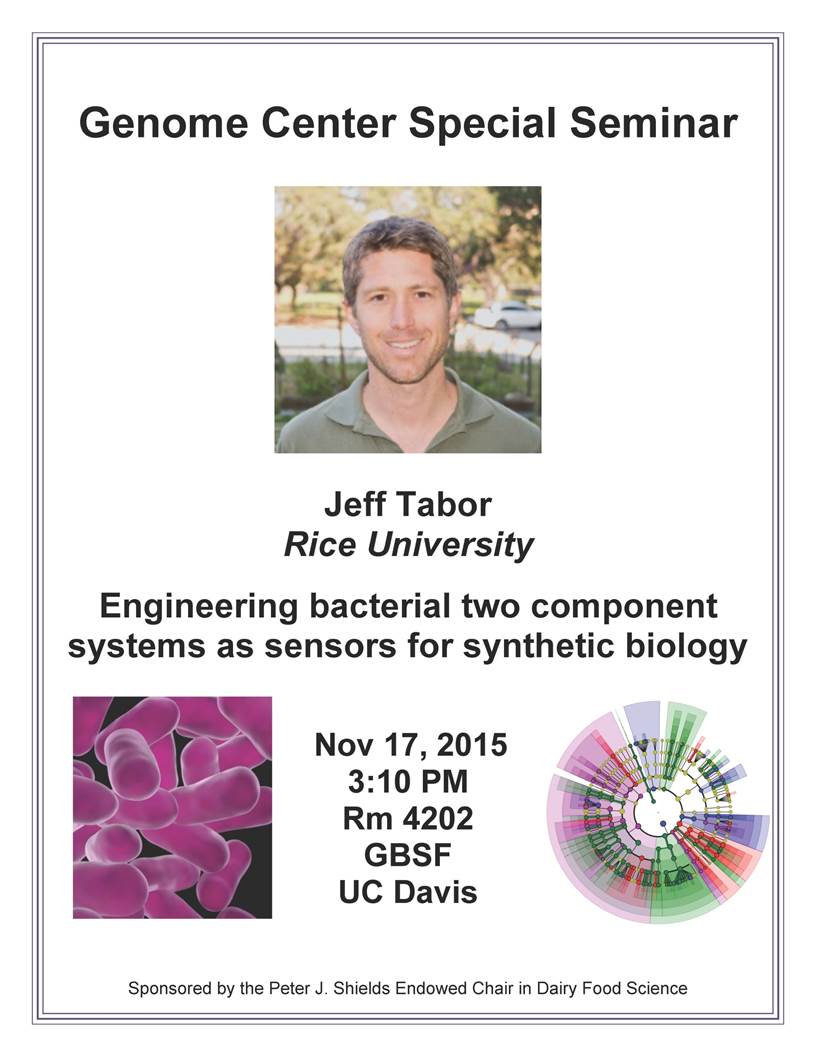
Jeff Tabor at #UCDavis 11/17 Engineering bacterial two component systems as sensors

Tabor Flier.pdf

NSF Funding: BIGDATA: Critical Techniques, Technologies, & Methodologies for Advancing Foundations and Applications of Big Data Sciences & Engineering

Via an NSF listserv:

Dear Colleagues,

An NSF funding opportunity update is now available:

Critical Techniques, Technologies, and Methodologies for Advancing
Foundations and Applications of Big Data Sciences and Engineering (BIGDATA)

Full Proposal Deadline Date: February 9, 2016

Please see

http://www.nsf.gov/funding/pgm_summ.jsp?pims_id=504767&org=DMS

for details and links to additional information.

Susan Holmes at #UCDavis Thu 4 PM MSB 1147

Who: Susan Holmes (Stanford Univ.)
When: Thursday, Nov 12, 4:10pm,
Where: MSB 1147, UC Davis
What: Analyzing data from perturbation experiments: the case of the human microbiome.

At #UCDavis 11/13: Matthew Barber on “Blood and Iron – Evolutionary Conflicts t Host-Microbe Interfaces”