“The bleeting edge: Blog and Tweet or Perish” talk by Jonathan Eisen for #PublicationMismatches from Jonathan Eisen

Saw this tweet earlier today
Not one woman: http://t.co/zU0uhELuvI. WTF
— Female Scientist (@female_science) April 16, 2014
//platform.twitter.com/widgets.js
And something seemed hauntingly familiar about the organization referenced. Turns out this is not the first time they have had issues with Gender Balance. So I responded
Well @female_science Global Engage does it again – I posted about their previous meeting gender ratio issues here http://t.co/8fIr2KZjTK
— Jonathan Eisen (@phylogenomics) April 16, 2014
//platform.twitter.com/widgets.js
Incredibly distasteful and painful to see this. This group “Global Engage” ran a Plant Genomics meeting last year that I posted about becuase the gender ratio was quite bad for the speakers: YAMMGM – yet another mostly male genomics meeting (series): Plant Genomic Congresses by Global Engage
And after seeing this new Tweet I dug around their web site some more and it is really unpleasant. Look at their Advisory Panel (which is what Female Scientist was pointing to):
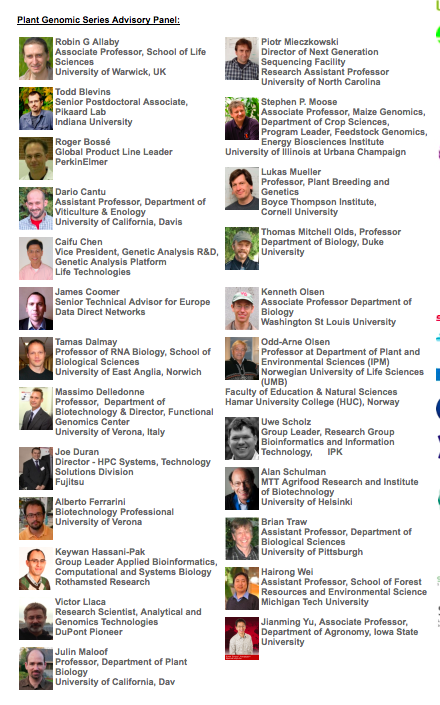
24 scientists. All of them men. If you know any of them, as I do, I would recommend you contact them and suggest they resign from this apparently gender-biased organization or force them to add some women to their advisory panel.
The speaker list for their next plant genomics meeting is quite skewed too. I could find 49 men and 5 women. What a joke.
I call upon everyone in the community to boycott this meeting and any organized by Global Engage in the future. They have been informed previously of their gender ratio issues and are clearly not doing anything about it. And in plant genomics there are so many excellent female scientists that this simply has to be a case of some type of bias.
In addition, I would recommend calling on the sponsors to withhold funding from this meeting and others organized by this group.
Sponsors include
Illumina
Life Technologies
Lucigen
Raindance
Takara
Clontech
Nugen
and
Sigma-Aldrich
From an email I recieved:
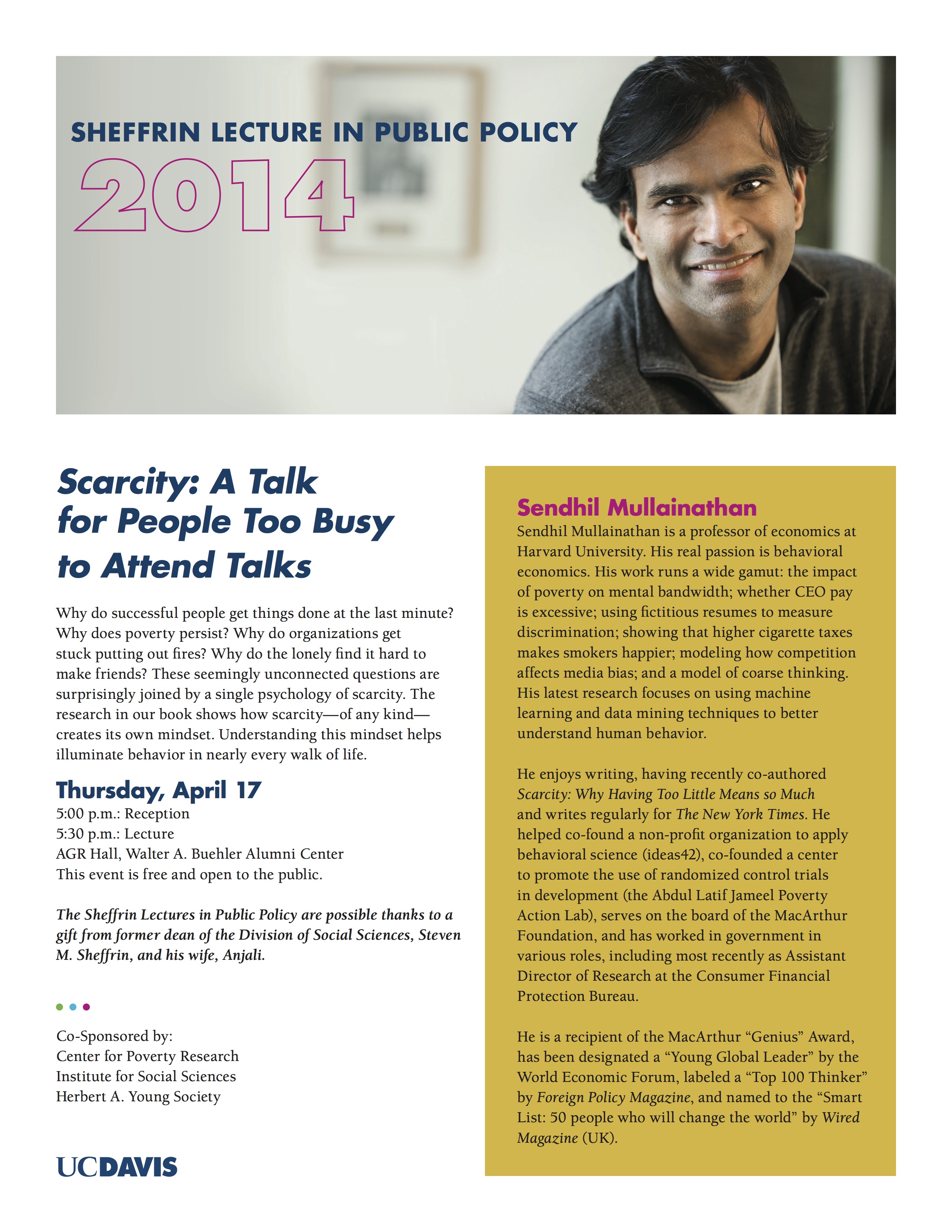
The annual Sheffrin Lecture in Public Policy (an annual Division of Social Sciences Event) will take place this Thursday, April 17th, 5:30 pm in the Alumni Center (AGR Room) and will feature Professor Sendhil Mullainathan from Harvard, talking about his recent book, Scarcity (co-authored with Princeton Psychologist Eldar Shafir).
Some more detail is below:
Sharing …
**Please share this special seminar announcement with others who may be interested
Luke Stewart
Senior Field Application Specialist
Fluidigm Corporation
Noriko Satake, MD
Assistant Professor, UC Davis
Single Cell Genomics – cutting edge microfluidic tools defy the law of averages by enabling resolution at the single cell level
Friday, April 25, 12:10 – 1:00 pm
Education Building, Lecture Hall 1222
4610 X Street, Sacramento 95817
UC Davis Health System campus
Light lunch will be provided for those who
RSVP by April 22 to ocr@ucdavis.edu
Co-hosted by:
BGI@UC Davis, the UCDCCC Genomics Shared Resource and the Department of Pathology & Laboratory Medicine
BGI@UC Davis will be presenting a seminar series to be held once per quarter during the academic year. If you have questions or need additional information, please email bgi-ucdavis@ucdavis.edu.
BGI UC Davis seminar Stewart 4-2014.pdf
New paper out about feeding by the parasitic amoeba Entamoeba histolytica. Apparently, the work shows that this organism feeds by in essence taking bites out of cells. (I say apparently because the paper is not open access and I don’t have access to it from where I am writing).
Anyway – there are a lot of news stories about this. And for some reason (I am not quite sure why) this has inspired headline writers to get out their pun pens and creative thinking caps. Here are some of the headlines:
And more coming I assume.
Though as far as I can tell none of the stories picked up on a key word play that could have been made. The lead scientist behind the study is named Petri. Someone really should have had “dish” in the title …
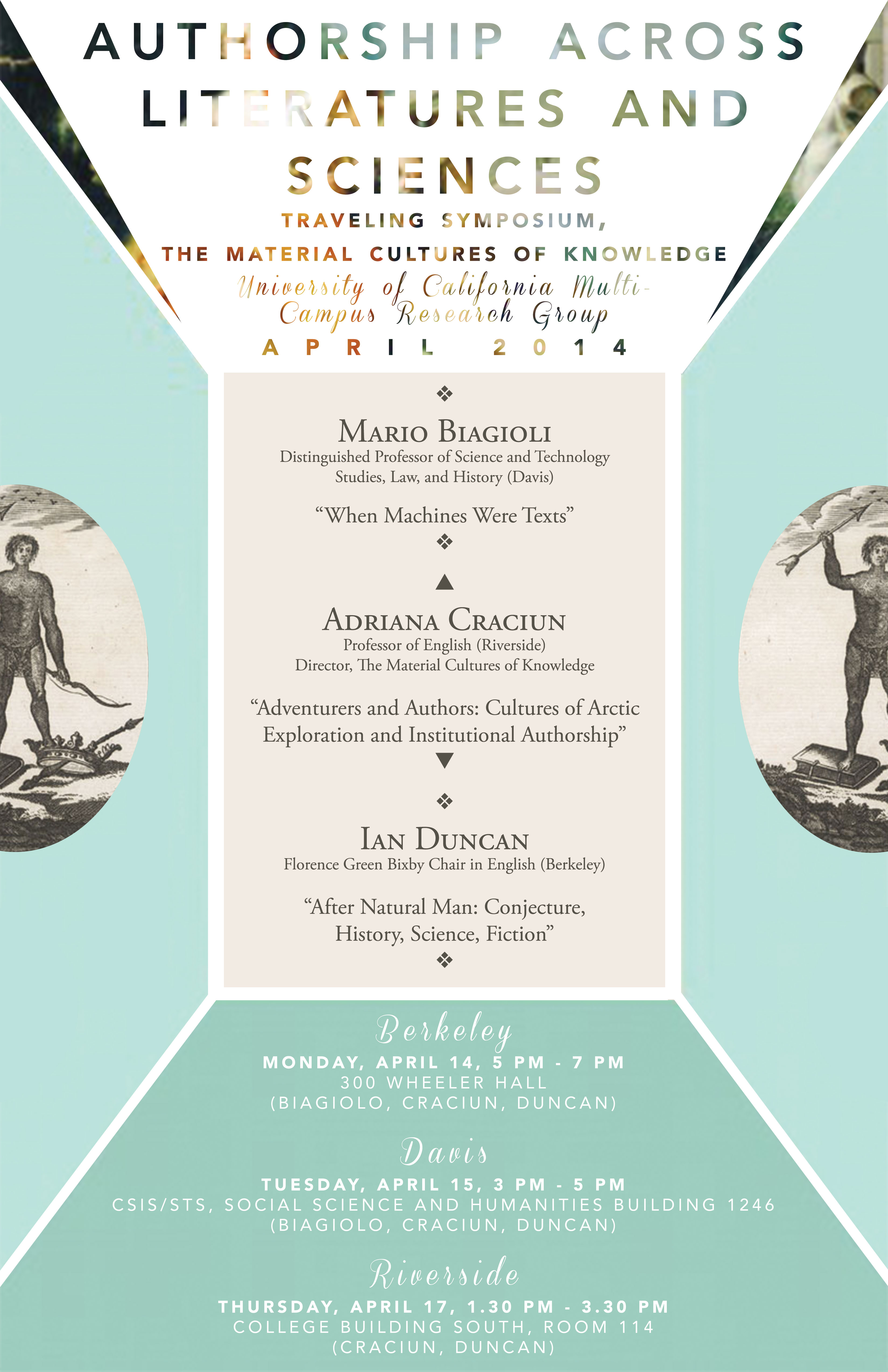
AUTHORSHIP BETWEEN LITERATURE AND SCIENCE
A workshop of the “The Material Cultures of Knowledge” Multi-campus Research Group, sponsored by UCHRI
(materialcultures.ucr.edu)
When: Tuesday, April 15, 3:00-6:00PM
Where: CSIS/STS Room, SSH 1246 (Map: http://tinyurl.com/1246ssh)
*Please RSVP if you plan to attend: http://tinyurl.com/AuthorshipDavis2014
Speakers will include:
ADRIANA CRACIUN (English, UC Riverside), “ADVENTURERS AND AUTHORS: CULTURES OF ARCTIC EXPLORATION AND INSTITUTIONAL AUTHORSHIP”
IAN DUNCAN (English, UC Berkeley), “AFTER NATURAL MAN: CONJECTURE, HISTORY, SCIENCE, FICTION”
MARIO BIAGIOLI (STS, Law, & History, UC Davis), “WHEN MACHINES WERE TEXTS: AUTHORS V. INVENTORS IN EARLY COPYRIGHT DEBATES”
With Comments From:
STANLEY ROBINSON (Author)
DAVID SIMPSON (English, UCD)
Below is a guest post from Kevin Penn, who used to work in my lab …
I am a former Research Associate of Jonathan’s interested in understanding evolution and ecology of microbes in natural environments. Recently I’ve become interested in learning about the expression of secondary metabolite related genes in natural settings to put the gene’s products into an ecological context, because almost certainly microbes are not making natural products just to benefit humans. I am currently studying these topics as a post-doc in Janelle Thompson’s lab at MIT.

University of California, Davis College of Biological Sciences
Special Seminar
Dr. John Wingfield
Assistant Director for the Biological Sciences National Science Foundation USA
“Vision for Biology at the National Science Foundation”
Thursday, April 10, 2014 1:10 PM
1022 Life Sciences
John Wingfield seminar.pdf
Using Social Media
to Promote Your Research


Many view social media as either a fun distraction, a waste of time – or both! But social media tools can be a tremendous resource for academics seeking to share their research, find new collaborations, and ultimately advance their careers.
Attend this workshop to learn how to:
· Use social media to share and promote your research
· Identify appropriate audiences and avoid pitfalls
· Choose the right platforms to help you achieve your goals
Please pre-register using this online form: http://bit.ly/1ajX6Pc (Pre-registration will help to guide the format of the workshop and the type of social media tools covered)
Workshop Leader: Holly Bik, Ph.D., Holly Bik is a postdoctoral scholar in marine genomics, working in Jonathan Eisen’s lab at the University of California Davis. Dr. Bik is extensively involved in the use and promotion of social media in academic settings. She has several social media sites dedicated to the dissemination of science including: Dr. Holly Bik | Deep Sea News; @hollybik – Twitter; Holly’s personal Homepage; Holly Bik – Google Profile
Sponsored by


Preparing for some lectures at UC Davis for Biodiversity and The Tree of Life course and came across this: The Prokaryote-Eukaryote Dichotomy: Meanings and Mythology by Jan Sapp which I had not really scrutinized before. It is quite good and has lots of information on the history of microbiology and the twisted history of the prokaryote – eukaryote distinction. Veryvery interesting stuff. And freely available in Pubmed Central. Thank you thank you thank you Pubmed Central and the American Society for Microbiology.




 Jonathan Eisen's Lab