Dear UC Davis Faculty, Staff, Students, and Community Members,
This is a reminder that our next Forum, featuring Chancellor Francisco Rodriguez, will take place one week from today on Monday, April 9th in the Multipurpose Room of the Student Community Center. The lecture will run from 3-4:30 PM with a reception and light refreshments to follow.
In this Forum, Chancellor Rodriguez will proceed from the observation that America’s community colleges— which are the most egalitarian institutions of public higher education, serving more than 12 million students each year—play a leading role in supporting social mobility as well as our nation’s strength, economic health and prosperity, and democracy. He will address how community colleges currently face an array of formidable challenges, including demands to increase access and equity; raise completion and graduation rates; and improve postgraduate outcomes. Indeed, they must meet these challenges in a climate of decreasing public confidence in higher education, staggering enrollments, and segregated educational attainment. Dr. Rodriguez will describe how community colleges provide the best return on investment in higher education.
This event is free and open to the public. If you wish to attend, please RSVP using the link below:
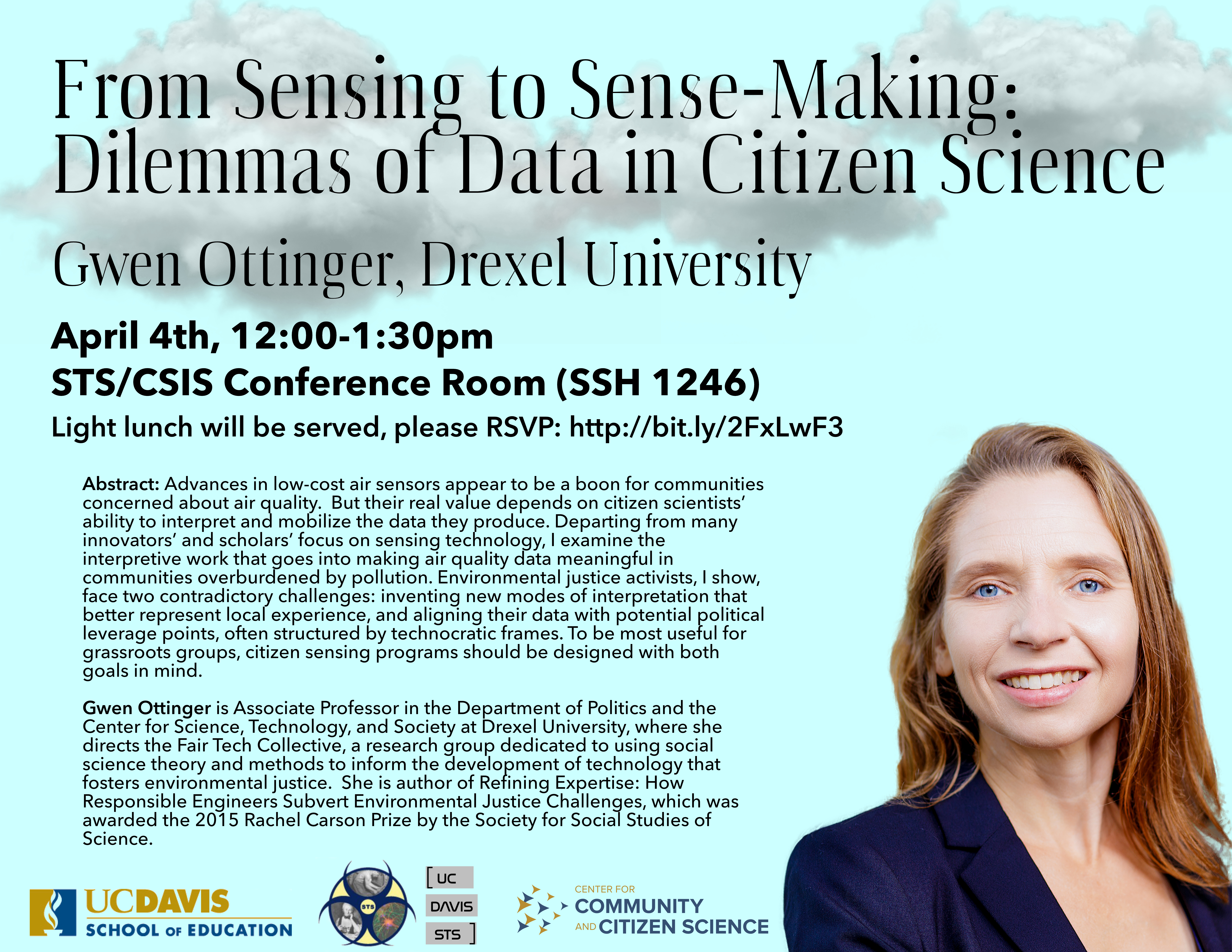
"From Sensing to Sense-Making: Dilemmas of Data in Citizen Science"Gwen Ottinger, Drexel University
Wednesday April 4th, 12:00-1:30
STS/CSIS Conference Room (SSH 1246)
Light lunch will be served; please RSVP.
Abstract: Advances in low-cost air sensors appear to be a boon for communities concerned about air quality. But their real value depends on citizen scientists’ ability to interpret and mobilize the data they produce. Departing from many innovators’ and scholars’ focus on sensing technology, I examine the interpretive work that goes into making air quality data meaningful in communities overburdened by pollution. Environmental justice activists, I show, face two contradictory challenges: inventing new modes of interpretation that better represent local experience, and aligning their data with potential political leverage points, often structured by technocratic frames. To be most useful for grassroots groups, citizen sensing programs should be designed with both goals in mind.
Gwen Ottinger is Associate Professor in the Department of Politics and the Center for Science, Technology, and Society at Drexel University, where she directs the Fair Tech Collective, a research group dedicated to using social science theory and methods to inform the development of technology that fosters environmental justice. She is author of Refining Expertise: How Responsible Engineers Subvert Environmental Justice Challenges, which was awarded the 2015 Rachel Carson Prize by the Society for Social Studies of Science.
Presented by the UC Davis Program in Science and Technology Studies, the School of Education, and the Center for Community and Citizen Science.
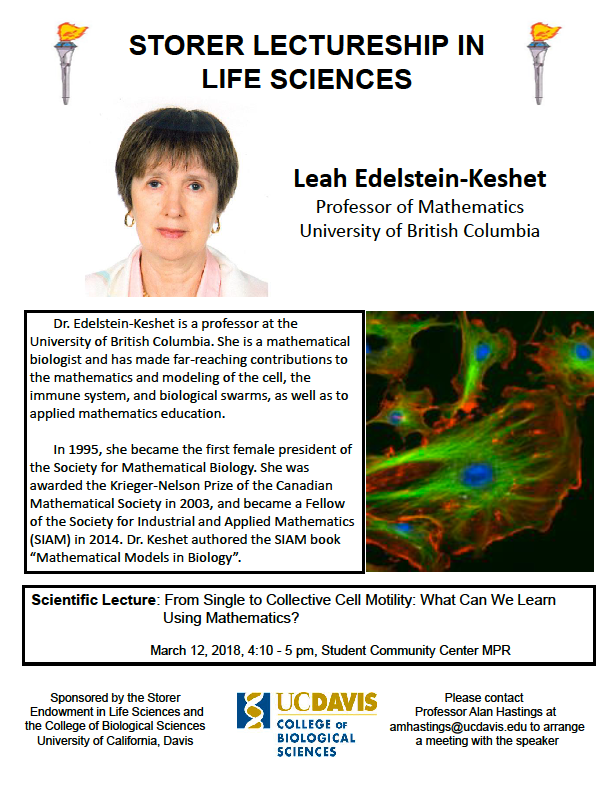
We are pleased to announce Dr. Edelstein-Keshet, Professor at the University of British Columbia, will be presenting “From Single to Collective Cell Motility: What Can We Learn Using Mathematics?” as part of the Storer Lectureship in Life Sciences Series. The lecture is at 4:10 pm on Monday, March 12, 2018 in the Student Community Center.
Dr. Edelstein Keshet is a mathematical biologist and has made far-reaching research contributions in areas such as the mathematics and modeling of the cell, the immune system, biological swarms and applied mathematics education.
In 1995, Dr. Keshet became the first female president of the Society for Mathematical Biology. She was awarded the Krieger-Nelson Prize of the Canadian Mathematical Society in 2003 and became a Fellow of the Society for Industrial and Applied Mathematics (SIAM) in 2014. Dr. Keshet authored the SIAM book “Mathematical Models in Biology.”
Dr. Giulio De Leo is the seminar speaker for the Ecology and Evolution Seminar Series Today Thursday, Feb. 22nd at 4:10pm in 2205 Haring Hall.
His talk is entitled: “Planetary Health: novel ecological solutions for the control of environmentally transmitted diseases”
Abstract: In the past few decades, the unprecedented rate of technological innovation has contributed to the decline of diseases that have afflicted humanity for centuries. Yet, for diseases with obligate environmental transmission, such as malaria and schistosomiasis, targeting pathogens in the human host through vaccines and drugs might not be enough. In my talk, I present empirical evidence and theoretical considerations from a field project based in Senegal to promote a more holistic approach that acknowledges the ecological complexities driving disease dynamics and investigates the interactions of people and the environment. The ultimate goal is to identify "ecological levers" we can use to develop cost-effective solutions that can improve human health and protect the environment.
For more information on Giulio and his current work, please see the De Leo lab website, https://deleolab.stanford.edu/ .
So – in the interest of showing the power of science and the power of microbiome science, I have decided to tackle (so to speak) the topic. If you are not familiar with the power of microbiome science in addressing Tom Brady related controversies then you must check out the use of microbial forensics to solve the #deflategate controversy.
So given this prior record of the value of mofofospoomics (microbiome forensics for sports) I decided to see what we could learn about Tom Brady’s injury.
I started, as any goo microbiome study does, with collecting all the relevant hypotheses to test and not in any way doing an exploratory analysis. So I surveyed the internet by Googling, and searched around Twitter for 3-4 minutes and I found the following plausible hypothesis:
A: Brady was really injured in practice and got a cut that was then treated with stitches and topical antibiotics.
B. Brady had surgery to add an additional finger to hold a future Super Bowl championship ring. In addition, one would assume that oral or IV antibiotics were given as part of the post surgery treatment.
C. Brady and Bill Belichick are faking it to force Jacksonville to alter practice plans.
All three seem completely plausible. I would give them each equal wait in a Bayesian prior sense. So the key question was – could one develop some ways to use a mofofospoomics approach to test for which of these three hypothesis was most likely to be correct.
The first thing to do was to make some mofofospoomics related predictions based on each hypothesis. This actually was relatively easy.
Under hypothesis A, I would expect one key mofofospoomics related signature. Assuming the topical antibiotics were only applied to his right hand then one would expect his right hand to have a different microbiome than his left and to look abnormal like all antibiotic treated skin samples do. So to test for this hypothesis A all we would need would be some hand microbiome samples from him.
Under hypothesis B, I would expect two mofofospoomics related signatures. First, one would expect Brady’s hand to show the typical signature of post surgical changes in the microbiome (see for example Grice 2014). In addition, one would expect there to be affects of the antibiotics used. The oral or IV antibiotics would be expected to affect all of his microbiome – skin and gut for example. Thus both his hands should look like apocalypse happened relative to the microbiome. Also we might expect the new finger to look different from the other fingers since translated parts look more like the donor than the recipient. So to test for this hypothesis B all we would need would be some hand microbiome samples from him and also possibly a fecal sample.
Under hypothesis C, I would expect no mofofospoomics related signatures. That his, his hands should look normal. Or maybe they should look normal for a superstar athlete. So one would need to compare to other well known athlete microbiome signatures.
So – from examination of the possible tests for the three hypothesis it seemed that getting hand microbiome samples for Brady would allow us to use a mofofospoomic approach to determine which of the three was best.
Thus the next issue was – how to get hand microbiome samples from Mr. Brady. First, we tried to get the gloves he has been wearing since the “injury” assuming we could turn them inside out and do all sorts of cool things. Alas, apparently, he has not taken them off at all.
So all we would need would be to get his latest phone. To do this, we placed fake garbage cans on the path from the parking area to their training facility yesterday and .. voila .. Brady walked by and tossed something into the can. Using our patented SmartGarbage sample collector, what he threw in was sealed inside sterile, DNA free plastic. And later in the evening we collected it and … voila voila .. we had a smashed phone itself in a plastic bag (I guess Brady does not want people to get exposed to the cell phone dust). Thanks Tom.
So we took the phone back to our private lab and we asked one key question that was critical to whether we could proceed. Will it blend? And it did.
So then we took the cell phone dust and did standard mofofospoomic analysis on it (DNA isolation, both rRNA gene PCR and sequencing and shotgun metagenomic sequencing, de multiplexing, QC). Kit and other controls were included in every step. And we also downloaded and added sequences from studies of human skin, hands, antibiotic treated or not, cell phones, and also some controls like sports objects.
And then we we fed all the data into the new integrated MAQDADDY pipeline (a combination of Mothur, Anvi’o, QIIME, and DADA). And we used it to test the three hypotheses. Amazingly none of them showed a good match to the data.
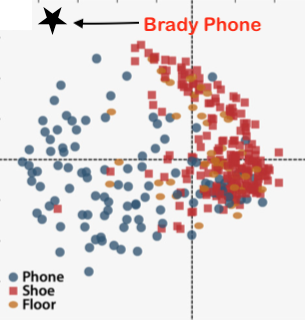
For example, the Brady phone sample did not really even resemble a phone well
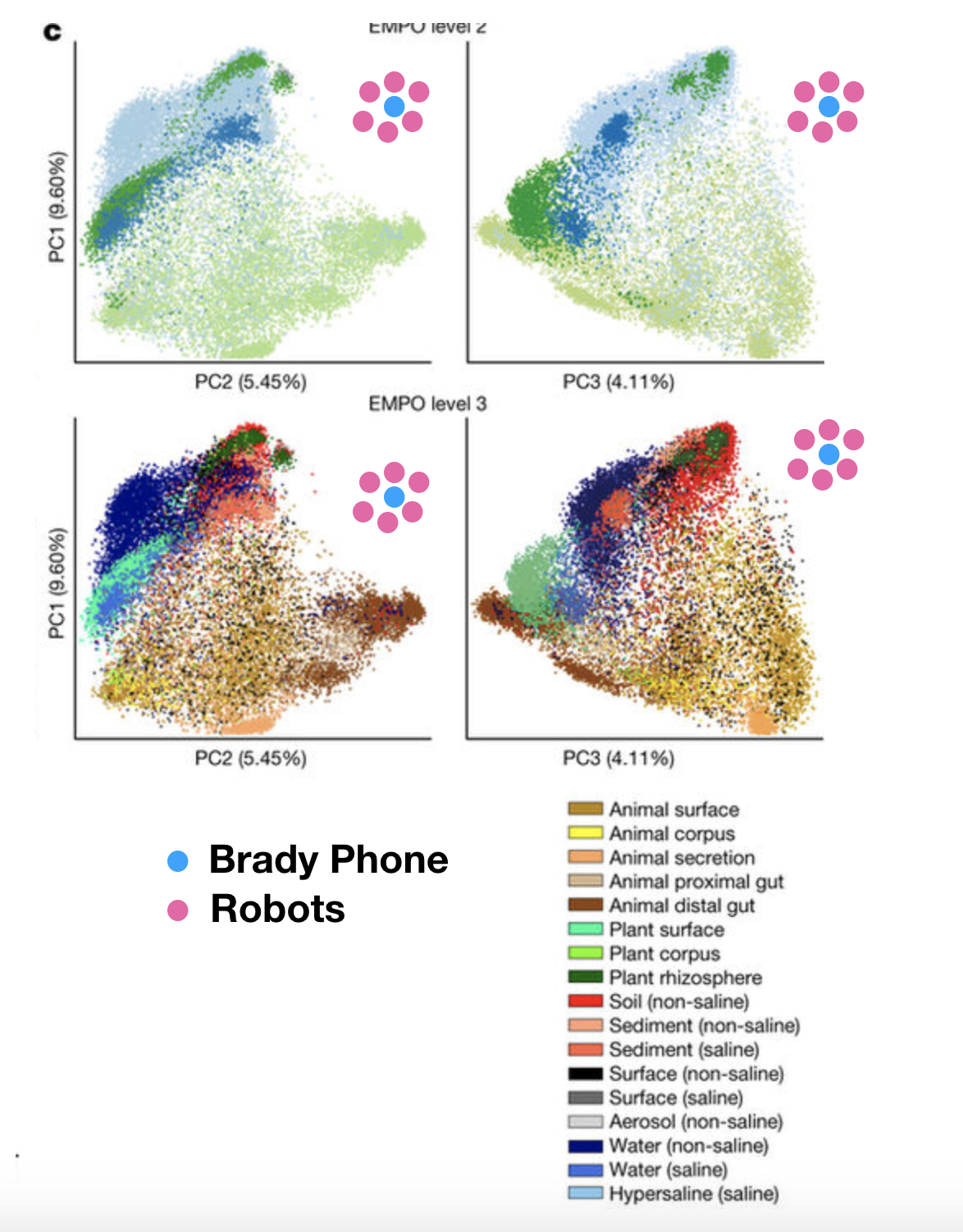
So this was really disappointing. But as one last ditch effort, we decided to download all of the available microbiome data from any sample on the planet. Like all of it. We then reran the MAQDADDY pipeline and found an amazing result.
What I think this means is that Tom Brady had a Luke Skywalker operation. That is, his hand is robotic. So cool.






 Jonathan Eisen's Lab