
| Koch’s postulates in the age of viral metagenomics
28 April 2016, noon A Virginia Perry Wilson endowed seminar featuring the great and mighty virus hunter: Dr. Eric Delwart, PhD Blood Systems Research Institute, UCSF 1010 Valley Hall |
| Seminar (and lunch) coordinated by The Veterinary Pathology Club |
Eisen Lab Blog

Letter from #UCDavis Profs to Janet Napolitano about possible sexism in responses to Chancellor Katehi’s activities
The current Chair of the UC Davis Division of the Academic Senate forwarded an email to UC Davis faculty today. This email included a letter that had been send from from Linda Bisson (past Chair of the UC Davis Division of the Academic Senate) and Rachael E. Goodhue (Chair Elect of UC Davis Division of the Academic Senate) to the President of the University of California Janet Napolitano. The letter’s overall message is concern about possible sexism in how the Chancellor of UC Davis is being treated in regard to recent events at UC Davis.
I note – I have received many (over a dozen) private messages also expressing concern that some of the reaction to Chancellor Katehi’s activities may be sexist. Mind you – most of these people are not defending the activities of the Chancellor but are concerned about the responses to her activities. I think it is important for these expressions to be more widely viewed and thus I asked Linda Bisson if I could post it here and she said yes.
From: Linda Bisson
Date: Sun, Apr 24, 2016 at 6:43 AM
Subject: Letter to President Napolitano
Dear President Napolitano:
We want to express grave concern over a pattern of negativism in the press and social media regarding women Chancellors and senior administrative leaders. There are strong parallels between the singularly intensive criticism of our Chancellor Linda Katehi and that previously of Chancellors Fox (UCSD) and Denton (UCSC), and of UC Vice President Greenwood. Yet, the activities that are being criticized clearly fall within the standards of UCwide practice. This pattern is exemplified by a 2006 LA Times article that criticized compensation practices for senior UC executives: those singled out for criticism for “extravagant pay practices, perks and privilege for top executives” are all women (http://articles.latimes.com/2006/feb/16/local/me-cap16). The intensity of the criticism at the time ended in tragedy for Chancellor Denton. Chancellor Fox’s term was equally framed as fraught with turmoil, turmoil apparently not experienced by her male colleagues who were facing identical issues due to budget cuts and lack of diversity and inclusion. In an article in the San Diego Union Tribune written on Chancellor Fox’s decision to step down (http://www.sandiegouniontribune.com/news/2011/jul/05/fox- leaving-ucsd/?#article-copy), she is described in terms steeped in implicit gender bias such as the quote ascribed to former President Atkinson: “She handled that as well as she could have handled it” – not as well as anyone could have handled it or as well as it could have been handled.
Women in leadership positions are often the victims of intense implicit bias and, as a consequence, of the phenomenon of “single storyism” – the reduction of their actions to a simple narrative that appeals to the biases of a broad section of society, in this case implicit gender bias and women being incompetent for their position. Whatever they say or do in response is twisted to fit the “single story.” We think the LA Times article listed above illustrates perfectly the problem of the single story experienced by senior women administrators at UC. If the LA Times story were rewritten today, Chancellor Katehi’s name is likely the only one that would be added to the list.
All of UC is richer because of the participation of women and underrepresented groups at all levels. We know you and your leadership team share this belief. We are concerned that UCOP does not recognize that senior administrators who are identified with an underrepresented identity vital to our diversity are subject to vilification in the press simply because of that identity. We are also concerned, as recent press regarding our Chancellor Katehi demonstrates, that Chancellors and other senior administrators are not well-equipped to deal with single storyism, nor is there the recognition that others, such as UCOP, must step in to address the criticism as well.
The absence of factual information on UC policies and practices with respect to external compensation for all senior administrators has led to speculative and negative public debate regarding a single senior woman, when the practice of external involvement is widespread. We would like to request clear articulation from UCOP of both the formal policies and the informal practices as they pertain to executive compensation (e.g., have senior managers been encouraged to participate in activities outside UC). We note that legislators are calling for the same review. UCOP’s understanding of the broader issues involved is essential to informing these external discussions. The need for UCOP to take action is urgent.
We thank you for considering this request.
Linda F. Bisson, Former Chair, Davis Division of the Academic Senate, 2006-2008 & 2011-2012
Rachael E. Goodhue, Chair Elect, Davis Division of the Academic Senate 2016-2018
Share this:
May 2: New Research Methods for Critically Engaging the Equity Question in Higher Education
The Provost’s Forums
on the Public University and the Social Good
Monday, May 2, 2016
New Research Methods for Critically Engaging the Equity Question in Higher Education
Estela Mara Bensimon
Professor of Higher Education and Director of the Center for Urban Education at the University of
Southern California
Estela Mara Bensimon is particularly interested in place-based, practitioner- driven inquiry as a means of organizational change in higher education. Her current research is on issues of racial equity in higher education from the perspective of organizational learning and socio-cultural practice theories.
Dr. Bensimon has received grants from the National Science Foundation to study Latina and Latino students in higher education, the Bill and Melinda Gates and Ford Foundations to complete system-level work on college completion in Colorado, and the Teagle Foundation to examine the expanding role of private institutions in transfer pathways. Her publications about equity, organizational learning, practitioner inquiry, and change include: Confronting Equity Issues on Campus: Implementing the Equity Scorecard in Theory and Practice; The Underestimated Signi cance of Practitioner Knowledge in the Scholarship on Student Success; Doing Research that Makes a Difference; Equality in Fact, Equality in Results: A matter of institutional accountability; Measuring the State of Equity in Public Higher Education; and Closing the Achievement Gap in Higher Education: An Organizational Learning Perspective.
Previously, Dr. Bensimon has held the highest leadership positions in the Association for the Study of Higher Education and in the American Education Research Association Division on Postsecondary Education. She has served on the boards of the American Association for Higher Education and the Association of American Colleges and Universities.
In her lecture, Dr. Bensimon will discuss how the elimination of af rmative action has generated a strong and comprehensive line of research that documents empirically the educational bene ts of diversity. This movement provides legal and value-free justi cation for use of race in admissions to public universities. Despite its legal persuasiveness, this body of work has not eradicated inequity in higher education outcomes for subordinated groups. Professor Bensimon will analyze the intractable nature of racial inequity in higher education as an organizational learning problem. She will then discuss research methods pioneered by the Center for Urban Education, which seeks to assist scholars and practitioners to address racial inequity and remediate institu- tional practices and campus cultures, structures, and policies.
Lecture:
3 to 4:30 p.m. Multipurpose Room Student Community Center
Reception:
4:30 to 5:30 p.m. Upstairs Patio
Student Community Center
Share this:
UC Davis Storer Lecture series – since 1963 87% of speakers are male
I wrote this blog post a while ago but never published it partly out of fear for upsetting some of my colleagues. I try to be brave about such things, but I guess I just did not quite get up the poxy. Well, today something came up that stimulated me to write the post.
I got an email announcement for a talk that seems potentially quite interesting. The problem is not the talk. The problem is with the endowed Lectureship that this talk is connected to. So here is the post I have worked on on and off over the last year or more.
UC Davis has an endowed lecture series- the Storer Lectureship in the Life Sciences. It has been running since the 1960s and is a relatively big deal on campus here. The speakers come in, usually give one or two talks (one for the public and one for researchers). They usually have a big dinner (I have gone to a few of these) and the speakers get a decent honorarium (a few thousand dollars) and some sort of gift.
Most years I have been here, I have received a request from the organizers for suggested speakers and every once in a while I have made suggestions, some of which have even led to invitations. Recently, I had suggested a famous colleague who is also a UC Davis alum. Alas, she could not come. The organizers asked if I had any other suggestions and I sent them a list of a few candidates who are both very good, well known and do something related to microbes. The organizers really liked one of the suggestions and asked if I would be willing to invite this person.
So I started drafting a letter. And as part of drafting a letter I wanted to give examples of past speakers to show how great a set of speakers we had for this series. So I Googled “Storer” and
UC Davis” or something like that and got to the page:
Storer Lectureship in the Life Sciences
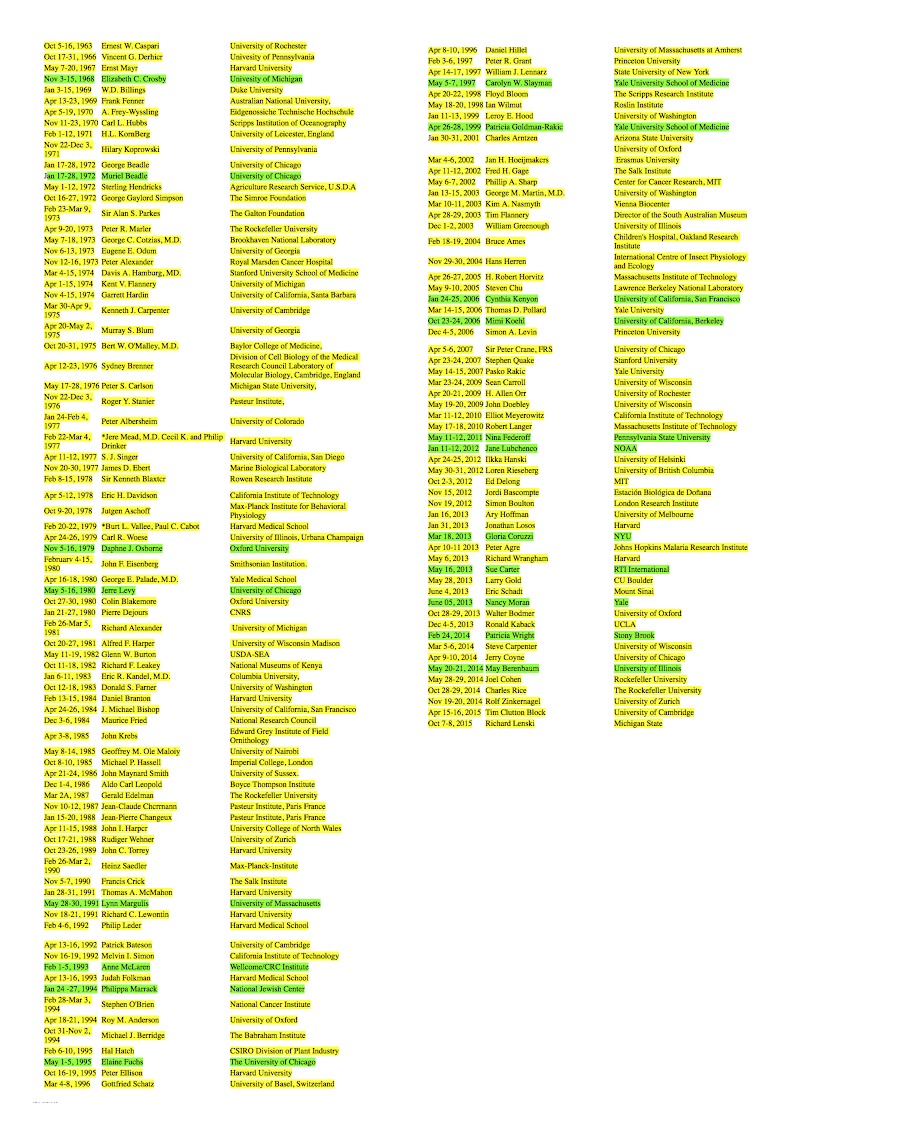
And that is when I got a bit heartbroken. The speakers have been, well, very male. I note I spent a while looking at descriptions of each speaker that I did not know to try and determine their gender, looking at their web sites if available, or how they were described (e.g., what pronouns were used). I am pretty confident in the assignments though I realize this is an error prone approach. Here is the full list as far as I have put together with the males labelled in yellow and females in green.
| Oct 5-16, 1963 | Ernest W. Caspari | University of Rochester |
| Oct 17-31, 1966 | Vincent G. Derhicr | Univesity of Pennsylvania |
| May 7-20, 1967 | Ernst Mayr | Harvard University |
| Nov 3-15, 1968 | Elizabeth C. Crosby | Univesity of Michigan |
| Jan 3-15, 1969 | W.D. Billings | Duke University |
| Apr 13-23, 1969 | Frank Fenner | Australian National University, |
| Apr 5-19, 1970 | A. Frey-Wyssling | Eidgenossiche Tcchnische Hochschule |
| Nov 11-23, 1970 | Carl L. Hubbs | Scripps Institution of Oceanography |
| Feb 1-12, 1971 | H.L. KornBerg | University of Leicester, England |
| Nov 22-Dec 3, 1971 | Hilary Koprowski | University of Pennsylvania |
| Jan 17-28, 1972 | George Beadle | University of Chicago |
| Jan 17-28, 1972 | Muriel Beadle | University of Chicago |
| May 1-12, 1972 | Sterling Hendricks | Agriculture Research Service, U.S.D.A |
| Oct 16-27, 1972 | George Gaylord Simpson | The Simroe Foundation |
| Feb 23-Mar 9, 1973 | Sir Alan S. Parkes | The Galton Foundation |
| Apr 9-20, 1973 | Peter R. Marler | The Rockefeller University |
| May 7-18, 1973 | George C. Cotzias, M.D. | Brookhaven National Laboratory |
| Nov 6-13, 1973 | Eugene E. Odum | University of Georgia |
| Nov 12-16, 1973 | Peter Alexander | Royal Marsden Cancer Hospital |
| Mar 4-15, 1974 | Davis A. Hamburg, MD. | Stanford University School of Medicine |
| Apr 1-15, 1974 | Kent V. Flannery | University of Michigan |
| Nov 4-15, 1974 | Garrett Hardin | University of California, Santa Barbara |
| Mar 30-Apr 9, 1975 | Kenneth J. Carpenter | University of Cambridge |
| Apr 20-May 2, 1975 | Murray S. Blum | University of Georgia |
| Oct 20-31, 1975 | Bert W. O’Malley, M.D. | Baylor College of Medicine, |
| Apr 12-23, 1976 | Sydney Brenner | Division of Cell Biology of the Medical Research Council Laboratory of Molecular Biology, Cambridge, England |
| May 17-28, 1976 | Peter S. Carlson | Michigan State University, |
| Nov 22-Dec 3, 1976 | Roger Y. Stanier | Pasteur Institute, |
| Jan 24-Feb 4, 1977 | Peter Albersheim | University of Colorado |
| Feb 22-Mar 4, 1977 | *Jere Mead, M.D. Cecil K. and Philip Drinker | Harvard University |
| Apr 11-12, 1977 | S. J. Singer | University of California, San Diego |
| Nov 20-30, 1977 | James D. Ebert | Marine Biological Laboratory |
| Feb 8-15, 1978 | Sir Kenneth Blaxtcr | Rowen Research Institute |
| Apr 5-12, 1978 | Eric H. Davidson | California Institute of Technology |
| Oct 9-20, 1978 | Jutgen Aschoff | Max-Planck Institute for Behavioral Physiology |
| Feb 20-22, 1979 | *Burt L. Vallee, Paul C. Cabot | Harvard Medical School |
| Apr 24-26, 1979 | Carl R. Woese | University of Illinois, Urbana Champaign |
| Nov 5-16, 1979 | Daphne J. Osborne | Oxford University |
| Februarv 4-15, 1980 | John F. Eisenberg | Smithsonian Institution. |
| Apr 16-18, 1980 | George E. Palade, M.D. | Yale Medical School |
| May 5-16, 1980 | Jerre Levy | University of Chicago |
| Oct 27-30, 1980 | Colin Blakemore | Oxford University |
| Jan 21-27, 1980 | Pierre Dejours | CNRS |
| Feb 26-Mar 5, 1981 | Richard Alexander | University of Michigan |
| Oct 20-27, 1981 | Alfred F. Harper | University of Wisconsin Madison |
| May 11-19, 1982 | Glenn W. Burton | USDA-SEA |
| Oct 11-18, 1982 | Richard F. Leakey | National Museums of Kenya |
| Jan 6-11, 1983 | Eric R. Kandel, M.D. | Columbia University, |
| Oct 12-18, 1983 | Donald S. Farner | University of Washington |
| Feb 13-15, 1984 | Daniel Branton | Harvard University |
| Apr 24-26, 1984 | J. Michael Bishop | University of California, San Francisco |
| Dec 3-6, 1984 | Maurice Fried | National Research Council |
| Apr 3-8, 1985 | John Krebs | Edward Grey Institute of Field Ornithology |
| May 8-14, 1985 | Geoffrey M. Ole Maloiy | University of Nairobi |
| Oct 8-10, 1985 | Michael P. Hassell | Imperial College, London |
| Apr 21-24, 1986 | John Maynard Smith | University of Sussex. |
| Dec 1-4, 1986 | Aldo Carl Leopold | Boyce Thompson Institute |
| Mar 2A, 1987 | Gerald Edelman | The Rockefeller University |
| Nov 10-12, 1987 | Jean-Claude Chcrrnann | Pasteur Institute, Paris France |
| Jan 15-20, 1988 | Jean-Pierre Changeux | Pasteur Institute, Paris France |
| Apr 11-15, 1988 | John I. Harpcr | University College of North Wales |
| Oct 17-21, 1988 | Rudiger Wehner | University of Zurich |
| Oct 23-26, 1989 | John C. Torrey | Harvard University |
| Feb 26-Mar 2, 1990 | Heinz Saedler | Max-Planck-Institute |
| Nov 5-7, 1990 | Francis Crick | The Salk Institute |
| Jan 28-31, 1991 | Thomas A. McMahon | Harvard University |
| May 28-30, 1991 | Lynn Margulis | University of Massachusetts |
| Nov 18-21, 1991 | Richard C. Lewontin | Harvard University |
| Feb 4-6, 1992 | Philip Leder | Harvard Medical School |
| Apr 13-16, 1992 | Patrick Bateson | University of Cambridge |
| Nov 16-19, 1992 | Melvin I. Simon | California Institute of Technology |
| Feb 1-5, 1993 | Anne McLaren | Wellcome/CRC Institute |
| Apr 13-16, 1993 | Judah Folkman | Harvard Medical School |
| Jan 24 -27, 1994 | Philippa Marrack | National Jewish Center |
| Feb 28-Mar 3, 1994 | Stephen O’Brien | National Cancer Institute |
| Apr 18-21, 1994 | Roy M. Anderson | University of Oxford |
| Oct 31-Nov 2, 1994 | Michael J. Berridge | The Babraham Institute |
| Feb 6-10, 1995 | Hal Hatch | CSIRO Division of Plant Industry |
| May 1-5, 1995 | Elaine Fuchs | The University of Chicago |
| Oct 16-19, 1995 | Peter Ellison | Harvard University |
| Mar 4-8, 1996 | Gottfried Schatz | University of Basel, Switzerland |
| Apr 8-10, 1996 | Daniel Hillel | University of Massachusetts at Amherst |
| Feb 3-6, 1997 | Peter R. Grant | Princeton University |
| Apr 14-17, 1997 | William J. Lennarz | State University of New York |
| May 5-7, 1997 | Carolyn W. Slayman | Yale University School of Medicine |
| Apr 20-22, 1998 | Floyd Bloom | The Scripps Research 1nstitute |
| May 18-20, 1998 | Ian Wilmut | Roslin Institute |
| Jan 11-13, 1999 | Leroy E. Hood | University of Washington |
| Apr 26-28, 1999 | Patricia Goldman-Rakic | Yale University School of Medicine |
| Jan 30-31, 2001 | Charles Arntzen | Arizona State University |
| University of Oxford | ||
| Mar 4-6, 2002 | Jan H. Hoeijmakcrs | Erasmus University |
| Apr 11-12, 2002 | Fred H. Gage | The Salk Institute |
| May 6-7, 2002 | Phillip A. Sharp | Center for Cancer Research, MIT |
| Jan 13-15, 2003 | George M. Martin, M.D. | University of Washington |
| Mar 10-11, 2003 | Kim A. Nasmyth | Vienna Biocenter |
| Apr 28-29, 2003 | Tim Flannery | Director of the South Australian Museum |
| Dec 1-2, 2003 | William Greenough | University of Illinois |
| Feb 18-19, 2004 | Bruce Ames | Children’s Hospital, Oakland Research Institute |
| Nov 29-30, 2004 | Hans Herren | International Centre of Insect Physiology and Ecology |
| Apr 26-27, 2005 | H. Robert Horvitz | Massachusetts Institute of Technology |
| May 9-10, 2005 | Steven Chu | Lawrence Berkeley National Laboratory |
| Jan 24-25, 2006 | Cynthia Kenyon | University of California, San Francisco |
| Mar 14-15, 2006 | Thomas D. Pollard | Yale University |
| Oct 23-24, 2006 | Mimi Koehl | University of California, Berkeley |
| Dec 4-5, 2006 | Simon A. Levin | Princeton University |
| Apr 5-6, 2007 | Sir Peter Crane, FRS | University of Chicago |
| Apr 23-24, 2007 | Stephen Quake | Stanford University |
| May 14-15, 2007 | Pasko Rakic | Yale University |
| Mar 23-24, 2009 | Sean Carroll | University of Wisconsin |
| Apr 20-21, 2009 | H. Allen Orr | University of Rochester |
| May 19-20, 2009 | John Doebley | University of Wisconsin |
| Mar 11-12, 2010 | Elliot Meyerowitz | California Institute of Technology |
| May 17-18, 2010 | Robert Langer | Massachusetts Institute of Technology |
| May 11-12, 2011 | Nina Federoff | Pennsylvania State University |
| Jan 11-12, 2012 | Jane Lubchenco | NOAA |
| Apr 24-25, 2012 | Ilkka Hanski | University of Helsinki |
| May 30-31, 2012 | Loren Rieseberg | University of British Columbia |
| Oct 2-3, 2012 | Ed Delong | MIT |
| Nov 15, 2012 | Jordi Bascompte | Estación Biológica de Doñana |
| Nov 19, 2012 | Simon Boulton | London Research Institute |
| Jan 16, 2013 | Ary Hoffman | University of Melbourne |
| Jan 31, 2013 | Jonathan Losos | Harvard |
| Mar 18, 2013 | Gloria Coruzzi | NYU |
| Apr 10-11 2013 | Peter Agre | Johns Hopkins Malaria Research Institute |
| May 6, 2013 | Richard Wrangham | Harvard |
| May 16, 2013 | Sue Carter | RTI International |
| May 28, 2013 | Larry Gold | CU Boulder |
| June 4, 2013 | Eric Schadt | Mount Sinai |
| June 05, 2013 | Nancy Moran | Yale |
| Oct 28-29, 2013 | Walter Bodmer | University of Oxford |
| Dec 4-5, 2013 | Ronald Kaback | UCLA |
| Feb 24, 2014 | Patricia Wright | Stony Brook |
| Mar 5-6, 2014 | Steve Carpenter | University of Wisconsin |
| Apr 9-10, 2014 | Jerry Coyne | University of Chicago |
| May 20-21, 2014 | May Berenbaum | University of Illinois |
| May 28-29, 2014 | Joel Cohen | Rockefeller University |
| Oct 28-29, 2014 | Charles Rice | The Rockefeller University |
| Nov 19-20, 2014 | Rolf Zinkernagel | University of Zurich |
| Apr 15-16, 2015 | Tim Clutton Block | University of Cambridge |
| Oct 7-8, 2015 | Richard Lenski | Michigan State |
| April 22, 2016 | Steve Nowicki | Duke University |
The total numbers come to 19 females out of 142 speakers or ~13% female and 87% male. Ugh.
And the person I had suggested to invite was male. So I wrote back to the organizers and I wrote:
From: Jonathan Eisen
Sent: Thursday, June 11, 2015 11:34 AM
To: XXXCc: XXX
Subject: Abyssmal gender ratio of speakers in the Storer Lectureship series
XXX and XXXX
With sincere apologies but …
In preparing a letter of invitation for XXX I decided to include some examples of previous Storer Lecturers. And therein lies the problem On the web sitehttp://www.dbs.ucdavis.edu/seminars_and_events/storer_lecture_list.htmlfrom my count, there are 121 past speakers listed. Of these, 15 appear to be female (from my estimate). That comes to 12%. That is embarassaingly low. I hope my calculations here are wrong.
Can you tell me if the Storer Lectureship has any policies regarding diversity of speakers? If yes, can you provide me with those details.
If no, I recommend you implement one as soon as possible. Either way, I refuse to have my name affiliated with this series, and will not invite anyone to talk in it, without further information and without some serious attempt to figure out how to do a better job representing the diversity of biologists who could give such talks.
Jonathan
They wrote back with a very detailed response and were very supportive of the concept of increasing diversity of speakers. And they explained some of the efforts they had made in this regard. And they really seem to be trying in some ways. But in the end, their main justification for the lack of diversity was that they were trying to invite already recognized, in essence famous, biologists. People who had won a Nobel or were in the National Academy of Sciences or were HHMI investigators. And this pool, that they had chosen, was skewed in gender balance.
So I wrote back to them June 18:
All
Thanks very much for the response.
I understand you have some constraints and greatly appreciate that you are committed to trying to improve the diversity of speakers. However, the end result is truly not acceptible in my mind and therefore I believe more needs to be done, urgently, to improve the situation.
What are some possible ways to improve the situation?
Well, the number one recommendation I would make would be to not constrain the pool to honorific groups that themselves have severe skews. No we cannot solve those skews and there are many causes for them. But I believe it is a major mistake to use the diversity of those groups (NAS, Nobel, HHMI) as a target. Either invite people to represent diversity well even from a constrained pool, or, open up to a broader pool (there are plenty of incredible scientists who have not gotten HHMI, NAS, or Nobels).
In addition to opening up the pool and not aiming at such a low bar, there are many things one can do to improve the diversity of speakers. I have written about this extensively as have many others. I can point the committee to some of these articles if interested.
In the end, whatever the reasons are, the Storer series has ended up with extremely biased gender ratio of speakers. I think it is up to the committee to fix this with a combination of actions. But the first thing I would recommend is to not use the diversity of a set of pools you have chosen as an excuse. We can and should do better and if the pools are the reason, the pools from which you sample need to be changed.
Jonathan
They wrote back, saying they were really committed to achieving better gender balance in the future writing “we are totally committed to the same goals as you in terms of gender balance now and in the future.” And they also wrote that they expected “the final lineup to reflect at least 30 percent or more female” as long as one additional woman (the person I had originally recommended) would come (though I had told them she said she could not). And then they asked if I would reconsider inviting the man who I had been about to invite that had started this whole discussion.
So I wrote back again July 14:
Thanks again for the response. And though I do not want to continue beating a dead horse, I am not convinced we are doing enough in this area. For example, what explains the “at least 30 percent” and how close to 30% will that be. This is important as, for example, the National Science Foundation will not support their people attending meetings if female speakers are at < 33%. I think 30% is, to be honest, just not acceptable in biology. So beofre contributing any more to this series I need to know exactly what is meant by "we are totally committed to the same goals as you in terms of gender balance now and in the future.”
For example, here are some questions I would like to know the answers to:
- Are you committed to achieving gender balance in the speaker series or just saying you are being more even than before?
- Are you committed to researching and using diverse options to ensure diversity of speakers beyond just focusing on who is invited?
- Are you interested in understanding why the series has been so undiverse in the past and addressing this directly or just moving forward?
- Are you willing to address the lack of diversity in the past publicly and also discuss efforts to improve the diversity?
I would very much like to know more detail about how serious you are to having a diverse series and what you plan to do to achieve this.
With apologies, but in regard to inviting XXX or XXX. I am sorry but given the past record of this series, which as I said is among the worst I have seen anywhere, I am just not willing to be involved in any way until I see a stronger and more public committment to diversity.
I am happy to help with the series and to help improve the diversity of speakers. But this should be done openly and publicly and forcefully. And without evidence of this, I am unable and unwilling to be involved.
And, well, I have not heard from them again. So, I am writing this. For many reasons. But a key one is, I think we need to be more public about such issues. And we just need to fix things that are broken.
So today I decided to make the post live. I wish I had done this earlier.
Some responses
The Tree of Life: UC Davis Storer Lecture series – Concerning stats about gender disparities from @phylogenomics https://t.co/Auo9KQWoG9
— Andy Jones (@andyojones) April 21, 2016
//platform.twitter.com/widgets.js
Important read: “UC Davis Storer Lecture series – since 1963 87% of speakers are male” https://t.co/gcsgSt1Woe
— Alexandra Rosati (@AlexGRosati) April 21, 2016
//platform.twitter.com/widgets.js
Another example of male-biased seminar series. https://t.co/cFFrErA8Ah
— Haldre Rogers (@haldre1) April 22, 2016
//platform.twitter.com/widgets.js
Share this:

American Academy of Arts and Sciences – where men choose men to be cheered
So – I saw multiple posts by colleagues on Facebook and Twitter about gender skew in the newly elected members of the American Academy of Arts and Sciences. So I decided to take a look at the list. And it is indeed really skewed. Here is my analysis of gender ratio for mathematical and physical sciences and biological sciences.

| Field | Male | Female |
| Math and Physical Sciences Totals | 32 | 10 |
| Math | 5 | 1 |
| Physics | 6 | 1 |
| Chemistry | 7 | 1 |
| Astronomy | 3 | 4 |
| Engineering | 5 | 1 |
| CS | 5 | 2 |
| Intersection | 1 | 0 |
| Biology Totals | 31 | 8 |
| Biochemistry | 4 | 2 |
| Cell and Development | 7 | 1 |
| Neuroscience | 6 | 2 |
| Ecovo | 7 | 1 |
| Medical | 5 | 1 |
| Intersection | 2 | 1 |
More detail below:
CLASS I — Mathematical and Physical Sciences (41)
FOREIGN HONORARY MEMBERS (4)
SECTION 1 — Mathematics (6)
Pavel Etingof
Massachusetts Institute of Technology
Leslie Greengard
New York University/Simons Foundation
Janos Kollar
Princeton University
Bryna R. Kra
Northwestern University
Andrei Okounkov
Columbia University
Vladimir Rokhlin
Yale University
SECTION 2 — Physics (7)
Barbara V. Jacak
University of California, Berkeley
Christopher Jarzynski
University of Maryland
Hirosi Ooguri
California Institute of Technology
Roberto D. Peccei
University of California, Los Angeles
Robert J. Schoelkopf
Yale University
Steven R. White
University of California, Irvine
Foreign Honorary Member — Physics
Thibault Damour
Institut des Hautes Etudes Scientifiques
SECTION 3 — Chemistry (8)
Donald Hilvert
Eidgenössische Technische Hochschule Zürich, Zurich, Switzerland
Jeffery W. Kelly
Scripps Research Institute
Scott J. Miller
Yale University
Melanie S. Sanford
University of Michigan
Isiah M. Warner
Louisiana State University
Michael R. Wasielewski
Northwestern University
Foreign Honorary Members — Chemistry (2)
Hans-Joachim Freund
Fritz-Haber-Institut der Max-Planck-Gesellschaft
R. Benny Gerber
Hebrew University of Jerusalem/University of California, Irvine
SECTION 4 — Astronomy and Earth Sciences (7)
Andreas J. Albrecht
University of California, Davis
Joshua A. Frieman
Fermi National Accelerator Laboratory/University of Chicago
Jacqueline Hewitt
Massachusetts Institute of Technology
Chryssa Kouveliotou
George Washington University
Terry A. Plank
Columbia University
Lisa Tauxe
University of California, San Diego
Foreign Honorary Member — Astronomy and Earth Sciences
Thomas F. Stocker
University of Bern
SECTION 5 — Engineering Sciences and Technologies (6)
Donna Gail Blackmond
Scripps Research Institute
Gerald G. Fuller
Stanford University
Steve Granick
Ulsan National Institute of Science and Technology, Ulsan, Republic of Korea
Donald E. Ingber
Harvard University/ Boston Children’s Hospital
Robert B. Phillips
California Institute of Technology
Peter W. Voorhees
Northwestern University
SECTION 6 — Computer Sciences (6)
Jeffrey A. Dean
Google
Sanjay Ghemawat
Google Incorporated
Anna R. Karlin
University of Washington
Tom M. Mitchell
Carnegie Mellon University
Tal D. Rabin
IBM T.J. Watson Research Center
Scott J. Shenker
University of California, Berkeley
CLASS I INTERSECTION CANDIDATES (1)
Timothy P. Lodge
University of Minnesota
CLASS II — Biological Sciences (38)
FOREIGN HONORARY MEMBERS (6)
SECTION 1 — Biochemistry, Biophysics and Molecular Biology (6)
Richard H. Ebright
Rutgers University
Lila M. Gierasch
University of Massachusetts
Robert M. Glaeser
University of California, Berkeley/Lawrence Berkeley National Laboratory
Adrian R. Krainer
Cold Spring Harbor Laboratory
Lawrence A. Loeb
University of Washington
Eva Nogales
University of California, Berkeley
SECTION 2 — Cellular & Developmental Biology, Microbiology, and Immunology (8)
Keith W.T. Burridge
University of North Carolina at Chapel Hill
Mark W. Hochstrasser
Yale University
Michael J. Lichten
National Cancer Institute
Joachim Messing
Rutgers University
Carl F. Nathan
Weill Cornell Medical College
Anne M. Villeneuve
Stanford University
Foreign Honorary Members — Cellular & Developmental Biology, Microbiology, and Immunology (2)
Carl-Henrik Heldin
Ludwig Institute for Cancer Research/Uppsala University
Christof Niehrs
Institute of Molecular Biology
SECTION 3 — Neurosciences, Cognitive Sciences, and Behavioral Biology (8)
Michael S. Brainard
University of California, San Francisco
John Gabrieli
Massachusetts Institute of Technology
Alex L. Kolodkin
Johns Hopkins University School of Medicine
Kelsey C. Martin
University of California, Los Angeles
Bruce R. Rosen
Harvard Medical School/Massachusetts General Hospital
John L. R. Rubenstein
University of California, San Francisco
Foreign Honorary Members — Neurosciences, Cognitive Sciences, and Behavioral Biology(2)
Tamar Flash
Weizmann Institute of Science
Nancy Y. Ip
Hong Kong University of Science and Technology
SECTION 4 — Evolutionary and Population Biology, and Ecology (7)
Farooq Azam
University of California, San Diego
Andrew G. Clark
Cornell University
Douglas J. Emlen
University of Montana
Joel Grant Kingsolver
University of North Carolina at Chapel Hill
Mark Alan McPeek
Dartmouth College
Sarah P. Otto
University of British Columbia
Foreign Honorary Member — Evolutionary and Population Biology, and Ecology
Ary A. Hoffmann
University of Melbourne
SECTION 5 — Medical Sciences, Clinical Medicine, and Public Health (6)
John Michael Carethers
University of Michigan Medical School
James R. Downing
St. Jude Children’s Research Hospital
Gary Gilliland
Fred Hutchinson Cancer Research Center
Beatrice H. Hahn
University of Pennsylvania Perelman School of Medicine
Warren J. Leonard
National Institutes of Health
Ralph Weissleder
Harvard Medical School/ Massachusetts General Hospital
CLASS II INTERSECTION CANDIDATES (3)
Steven E. Jacobsen
University of California, Los Angeles
Yang Shi
Harvard Medical School/ Boston Children’s Hospital
Foreign Honorary Member — Intersection
Karen H. Vousden
Beatson Institute for Cancer Research, Glasgow, U.K.
Also these cross-field areas are not doing so well (not included in chart or table above).
TOTAL: 213
FELLOWS: 176
FOREIGN HONORARY MEMBERS: 37
INTERCLASS CANDIDATES (10)
FOREIGN HONORARY MEMBERS (5)
Benjamin F. Cravatt
The Scripps Research Institute
Robert L. Goldstone
Indiana University
Larry L. Jacoby
Washington University in St. Louis
Jay D. Keasling
University of California, Berkeley/LBNL
Gordon D. Logan
Vanderbilt University
Foreign Honorary Members (5)
Edwin Cameron
Constitutional Court of South Africa
Fergus I.M. Craik
Rotman Research Institute/University of Toronto
Menachem Magidor
Hebrew University of Jerusalem
Mikhail Borisovich Piotrovsky
State Hermitage Museum/St. Petersburg State University
Shimon Ullman
Weizmann Institute of Science
EMERGING FIELD CANDIDATE (1)
Robert J. Full
University of California, Berkeley
Share this:

“Making Social Science Transparent” conference at #UCDavis 4/22/16: register today!
The Institute for Social Sciences at UC Davis cordially invites you to attend:
“Making Social Science Transparent: A Conference on the Issues of Transparency, Data and Code Accessibility, Replication, and Reproducibility”
Friday, April 22, 2016
8:30 a.m.-6:00 p.m.
Location: AGR Room, Walter A. Buehler Alumni Center, UC Davis
This conference is free and open to the public, but registration is required. Register now
For more information and a complete list of speakers, please visit the ISS website or see the attached poster. We hope you will join us!
Share this:
Reproducibility workshop at #UCDavis May 4

Workshop for increasing openness and reproducibility in
quantitative research
There are many actions researchers can take to increase the openness and reproducibility of their work. Please join us for a workshop, hosted by theCenterforOpenScience, to learn easy, practical steps researchers can take to increase the reproducibility of their work. The workshop will be hands-on. Using example studies, attendees will actively participate in creating a reproducible project from start to finish.
Topics covered:
* Project documentation
* Version control
* Pre-Analysis plans
* Open source tools like the Center for Open Science’sOpenScienceFramework to easily implement these concepts in a scientific workflow. You can think of OSF as an electronic notebook.
This workshop is aimed at faculty, staff, and students across disciplines, who are engaged in quantitative research. The workshop does not require any specialized knowledge of programming. Participants will gain a foundation for incorporating reproducible, transparent practices into their current workflows.
Attendees will need to bring their own laptop in order to fully participate.
Date: Wednesday, May 4th, 2016
Time: Two Sessions (9am-12pm; or 1pm-4pm)
Location: Shields Library, DSI Classroom, room 360
Pizza lunch will be provided at noon for attendees from both sessions.
Please RVSP by April 8th as space is limited.
Share this:

As more publishers require scholars to get ORCID id’s, the ORCID team to present on 4/20 at the Library
The Data Management Program at the UC Davis Library is hosting two seminars on the benefits of ORCID, an identifier for researchers, authors and creators. ORCID is now required by publishers like Science, PNAS, PLoS, EMBO, eLife, so this is an opportunity for faculty, staff and students in Ecology who publish in their journals to have their questions answered by Laurel Haak and Douglas Wright, Directors of the ORCID team. The seminars will be held on April 20th in the 2nd Floor Instruction Room in the Shields Library.
3:00 PM The Benefits of ORCID to Individual Researchers, Authors and Creators
4:00 PM The Benefits of ORCID to Research Institutions
Please, R.S.V.P. to vensberg.
Thank you,
Share this:
Today at #UCDavis: Dr. Gitta Coaker on “Plant innate immune signaling”


4/21 at #UCDavis: Interface and Intimacy: Software Prototyping for a New Media
INTIMACY & INTERFACE
Software Prototyping
for a New Media
| Thursday, April 21st
2-4 p.m. Data Science Initiative suite 360 Shields Library |
This talk will explore the implications of “intimacy” and how it rubs against the dogma of automation in the computer science field. A selection of prototypes, work and sketches will be shown, re-imagining our relationship to archive and media, through a discussion about what it means to “interface” with the past, with the present, and with one another. Several audiovisual tools for analysis and exploration will also be shared and installed in the Digital Scholarship and Data Science Labs, for research uses within the campus community.
Robert M. Ochshorn is a Berlin-based artist, programmer, and researcher developing media interfaces for extending human perceptive and expressive capabilities. Ochshorn has a computer science background and consults for the Communications Design Group (CDG) Lab in San Francisco, founded by Alan Kay and Bret Victor on the model of Xerox PARC. He has worked in the Interrogative Design Group at MIT and Harvard, and has held fellowships in the Design Department of Jan van Eyck Academie and the Akademie Schloss Solitude.
For more information, contact Marit MacArthur at mjmacarthur.
 Jonathan Eisen's Lab