Eisen Lab Blog

STEM Women: How Men Can Help, w/ Professor Jonathan Eisen (hey, that’s me)

Just got done with an interview “STEM Women: How Men Can Help, with Professor Jonathan Eisen” done via Google Hangout with Buddhini Samarasinghe and Zuleyka Zavallos.

Video of the chat has been posted to Youtube.

And there is a Google Plus Event Page here.

The story behind “Programmable removal of bacterial strains by use of genome-targeting CRISPR-Cas systems”

Below is another in the “Story Behind the Paper” series.  This one is by Chase Beisel from NC State.

<!– /* Font Definitions */ @font-face {font-family:Times; panose-1:2 0 5 0 0 0 0 0 0 0; mso-font-charset:0; mso-generic-font-family:auto; mso-font-pitch:variable; mso-font-signature:3 0 0 0 1 0;} @font-face {font-family:"MS 明朝"; mso-font-charset:78; mso-generic-font-family:auto; mso-font-pitch:variable; mso-font-signature:-536870145 1791491579 18 0 131231 0;} @font-face {font-family:"Cambria Math"; panose-1:2 4 5 3 5 4 6 3 2 4; mso-font-charset:0; mso-generic-font-family:auto; mso-font-pitch:variable; mso-font-signature:-536870145 1107305727 0 0 415 0;} @font-face {font-family:Cambria; panose-1:2 4 5 3 5 4 6 3 2 4; mso-font-charset:0; mso-generic-font-family:auto; mso-font-pitch:variable; mso-font-signature:-536870145 1073743103 0 0 415 0;} /* Style Definitions */ p.MsoNormal, li.MsoNormal, div.MsoNormal {mso-style-unhide:no; mso-style-qformat:yes; mso-style-parent:""; margin:0in; margin-bottom:.0001pt; mso-pagination:widow-orphan; font-size:12.0pt; font-family:Cambria; mso-ascii-font-family:Cambria; mso-ascii-theme-font:minor-latin; mso-fareast-font-family:"MS 明朝"; mso-fareast-theme-font:minor-fareast; mso-hansi-font-family:Cambria; mso-hansi-theme-font:minor-latin; mso-bidi-font-family:"Times New Roman"; mso-bidi-theme-font:minor-bidi;} .MsoChpDefault {mso-style-type:export-only; mso-default-props:yes; font-family:Cambria; mso-ascii-font-family:Cambria; mso-ascii-theme-font:minor-latin; mso-fareast-font-family:"MS 明朝"; mso-fareast-theme-font:minor-fareast; mso-hansi-font-family:Cambria; mso-hansi-theme-font:minor-latin; mso-bidi-font-family:"Times New Roman"; mso-bidi-theme-font:minor-bidi;} @page WordSection1 {size:8.5in 11.0in; margin:1.0in 1.25in 1.0in 1.25in; mso-header-margin:.5in; mso-footer-margin:.5in; mso-paper-source:0;} div.WordSection1 {page:WordSection1;} –In this guest post, I tell the story behind the paper my colleagues and I recently published in mBio. This post briefly recounts the trials and travails of my research group’s first publication and describes the remarkable versatility of CRISPR. Before launching into the highs and lows of the idea-to-paper process, I want to thank Jonathan for this unique opportunity to share our story.

CRISPR: an abbreviated tutorial for the uninitiated

Our paper offers a novel application of the CRISPR-Cas adaptive immune systems. Unlike humans’  adaptive immune systems, CRISPR-Cas systems use RNA to recognize foreign invaders. Recognition occurs through simple base pairing between the RNA (called CRISPR RNAs) and complementary foreign nucleic acids, leading to target cleavage and degradation. Through a poorly understood mechanism, these systems can acquire new CRISPR RNA-encoding sequences, providing immunity against future infections.

Overview of DNA-targeting CRISPR-Cas systems.

One of the remarkable aspects of CRISPR-Cas systems is that synthetic CRISPR RNAs can be designed to guide cleavage of almost any DNA sequence. This ability in turn has opened a remarkably broad set of applications, including genome editing, transcriptional activation and repression, phage defense, genotyping, synthetic restriction enzymes, and curing of latent viruses. I have no doubt that (1) I neglected to mention a few and (2) others will be reported in the oncoming months.

An idea is born

The story begins when I was a postdoc in the Storz lab at the National Institutes of Health. I was characterizing Hfq-binding small RNAs in E. coli and was interested in understanding and exploiting regulatory RNAs. It was during this time I learned about CRISPR-Cas systems. I was intrigued about the parallels between these systems and RNA interference–the focus of my PhD thesis–where the principal difference was that CRISPR-Cas systems seemed to go after DNA whereas RNA interference went after RNA. Note that this was also at a time (2010) when little was known about the system, let alone its biotechnological potential. At the time, the system had been shown to go after the DNA of foreign invaders, although one of the initial questions was why it didn’t go after its own DNA. While excellent work by Luciano Marraffini and others showed that a few safeguards were in place to prevent self-targeting, other work by Rotem Sorek and Udi Qimron suggested or demonstrated that CRISPR could target the genome and (most importantly) that this was a bad thing.
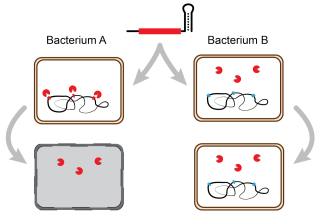
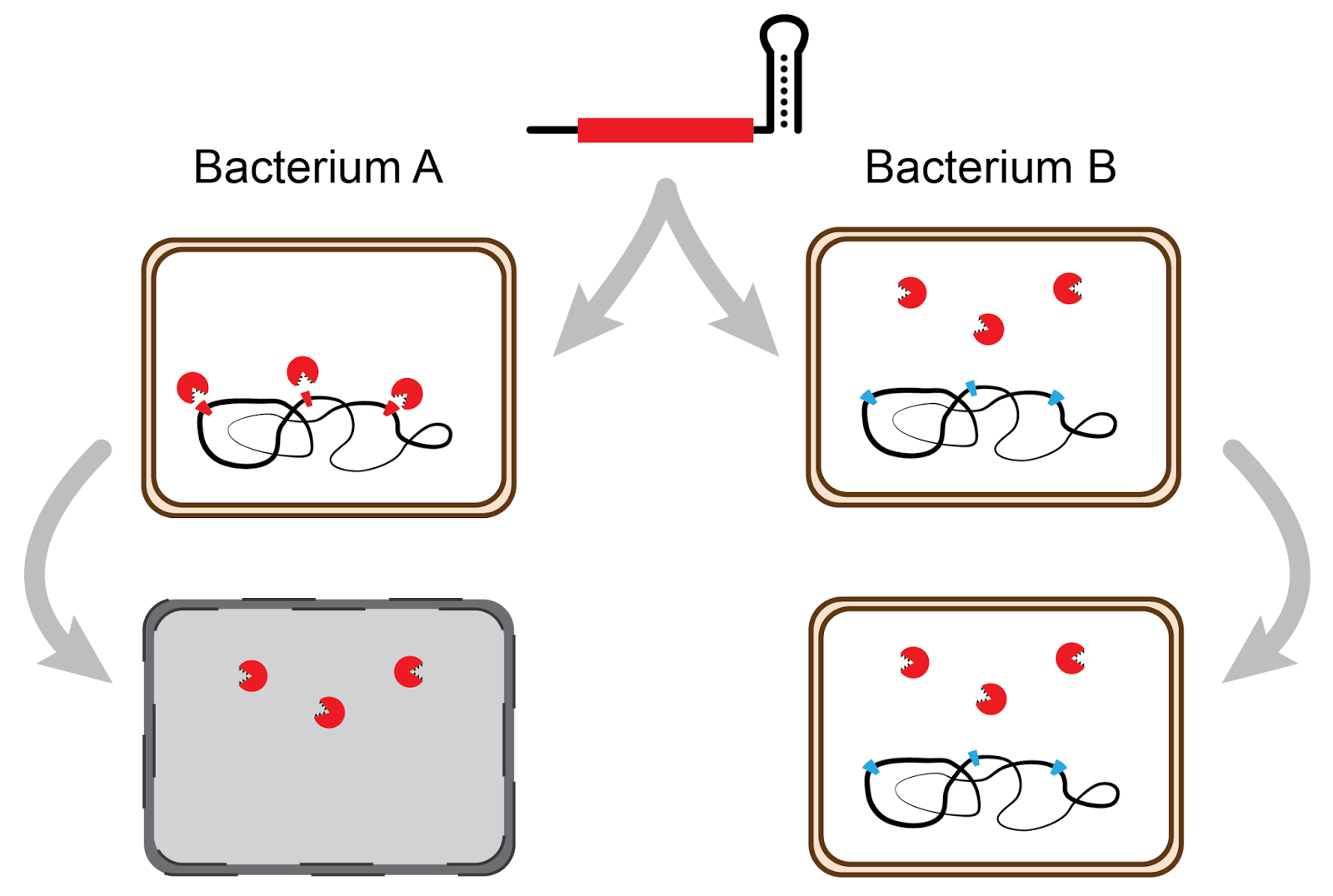
The idea.

During a trip to the University of Washington to visit my colleague Georg Seelig, we concocted the idea of targeting the microbial genome with CRISPR on purpose. What was so appealing about the idea was that (1) we were inducing the equivalent of an autoimmune response, (2) targeting would be sequence-specific, and (3) the mechanism of attack was independent of how antibiotics act. For these two reasons, we saw genome-targeting CRISPR RNAs as a “smart” antibiotic that could selectively kill bacteria and circumvent antibiotic resistance. Suffice to say, we were excited.

Obtaining funding (or not)

Our first step was to obtain funding for this idea. We first tried the Gates Foundation and the USAMRMC, although neither organization funded the work. Later, I submitted the idea to ARO, NSF, and the Pew Research Foundation. Still no funding. Fortunately, an internal funding source at NC State University provided a small grant to pursue the idea. This grant and my start-up funds were sufficient to carry the project to completion.

The long research path

While Georg focused on other pursuits, I began my faculty position at NC State and made this idea one of my lab’s first projects. My initial goal was to evaluate how plasmids encoding genome-targeting CRISPR RNAs affect transformation efficiency, an imperfect but reasonable proxy of killing. Heidi Klumpe, a talented undergraduate student who joined my fledgling lab, cloned most of our initial constructs. Unfortunately, we had to go through a few design rounds before finding a construct in which we could easily and cheaply clone in new CRISPR RNAs. During this time, one of my first graduate students, Ahmed Abdelshafy Gomaa, joined the group and began working with Heidi. The two made great progress and, after ample troubleshooting and optimization, settled on a system that showed large reductions in the transformation efficiency (~105) when targeting the genome. Anticipating the potential to be scooped (a common experience in the CRISPR field), I convinced Michelle Luo, a more recent graduate student in the group, to help advance the experiments. In the end, the three students were doing endless transformations and dilution plating, then counting colonies over and over again. I am grateful that they never complained.

What was intriguing about these experiments was that only two “design rules” needed to be followed: (1) find a protospacer-adjacent motif or PAM–a short sequence recognized by some Cas proteins–and (2) incorporate the adjacent sequence into a CRISPR RNA. It didn’t matter which sequences we targeted, whether the sequences were in coding regions, non-coding regions, top strands, bottom strands. As long as we followed these rules, there was a tremendous reduction in the transformation efficiency.

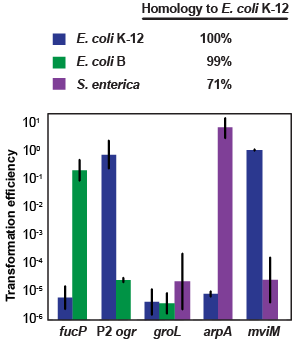
Targeted removal. Credit: C. Beisel/mBio.

We next wanted to prove that the sequence specificity of killing could differentiate even closely related strains. After much debate about which strains to test, we chose our K-12 strain of E. coli and a B strain, one of its cousins. We needed to find unique sequences between the two genomes, and, although there are likely simple bioinformatics tools to do this, Ahmed manually went through the genomes to find unique sequences. Fortunately, he didn’t have to work too hard despite the fact that the bacteria share 99% of the genomic content. The resulting tests confirmed our predictions: target one strain and only that strain transforms extremely poorly. We incorporated Salmonella to differentiate commensals and pathogens (and to increase the attractiveness of this work to publishers), although these experiments were delayed as we sought BSL2 approval.

A fruitful collaboration

During this time, I met Rodolphe Barrangou, a giant of the CRISPR field who was still working in industry. We struck up a friendship that later led to an ongoing collaboration once he decided to join NC State’s faculty. Rodolphe has been working with Streptococcus thermophilus, which encodes four different CRISPR-Cas systems. Through our interactions, we decided that demonstrating genome targeting through two of its endogenous CRISPR-Cas systems would further strengthen the story. Fortunately, the data quickly came thanks to the efforts of Rodolphe’s first lab member, Kurt Selle. With these data, we felt that we had a sufficient story to submit for publication.

The publication process

Based on the novelty of the idea, general interest in all things CRISPR, our data, and (to a certain degree) my own naivety, we shot high. Unfortunately, we didn’t make it past the editors at Nature Biotechnology, so we next tried submitting a Brief Communication to Nature Chemical Biology. The editors were kind enough to send it out for review, although the reviewers were not so kind, questioning the novelty of the idea and its downstream potential. However, the reviews were extremely helpful as we repackaged the work and performed additional experiments demonstrating selective removal in mixed cultures and the selective titration of individual strains.

Encouraged by the new version of the paper, we next tried PNAS. However, we didn’t make it past the Editorial Board, so we moved on to Nucleic Acids Research. Again, the editors said “no”–in this case, because our paper fell outside of the scope of the journal. Not sure where to go next, we chose mBio, an up-and-coming Open Access journal that publishes broadly across the field of microbiology. Half expecting another rejection before review, we were pleasantly surprised that the paper went out and received positive reviews. After a month of additional experiments, we were able to resubmit the final version that was accepted shortly thereafter. I received the acceptance email on December 20th–a wonderful Christmas present.

The aftermath

Matt Shipman in the the News Services Office at NC State prepared a press release for the article–a collaboration I would recommend to researchers who have not interacted with their institution’s news office. That said, inaccurately written releases can promise too much, creating false impressions of the work’s potential and (if nothing else) annoy your fellow colleagues.

Thankfully, our press release was picked up by a number of science websites. Nature also highlighted this work in its most recent issue, though I’m not sure whether their interest had anything to do with the press release. Most importantly, through the press release, Matt putt me in touch with Jonathan, and the rest is history.

Storify Summary of Day2 of #PublishPerish14

Another quick post here. I am working on a web site summarizing everything from our recent meeting we hosted at UC Davis:

To capture what was going on on Twitter I used Storify to make a summary of Day 2.

See below.

Storify summary of Day 1 from #PublishPerish14 Meeting

Quick post here.  I am working on a web site summarizing everything from our recent meeting we hosted at UC Davis:

To capture what was going on on Twitter I used Storify to make a summary of Day 1. See below.


#UCDavis Genome Center Looking for a Manager for the DNA Technologies Core

UC Davis Genome Center Looking for a Manager for the DNA Technologies Core

Manager of the DNA Technologies and Expression Analysis Cores, (Academic Administrator V)

The Genome Center, UC Davis

The UC Davis Genome Center integrates experimental and computational approaches to address key biological problems in genomics. The Genome Center has five service cores that operate on a recharge basis to provide diverse research groups on and off campus with access to state–of-the-art technologies and technical staff on an at-cost, as-needed basis. The DNA Technologies and Expression Analysis Cores provide a broad range of services with particular emphasis on high-throughput DNA sequencing, SNP genotyping, and expression analysis. More details can be found at

https://recruit.ucdavis.edu/apply/JPF00219.

The Genome Center invites applications for the position of CoreManagerwho will have responsibility for the development and day-to-day running of the DNA Technologies and Expression Analysis Service Cores of the Genome Center. These responsibilities include but are not limited to advising researchers on project design, data interpretation, supervision of core staff, operation of the cores’ instrumentation, evaluation and development of new protocols, oversight of the cores’ finances, and conducting courses to enable researchers to use the cores’ technologies.

This position requires a Ph.D. in Molecular Biology, Biochemistry, Genetics, Chemistry, or related field with at least four years of postdoctoral experience. The individual should have knowledge and experience in molecular biology as reflected in his/her publication record. Demonstrated experience in running a service unit and supervising staff is required. The incumbent must possess broad chemical, biochemical, computational, and technical knowledge sufficient to supervise technical staff, troubleshoot problems, refine technologies, and advise researchers. The position is open until filled. Applications should be completed by February 22nd, 2014 to ensure full consideration. Applicants should apply on-line with names for at least three letters of recommendation at https://recruit.ucdavis.edu/apply/JPF00219.

The University of California is an affirmative action/equal opportunity employer

DNA Manager advert updated 021414 RWM.doc

Valentine’s Day Seminar at #UCDavis: Herbert M Sauro: Reproducibility in Systems and Synthetic Biology: Issues at the bench and the computer.

The Genome Center Biological Networks Seminars Series present:

Reproducibility in Systems and Synthetic Biology: Issues at the bench and the computer.

Speaker: Herbert M Sauro
Associate Professor
Department of Bioengineering

University of Washington
Date: Friday, February 14th, 2014, 10am – 11pm
Location:  1005 GBSF

Abstract:
Reproducibility has been and is becoming more of an issue as the research we do becomes more complex. In the work I do there are two areas that warrant concern. The first is that the computational experiments we publish as a community are rarely if ever reproducible. Secondly, in synthetic biology where we design new organisms which are are also published we again are confronted with the fact that the bulk of published synthetic biology designs can not be recreated without recourse to the original constructs themselves. Sometimes even then the reported experiments cannot be reproduced. Reproducibility is at the heart of the scientific method and it damages science, particularly in the eyes of the general public, if the work we do cannot be easily reproduced. In addition, there are cost concerns when it can take months of labor to recreate work already done. The good news is that, at least in computational science, the reason for the lack of reproducibility is due almost entirely to human error. This is likely to true in experimental science as well. Human error can in theory be easily corrected. In this talk I will discuss some of the efforts going in my lab and others in relation to reproducibility in computational modeling and the design and implementing of synthetic organisms.

Publish or Perish: The Future of Scholarly Communications and Academic Careers #PublishPerish14

Meeting about to start and thought I would post announcement here too.  Follow on Twitter at #PublishPerish14 

Scholarly publishing is in a bit of turmoil.  This upheaval impacts not only the dissemination of knowledge but also the assessment of scholars (and thus their careers).  For two days in February 2014 at UC Davis we will cover some of the key changes in scholarly publishing with a focus on how they impact the careers of academics.  Some key details of the meeting are summarized below:
  • Sessions topics will focus on changes occurring in scholarly publishing (in journal publishing, other forms of digital publishing, peer review, and economics of publishing) and on changes in assessment (alt metrics, assessment by institutions, and new models for evaluating scholars).
  • Each session of the meeting will include a mix of a keynote talk, short talks, and a panel discussion by leading experts in the field.  Ample time will be provided for discussions and networking as well.
  • In addition, at the end of Day 1 there will be a special Keynote talk by Yochai Benkler from Harvard University on ”Open Access, Cooperation, and Commons: The (Uncertain) Retreat of Possessive Individualism in Networked Society“ followed by a reception.
  • This meeting is organized by the UC Davis Innovating Communication in Scholarship (ICIS) Project (icis.ucdavis.edu), which is a collaboration between Mario Biagioli (UC Davis School of Law), Mackenzie Smith (UC Davis University Library) and Jonathan Eisen (UC Davis Genome Center).

Session Topics and Confirmed Speakers/Panel Participants
DAY 1: Thursday, Feb 13th
  • 8 – 8:30 am | Registration
  • 8:30 – 9 am | Welcoming Remarks
  • 9 – 10:30 am | Session 1 | The Changing Nature of the Journal
    • Heather Joseph, Scholarly Publishing and Academic Resources Coalition
    • John Inglis, Cold Spring Harbor Laboratory & BioRxiv
    • Chris Kelty, UCLA
    • Gregg Gordon, Social Science Research Network
  • 10:30 – 11 am | Coffee
  • 11 am – 12:30 pm | Session 2 | Beyond Journals & New Forms of Digital Publishing
    • Carly Strasser, California Digital Library
    • Carl Boettiger, ROpenSci
    • Erik Kansa, Alexandria Archive Institute & Open Context
    • Kaitlin Thaney, Mozilla Science Lab
  • 12:30 – 2 pm | Lunch
  • 2 – 3:30 pm | Session 3 | Innovations in Peer Review
    • Victoria Stodden, Columbia University
    • Emily Ford, Portland State University
    • Ivan Oransky, Retraction Watch & New York University
    • Cesar A. Berrios-Otero, Faculty of 1000
    • Jonathan Dugan, Public Library Of Science
  • 3:30 – 4 pm | Venue Shift & Coffee
    • Note venue shift to Buehler Alumni Center, AGR Room for keynote address
  • 4 – 6 pm | Buehler Alumni Center, AGR Room | Keynote Address*
    • Yochai Benkler, Harvard University on “Open Access, Cooperation, and Commons: The (Uncertain) Retreat of Possessive Individualism in Networked Society”
  • 6 – 7 pm | Reception*
* Hosted jointly with the Mellon Initiative on Digital Cultures & the Provost’s Forums on the Future of the Public University and the Social Good
DAY 2: Friday, Feb 14th
  • 9 – 9:45 am | Opening Talk
    • Diane Harley, Center for Studies in Higher Education & UC Berkeley, “Predicting the future of scholarly communication: faculty values, disciplinary cultures, and advancing careers”
  • 9:45 – 11:15 am | Session 4 | Changing the Value Proposition of Publishing
    • Greg Tananbaum, ScholarNext
    • Peter Binfield, PeerJ
    • Allison Fish, UC Davis
    • Todd Vision, Dryad & UNC Chapel Hill
  • 11:15 – 11:30 am | Coffee
  • 11:30 – 1 pm | Session 5 | Altmetrics: Do They Measure Anything Useful?
    • Molly McCarthy, UC Davis
    • Nettie Lagace, National Information Standards Organization
    • Anurag Acharya, Google Scholar
    • Jennifer Lin, Public Library Of Science
  • 1:00 – 2:30 pm | Lunch
  • 2:30 – 4:00 pm | Session 6 | Assessment
    • Linda Katehi, Chancellor, UC Davis
    • Sarah Greene, Rapid Science
    • Margie Ferguson, Modern Language Association & UC Davis
    • Kerry Ann O’ Meara, University of Maryland
    • Josh Rosenbloom,  STAR METRICS
  • 4 – 4:15 pm | Coffee Break
  • 4:15 – 5 pm | Closing Discussion | What we have learned, where we are now, & what we need to do next
    • Discussants: Yochai Benkler (Harvard), Mario Biagioli (UC Davis), Jonathan Eisen (UC Davis), Josh Greenberg (Sloan Foundation), Heather Joseph (SPARC), and MacKenzie Smith (UC Davis).
  • 5 – 6 pm | Bonus Session | Lightning Talks

The Life Sciences Podcast on #OpenAccess

Quick post here.  There is a new podcast that may be of interest Episode 8: The open access debate | The Life Sciences Podcast.  From the Faculty of Life Science of the University of Manchester – they interviewed me, Alicia Wise from Elsevier, two librarians – Jan Wilkinson and Simon Bains and Andrea Baier from the British Ecological Survey and discuss multiple issues associated with open access publishing.

Announcement: CFP: The Contours of Algorithmic Life conference @ UC Davis

Got this by email and seemed of possible interest though it is not what I expected based on the title.

CFP: The Contours of Algorithmic Life

A conference sponsored by The Mellon Research Initiative in Digital Cultures
May 15-16, 2014 at the University of California, Davis

Submission Deadline: March 1, 2014
Send submissions to algorithmiclife

As algorithms permeate our lived experience, the boundaries and borderlands of what can and cannot be adapted, translated, or incorporated into algorithmic thinking become a space of contention. The principle of the algorithm, or the specification of the potential space of action, creates the notion of a universal mode of specification of all life, leading to discourses on empowerment, efficiency, openness, and inclusivity. But algorithms are ultimately only able to make intelligible and valuable that which can be discretized, quantified, operationalized, proceduralized, and gamified, and this limited domain makes algorithms necessarily exclusive.

Algorithms increasingly shape our world, our thought, our economy, our political life, and our bodies. The algorithmic response of NSA networks to threatening network activity increasingly brings privacy and political surveillance under algorithmic control. At least 30% of stock trading is now algorithmic and automatic, having already lead to
several otherwise inexplicable collapses and booms. Devices such as the Fitbit and the NikeFuel suggest that the body is incomplete without a technological supplement, treating ‘health’ as a quantifiable output dependent on quantifiable inputs. The logic of
gamification, which finds increasing traction in educational and pedagogical contexts, asserts that the world is not only renderable as winnable or losable, but is in fact better–i.e. more effective–this way. The increased proliferation of how-to guides, from HGTV and DIY television to the LifeHack website, demonstrate a growing demand for
approaching tasks with discrete algorithmic instructions.

This conference seeks to explore both the specific uses of algorithms and algorithmic culture more broadly, including topics such as: gamification, the computational self, data mining and visualization, the politics of algorithms, surveillance, mobile and locative technology, and games for health. While virtually any discipline could have something productive to say about the matter, we are especially
seeking contributions from software studies, critical code studies, performance studies, cultural and media studies, anthropology, the humanities, and social sciences, as well as visual art, music, sound studies and performance. Proposals for experimental/hybrid
performance-papers and multimedia artworks are especially welcome.

Areas open for exploration include but are not limited to: daily life in algorithmic culture; gamification of education, health, politics, arts, and other social arenas; the life and death of big data and data visualization; identity politics and the quantification of selves, bodies, and populations; algorithm and affect; visual culture of algorithms; algorithmic materiality; governance, regulation, and ethics of algorithms, procedures, and protocols; algorithmic imaginaries in fiction, film, video games, and other media; algorithmic culture and (dis)ability; habit and addiction as
biological algorithms; the unrule-able/unruly in the (post)digital age; limits and possibilities of emergence; algorithmic and proto-algorithmic compositional methods (e.g., serialism, Baroque fugue); algorithms and (il)legibility; and the unalgorithmic.

For more information, especially on updates regarding featured keynote speakers and performers, check out the conference website at: algorithmiclife.ucdavis.edu

Please send proposals of no more than 250 words to algorithmiclife by March 1, 2014.

Decisions will be made by March 8, 2014.

Nice collection in IJSEM on Integrating genomics into Microbial Systematics

Nice collection in IJSEM worth looking at.  The overview is particularly useful

Overview:

Other papers