How sweet it is – forty bonus years of life, and still going

Well, I am not really sure when it all started but I am sure when we figured out what was going on. It was July 22, 1984. Forty years ago today. In some ways you could say it was a good day, because I did not die. In other ways, it was a bad day, because I nearly died and also found out what had been going so wrong with my body for some time.

Though as I said I am not sure when it all started, I do know that for a few months my health was deteriorating. I had told my father, who was a doctor (though he did research at the NIH and was not a practicing clinician), that I just did not feel right. I had been mentioning this for a month or more. But in July I mentioned it more. And he did not seem to think there was anything to worry about.

I was a pretty active kid then and was quite athletic – at least – before my body started having issues. I think this is partly why my dad thought that I must be fine. I played soccer, baseball, street hockey and various other sports.

I had even made the Varsity Baseball team as a sophomore and had done OK.

As an aside, it is kind of fun to see discussion of how I played baseball with Anthony Dilweg who went on to play QB for the Green Bay Packers. Anyway … back to the story. And as another aside, it is cool to me that I am still in touch, at least a tiny bit, with a few people from this team (e.g., Tom Nylen, Andy Keith).

Anyway – more on that in a bit. It was now the summer. And I was still pretty active. Most days went something like this. I was taking Driver’s Ed classes in downtown Bethesda getting ready to get my drivers license. I would bike to the class. Then I biked over to work at the Carey Winston Company where I did data entry, in a job that my friend Ross Kaminsky helped me get. Then I would bike to my High School (Walt Whitman) where I had baseball practice for a summer league team. And then I would bike home. On days when I had a game I think I would bike home, get my uniform on, and then either bike (if the game was nearby) or get a ride from my mom or brother. With all this activity it made a little bit of sense that I might also feel tired all the time, and also that I was pretty skinny. So I think my dad thought “Oh, he must be fine.”

But I knew something was up. Something definitely was not right. And a few days before July 22, I had decided I was going to force the issue. In part, this was because I was feeling worse and worse. But also in part it was because my brother and I had our first backpacking trip planned, with a friend Matt Smith. I was excited about this but also a bit worried due to my health issues. Basically, I was just really really tired. That was the number one symptom. Just crazy tired. And I felt weak. Really weak. (I had other symptoms but more on those later). So here I was – getting ready for my first real outdoor adventure – to hike up Old Rag Mountain with Matt (and Eagle Scout) and my brother and to camp overnight and then get picked up the next day. This did not seem like an ideal time to do that, given that I felt like I could barely walk some of the time.

You see, despite being really active, and doing OK at some of these activities, I just knew something was wrong. In retrospect, something had been going wrong for actually quite some time. Amazingly, I even found that I discussed this pretty openly with people writing stories for our school paper about the Varsity Baseball team in the Spring. For example:

I had a good throwing arm as a pitcher so I could do ok. But I was tired all the time. Like really really tired. For every game. And things had been getting worse over the Summer. So – even though my dad did not think something was wrong, I did. So as I said, I was going to force the issue.

But then somewhere July 18th or 19th, I was the starting pitcher for our team in a baseball game and I pitched phenomenally well – a two hit shutout. I felt awful through the whole thing, but the result was excellent. And I felt like, if I could do that, I must be fine. So we decided to go ahead with the backpacking trip.

So – anyway – back to the summer league game. I pitched well and decided that it was OK to go on this trip. Here is what I wrote about that in a school essay (with corrections from my English Teacher)

This was unquestionably one of the dumbest decisions I have ever made. My mom and dad drove us to the trailhead for Old Rag Mountain, I think on Saturday morning. And then eventually me, Mike and Matt headed up the mountain.

And here is where the shit truly hit the fan. I did not tell you one of the key other symptoms I had, which was thirst. Just devastating thirst. I could not imbibe enough liquid. I basically drank my 2 day supply of water in like 30 minutes and then basically polished off as much of the water of my companions that they would let me have. So just like that, we were out of water basically. Oh, and I was also peeing all the time too. Yay.

Here is what I wrote about that in that school essay mentioned above (with corrections from my English Teacher)

Somehow, yes, we made it up Old Rag Mountain and ended up sleeping near the top. The whole time, I felt like I was dying. And in fact, I was. Somehow I made it through the night. Also – despite what I said in the essay – my brain was not functioning particularly well and I really do not remember much about that night. Maybe my brother or Matt Smith can chime in at some point. I vaguely remember that we could not find any water and that Matt had brought some adult beverage to drink which he consumed and my brother had to try and figure out how to deal with the drinker and the dying person at the same time. Anyway – it was not a good night. But I did make it through the night.

I do not have any pictures from the trip but if you are interested – here is some information about hiking up Old Rag:

From https://www.nps.gov/thingstodo/old-rag-summit-berry-hollow.htm

Although I was alive the next morning, I was not doing well. I was so so so so so so so tired. And so confused. And so so so so so so thirsty. And since we were basically out of water, things were not good. On our hike down the other side of the mountain, I started drinking from puddles and trickling baby streams of water. Anything I could find. I slurped from muddy puddles like a dog. And I could barely move. My body hurt like never before. My legs were so weak. And my brain was not all there.

Finally we got down to near where we were to be picked up and there was a house and maybe a farm down there. But most importantly, something there I think saved my life. A hose. I turned it on. And drank. And drank. And drank. And drank. And then peed. And drank some more. And then peed more. And then drank. We waited there for a bit for Matt’s parents to pick us up but the water I got from that hose I am fairly certain saved me.

Clearly, the next thing to do was to go to the hospital. But that was not to be. We got dropped off in the early evening and my dad’s lab had some sort of party that we went to. I barely remember this but I do know they were playing volleyball and despite this being one of my favorite activities normally I did not play. I just sat on the ground nearby, not moving. And at some point I think my parents / my dad realized there was in fact something really wrong.

I vaguely remember that we left the party and went to a drug store (I think People’s) to buy a urine sugar testing kit. And at some point we tested my urine and it was off the scale – literally filled with sugar. And so my dad said something to the effect of – “You have diabetes, we have to go to the hospital.” And off we went to Bethesda Naval Hospital to the emergency room (because my dad worked at the NIH and was a commissioned officer in the Navy, we got our medical care there).

I think I was pretty much not fully alert during all of this. But eventually I was transferred to a bed in the pediatrics unit and then spent many days in the hospital recovering and learning how to treat myself as a diabetic.

In many ways, I was lucky to be alive. I easily could have died on that backpacking trip and if I had not found that hose at the end of the trip, I think I might have died out there. I was in rough shape and things had been going poorly for a while. I looked like a famine victim. I had lost something like 40-50 pounds over a few months. I was in full blown diabetic ketoacidosis and slipping away until they gave me IV fluids and eventually insulin in the ER. Here is the page from my admissions (missing some details on various tests they ran, but suffice it to say I was not doing well)

So in retrospect again, it is pretty crazy that I had not gone in to get checked out before this crisis. Certainly, my dad, an endocrinologist (though again, one who did research in a lab at the NIH and did not practice) probabiy should have caught this earlier. We even had just been in Quebec where my dad was attending the Endocrine Society Annual Meeting and I had been surrounded at various events by world leading endocrinologists.

At dinners, I was getting up all the time to pee, but I did not announce this. And if anyone noticed me seeming fidgety, they probably either thought I was a typical bored teenager or maybe thought I was on drugs.


See https://academic.oup.com/edrv/article-abstract/5/2/370/2548924?redirectedFrom=fulltext

I note – one of the issues with my deteriorating health was that it came along slowly, over many many months. It was like the proverbial frog in the frying pan story – I just kept adjusting and adjusting and adjusting my baseline expectations about what was normal and what was OK slowly over time. And I did not even notice really all the issues. The one I noticed most was fatigue and weakness. What I did not really notice, which seems really bizarre in retrospect, was two key other symptoms that had gotten worse and worse and worse over the months. These were thirst, and the need to pee all the time.

For example, by that time in Mid July, my daily routine was not quite as I laid it out above. This was the daily routine with the full details with the extra new details highlighted with underlining and bolding.

Most days went something like this. I got up in the morning early because I had to pee. Then I went downstairs and made a large two liter pitcher of orange juice from a frozen can. And I drank most of it. I was taking Driver’s Ed classes in downtown Bethesda getting ready to get my drivers license. I would bike to the class. Although it was only about a 20 minute bike ride to the class, I would stop on the way at Montgomery Donuts to get a drink and use the bathroom.

Then I would go to class where every 20 minutes or so I would get up to pee. Then I biked over to work at the Carey Winston Company where I did data entry, in a job that my friend Ross Kaminsky helped me get. While working I would spend a lot of time getting up to use the restroom and to buy sodas to quench my thirst. Then I would bike to my High School (Walt Whitman) where I had baseball practice for a summer league team. And during practice, or even during games, I would have to sneak off all the time to pee in the bushes and to also get a drink. And then I would bike home.

Oh and of course, since I did not know I was a diabetic, I was probably making things worse by drinking sweetened drinks all the time. Yes, they seemed to quench my thirst. But they just added more sugar to the fire.

And again, in retrospect, I had been “building” up to this for some time. During the second semester in high school that Spring, I remember having to pee between classes a lot. I remember even being stressed during classes about needing to pee and get excused all the time even before class.

Yes, clearly, it would have been better to have figured things out sooner. But somehow, I did not die. And that was a good thing. As I was in the Navy Hospital, trying to comprehend what this all meant, for reasons that I am not entirely sure of, I did not spend a lot of time lamenting about “Why me?” I mean, sure, it sucked. And sure, I knew my life was altered. But I somehow just wanted to move forward, get on with my life, and deal with the altered reality.

This moving forward thing in part I think came from my general nature. But there were also a few things that happened while I was in the hospital and shortly after that really really helped my perspective and I mention some of these in the next few paragraphs.

One thing that helped me immensely once I was in the hospital was that the pediatrician who took care of me was Dr. Marion Balsam, who happened to be the mom of a friend Ross Kaminsky. I had hung out a lot with Ross a few years before that and knew his mom and this was just remarkably comforting. Plus she was a just phenomenal doctor.

Another thing that really really helped me move forward was the fact that there was a kid in the bed next to me who had brain damage from some type of accident. I realized that things could be much worse than having to take shots and deal with a defective pancreas.

But even with those two things helping me in ways, I was still not fully in a good place mentally. For example, I was at the Bethesda Naval Hospital and alas I had a painful conversation with one of the orderlies who was taking care of me on Day 2 or so. You see, I had dreams of going to the US Naval Academy and playing baseball there and we were discussing this. I had even had a discussion with the Navy Baseball Coach and had either taken or at least signed up for the ASVAB test (I can’t remember anymore). Alas, the orderly then, matter of factly, told me, you can’t join the Navy as a diabetic. Well, shit, there went that dream.

So, you know, even though physically I was starting to feel better than I had in months (IV fluids and insulin for the win …), mentally I was still not in a completely great place. But fortunately I had a lot of visitors (my family and friends must have worked hard to keep me occupied). This was really really uplifting. Someone – possibly Ross – even took me on my first “outing” to get out of the hospital ward. We went bowling at the Navy Bowling alley nearby).

And one of those visitors definitely changed my mental state. You see there was a girl who I had a bit of a crush on who came to visit me in the hospital because it turned out she was also a diabetic (I had not known that). And, well, eventually we developed a relationship – my first real girlfriend. Honestly, I think she probably is more responsible for me being alive today than anyone else because she taught me about diabetes and I wanted to get my diabetes in control to show her that I could do it.

A fourth thing that definitely helped me was that my family had a trip to Alaska planned for a few weeks from when I went in to the hospital and Dr. Balsam encouraged us to still go on the trip. Since my dad was a doctor, in theory he could help take care of any issues that arose. So I had incentive to show that I could manage my diabetes as soon as possible so they would let me go on this trip. And we did. And the trip was incredible. Here are a few pics from that trip:

Although another time I will tell the story about how I cracked a rib and my dad was worried I had punctured my spleen when I crashed into a fire pit while playing frisbee at a campsite in the middle of nowhere. And we cut our trip short by a day to get me to a hospital for a check up. But another time.

A final thing that helped me move forward is, well, that the medicine (insulin basically) was like magic. When they first gave me some in the hospital, I literally think I could feel my body starting to wake up and work again. And since I was almost 16 and had been a science dork of sorts, I actually already knew what insulin was and what diabetes was. I had not imagined I would get it of course, but knowing what it was all about certainly helped too.

Anyway, 40 years ago today, I got knocked down. But I got back up. And it has certainly not been easy. But I am still here. Always looking forward. And looking backwards, from a historical point of view, but rarely from a “why me” point of view. I truly feel blessed to have had these extra forty years. Here’s to forty more.

UPDATE 7/25/2024

Got some nice responses to my post at various social media sites and thought I would share links here.

So I wrote a thing about having a bonus forty years of life.phylogenomics.me/2024/07/22/h…

Jonathan Eisen (@phylogenomics.bsky.social) 2024-07-22T16:38:53.880Z

Real time blood glucose levels on Apple Watch

Made a storify of a discussion from Twitter. Loving my new Apple Watch with real time glucose values via my Dexcom CGM.

Guest Post on Open Source Hacker Insulin by Anthony Di Franco

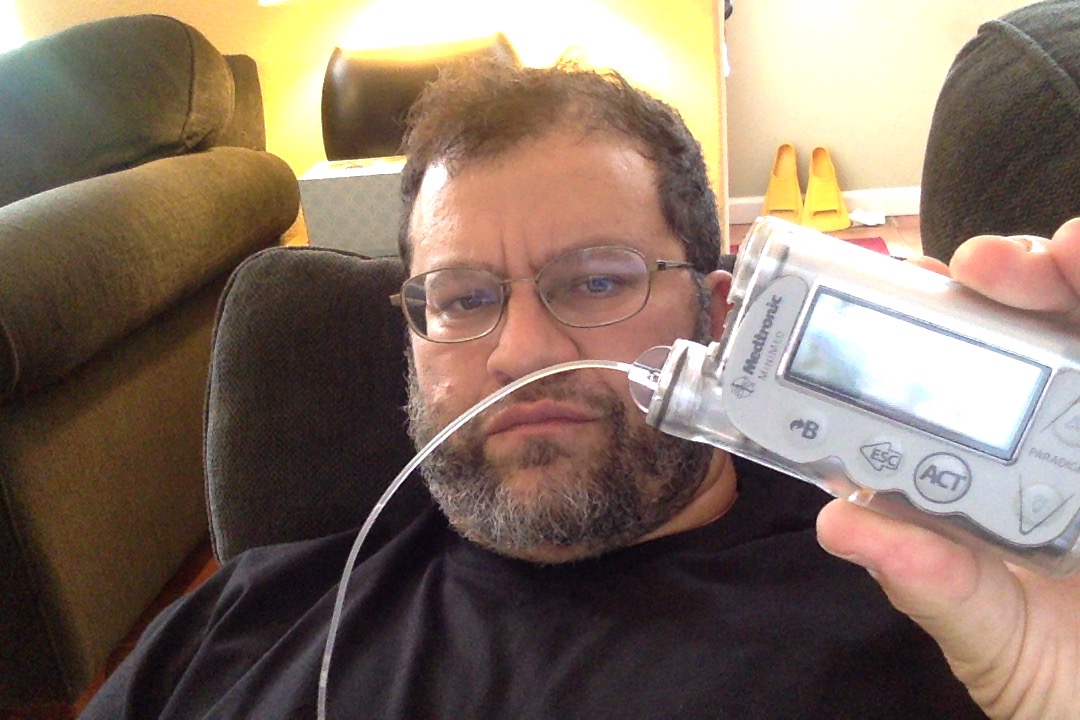
Last night I had a minor freak out episode.  My insulin pump alarm sounded at like 1:30 in the morning (I have type 1 diabetes). It was out of insulin (well, the alarm said “No Delivery” which is what it does when it is out of insulin.  So I got up, barely alert, and went to the fridge to get a bottle from my insulin supply.

This is not a usual occurrence.  Usually, I pay attention to the warning alarms saying my pump is running low.  But this time I had ignored them.  I guess I thought it would last through the night.  Oops.  But, in the grand scheme of things, this is not that big a deal.  All I have to do is get a new cartridge for the insulin, fill it, and then rewind the pump and load the new cartridge and prime the pump.  Except, this time, I took out the last bottle I have of insulin for my pump from the fridge, and as I turned around to the kitchen island, my hand carrying the insulin wacked into the fridge door, and the bottle flew out of my hand.  It went up a bit and then headed down to our brutally hard tile floor.  I instinctively reached out with my foot and somehow the bottle landed on my foot, not the floor (this is probably related to the daily soccer I have been doing with my son for the last year or so).  My foot-eye coordination never used to be so good.  And thankfully the bottle did not break.  And I loaded up my pump and primed it and headed back to bed.  But I could not sleep.  I was wondering – what would I do if I ran out of insulin or my last bottle broke.  I guess I would go to a 24 hour pharmacy or an emergency room.  Or I would use the now expired back up insulin I had in the fridge.  And then I wondered, what would I do if I could not get any insulin from a drug store or a hospital.

It seemed to me that the best solution would be to have some sort of freeze dried supply of insulin at home that I could rehydrate in an emergency.  So I started Googling that.  And not much came up that seemed right.   And since I was pretty tired, I onyl spent a few minutes at the computer and then I went back to bed.  But to say this ate at me would be an understatement.

This morning I got up, not as early as normal and took my son to school and then headed off to this workshop that was happening on campus hosted by my ICIS (Innovating Communication in Scholarship) Project on “The Social Life of Medical Data

And bizarrely and amazingly, the topic of making DIY insulin came up part way through the meeting.

//platform.twitter.com/widgets.js What a coincidence. Although the speaker said he was not going to focus on this, after I posted the Tweet, a response came implying that someone was working on this

//platform.twitter.com/widgets.js Well, wow. I had no idea. It makes sense, but I had no idea. And I wondered, is this anyone I know at the Counter Culture Labs doing this. And a few minutes later the answer came to that when I got an email from Patrik D’haeseleer – a friend, colleague, collaborator, and co-author

Hi Jonathan,  

We’re actually trying to get Anthony’s piece on Open Source Hacker Insulin guest posted somewhere before our kickstarter for Counter Culture Labs ends tomorrow (under the motto “if it’s worth doing, it’s worth doing last-minute”)  

Would you be interested in hosting it as a guest blog post?

And so I said yes.  And, well, here it is.


Open Source Hacker Insulin

Anthony Di Franco


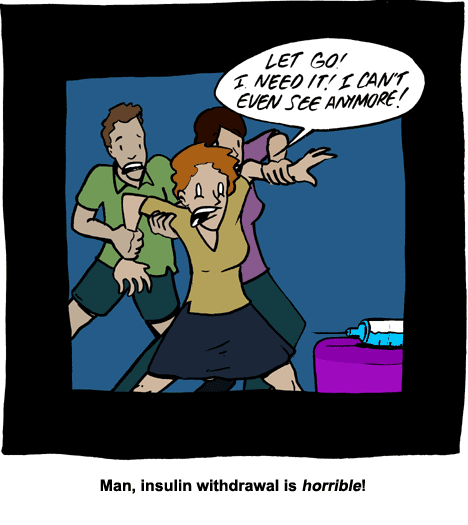
The effects of untreated diabetes include blindness, impotence, nerve damage and necrosis in the extremities, kidney failure, cardiovascular disease, coma, and death—all good reasons to assure the broad and consistent availability of insulin with decentralized production. Illustration by Zach Weiner of “Saturday Morning Breakfast Cereal.”

Hi, I’m Anthony Di Franco. I’m a member of Counter Culture Labs, a biohacker collective in Oakland. (We’re currently running a Kickstarter campaign to cement the core capabilities we need to pursue research – more on that below!) I also have type I diabetes. My general interest in biohacking is part of my interest in technological STEMI compression: making technology more efficient and effective and making it work at smaller scales, so that it empowers individuals more and more. My more specific interest is in doing this for the technologies that treat diabetes: mainly those for measuring blood glucose levels and making, purifying, and administering insulin. I’ve written previously about these topics in Biocoder magazine, among several others, where I suggested a variety of possibilities that might be well-suited to decentralized hackerspace development.

Right now I’d like to focus on insulin production and purification, without which measurement is mostly moot. The goal of producing insulin aligns well with the goals of the broader DIYbio movement for two reasons. First, because recombinant insulin was the first major commercial success of synthetic biology at scale, and set an early example of tools and techniques that shaped the future development of biologics. Second, irrespective of the role they happened to play in history, the tools involved are fundamental to biology and medicine and cover the core functions needed for all serious DIYbio research and other community goals: production and purification of biologics.

Open sourcing treatments is also important because pharmaceuticals in general and insulin and insulin pumping specifically suffer from perverse economic incentives that, at least in part, favor keeping people on the treatments with the most disposable or consumable supplies possible, at the highest price relative to the cost of manufacturing. In terms of the famous razor/blade business model, patients are the razors, and the treatments we need are a long stream of blades with a reliable revenue stream attached. Open source efforts could develop incentives more attuned to encouraging innovations that improve patient outcomes and constitute progress toward a definitive cure, in contrast with the current model which encourages corporations to sit on profits harvested by keeping patients addicted to consumable supplies.

With all that in mind, I’m pleased to announce a new collaboration between members of Counter Culture Labs and Arcturus Biocloud to develop generic insulin. Despite there being no formal barriers to its development, there remains no generic insulin on the market, a perplexing puzzlement pondered in context by Jeremy A Greene in his article in the New England Journal of Medicine. Now, we’re preparing to address this problematic situation directly. Arcturus biocloud will provide the means to economically produce the insulin, but we’ll still need to develop the means to purify it, eventually to the point where we need not fear the catastrophic consequences of injecting it in impure form – fulminant or chronic allergic reaction to insulin, both of which carry fatal risks. Even though we’re producing the insulin for research purposes only, and certainly aren’t intending to inject it into any living beings in the foreseeable future, a main goal is to demonstrate that we can achieve usable levels of purity in a DIY setting, and to document how we do and share the knowledge. To do that, we’ll need to equip Counter Culture Labs with the basics for isolating and purifying biologics, and for that we’ll need our kickstarter campaign to succeed. Fortunately, we’ve recently met our base goal, which will let us cover the basics of staying in the building and keeping things up to code. But we’ll still need much more to equip ourselves to work on projects like insulin purification, so we hope we can rely on your support as we pursue our stretch goals.

Please also consider becoming a member and donating via our regular website after our kickstarter ends as that is how we fund DIY insulin and projects like it in the long term.


Anthony Di Franco works at the intersections of complex adaptive systems, economics, and computing. He is a board member of the East Bay biology hackerspace, Counter Culture Labs, where he teaches and organizes events on topics at the intersection of computation and biology. He is also the author of the transgressive historical wuxia manhua, Three Sovereigns.

Harvard, hope and hype: the sad reason behind overselling diabetes stem cell work – raising money

Earlier in the week I got all fired up – not in a good way – about a press release and news stories relating to a new paper from Doug Melton on a insulin producing STEM cell study

//platform.twitter.com/widgets.js With a little more discussion I just got more angry

//platform.twitter.com/widgets.js

//platform.twitter.com/widgets.js

//platform.twitter.com/widgets.js I was angry both about the overselling of the implications of the paper and the fact that the paper was not published in an open manner. This was despite the stated goals of HHMI which funds some of the Melton Lab work.

//platform.twitter.com/widgets.js
I was especially upset that much of the press coverage was reporting on an imminent cure for type I diabetes when this was clearly not imminent. Although I note – some coverage was OK. Like these:

//platform.twitter.com/widgets.js

//platform.twitter.com/widgets.js Another good piece of news – HHMI got Doug Melton to post a copy of the paper on a web site

//platform.twitter.com/widgets.js Although this was kind of hidden

//platform.twitter.com/widgets.js

//platform.twitter.com/widgets.js Another good thing – Paul Knoepfler, a colleague of mine at UC Davis wrote a blog post for his excellent STEM cell blog about the Harvard study and the hype.

//platform.twitter.com/widgets.js

//platform.twitter.com/widgets.js But the hype was still spreading …

//platform.twitter.com/widgets.js So I felt like there was a continued need to say something about this

//platform.twitter.com/widgets.js I even changed a talk I was giving on Sunday to include a discussion of this paper and the hype as, well, a bad thing
  

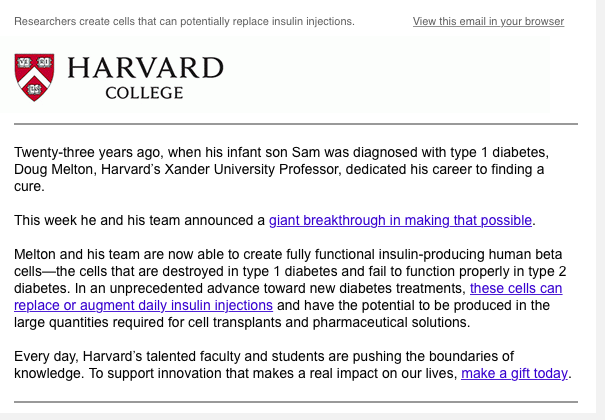
And I thought, and kind of hoped, that this might just go away. And then, many people forwarded me this email from Harvard sent out as part of a fundraising campaign. Most of the people who sent it to me sent it in happiness with the possibility of a cure for type 1 diabetes. Here is the email:

Of for $&*#*# sake.  Really.  So now Harvard was going to use this as a fundraising tool.  And they would oversell it even more:

“A giant breakthrough in making that possible” with “that” referring to “finding a cure”.  And then they say “these cells can replace or augment daily insulin injections” without saying that this WAS NOT IN HUMANS.  THIS WAS IN MOUSE.  $*#($#) DECEPTIVE LYING SCHMUCKS.

And they end this email with “make a gift today.”  How about this Harvard.  I will make donations to anyone but you until you stop marketing in hope and hype and start being responsible.

UPDATE 10/16/14 8 AM PST

Some of the overhyped statements relating to this story:

Harvard Press Story: “We are now just one preclinical step away from the finish line,” said Melton

Rawstory: Stem-cell cure for Type 1 diabetes ‘on par with discovery of antibiotics’

Telegraph: Cure for Type 1 diabetes iminent

Times of India: Type 1 diabetes cure within reach after breakthrough that could spell end of insulin injections for millions

BBC: Giant Leap to Type 1 Diabetes Cure

The saga of my pancreas..feet..microbiome ..blood.. liver – part 1

Well, this just keeps going – on and on and on.  I thought I would be able to write a post when it was all done.  But clearly not.  So below is part 1 of an ongoing tale about me – my microbiome – my pancreas – my feet – my liver – my blood – and more.

Medical Record from my being admitted to
the hospital in 1984.

This particular saga started – I guess – in 1984.  That was when, at 15 years old, I came pretty close to dying before being diagnosed with type I diabetes.

My immune system had betrayed me by killing the beta cells in my pancreas. Thanks a lot immune system. Anyway – this is not supposed to be a post about diabetes. So – flash forward to a few weeks ago. Diabetes for almost 30 years and no major complications to note. Many annoyances. Some minor complications. But overall, I am doing OK.  Obsessive checking of my blood sugar and trying to keep my sugar in control and trying to regularly exercise seems to have kept the diabetes gods appeased. Eyes generally always have looked good. Feet HAD always checked out. Kidneys always seemed good.  Knock on wood – all was as good as I could hope for.

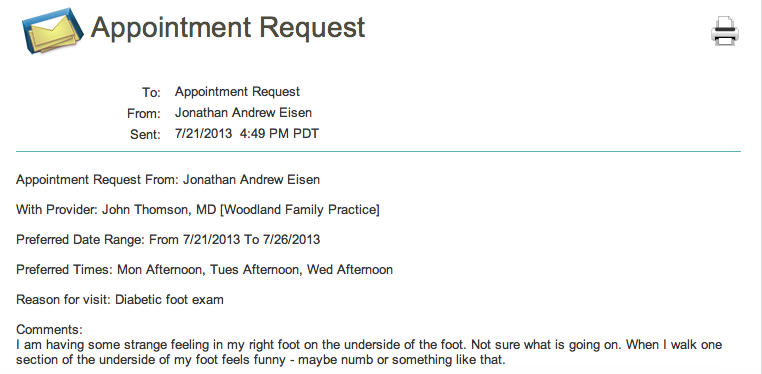
But then … something came up.  A month and a half or so ago I kept noticing this funny feeling on the bottom of my right foot. Near the toes. Exactly the same kind of feeling one gets when one has a bandaid or tape stuck to my foot (which, given I have two kids both of whom put bandaids on every minor scratch and then leave them lying all over the house and our pool deck – is not too rare).  I thought – maybe the feeling will go away. But it didn’t. It was lurking there. And after a week or so I decided I should get my doctor to check it out. So I put in an electronic request for an appointment on 7/21:

Appointment request.

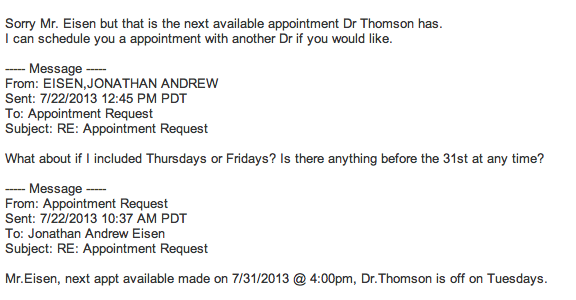
I love this MySutterOnline system. After a few messages back and forth I set up an appointment for 7/31. Seemed reasonable. Nothing here seemed urgent.

Appointment info.

I did not want to see another doctor since, well, my doctor is awesome.  Best doctor I have ever had.

And on 7/31 I headed on in.  First I saw my doc’s assistant.  She asked a lot of questions as always.  I tried to explain the feeling on my foot.  Not numb.  Not pain.  Just weird.  Like something was stuck there.  She did not quite get it.  Kept asking about whether it felt numb or not.  But eventually the doctor came in.  And he asked some questions with his assistant there and explained to her that what I was experiencing is actually a pretty common thing in diabetics – not pain – not numb – just weird.

So – on to the foot exam.  He did a series of tests of my feet – circulation – feeling – and more.  And all looked good.  No detectible issues.  Except one thing.  Dermatophytes.  Veritable bucketloads of them. One my toenails.  And in the cracks between toes.  And right at the spot where I was feeling the weird feeling.  Oh – I should explain.  Dermatophytes are a kind of fungus.  On one’s feet they are generally referred to as “Athlete’s Foot.”

Athlete’s Foot fungus.

And my doctor explained – I have a decent case of this Athlete’s Foot.  And the weird feeling I was having could be caused by these fungi rather than the thing I feared – diabetic neuropathy.  So he said – he recommended that we first try and treat the fungal infection and hopefully the weird feeling in my foot would go away.  And getting rid of the dermatophytes would probably be a good things anyway.

So – how to get rid of them?  Oral antifungals was what he recommended.  A long long dose – three months or so.  With one issue – the antifungals could damage my liver.  And thus it was a good idea to screen my liver before, during and after the treatment.  So he ordered a liver panel test and also sent off a prescription for the antifungal terbinafine.  So – I left the office and decided – this was not so bad.  If my foot issue was caused by the fungi then perhaps it could be eliminated.  But of course I was worried about the effects on my liver.  And I was also wondering – what happens to my microbiome (the fungi and the others) when one takes antifungal drugs.  So in the medical office parking lot I googled around looking for information on microbiome studies after antifungals.  And I could not find too much.  So I decided perhaps some microbiome researchers might want to study me while I went through the treatment.

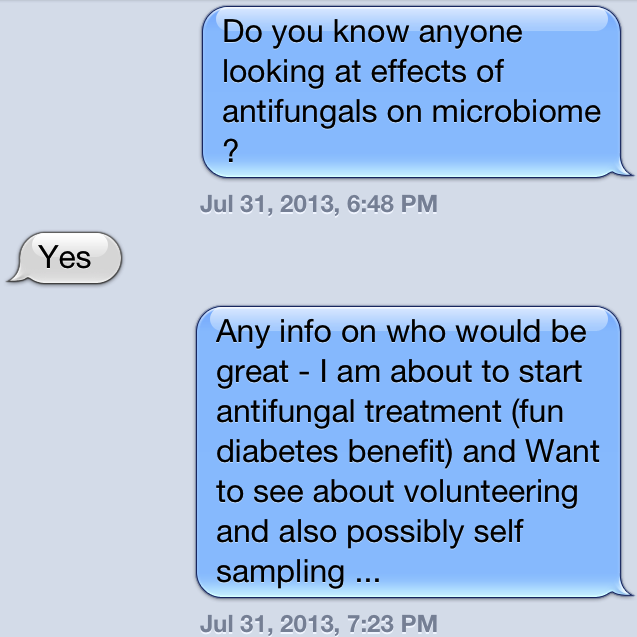
So – I text messaged Rob Knight – the guru of all things related to the human microbiome and one of the key people behind the American Gut project.  And I asked:

Text messages with Rob Knight

And eventually he told me that there were some studied going on but unlikely to be able to enroll in them.  He then suggested perhaps I could sign up for the American Gut Project and collect some samples via them.  And so – after I series of emails I volunteered to sample my self.  All seemed good.

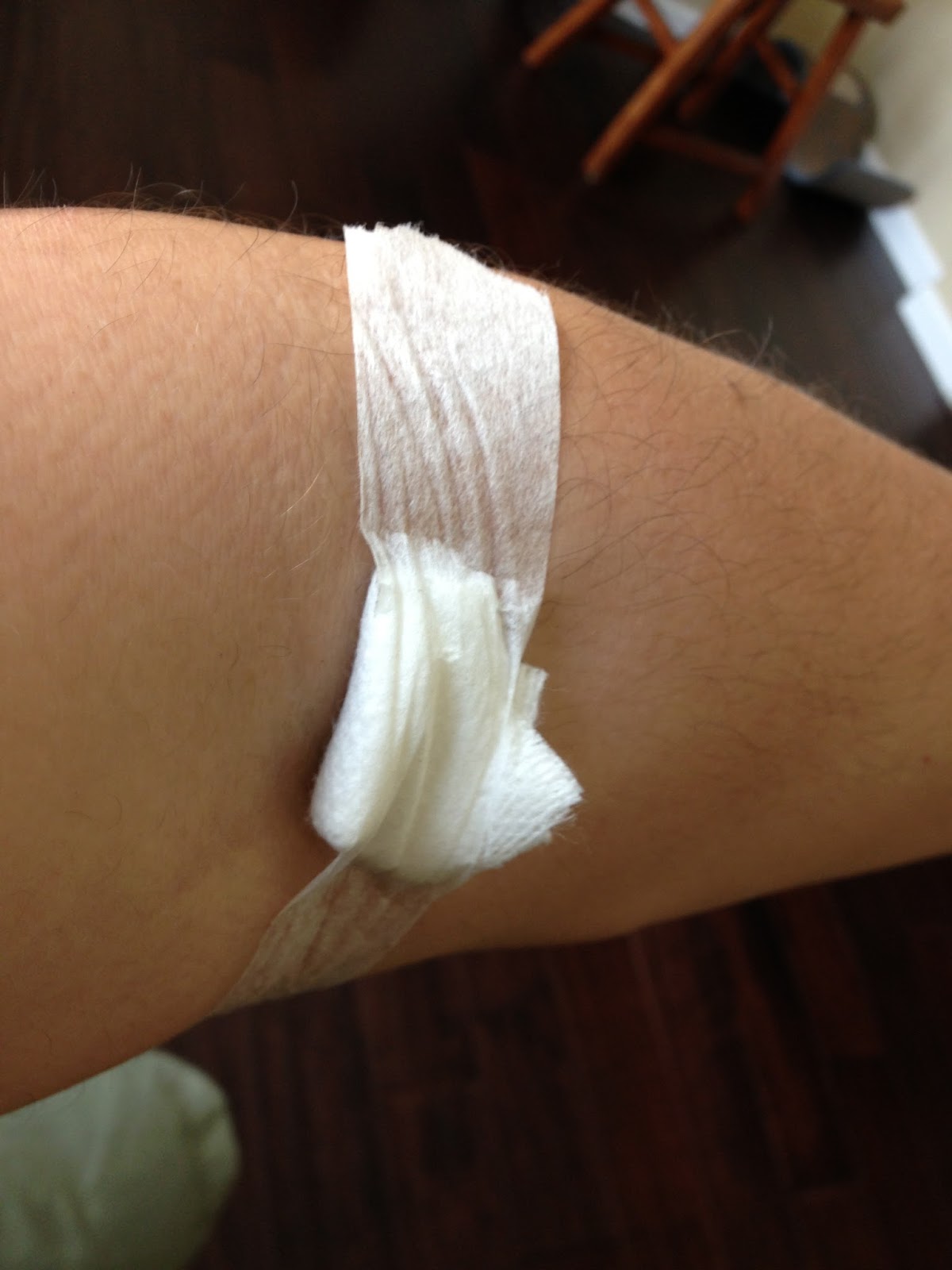
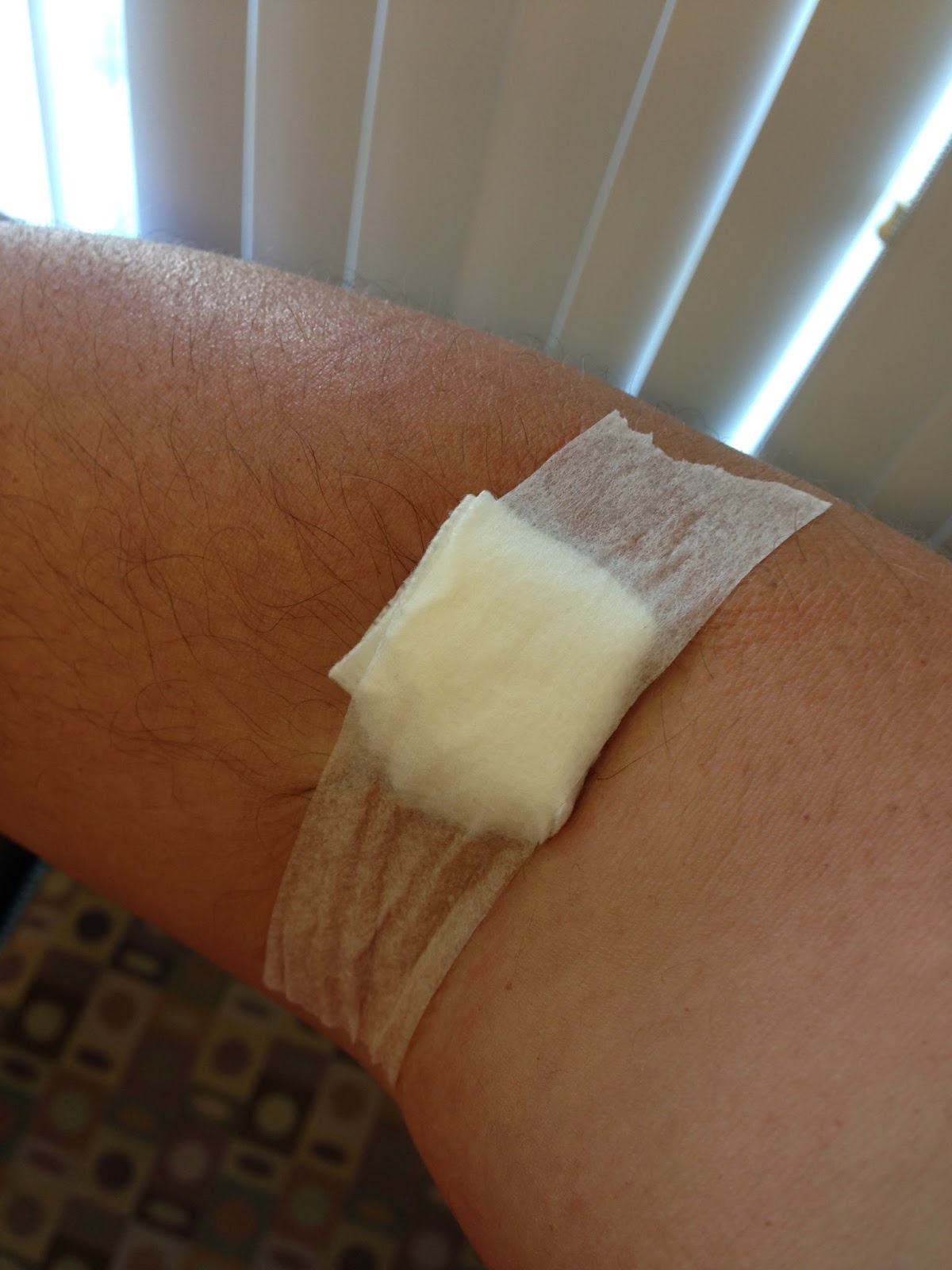
Finally got around to getting the blood drawn 8/8.

Yes, I had my blood drawn.

And when I got back from the lab I found a nice surprise waiting for me.  

Package from the American Gut project.

And I decided to post a bit about the whole saga.  I posted to FB rather than my blog for many reasons.  I did not yet feel comfortable making all of this fully public but I wanted friends and family to know.  And secretly I was hoping that one person who I knew – who was a family friend – who I knew read my FB posts – and who was a MD working on antimicrobial compounds – might see the post and offer some advice.  I did not want to ask directly I guess so this was a way of trying to get some input without asking.

Lemons to lemonade for summer 2013. 

Well, without making this a TMI post, let’s just say I am having some foot problems that I hope are NOT due to a serious type I diabetes complication (~30 years of type I and no known major complications – lots of minor annoyances but nothing major). So I am hoping that my issues are caused by athlete’s foot. And to try and deal with that I will be most likely be starting on a long term antifungal treatment next week. There are risks of side effects – such as liver damage – so I am getting some blood tests done first and will be monitored during the three months I will be on the AF.

So where you may ask is the lemonade? While on the way home from the doctor’s last week after deciding to do the AF treatment I volunteered to be considered to be a subject for a microbiome study of the effects of AFs on the microbiome. Still have to do some paperwork for that, go through informed consent, and such. But hopefully I will have my microbiome studied for the first time and with a real potential use other than microbiome gazing. Stay tuned for more details. Going to be documenting the whole thing.


So – I was going to finally study my own microbiome.  And I could do it with a cool project – the American Gut Project.  Seemed like a good thing.  And it is … but one minor complication.  I wanted to not yet start sampling myself until after getting the liver test done.  Seemed like a formality.  Except of course … it wasn’t.

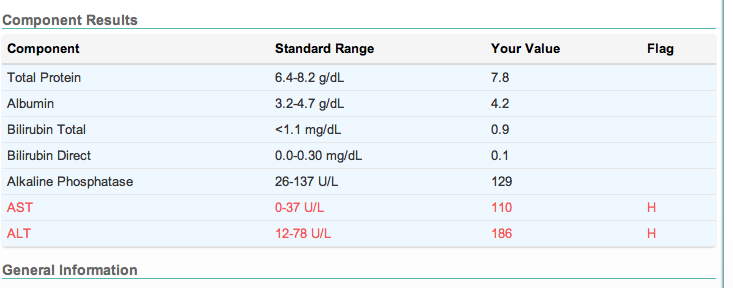
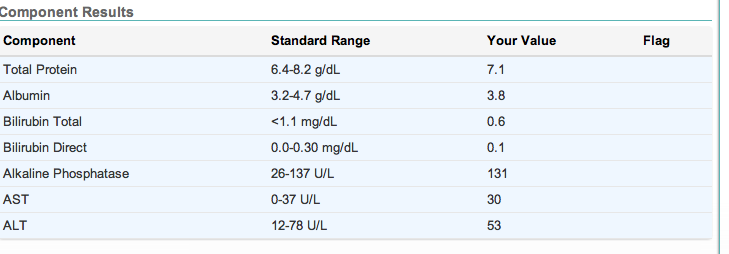
On 8/11 or 12 I got a message saying the test results were back.  I was busy and did not check until on 8/13. I logged in to see what they were.  Lipid profile looked OK (well, LDL cholesterol was a little high but not much).  But the liver panel was disconcerting:

Liver Panel #1

Uggh.  I have had many liver panels done over the years.  And none showed any abnormalities.  Until now.  So – I spent the whole night googling and learning about what elevated ALT and AST could mean and what could have caused that.  And was mostly freaking myself out.  But I realized this meant I should probably not start on the antifungal drugs.  Which was probably good since 8/14 I headed out with my family on a camping trip.

Just before heading out I sent a message to my doctor.

Messaging my Doc.

And I tried to ignore the liver thing.  But I admit that the few times I turned on my phone I used it to google about ALT and AST.  And also so a message back from my doc’s office.

Message back.

And when I returned from the camping trip I scheduled a follow up appointment with my doc and before the appointment he had me do some additional tests – based in part on email discussions between us.  One test was for hepatitis – which could have caused the elevated liver enzymes.  And the other test was to redo the liver panel.

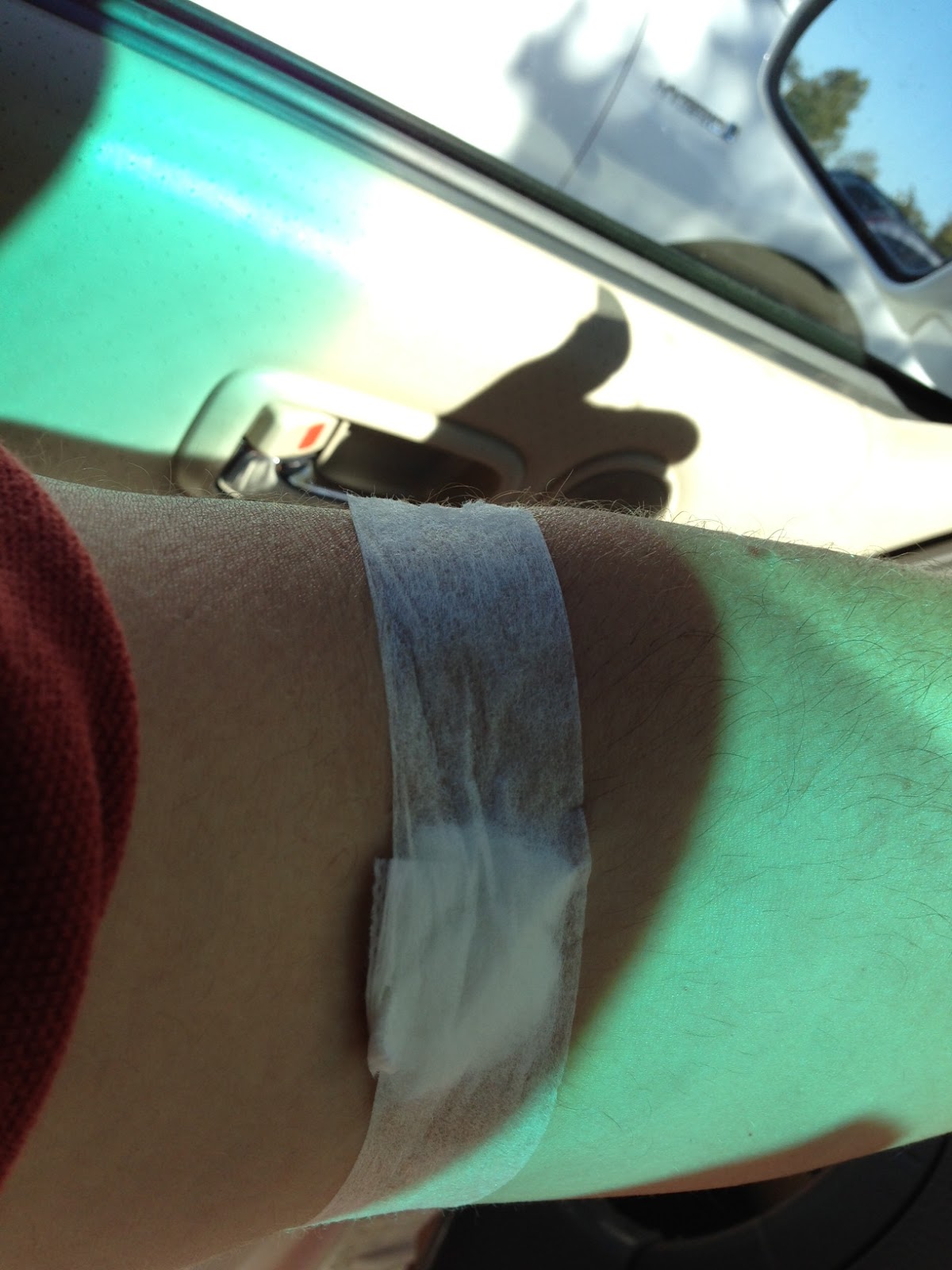
Yes .. had blood taken.

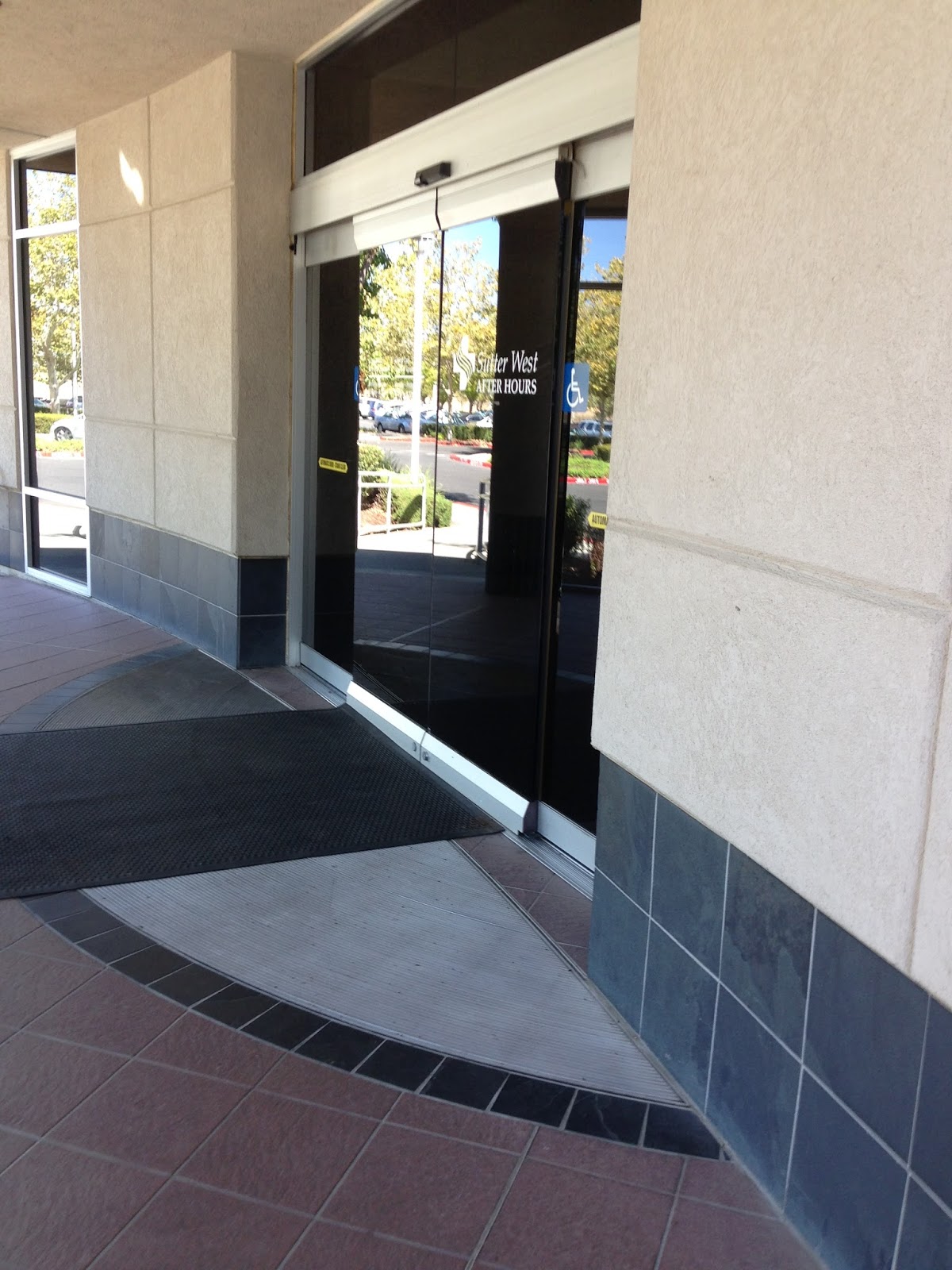
Outside of Sutter labs.

I had the tests done just before my appointment so we did not have results yet when I met him.  And at that appointment he also ordered an ultrasound test.  I scheduled that for 8/26 and went on in.

Waiting for the ultrasound.

I never had had an ultrasound done before.  It was weird in that it reminded me of all the ultrasounds my wife went through for pregnancies.  And I got that goo all over me and my clothing.  The technician was nice but would not give me any information on what she was seeing.  But she seemed so upbeat that all must be good right?

Then I got a bit of good news.  The hepatitis tests were all negative.  And strangely and nicely – the ALT and AST in the re-test were now in the normal range.

Liver Panel #2

Hmm.  Weird.  What did that mean?  Was it a bad test?  Or were my enzymes spiked temporarily?  So I spent a lot of time googling and looking around to try to understand the meaning of temporary increases in ALT and AST.  Not really helpful since I still did not know if the elevated levels were real or an error.  But I guess it was good news that the second test seemed normal and that the hepatitis tests were all negative.

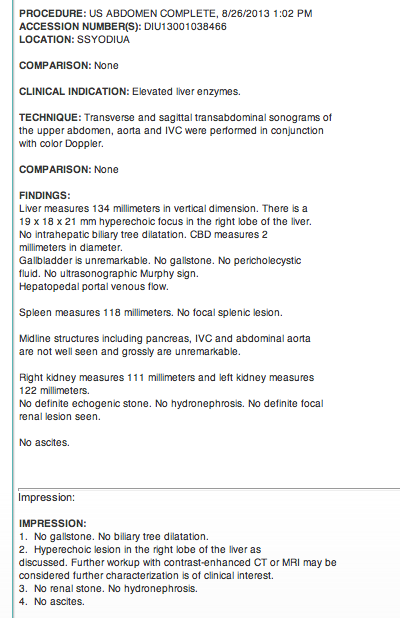
But alas, the good news would not last. On 8/27 I got the following results: (with the text and the screen shot …)

Ultrasound results


PROCEDURE: US ABDOMEN COMPLETE, 8/26/2013 1:02 PM

COMPARISON: None

CLINICAL INDICATION: Elevated liver enzymes. 

TECHNIQUE: Transverse and sagittal transabdominal sonograms of the upper abdomen, aorta and IVC were performed in conjunction with color Doppler.

COMPARISON: None 

FINDINGS

Liver measures 134 mm in vertical dimension. There is a 19 x 18 x 21 mm hyperechoic focus in the right lobe of the liver. No intrahepatic biliary tree dilatation. CBD measures 2 mm in diameter. Gallbladder is unremarkable. No gallstone. No pericholecystic fluid. No ultrasonographic Murphy sign. Hepatopedal portal venous flow.

Spleen measures 118 mm. No focal splenic lesion.

Midline structures including pancreas, IVC and abdominal aorta
are not well seen and grossly are unremarkable.

Right kidney measures 111 mm and left kidney measures 122 mm. No definite echogenic stone. No hydronephrosis. No definite focal renal lesion seen.

No ascites. 

IMPRESSION:
1. No gallstone. No biliary tree dilatation.
2. Hyperechoic lesion in the right lobe of the liver as discussed. Further workup with contrast-enhanced CT or MRI may be considered further characterization is of clinical interest.
3. No renal stone. No hydronephrosis.
4. No ascites.

Now I have never looked at ultrasound results before.  But certainly one thing in there caught my eye —  “There is a 19 x 18 x 21 mm hyperechoic focus in the right lobe of the liver.

Well that did not sound good.  And googling did not make me feel any better.  And so …  Liver enzymes might be off. Or might have been off.  And I have a focus / lesion on my liver.  Fuck.

Today I talked to my doc and emailed with and talked to few others.  And the plan now is for an MRI or CT scan to look at the focus / lesion more carefully.  Could be nothing.  Could be something but mostly harmless.  Could suck.

So – this PM I had to go in for another blood test to check my kidneys to make sure they can handle the “contrast” dye to be used.  I await the results and tomorrow will be scheduling the imaging …

Another blood draw.

Sutter Lab

And STILL I have not sampled my microbiome.  But in emails with the folks from American Gut we decided that getting a good baseline of “before” before I go on any antifungal would be a good thing.  So I am going to start sampling, maybe tomorrow.

Oh – and I forgot to mention the parallel track here. Just after I made the Facebook post discussed above I did indeed get contacted by the family friend MD who had amazingly useful things to say and to do about the fungal infection.  But more on that later.  Probably soon.  I am not having an easy time sleeping.  So I write …


UPDATE 9/11/2013

Well, I had my liver MRI today.  It was pretty freaky – have never had an MRI before.  First, I had to fast for four hours, which was OK.  As a diabetic, I frequently don’t eat for long periods of time if my blood sugar is too high.  And then I went in to the Sutter Clinic in Davis.  I had pondered taking some sort of anti-anxiety medication or sedative as I can get claustrophobic but when I called the clinic they suggested I wait to do that until I talk to the MRI people because they might not recommend it.  Big mistake.  But I will get to that.

So I drove over to the clinic for my 11:40 AM appointment and parked and took a few pics on the way in.

Parking area at Sutter Davis

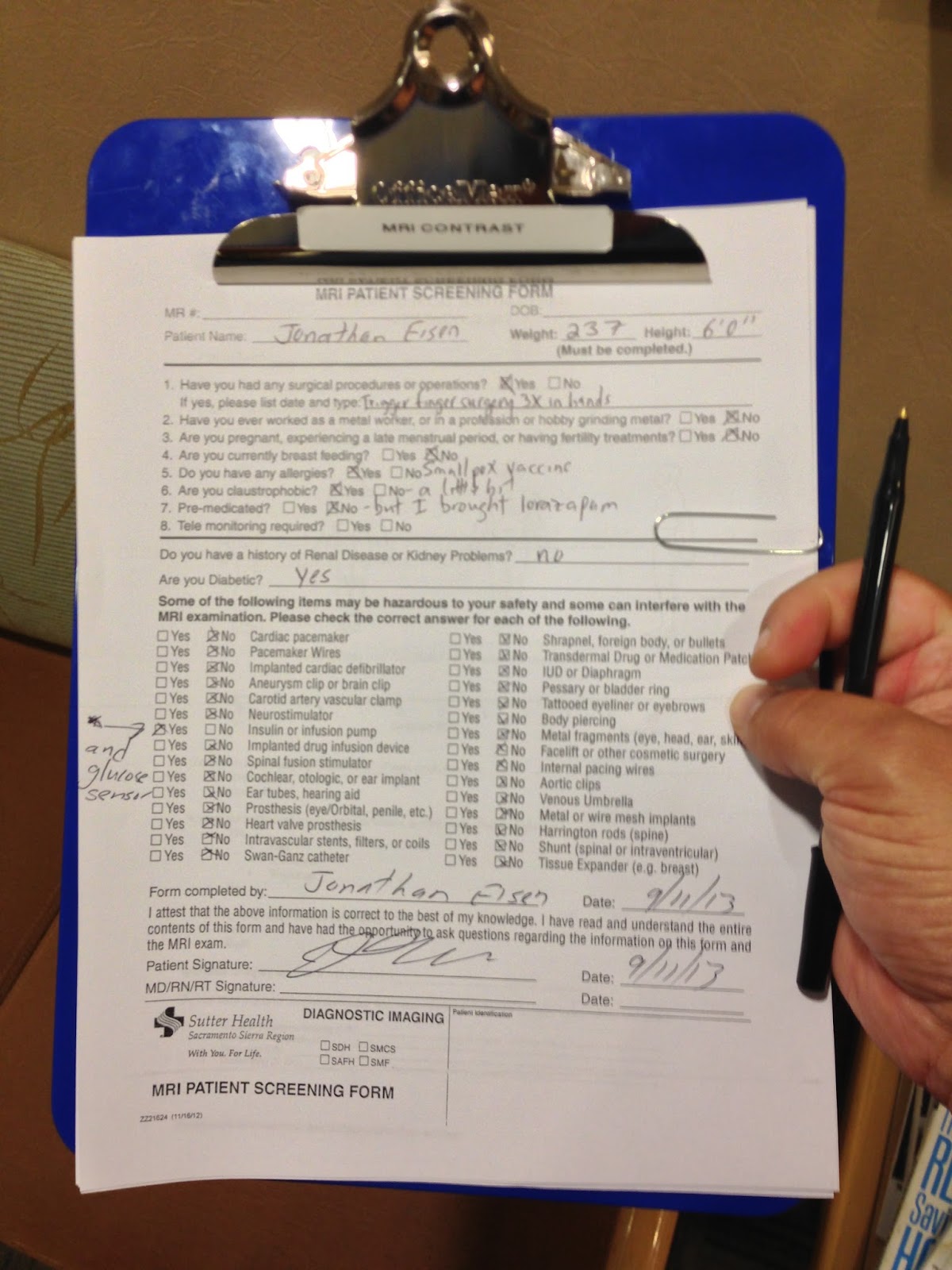
I had to fill out a collection of forms about medical background and whether I had any metal inside of me:

Forms

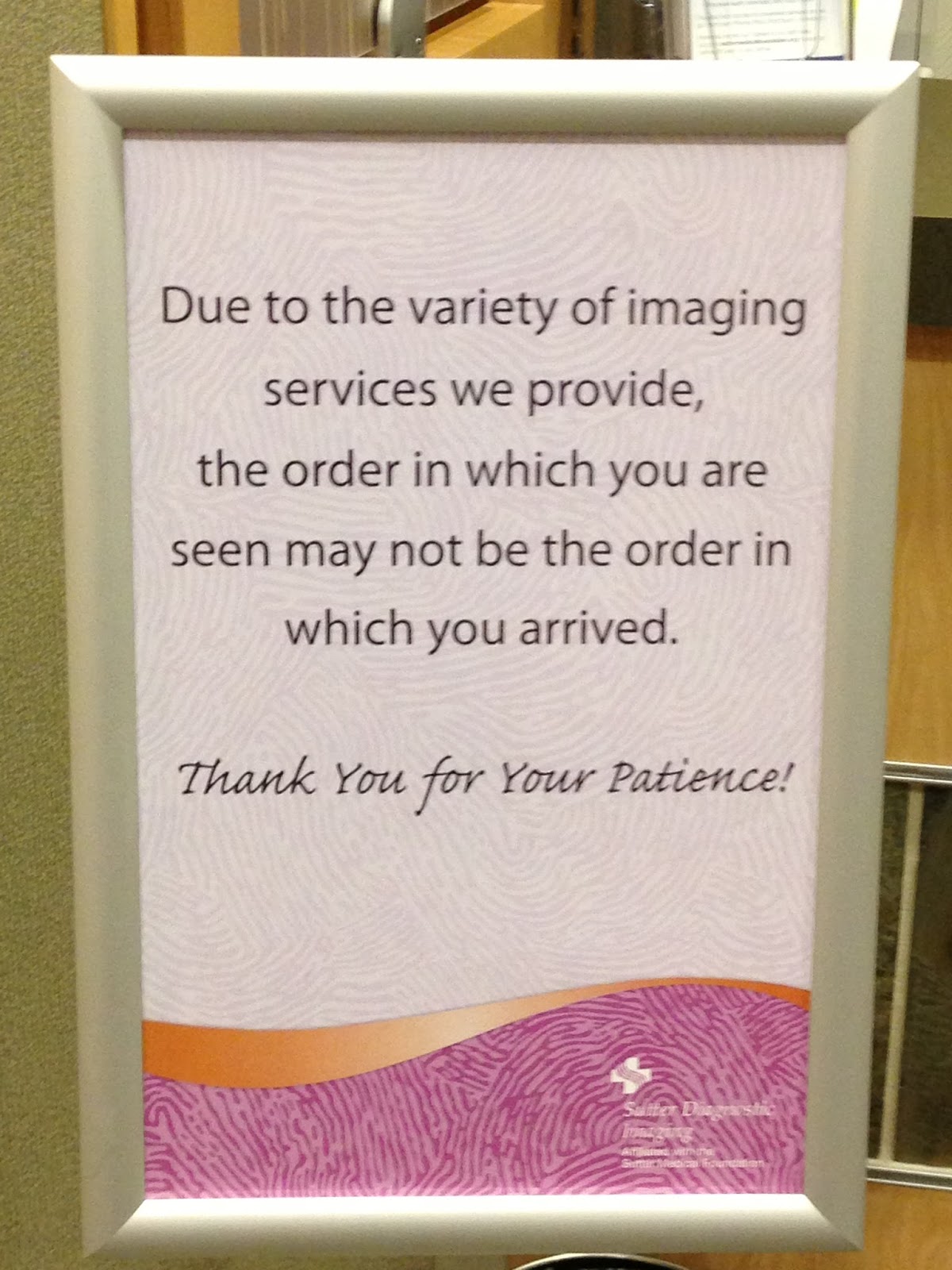
I asked again about the antianxiety meds at the front desk and they again said to wait until talking to the people doing the MRI.  As I pondered just taking something (I brought some lorazapam) anyway, I was called into the back within a minute or so.  Maybe I was out of order for the better:

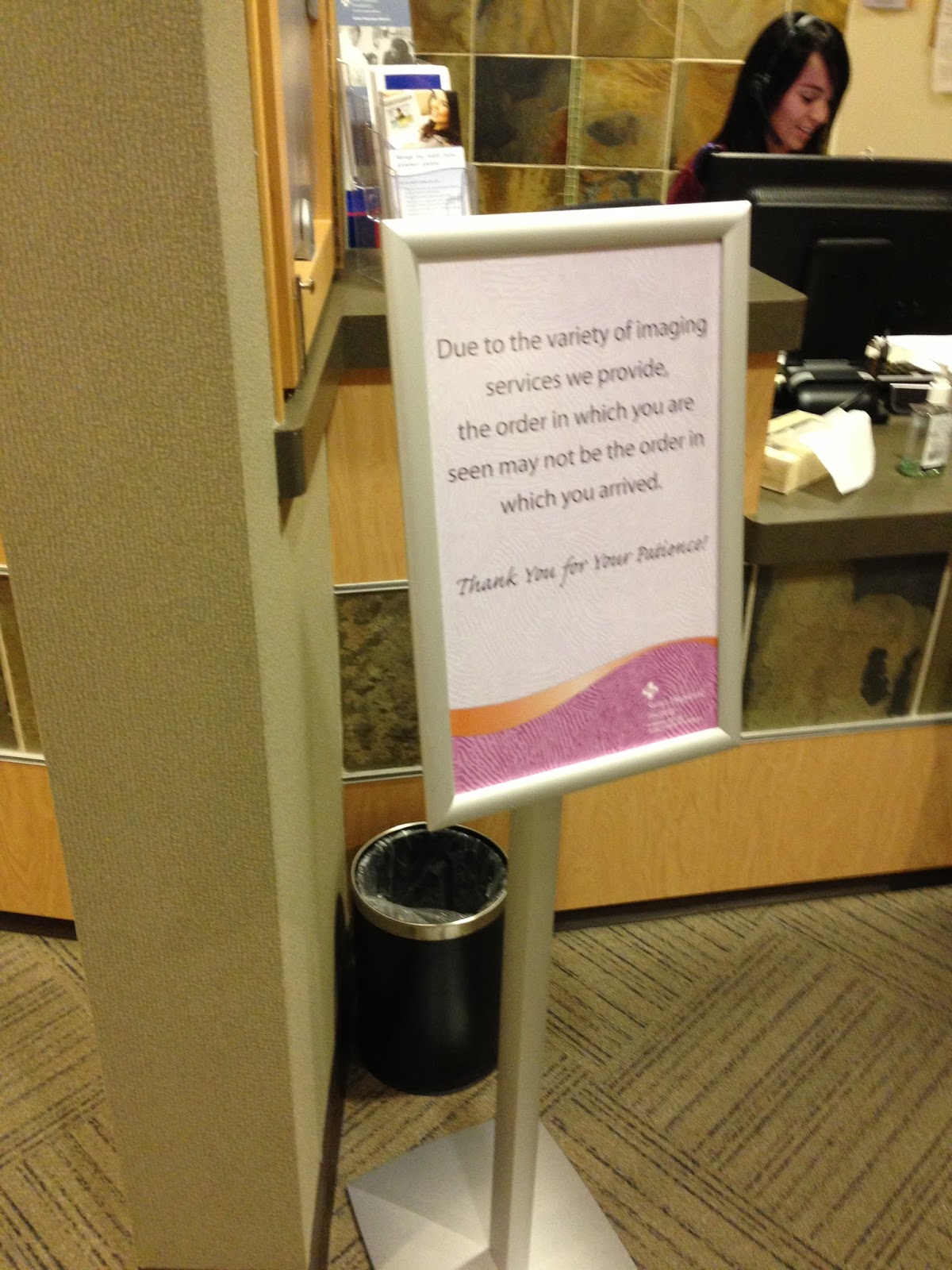
Not everyone in order …

In the back they told me I could put on a gown and some very posh medical shorts in a little changing area and I could lock up all my stuff in a drawer in there.

In the MRI changing room

The MRI lockbox

And then I asked about the antianxiety meds and they said something like “well, you should have done that a while ago since they take thirty minutes to kick in and we are ready to go”. Hmm.  Then they told me that I would not be going completely into the machine – my arms would stick out.  And my head would be near the opening.  So it sounded OK.  So I lay on the table and they put in an IV (for the contrast dye) and they got me nice and comfy with all sorts of pillows.  And they gave me earplugs.  And then they slid me into the machine.  Something like what is in this picture (I did not take any pics in the machine …)

From http://www.hfmhealth.org/?id=2255&sid=1

but with my arms over my head and my head a bit further into the machine.  In one hand I had a little squeeze ball to use if I needed to come out or needed their attention.  I seemed fine and then made a big mistake.  I opened my eyes.  And I could see nothing but the inside of the tube.  I felt trapped.  I shut my eyes again.  I tried to think of something else.  Baseball.  Movies.  Homeland (I had watched an episode from Season 2 the night before).  Anything.  But all I could think about was how close the tunnel walls were.  So – I squeezed the ball.  It took a few seconds for them to start to get me out – which felt like an eternity.  And I said – I don’t think I can do it.  And they said, well it may not be possible to do it today since it would take a while for the drugs to kick in if I took them.  And so they tried putting me in again and I lasted seconds.  Back out.  Fuck.  I needed to get this done.  So I asked – what if I took the lorazapam and maybe they could fit me in if the schedule was light?  And kindly they said they would look into rearranging the schedule – and a few minutes later they came back and said that as long as I had someone who could pick me up afterwards, they should be able to “squeeze me in” (their words) in their schedule after 30 or so minutes (so the meds could kick in).

So I took the lorazapam, and then spent thirty minutes in a side waiting room reading Sports Illustrated and trying to relax.  Actually, the 30 minutes of relaxation was possibly as useful as the drugs.  And then we started over.  Reconnected the IV.  Set me up on the ned.  And rolled me into the machine.  And I kept my eyes shut.  I thought nice thoughts.  And I made it.  An hour or so in the machine.  Breathing in and out.  Holding breath.  Over and over.  The technician was completely awesome – perfect soothing voice and soothing style.  Always telling me what was going on and how long each image run would take and asking how I was doing.  And then, as my arms started to get sore (they were awkwardly positioned over my head) it was over.  Phew.

Except, not phew.  Now I had to worry about the results.  I went home.  I worried.  I faded in and out (the lorazapam really did have some effect).  I napped.  My kids came home.  We hung out (though I was asleep through much of it).  And life went on.

UPDATE on 9/13/2013

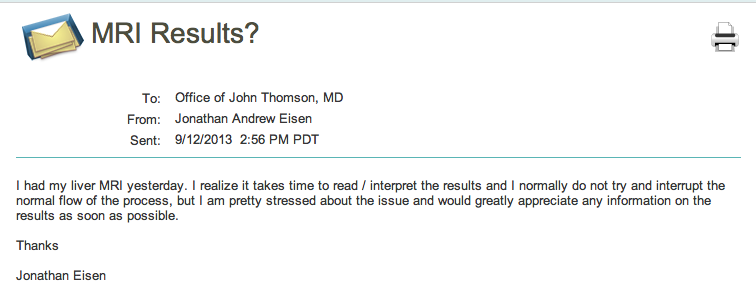
Thursday I spent most of the day working on a grant proposal and waiting for a phone call from my MDs.  It never came.  I called the imaging center, sniffing around to see if I could get the results sent directly to me.  Nope.  I emailed my primary care doc’s office … and wrote

Email to my docs

I then puttered around and hoped for a return message.  Nothing that day.  Uggh.  So I spent Thursday night a bit stressed, shall we say.

Friday 9/13/2013

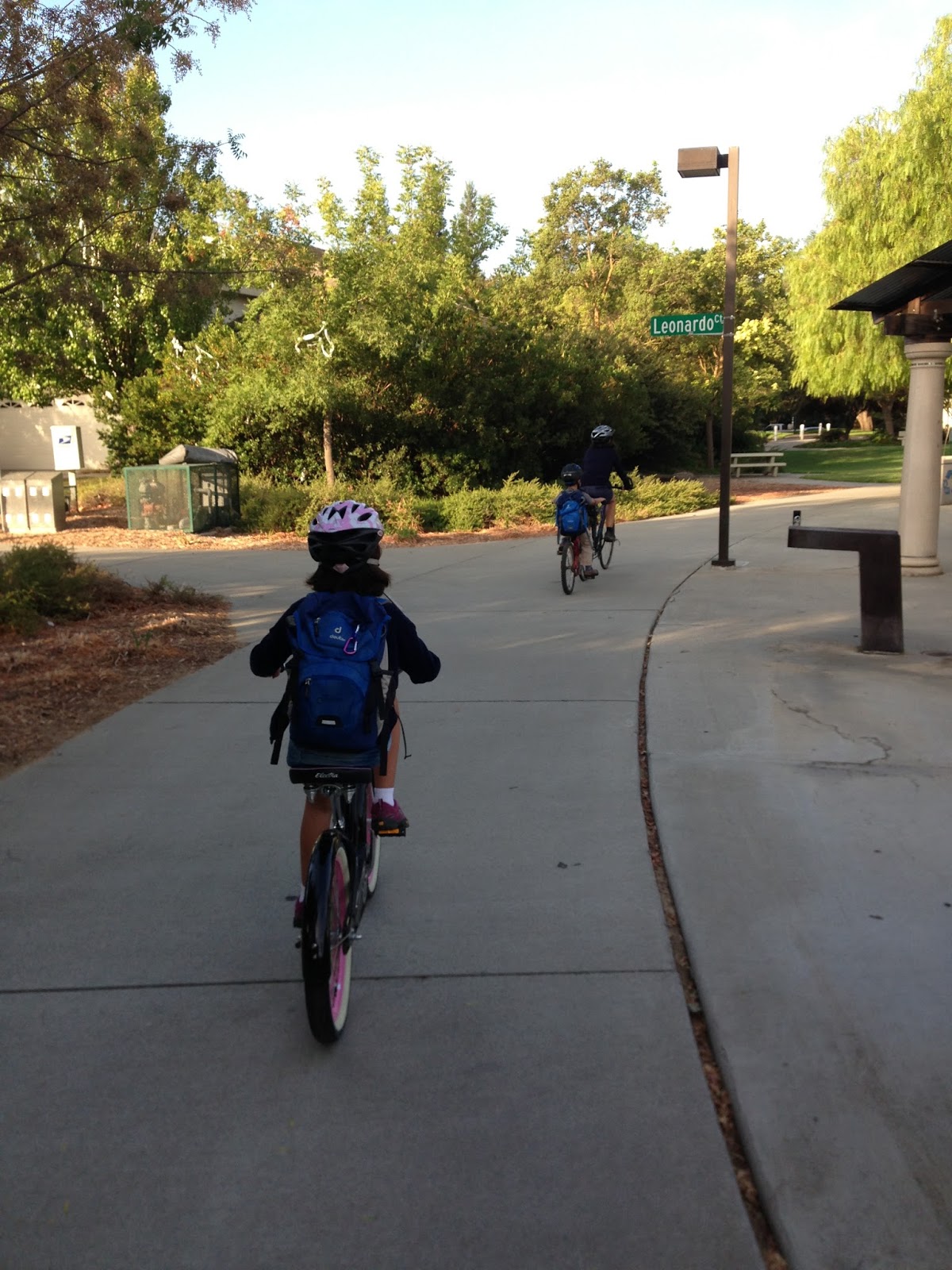
Tried to relax.  Biked with my kids to their school.  
Biking to school w/ kids & wife
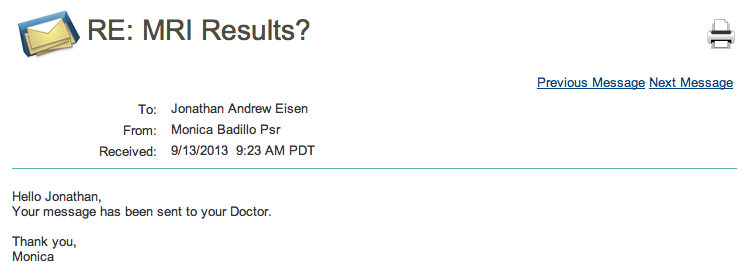
Came back to the house.  Was going to call my doctor.  And then I got an alert saying I had a message from the health care team online.  So I logged in and found this:

1st message back
Not what I was looking for.  So I puttered around the house some more.  Pondered how to hack into the MRI database and download my results.  Decided that was a bad idea (for now).  And then I got another message a few minutes ago saying I had a notification online.  So I went and logged in again and got this:

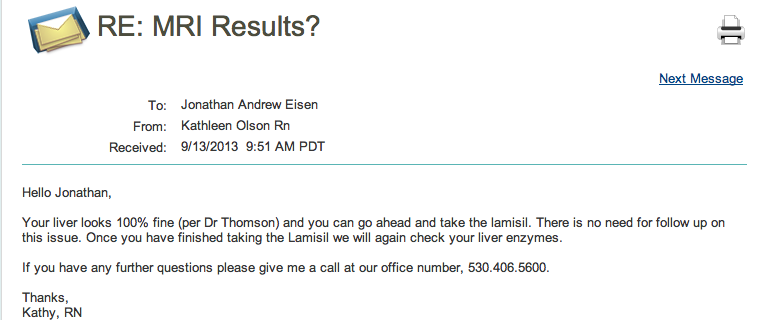
The good news

Well.  WHEEEEEEEEEEEEEEEEEEEEEEEEEEEEEE.  Certainly is good news.  Apparently. the MRI showed nothing wrong with my liver.  Not sure what was going on.  But boy this was much better news than I expected.  I figured I had some sort of problem at the least.  Maybe I still do.  But at least nothing apparently showed up in the MRI.  And now I can get back to what began this whole saga.  My feet.  Stay tuned.  Going to start some microbiome sampling today for the “before.”


UPDATE Sept. 17, 2013

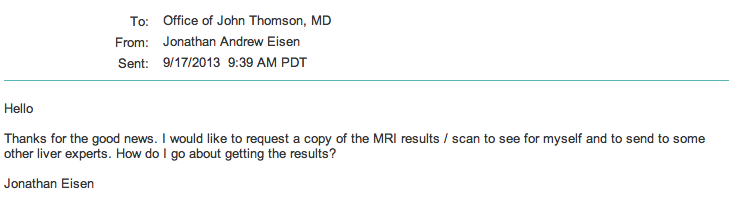
Well, I suppose it was a bit premature to be perfectly content with the message from my doctor …  I wrote to my doctor’s office asking how I go about getting a copy of the actual MRI scan so I would look at it myself and share it with some other medical professionals (and possibly even post it here).

Asking for the MRI scan

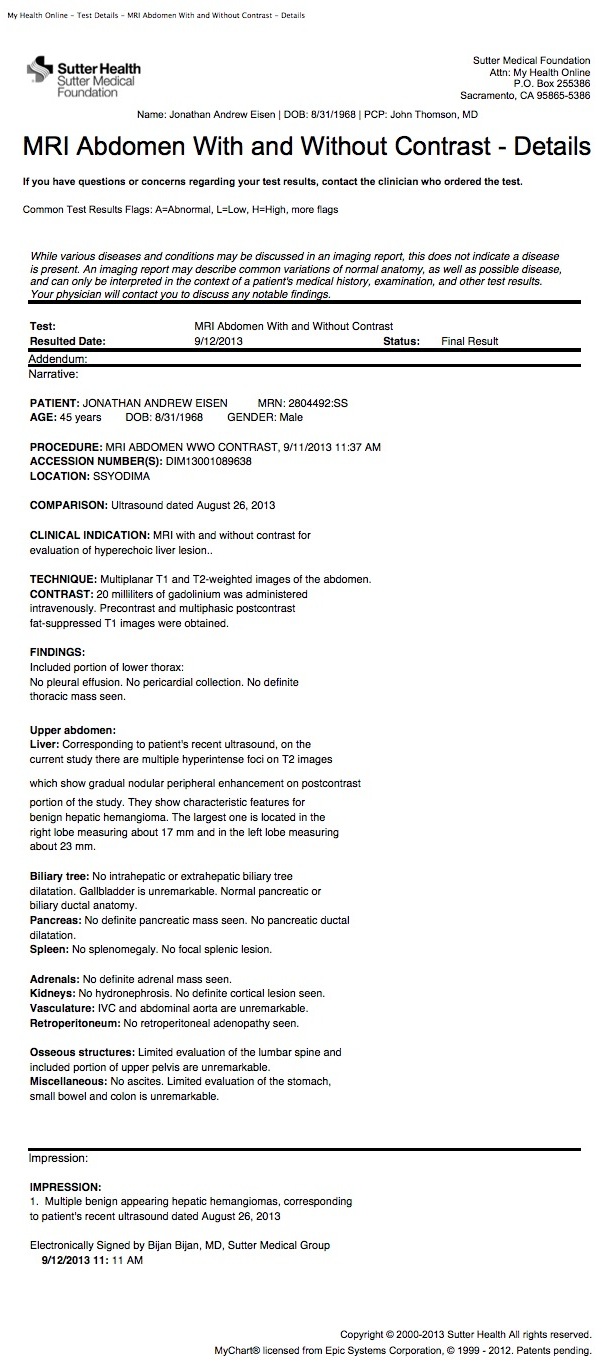
I still have not gotten the scan, but they did post the official MRI report from the radiologist.  Not quite as clean as I had imagined …

The full results

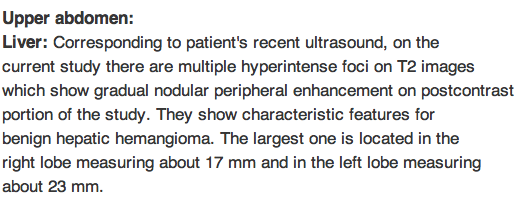
The key part is here:

The key parts

So – apparently  – the ultrasound was actually spot on.  I have multiple foci that “show characteristics of benign hepatic hemangioma”.  And they certainly aren’t tiny.  Now if these really are benign that is fine.  But now I am obliged to start digging around to see how often things that seem to be benign hepatic hemangiomas end up being something else … Uggh … it continues …

Overselling the microbiome: University Bern press release uses slight of hand to make mouse study seem to be about people

Interesting new paper came out recently on “Sex Differences in the Gut Microbiome Drive Hormone-Dependent Regulation of Autoimmunity.”  It is alas in Science so it is not available openly.

Anyway there are some news stories about the article where you can get the gist of it.  Best one is probably the blog post by Christine Gorman: Transplanted Bacteria Turn Up Testosterone to Protect Mice against Diabetes.  The story is pretty interesting.

For those who do not know I have been a bit obsessed about the connection between diabetes and the microbiome for a while.  See my Ted talk for example where I discuss my own personal connection to this issue.

http://embed.ted.com/talks/jonathan_eisen_meet_your_microbes.html

But the science is not what I want to talk about here.  What I want to talk about is how science press releases can just be awful.  The one for this paper is like some sort of con artist’s scheme.  Here it is on Science Daily: Good bacteria in the intestine prevent diabetes, study suggests.  First, they lure you in with a headline that, well, fails to mention that the study was in mice.  And then they keep trying to lure you with some lines about humans and their microbes.  In fact, the first two and half paragraphs I think are pretty deceptive.

All humans have enormous numbers of bacteria and other micro-organisms in the lower intestine. In fact our bodies contain about ten times more bacteria than the number of our own cells and these tiny passengers are extremely important for our health. They help us digest our food and provide us with energy and vitamins. These ‘friendly’ commensal bacteria in the intestine help to stop the ‘bad guys’ such as Salmonella that cause infections, taking hold. Even the biochemical reactions that build up and maintain our bodies come from our intestinal bacteria as well as our own cells.  

Pretty important that we get along with these little bacterial friends… definitely. But as in all beautiful relationships, things can sometimes turn sour. If the bacteria in the intestine become unbalanced, inflammation and damage can occur at many different locations in the body. The best known of these is the intestine itself: the wrong intestinal bacteria can trigger Crohn’s disease and ulcerative colitis. The liver also becomes damaged when intestinal bacteria are unbalanced. 

Research groups led by Professor Jayne Danska at the Sick Children’s Hospital of the University of Toronto and Professor Andrew Macpherson in the Clinic for Visceral Surgery and Medicine at the Inselspital and the University of Bern have now shown that the influence of the intestinal bacteria extends even deeper inside the body to influence the likelihood of getting diabetes. In children and young people, diabetes is caused by the immune cells of the body damaging the special cells in the pancreas that produce the hormone insulin.

Yup – lots and lots of stuff about people.  Which is fine.  I like people.  But the thing is. The paper is about mice.  So lines like “have now shown that the influence of the intestinal bacteria extends even deeper inside the body to influence the likelihood of getting diabetes” are kind of misleading because so far there has been no mention of mice and that line is they only true for mice, not people.  And then they wrap up this section with another line about people, clearly trying to imply that the “have now shown …” part is relevant to people.

And then, finally, they turn to mice.

By chance, 30 years ago, before the development of genetic engineering techniques, Japanese investigators noticed that a strain of NOD laboratory mice tended to get diabetes. These mice (also by chance) have many of the same genes that make some humans susceptible to the disease. With the help of the special facilities of the University of Bern and in Canada, these teams have been able to show that the intestinal bacteria, especially in male mice, can produce biochemicals and hormones that stop diabetes developing.

And then they go back to people.

Diabetes in young people is becoming more and more frequent, and doctors even talk about a diabetes epidemic. This increase in diabetic disease has happened over the last 40 years as our homes and environment have become cleaner and more hygienic. At the moment, once a child has diabetes, he or she requires life-long treatment. 

“We hope that our new understanding of how intestinal bacteria may protect susceptible children from developing diabetes, will allow us to start to develop new treatments to stop children getting the disease,” says Andrew Macpherson of the University Bern.

Wow.  So in a press release about a paper that is about mice, there are three sentences about mice and the rest are about people.  The thing is, in case you don’t know – mice are not the same as people.  Just saying.  And for trying to overplay the connection of their work to humans, I am giving the writer’s of this press release my coveted Overselling the Microbiome Award.

Past posts about this award include:

Diabetes and the microbiome – some hype and some caution – in the same stories

A new paper is getting some press on a link between type II diabetes and the microbiome.  The paper is here.  The abstract of the paper reads:
Assessment and characterization of gut microbiota has become a major research area in human disease, including type 2 diabetes, the most prevalent endocrine disease worldwide. To carry out analysis on gut microbial content in patients with type 2 diabetes, we developed a protocol for a metagenome-wide association study (MGWAS) and undertook a two-stage MGWAS based on deep shotgun sequencing of the gut microbial DNA from 345 Chinese individuals. We identified and validated approximately 60,000 type-2-diabetes-associated markers and established the concept of a metagenomic linkage group, enabling taxonomic species-level analyses. MGWAS analysis showed that patients with type 2 diabetes were characterized by a moderate degree of gut microbial dysbiosis, a decrease in the abundance of some universal butyrate-producing bacteria and an increase in various opportunistic pathogens, as well as an enrichment of other microbial functions conferring sulphate reduction and oxidative stress resistance. An analysis of 23 additional individuals demonstrated that these gut microbial markers might be useful for classifying type 2 diabetes.
Seems pretty reasonable.  All they say there is that they found associations between bacteria and diabetes.  That is interesting but they do not seem to present any evidence about a causal connection.  Perhaps people who get type II diabetes end up then having their microbiome shift.  Perhaps a shift in the microbiome causes type II diabetes.  Or perhaps something else (e.g., excessive inflammation) causes both type II diabetes and microbiome shifts.  Who knows.

But alas a bit of hype crept into some of the the news stories.  And it seems that the scientists behind the study are responsible for some of this hype.  For example, consider the article Changes in Intestinal Bacteria Linked to Type 2 Diabetes – US News and World Report.  One quote is a bit much for me:

“I think our study provides many targets for disease prevention and treatment through gut microbiotia in the near future,” said study senior author Jun Wang, executive director of the Beijing Genomics Institute in Shenzhen, China.

Fortunately the reporter who wrote this story does a very good job of providing cautious interpretations.  See for example:

“There’s no way right now that you can say there’s a cause-and-effect relationship. It could be that the patients with diabetes were treated with drugs that changed their gut flora. Or maybe they ate differently? This is an interesting hypothesis — that gut bugs could influence diseases states — but it’s far from proven,” said Dr. Stuart Weinerman, associate chief of the division of endocrinology at North Shore University Hospital/Long Island Jewish Medical Center in New Hyde Park, N.Y.

Also see stories like Gut bacteria could cause diabetes from Science Codex.  The title alone makes me want to cry.  Some quotes as well as discussion in that article also seem, well, not cautious enough.

The research, which was recently published in the scientific journal Nature, also demonstrated that people with type 2 diabetes have a more hostile bacterial environment in their intestines, which can increase resistance to different medicines.

Definitely not buying this “hostile” environment claim.  Fortunately as with the US News story, there is some caution presented

“It is important to point out that our discovery demonstrates a correlation. The big question now is whether the changes in gut bacteria can affect the development of type 2 diabetes or whether the changes simply reflect that the person is suffering from type 2 diabetes.”

 So – the stories seem to actually be doing an OK job with the correlation vs. causation issue I have complained about many times.  And though some of the scientists may be pushing a bit of overinterpretation the reporters and even the press releases have some decent cautionary statements.