Getting John Henry and his hammer into a scientific paper

Gotta love a scientific paper that quotes John Henry stories. In Andy Ellington’s primer on ribozyme evolution (PLoS Biology – Man versus Machine versus Ribozyme) he leads off with

The steam drill was on the right hand side,

John Henry was on the left,

Says before I let this steam drill beat me down,

I’ll hammer myself to death”—The Ballad of John Henry (American, traditional)

His point here is to talk about man versus machine and to then discuss the recent article in PLoS Biology on a “Darwinian Machine” which I wrote about previously. (I think he is also making a bit of a play on words with the hammerhead ribozyme, but I am not sure). Anyway, Ellignton’s article is worth checking out. I especially like the ending

Machine-based continuous evolution should be the best of all worlds, combining man’s mental ability to chart the future with automated control of selection stringency with the still unpredictable mode and tempo of evolution’s relentless drive.

Figure from Ellington’s PLoS Biology paper. I can put it here because it is a fully Open Access paper using a broad Creative Commons license. All I have to do is cite the source. And so I am. Andy Ellington. PLoS Biol 6(5): e132 doi:10.1371/journal.pbio.0060132

Figure reportedly by Angel Syrett (see comments).

Simpsons Evolution Video

Just a little post showing this Simpsons Evolution Video from YouTube

Kudos to New Scientist’s "24 myths and misconceptions" about evolution

New Scientist has a pretty good article on myths and misconceptions about evolution (see Evolution: 24 myths and misconceptions).

They really hit on many of my pet peeves on evolution. Among my favorites:

Many of these fit in well with my Adaptationomics Award which I will start giving out again soon ….

Francisco J. Ayala – Evolution – Scientists Who Believe in God – – New York Times

Good to see someone other than Francis Collins getting some press about bridging the gap between evolution and religion. Today it is Francisco Ayala, an evolutionary biologist at UC Irvine. There is an interesting story about him in the New York Times today (Francisco J. Ayala – Evolution – Scientists Who Believe in God ).

Now, I thought I knew a good deal about Ayala but I did learn a bit in the article about his life and background (e.g., he was a Dominican priest, which I did not know). I personally think the “religion” vs. “evolution” debate is pretty silly much of the time and succumbs to the modern obsession with controversy. Ayala’s new book “Darwin’s Gift to Science and Religion” apparently addresses this issue and I hope it does a better job than Collins’ book, which I found to be wanting in many areas. Of course, I guess I am a bit biased since I have had a soft spot for Ayala for many years and since he just wrote a very positive review of my new Evolution textbook. Now, if Collins wrote a positive review, I do not think I would like his book any more, but who knows …

Yoga and Evolution – How are they related?

Trick question. They are related because I am posting YouTube videos on those topics here. Just a little YouTube humor to help everyone get through the week. Warning – the evolution one is truly over the top and might offend a few so click on it with caution.

EnlightenUp The Film

Dawkins Rap

Breaking News: PZ Myers expelled from Expelled (the Movie)

Everyone must read, immediately, Pharyngula now.

PZ Myers writes about how he was expelled from the movie Expelled (a pro Intelligent Design movie). And the best part – Richard Dawkins was allowed in …

Creating Mitochondria and a sign that we need open peer review

Well, since everyone else is posting about this I figured I should too (see for example Steven Salzberg’s Blog, The Harvard Crimson, Pharyngula). If you have not heard yet, there is an article in the journal Proteomics that discussed how mitochondria must have been created by an intelligent designer.

For example on p8 the authors say:

“Alternatively, instead of sinking in a swamp of endless
debates about the evolution of mitochondria, it is better to
come up with a unified assumption that all living cells
undergo a certain degree of convergence or divergence to or
from each other to meet their survival in specific habitats.
Proteomics data greatly assist this realistic assumption that
connects all kinds of life. More logically, the points that show
proteomics overlapping between different forms of life are
more likely to be interpreted as a reflection of a single common
fingerprint initiated by a mighty creator than relying on
a single cell that is, in a doubtful way, surprisingly originating
all other kinds of life.”

Say what you want about the journal Proteomics but boy did they screw this one up. I think they probably should have caught this without much effort but who knows exactly what happened. In all fairness to them, it is possible for weird thin gs to slip through at any journal. Reviewers are busy. Editors are busy. Everyone is busy. How can we prevent this from happening again. There is a simple change we could make that would help. It is called Open Peer review. That is, if reviewers names were publicly attached to papers they reviewed, and their reviews were published, we would be less likely to see things like this happen. Then, if someone agrees to do paper review, they would be careful about it. Sure, we would probably have a harder time getting reviewers, but that would be better than publishing crap.

What are the risks with Open Peer review? Well, some people might feel afraid to criticize others especially people with power. Well, I find this sad. Scientists criticize our collaborators and friends ALL the time in private. Why not be public about it? Aren;t we supposed to be searching for the truth? If we are, shouldn’t we be willing to give our opinions in public forums?

What kid would want to study bacterial evolution when they grow up?

OK – I am a bit scared by this, because it shows how little I have changed since I was young. And in my memory, I was not a total science geek for my whole life (you know – I focus on the fact that in high school, I played baseball and hockey and other sports pretty seriously, I guess my memory skips over that I was captain of the math team too).

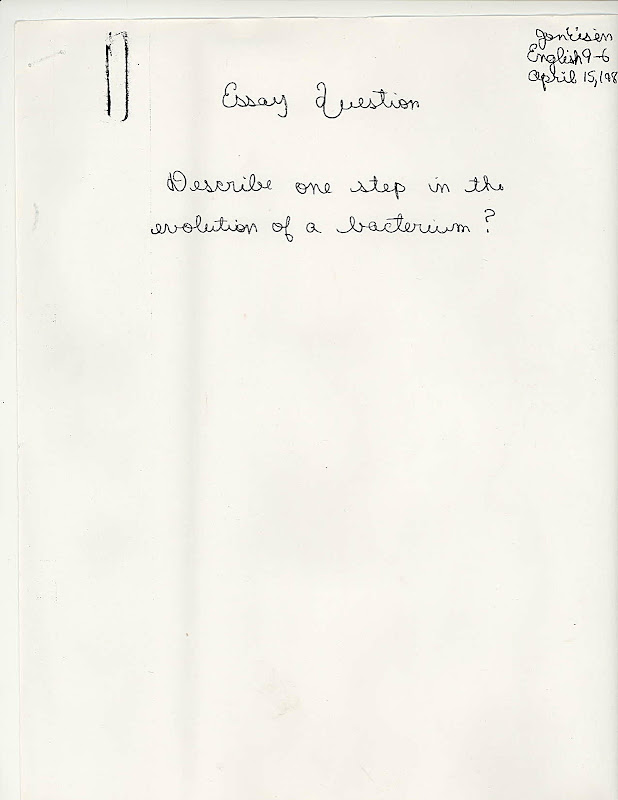
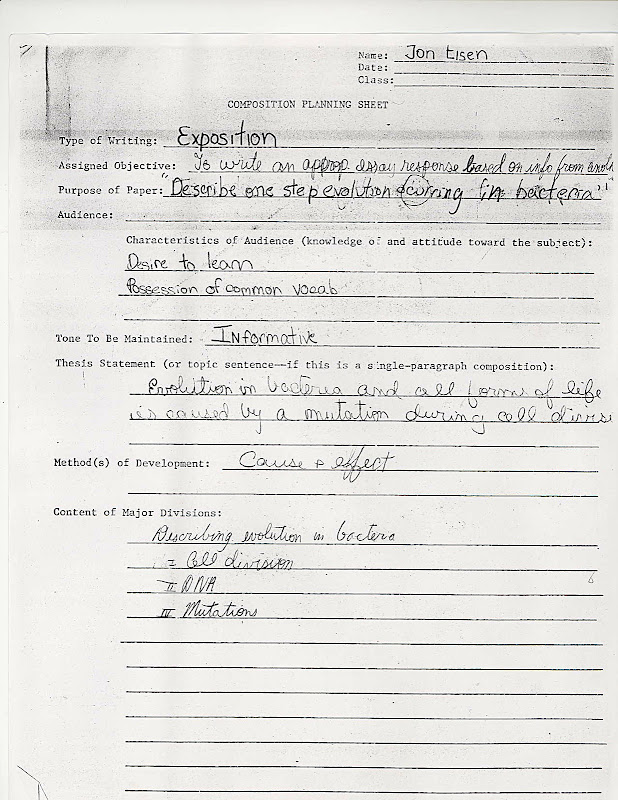
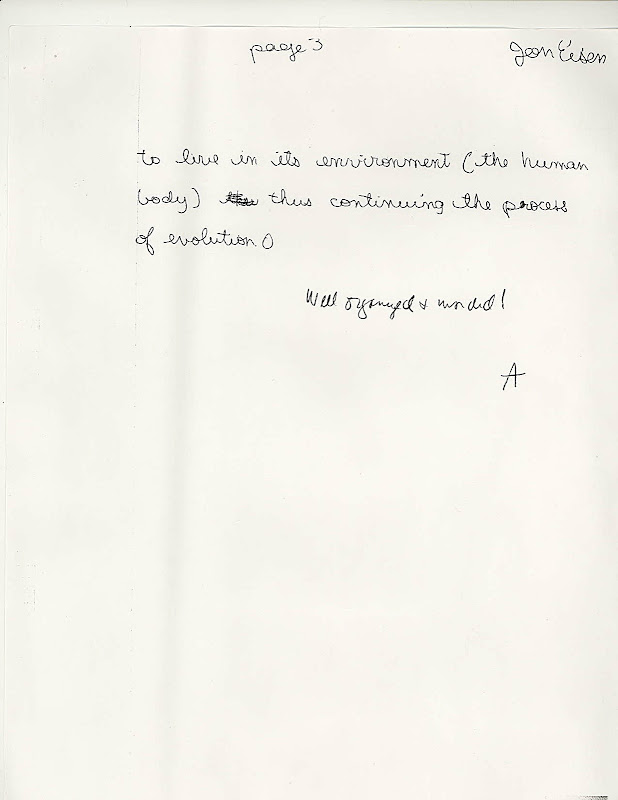
But I was digging through some old papers and found this … a paper I wrote in ninth grade. We got to select a topic for the paper and mine … “Describe one step in the evolution of a bacterium.” The funny thing is — I do not remember this at all. I mean, I remember reading books by Gould that got me interested in evolution. But surely Gould did not write a lot about bacterial evolution. Where did I come up with this topic? I haven’t a clue. Anyway – here is the essay – errors, fluffy handwriting, and all.

http://picasaweb.google.com/s/c/bin/slideshow.swf

Leslie Orgel – Still Speaking Wisely and Openly Even After Death

OK – my mind has been blown. Leslie Orgel, who just passed away recently, has a new Essay in PLoS Biology called “The Implausibility of Metabolic Cycles on the Prebiotic Earth.” Anyone interested in the origin of life should check this out.

He had me at the beginning … and as usual has very clear discussions of the steps needed for life to have originated:

If complex cycles analogous to metabolic cycles could have operated on the primitive Earth, before the appearance of enzymes or other informational polymers, many of the obstacles to the construction of a plausible scenario for the origin of life would disappear. If, for example, a complex system of nonenzymatic cycles could have made nucleotides available for RNA synthesis, many of the problems of prebiotic chemistry would become irrelevant. Perhaps a simpler polymer preceded RNA as the genetic material—for example, a polymer based on a glycerol-phosphate backbone [5] or a phosphoglyceric acid backbone. Could a nonenzymatic “metabolic cycle” have made such compounds available in sufficient purity to facilitate the appearance of a replicating informational polymer?

The paper then discusses details of various metabolic cycles and why the current evidence is not completely convincing in terms of the exact path that was taken in the origin of life. Note to ID supporters – this does not friggin‘ mean that he is saying life could not have originated from non living systems. He is simply pointing out that our understanding of it is incomplete. As, by the way, is our understanding of how blood works. But that does not stop us from thinking that blood does in fact, well, work.

Anyway, once you get over the fact that some ID supporters will misuse his work, the end is a great call for what needs to be done:

The prebiotic syntheses that have been investigated experimentally almost always lead to the formation of complex mixtures. Proposed polymer replication schemes are unlikely to succeed except with reasonably pure input monomers. No solution of the origin-of-life problem will be possible until the gap between the two kinds of chemistry is closed. Simplification of product mixtures through the self-organization of organic reaction sequences, whether cyclic or not, would help enormously, as would the discovery of very simple replicating polymers. However, solutions offered by supporters of geneticist or metabolist scenarios that are dependent on “if pigs could fly” hypothetical chemistry are unlikely to help

Yes, that is right, he got “if pigs could fly” into a paper. He was a great scientist. And it is nice for me to see one more paper of his. And this one, unlike pigs, can fly forever, because it is truly OA.

Survival of the fittest M&Ms

Fantastic evolution post on the best of Craigslist.

The post starts off with

Whenever I get a package of plain M&Ms, I make it my duty to continue the strength and robustness of the candy as a species. To this end, I hold M&M duels.

And then, after a crushing test of fitness

Occasionally I will get a mutation, a candy that is misshapen, or pointier, or flatter than the rest. Almost invariably this proves to be a weakness, but on very rare occasions it gives the candy extra strength. In this way, the species continues to adapt to its environment.

Then the winning M&M is sent to Mars with a note

Please use this M&M for breeding purposes.

Best part – Mars sent him a coupon for free M&Ms which he considers “grant money.” Who said evolution can’t be fun.

Thanks to Michael Eisen for pointing this out.