
Please see this post if you sample biological aerosols:
Tag: Misc.

Among the strangest official email msgs I have ever received
It has been brought to my attention that the practice of standing on the toilet seat has not only been identified in the women’s restroom, but also the men’s restroom. As a follow-up, the MSO/CAO for the departments has been notified of this safety & sanitary concern. As part of the corrective action, all stall doors (women and men) will be posted with the following notice: FOR SAFETY AND SANITARY REASONS, PLEASE DO NOT STAND ON THE TOILET SEAT.
Share this:
Seriously annoyed with Nucleic Acids Research and Oxford University Press right now
Well, I was working on adding some paper links for an online version of my CV and I discovered something very annoying.
I went to get a link for my 1994 paper in Nucleic Acids Research. I wrote this paper with my then girlfriend, now wife, and her advisor Ginny Walbot. The paper was on finding a “transpose” motif in one of the proteins that was part of the autonomous element for the Mutator transposon in maize “Sequence similarity of putative transposases links the maize Mutator autonomous element and a group of bacterial insertion sequences.”
So I went to Pubmed and searched for Eisen JA and Mutator and got the Pubmed entry here. And then I looked at the links in the upper right and there were two. One to NAR and one to Pubmed Central. I note – the paper has been freely available online for years. I vaguely remembered noticing some issue with the NAR version in the past so I went to that site. And there it was
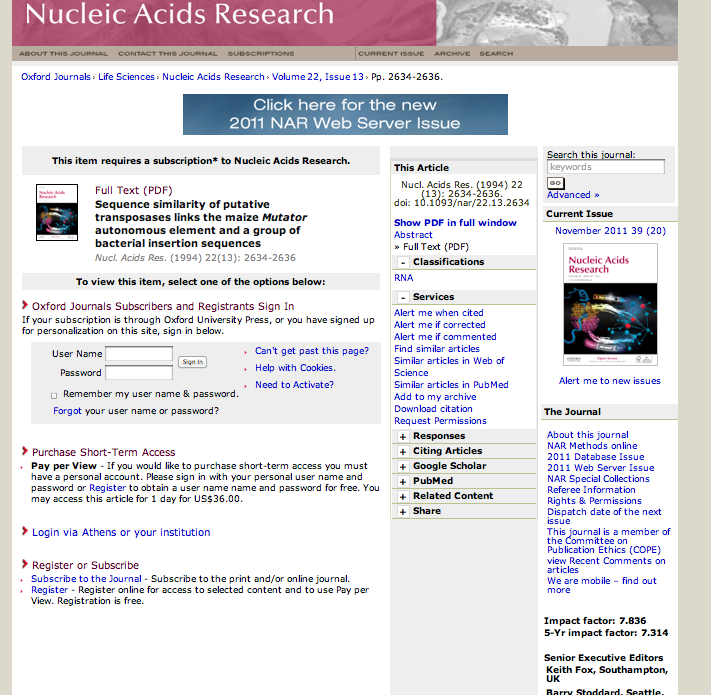
Wow. Even though the paper is freely available in Pubmed Central, NAR is trying to charge for it.
What the f**#?
Same thing for my other NAR articles:
- Evolution of the SNF2 family of proteins: subfamilies with distinct sequences and functions.
- A phylogenomic study of the MutS family of proteins.
- TIGRFAMs: a protein family resource for the functional identification of proteins.
Not sure what the deal with this is. Could be a glitch. COuld be a feature.
Share this:

Top 11 biology things with a connection to 11 for 11:11:11 AM on 11/11/11
In honor of 11:11:11 on 11/11/11
Things about 11 in Biology
- Chromosome 11 (human) – Wikipedia, the free encyclopedia
- The spatial-temporal clustering of Plasmodium falciparum infection over eleven years in Gezira State, The Sudan
- Simultaneous Determination of Eleven Major Flavonoids in the Pollen of Typha angustifolia by HPLC-PDA-MS.
- The cell generation cycle of the eleven-day mouse embryo
- Eleven daughters of NANOG.
- RPS11 – Wikipedia, the free encyclopedia
- Development and evolution of a variable left-right asymmetry in nematodes: the handedness of P11/P12 migration.
- Functional display of family 11 endoxylanases on the surface of phage M13.
- Polypeptide synthesis during lytic induction of phage 11 of Staphylococcus aureus.
- Evidence of Infection with H4 and H11 Avian Influenza Viruses among Lebanese Chicken Growers.
- Phylogenetic analysis of avian influenza viruses of H11 subtype isolated in Kazakhstan.
Share this:
Reading about Medical School requirements –
Just a quick one here. I am reading up on medical school curricula because I am thinking about designing a course on evolutionary medicine. Wondering what is going on these days with modernizing med. school requirements (that is what students need to take before med school) and what they take in med school.
I found this interesting page: Harvard Medical School: Requirements discussing revisions to what Harvard requires for incoming med. school students.
This led me to this HHMI AAM report which has some useful discussion of what physicians should learn about. I was glad to see a bit here and there about evolution. It is even listed as a core competency “Competency E8
Demonstrate an understanding of how the organizing principle of evolution by natural selection explains the diversity of life on earth.” with specific examples of things that could be taught.
If anyone knows any other good review docs on med. school requirements or med. school curricula I would appreciate pointers.
Thanks
Share this:
Tom Bruns talk on fungal dispersal at #UCDavis 11/10/11 #ecology #fungi
http://storify.com/phylogenomics/tom-bruns-talk-on-fungal-dispersal-at-uc-davis-11-10-11.js<a href=”http://storify.com/phylogenomics/tom-bruns-talk-on-fungal-dispersal-at-uc-davis-11-10-11″ target=”_blank”>View the story “Tom Bruns talk on fungal dispersal at UC Davis 11/10/11” on Storify</a>]
Share this:
What you need to know about infectious disease?
Gorgeous new book on Evolution
Just got a review copy of Evolution by Jean-Baptiste de Panafieu and Patrick Gries
Haven’t read it yet but it looks gorgeous
This is a smaller edition of an oversized hardcover published in 2007


