Ad for Genomics Faculty Position at UC Davis

Still getting back into things after being out sick … here is an Ad for a job everyone should want …

The UC Davis Genome Center integrates experimental and computational approaches to address key problems at the forefront of genomics. The Center is housed in a new research building with state-of-the-art computational and laboratory facilities and currently comprises 14 experimental and computational faculty. These faculty are developing an internationally recognized program in genomics and computational biology at Davis, building on and enhancing the unique strengths and unmatched breadth of the life sciences on the UC Davis campus.

The Genome Center invites applications for tenure-track faculty positions in all areas of genomics with emphasis on next-generation proteomics and statistical genomics involving animal, plant or microbial systems. Applicants interested in genomic approaches to human diseases and investigators employing large-scale, technology-driven approaches that complement existing strengths at UC Davis are particularly encouraged to apply. Candidates should be strongly motivated by the biological importance of their research and should value the opportunity to work in close collaboration with other groups and disciplines.

Candidates may be at any academic level. At the senior level, we invite applications from prominent scientists with distinguished records of research, teaching, and leadership in genomics. At the junior level, we invite applications from candidates whose accomplishments in innovative research and commitments to teaching demonstrate their potential to develop into the future leaders in these fields.

These positions require a Ph.D. or equivalent. Appointments will be at the Assistant, Associate or Full Professor level in an appropriate academic department in any of six schools, or colleges. The position will remain open until filled. For fullest consideration, applicants should submit a letter of application, a curriculum vitae, statements of research and teaching interests, and the names of at least five references to the Genome Center Web site www.genomecenter.ucdavis.edu by January 15, 2009.

The University of California is an affirmative action/equal opportunity employer

Outdoor Art at Robbins Hall

There is some relatively outdoor art at Robbins Hall at UC Davis. The art features plants, evolution and DNA — things I dig. Here are some pics.

Robbins Hall Outdoor Art

The only issue I have is that they did not highlight the bacteria that should be present on the bean roots (legumes fix nitrogen via nitrogen fixing bacteria that hang out in nodules in the roots). But if we take an artistic interpretation of the bean roots, some of the little black triangles there can be considered root nodules.

Anyway, just thought I would share the pics. The art is worth checking out if you are in the area.

http://picasaweb.google.com/s/c/bin/slideshow.swf

Aphid-bacterial symbiosis in more detail, and in the New York Times

Nice little bit in the New York Times tomorrow about aphids and their symbionts. Henry Fountain writes (Observatory – How Tiny Insects, With a Little Help, Survive on Plant Sap – NYTimes.com) about a new article by Angela Douglas, one of the true pioneers of endosymbiont research. In her study she dissects in fine scale detail which essential amino acids are missing from the aphid sap only diet and which ones are made by the symbionts. Interestingly, the research apparently shows that the aphids may have figured out how to make methionine by themselves. I say apparently since I have been unable to track down the paper which I assume is coming out soon.

I should note, in one of the symbioses like this that I have studied with Nancy Moran we found that there were two symbionts contributing to the nutrition of the host. We found that one of the symbionts was likely making amino acids for the host (an insect called the glassy winged sharpshooter which eats only xylem sap) and the other symbiont was likley making vitamins. Nancy showed later with John McCutcheon that the symbiont that was making vitamins also was predicted to be making methionine for the host. So it seems possible there might be a missing symbiont in the aphid study? Although it would be cool if the aphid has figured out how to make an amino acid most animals are not able to make.

Hat tip to Max Lambert for pointing this out.

Tree of Life Gift Recommendation – Climate Kits

Just a quick recommendations for a gift for this holiday seasons that seems cool (metaphorically and literally). It is the climate kit. It comes from a friend of mine from college, Kathy Washienko and this is some of their text:

Kits are convenient collections of tools and tips that will help your family and friends reduce your environmental impact. By grouping what you need in one handy package, a kit makes it easy and fun to take energy-saving steps. Each kit is ultimately a gift to our environment, but will also save you money in reduced energy costs.* And every kit comes with our innovative “rebate.” Check them out!

Sounds good to me. And given that I am trying here to promote trees (albeit phylogenetic ones, not real ones) I like that they are planting a tree and trying to be green.

"Free" large scale sequencing for Department of Energy related projects …

Interested in Department of Energy-related missions such as global carbon cycling, alternative energy production, and biogeochemistry? And want some genomes, metagenomes, or other things sequenced that are relevant to these topic areas? All you have to do is write a proposal to the Joint Genome Institute (JGI) Community Sequencing Program, get it selected by the review committee, and then the JGI will do the sequencing and some analysis for you.

Go to this web site to learn more ….JGI – CSP Overview.

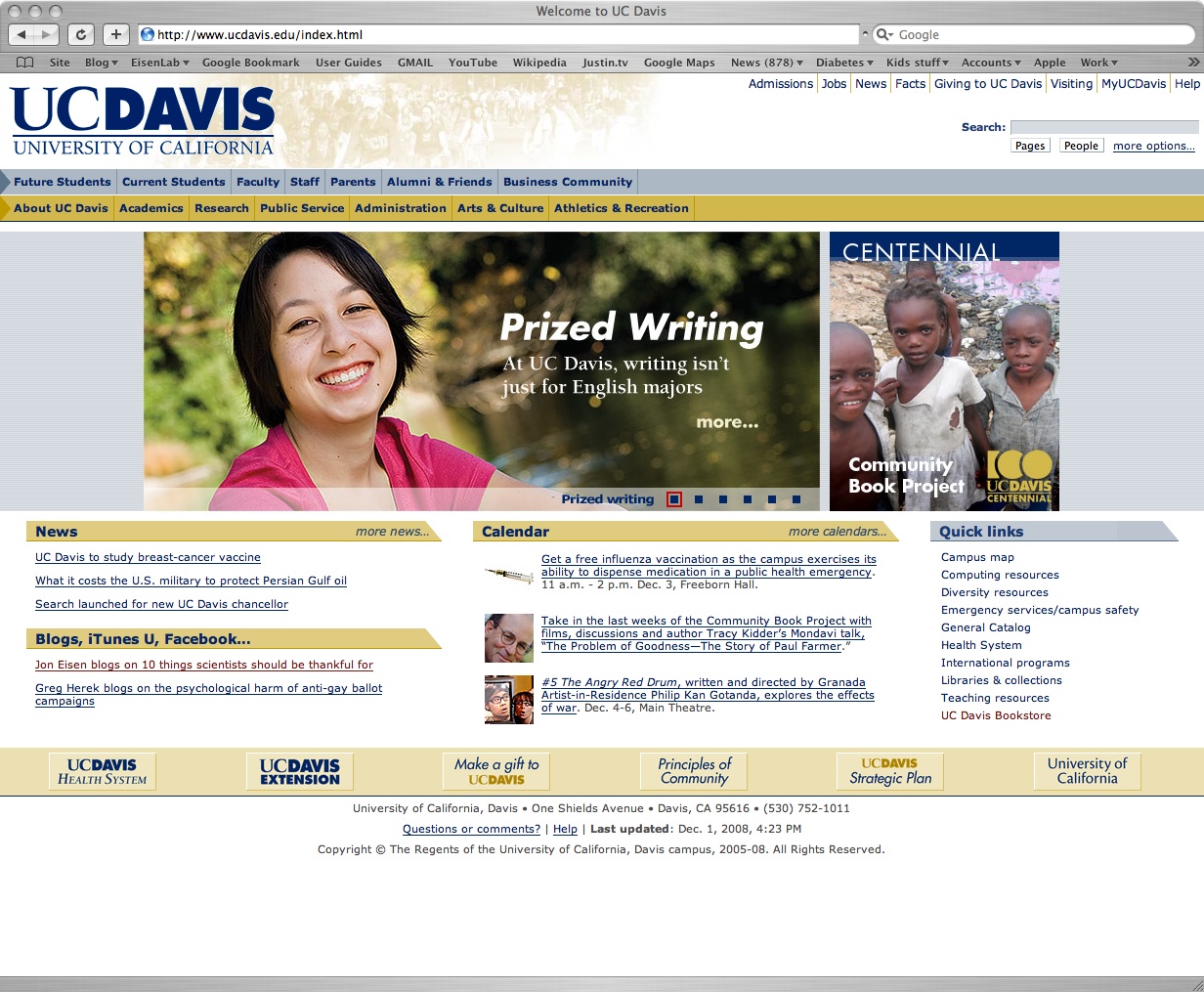
UC Davis giving further props to blogs (mine that is)


Hey – thanks UC Davis.  Thanks for promoting blogs on your front page (under the Blogs, iTunes and Facebook section) and thanks for promoting my “Things Scientists should be thankful for”posting.  

Attack of the Robo Lizards from Davis

OK – the robo lizards are not attacking. But they are used for some cool behavioral science research here at Davis. Terry Ord and Judy Stamps from UC Davis have a new paper in PNAS coming out this week where they used robo lizards to study the behavior of Anole Lizards. Check out the UCD news site here which has some videos (UC Davis News & Information :: Robo-lizards Help Prove Long-Standing Signaling Theory)

Open Microbial Diversity: PLoS papers on using 454-Roche pyrosequencing for rRNA studies

ResearchBlogging.org

Two new papers that just came out in PLoS Journals are definitely worth checking out. They are

Of course I am a bit biased I suppose as I am heavily involved in PLoS and also served as Academic Editor for these papers. But with that being said, I encourage people to check them out. In the PLoS Genetics paper from the labs of Mitch Sogin and David Relman labs discusses continued development of the use of 454-Roche pyrosequencing technology to carry out deep rRNA sampling. Anybody interested in characterizing a microbial community deeply in terms of what organisms are there should consider this approach.

And in the second paper, the same two labs present an in depth study using the 454-Roche rRNA sequencing to characterize the response of microbes in the human gut to antibiotic treatment. Though there have been a few other such studies this is the one that has the deepest characterization of the microbes present.

Note – one thing I find kind of humorous is that one of the authors is listed as Susan M. Huse in one of the papers (she is the first author on the PLoS Genetics paper) and Sue Huse in the other.

Huse, S., Dethlefsen, L., Huber, J., Welch, D., Relman, D., & Sogin, M. (2008). Exploring Microbial Diversity and Taxonomy Using SSU rRNA Hypervariable Tag Sequencing PLoS Genetics, 4 (11) DOI: 10.1371/journal.pgen.1000255

Dethlefsen, L., Huse, S., Sogin, M., & Relman, D. (2008). The Pervasive Effects of an Antibiotic on the Human Gut Microbiota, as Revealed by Deep 16S rRNA Sequencing PLoS Biology, 6 (11) DOI: 10.1371/journal.pbio.0060280

Open Genomics: Genome Evolution Simulator

Quick post here.   Cool new paper (and the software could be cool too but have not tried it yet) on simulating genome evolution.  The paper is from Ian Holmes and others at Berkeley (see his lab page on BioWiki here) and the paper can be found here in Genome Biology. Here is the abstract:

Controlled simulations of genome evolution are useful for benchmarking tools. However, many simulators lack extensibility and cannot measure parameters directly from data. These issues are addressed by three new open-source programs: GSIMULATOR (for neutrally evolving DNA), SIMGRAM (for generic structured features) and SIMGENOME (for syntenic genome blocks). Each offers algorithms for parameter measurement and reconstruction of ancestral sequence. All three tools out-perform the leading neutral DNA simulator (DAWG) in benchmarks. The programs are available at http://biowiki.org/SimulationTools.

Genomicron on Science by press release.

Just a quick one here. Ryan Gregory is going on against science by press release – one of my biggest pet peeves. Check it out at:

Genomicron: Science by press release.