I wrote this blog post a while ago but never published it partly out of fear for upsetting some of my colleagues. I try to be brave about such things, but I guess I just did not quite get up the poxy. Well, today something came up that stimulated me to write the post.
I got an email announcement for a talk that seems potentially quite interesting. The problem is not the talk. The problem is with the endowed Lectureship that this talk is connected to. So here is the post I have worked on on and off over the last year or more.
UC Davis has an endowed lecture series- the Storer Lectureship in the Life Sciences. It has been running since the 1960s and is a relatively big deal on campus here. The speakers come in, usually give one or two talks (one for the public and one for researchers). They usually have a big dinner (I have gone to a few of these) and the speakers get a decent honorarium (a few thousand dollars) and some sort of gift.
Most years I have been here, I have received a request from the organizers for suggested speakers and every once in a while I have made suggestions, some of which have even led to invitations. Recently, I had suggested a famous colleague who is also a UC Davis alum. Alas, she could not come. The organizers asked if I had any other suggestions and I sent them a list of a few candidates who are both very good, well known and do something related to microbes. The organizers really liked one of the suggestions and asked if I would be willing to invite this person.
So I started drafting a letter. And as part of drafting a letter I wanted to give examples of past speakers to show how great a set of speakers we had for this series. So I Googled “Storer” and
UC Davis” or something like that and got to the page:
Storer Lectureship in the Life Sciences
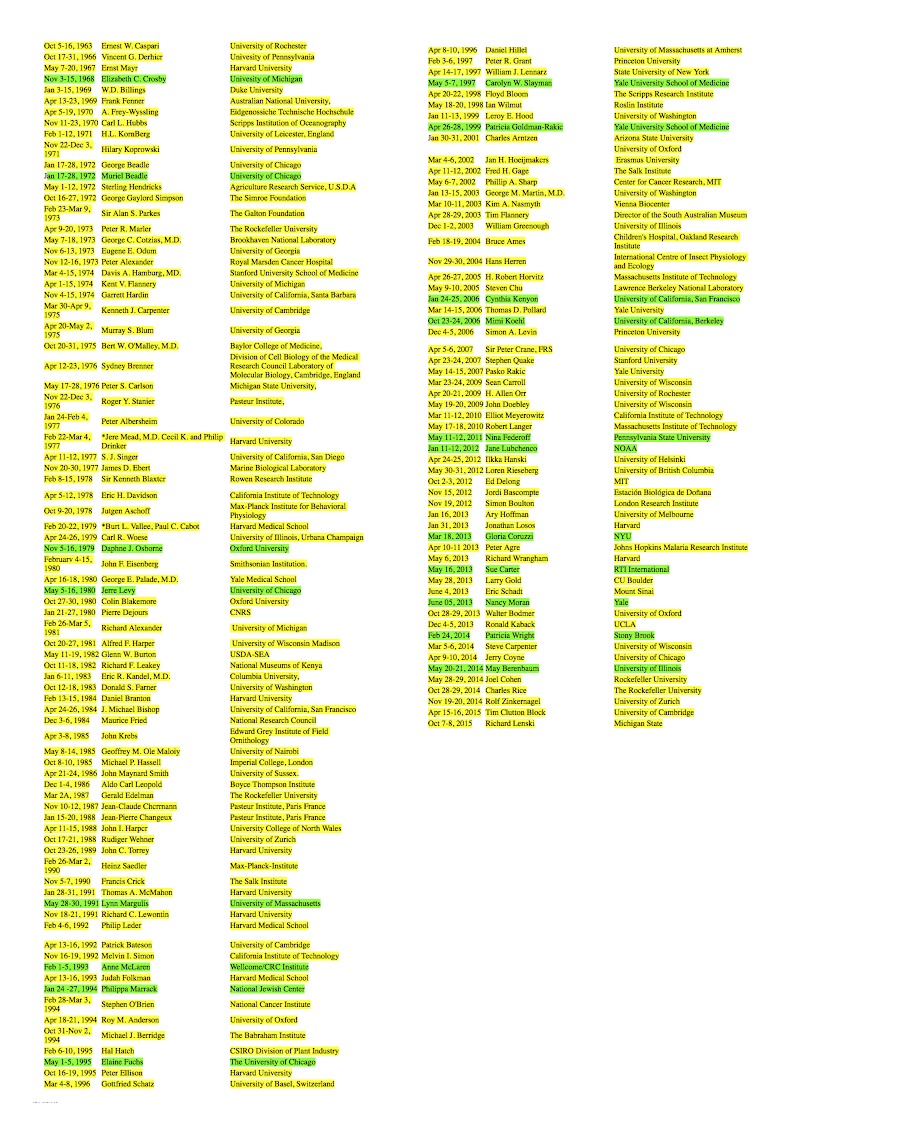
And that is when I got a bit heartbroken. The speakers have been, well, very male. I note I spent a while looking at descriptions of each speaker that I did not know to try and determine their gender, looking at their web sites if available, or how they were described (e.g., what pronouns were used). I am pretty confident in the assignments though I realize this is an error prone approach. Here is the full list as far as I have put together with the males labelled in yellow and females in green.
| Oct 5-16, 1963 |
Ernest W. Caspari |
University of Rochester |
| Oct 17-31, 1966 |
Vincent G. Derhicr |
Univesity of Pennsylvania |
| May 7-20, 1967 |
Ernst Mayr |
Harvard University |
| Nov 3-15, 1968 |
Elizabeth C. Crosby |
Univesity of Michigan |
| Jan 3-15, 1969 |
W.D. Billings |
Duke University |
| Apr 13-23, 1969 |
Frank Fenner |
Australian National University, |
| Apr 5-19, 1970 |
A. Frey-Wyssling |
Eidgenossiche Tcchnische Hochschule |
| Nov 11-23, 1970 |
Carl L. Hubbs |
Scripps Institution of Oceanography |
| Feb 1-12, 1971 |
H.L. KornBerg |
University of Leicester, England |
| Nov 22-Dec 3, 1971 |
Hilary Koprowski |
University of Pennsylvania |
| Jan 17-28, 1972 |
George Beadle |
University of Chicago |
| Jan 17-28, 1972 |
Muriel Beadle |
University of Chicago |
| May 1-12, 1972 |
Sterling Hendricks |
Agriculture Research Service, U.S.D.A |
| Oct 16-27, 1972 |
George Gaylord Simpson |
The Simroe Foundation |
| Feb 23-Mar 9, 1973 |
Sir Alan S. Parkes |
The Galton Foundation |
| Apr 9-20, 1973 |
Peter R. Marler |
The Rockefeller University |
| May 7-18, 1973 |
George C. Cotzias, M.D. |
Brookhaven National Laboratory |
| Nov 6-13, 1973 |
Eugene E. Odum |
University of Georgia |
| Nov 12-16, 1973 |
Peter Alexander |
Royal Marsden Cancer Hospital |
| Mar 4-15, 1974 |
Davis A. Hamburg, MD. |
Stanford University School of Medicine |
| Apr 1-15, 1974 |
Kent V. Flannery |
University of Michigan |
| Nov 4-15, 1974 |
Garrett Hardin |
University of California, Santa Barbara |
| Mar 30-Apr 9, 1975 |
Kenneth J. Carpenter |
University of Cambridge |
| Apr 20-May 2, 1975 |
Murray S. Blum |
University of Georgia |
| Oct 20-31, 1975 |
Bert W. O’Malley, M.D. |
Baylor College of Medicine, |
| Apr 12-23, 1976 |
Sydney Brenner |
Division of Cell Biology of the Medical Research Council Laboratory of Molecular Biology, Cambridge, England |
| May 17-28, 1976 |
Peter S. Carlson |
Michigan State University, |
| Nov 22-Dec 3, 1976 |
Roger Y. Stanier |
Pasteur Institute, |
| Jan 24-Feb 4, 1977 |
Peter Albersheim |
University of Colorado |
| Feb 22-Mar 4, 1977 |
*Jere Mead, M.D. Cecil K. and Philip Drinker |
Harvard University |
| Apr 11-12, 1977 |
S. J. Singer |
University of California, San Diego |
| Nov 20-30, 1977 |
James D. Ebert |
Marine Biological Laboratory |
| Feb 8-15, 1978 |
Sir Kenneth Blaxtcr |
Rowen Research Institute |
| Apr 5-12, 1978 |
Eric H. Davidson |
California Institute of Technology |
| Oct 9-20, 1978 |
Jutgen Aschoff |
Max-Planck Institute for Behavioral Physiology |
| Feb 20-22, 1979 |
*Burt L. Vallee, Paul C. Cabot |
Harvard Medical School |
| Apr 24-26, 1979 |
Carl R. Woese |
University of Illinois, Urbana Champaign |
| Nov 5-16, 1979 |
Daphne J. Osborne |
Oxford University |
| Februarv 4-15, 1980 |
John F. Eisenberg |
Smithsonian Institution. |
| Apr 16-18, 1980 |
George E. Palade, M.D. |
Yale Medical School |
| May 5-16, 1980 |
Jerre Levy |
University of Chicago |
| Oct 27-30, 1980 |
Colin Blakemore |
Oxford University |
| Jan 21-27, 1980 |
Pierre Dejours |
CNRS |
| Feb 26-Mar 5, 1981 |
Richard Alexander |
University of Michigan |
| Oct 20-27, 1981 |
Alfred F. Harper |
University of Wisconsin Madison |
| May 11-19, 1982 |
Glenn W. Burton |
USDA-SEA |
| Oct 11-18, 1982 |
Richard F. Leakey |
National Museums of Kenya |
| Jan 6-11, 1983 |
Eric R. Kandel, M.D. |
Columbia University, |
| Oct 12-18, 1983 |
Donald S. Farner |
University of Washington |
| Feb 13-15, 1984 |
Daniel Branton |
Harvard University |
| Apr 24-26, 1984 |
J. Michael Bishop |
University of California, San Francisco |
| Dec 3-6, 1984 |
Maurice Fried |
National Research Council |
| Apr 3-8, 1985 |
John Krebs |
Edward Grey Institute of Field Ornithology |
| May 8-14, 1985 |
Geoffrey M. Ole Maloiy |
University of Nairobi |
| Oct 8-10, 1985 |
Michael P. Hassell |
Imperial College, London |
| Apr 21-24, 1986 |
John Maynard Smith |
University of Sussex. |
| Dec 1-4, 1986 |
Aldo Carl Leopold |
Boyce Thompson Institute |
| Mar 2A, 1987 |
Gerald Edelman |
The Rockefeller University |
| Nov 10-12, 1987 |
Jean-Claude Chcrrnann |
Pasteur Institute, Paris France |
| Jan 15-20, 1988 |
Jean-Pierre Changeux |
Pasteur Institute, Paris France |
| Apr 11-15, 1988 |
John I. Harpcr |
University College of North Wales |
| Oct 17-21, 1988 |
Rudiger Wehner |
University of Zurich |
| Oct 23-26, 1989 |
John C. Torrey |
Harvard University |
| Feb 26-Mar 2, 1990 |
Heinz Saedler |
Max-Planck-Institute |
| Nov 5-7, 1990 |
Francis Crick |
The Salk Institute |
| Jan 28-31, 1991 |
Thomas A. McMahon |
Harvard University |
| May 28-30, 1991 |
Lynn Margulis |
University of Massachusetts |
| Nov 18-21, 1991 |
Richard C. Lewontin |
Harvard University |
| Feb 4-6, 1992 |
Philip Leder |
Harvard Medical School |
| Apr 13-16, 1992 |
Patrick Bateson |
University of Cambridge |
| Nov 16-19, 1992 |
Melvin I. Simon |
California Institute of Technology |
| Feb 1-5, 1993 |
Anne McLaren |
Wellcome/CRC Institute |
| Apr 13-16, 1993 |
Judah Folkman |
Harvard Medical School |
| Jan 24 -27, 1994 |
Philippa Marrack |
National Jewish Center |
| Feb 28-Mar 3, 1994 |
Stephen O’Brien |
National Cancer Institute |
| Apr 18-21, 1994 |
Roy M. Anderson |
University of Oxford |
| Oct 31-Nov 2, 1994 |
Michael J. Berridge |
The Babraham Institute |
| Feb 6-10, 1995 |
Hal Hatch |
CSIRO Division of Plant Industry |
| May 1-5, 1995 |
Elaine Fuchs |
The University of Chicago |
| Oct 16-19, 1995 |
Peter Ellison |
Harvard University |
| Mar 4-8, 1996 |
Gottfried Schatz |
University of Basel, Switzerland |
| Apr 8-10, 1996 |
Daniel Hillel |
University of Massachusetts at Amherst |
| Feb 3-6, 1997 |
Peter R. Grant |
Princeton University |
| Apr 14-17, 1997 |
William J. Lennarz |
State University of New York |
| May 5-7, 1997 |
Carolyn W. Slayman |
Yale University School of Medicine |
| Apr 20-22, 1998 |
Floyd Bloom |
The Scripps Research 1nstitute |
| May 18-20, 1998 |
Ian Wilmut |
Roslin Institute |
| Jan 11-13, 1999 |
Leroy E. Hood |
University of Washington |
| Apr 26-28, 1999 |
Patricia Goldman-Rakic |
Yale University School of Medicine |
| Jan 30-31, 2001 |
Charles Arntzen |
Arizona State University |
|
|
University of Oxford |
| Mar 4-6, 2002 |
Jan H. Hoeijmakcrs |
Erasmus University |
| Apr 11-12, 2002 |
Fred H. Gage |
The Salk Institute |
| May 6-7, 2002 |
Phillip A. Sharp |
Center for Cancer Research, MIT |
| Jan 13-15, 2003 |
George M. Martin, M.D. |
University of Washington |
| Mar 10-11, 2003 |
Kim A. Nasmyth |
Vienna Biocenter |
| Apr 28-29, 2003 |
Tim Flannery |
Director of the South Australian Museum |
| Dec 1-2, 2003 |
William Greenough |
University of Illinois |
| Feb 18-19, 2004 |
Bruce Ames |
Children’s Hospital, Oakland Research Institute |
| Nov 29-30, 2004 |
Hans Herren |
International Centre of Insect Physiology and Ecology |
| Apr 26-27, 2005 |
H. Robert Horvitz |
Massachusetts Institute of Technology |
| May 9-10, 2005 |
Steven Chu |
Lawrence Berkeley National Laboratory |
| Jan 24-25, 2006 |
Cynthia Kenyon |
University of California, San Francisco |
| Mar 14-15, 2006 |
Thomas D. Pollard |
Yale University |
| Oct 23-24, 2006 |
Mimi Koehl |
University of California, Berkeley |
| Dec 4-5, 2006 |
Simon A. Levin |
Princeton University |
| Apr 5-6, 2007 |
Sir Peter Crane, FRS |
University of Chicago |
| Apr 23-24, 2007 |
Stephen Quake |
Stanford University |
| May 14-15, 2007 |
Pasko Rakic |
Yale University |
| Mar 23-24, 2009 |
Sean Carroll |
University of Wisconsin |
| Apr 20-21, 2009 |
H. Allen Orr |
University of Rochester |
| May 19-20, 2009 |
John Doebley |
University of Wisconsin |
| Mar 11-12, 2010 |
Elliot Meyerowitz |
California Institute of Technology |
| May 17-18, 2010 |
Robert Langer |
Massachusetts Institute of Technology |
| May 11-12, 2011 |
Nina Federoff |
Pennsylvania State University |
| Jan 11-12, 2012 |
Jane Lubchenco |
NOAA |
| Apr 24-25, 2012 |
Ilkka Hanski |
University of Helsinki |
| May 30-31, 2012 |
Loren Rieseberg |
University of British Columbia |
| Oct 2-3, 2012 |
Ed Delong |
MIT |
| Nov 15, 2012 |
Jordi Bascompte |
Estación Biológica de Doñana |
| Nov 19, 2012 |
Simon Boulton |
London Research Institute |
| Jan 16, 2013 |
Ary Hoffman |
University of Melbourne |
| Jan 31, 2013 |
Jonathan Losos |
Harvard |
| Mar 18, 2013 |
Gloria Coruzzi |
NYU |
| Apr 10-11 2013 |
Peter Agre |
Johns Hopkins Malaria Research Institute |
| May 6, 2013 |
Richard Wrangham |
Harvard |
| May 16, 2013 |
Sue Carter |
RTI International |
| May 28, 2013 |
Larry Gold |
CU Boulder |
| June 4, 2013 |
Eric Schadt |
Mount Sinai |
| June 05, 2013 |
Nancy Moran |
Yale |
| Oct 28-29, 2013 |
Walter Bodmer |
University of Oxford |
| Dec 4-5, 2013 |
Ronald Kaback |
UCLA |
| Feb 24, 2014 |
Patricia Wright |
Stony Brook |
| Mar 5-6, 2014 |
Steve Carpenter |
University of Wisconsin |
| Apr 9-10, 2014 |
Jerry Coyne |
University of Chicago |
| May 20-21, 2014 |
May Berenbaum |
University of Illinois |
| May 28-29, 2014 |
Joel Cohen |
Rockefeller University |
| Oct 28-29, 2014 |
Charles Rice |
The Rockefeller University |
| Nov 19-20, 2014 |
Rolf Zinkernagel |
University of Zurich |
| Apr 15-16, 2015 |
Tim Clutton Block |
University of Cambridge |
| Oct 7-8, 2015 |
Richard Lenski |
Michigan State |
| April 22, 2016 |
Steve Nowicki |
Duke University |
The total numbers come to 19 females out of 142 speakers or ~13% female and 87% male. Ugh.
And the person I had suggested to invite was male. So I wrote back to the organizers and I wrote:
From: Jonathan Eisen
Sent: Thursday, June 11, 2015 11:34 AM
To: XXXCc: XXX
Subject: Abyssmal gender ratio of speakers in the Storer Lectureship series
XXX and XXXX
With sincere apologies but …
In preparing a letter of invitation for XXX I decided to include some examples of previous Storer Lecturers. And therein lies the problem On the web sitehttp://www.dbs.ucdavis.edu/seminars_and_events/storer_lecture_list.htmlfrom my count, there are 121 past speakers listed. Of these, 15 appear to be female (from my estimate). That comes to 12%. That is embarassaingly low. I hope my calculations here are wrong.
Can you tell me if the Storer Lectureship has any policies regarding diversity of speakers? If yes, can you provide me with those details.
If no, I recommend you implement one as soon as possible. Either way, I refuse to have my name affiliated with this series, and will not invite anyone to talk in it, without further information and without some serious attempt to figure out how to do a better job representing the diversity of biologists who could give such talks.
Jonathan
They wrote back with a very detailed response and were very supportive of the concept of increasing diversity of speakers. And they explained some of the efforts they had made in this regard. And they really seem to be trying in some ways. But in the end, their main justification for the lack of diversity was that they were trying to invite already recognized, in essence famous, biologists. People who had won a Nobel or were in the National Academy of Sciences or were HHMI investigators. And this pool, that they had chosen, was skewed in gender balance.
So I wrote back to them June 18:
All
Thanks very much for the response.
I understand you have some constraints and greatly appreciate that you are committed to trying to improve the diversity of speakers. However, the end result is truly not acceptible in my mind and therefore I believe more needs to be done, urgently, to improve the situation.
What are some possible ways to improve the situation?
Well, the number one recommendation I would make would be to not constrain the pool to honorific groups that themselves have severe skews. No we cannot solve those skews and there are many causes for them. But I believe it is a major mistake to use the diversity of those groups (NAS, Nobel, HHMI) as a target. Either invite people to represent diversity well even from a constrained pool, or, open up to a broader pool (there are plenty of incredible scientists who have not gotten HHMI, NAS, or Nobels).
In addition to opening up the pool and not aiming at such a low bar, there are many things one can do to improve the diversity of speakers. I have written about this extensively as have many others. I can point the committee to some of these articles if interested.
In the end, whatever the reasons are, the Storer series has ended up with extremely biased gender ratio of speakers. I think it is up to the committee to fix this with a combination of actions. But the first thing I would recommend is to not use the diversity of a set of pools you have chosen as an excuse. We can and should do better and if the pools are the reason, the pools from which you sample need to be changed.
Jonathan
They wrote back, saying they were really committed to achieving better gender balance in the future writing “we are totally committed to the same goals as you in terms of gender balance now and in the future.” And they also wrote that they expected “the final lineup to reflect at least 30 percent or more female” as long as one additional woman (the person I had originally recommended) would come (though I had told them she said she could not). And then they asked if I would reconsider inviting the man who I had been about to invite that had started this whole discussion.
So I wrote back again July 14:
Thanks again for the response. And though I do not want to continue beating a dead horse, I am not convinced we are doing enough in this area. For example, what explains the “at least 30 percent” and how close to 30% will that be. This is important as, for example, the National Science Foundation will not support their people attending meetings if female speakers are at < 33%. I think 30% is, to be honest, just not acceptable in biology. So beofre contributing any more to this series I need to know exactly what is meant by "we are totally committed to the same goals as you in terms of gender balance now and in the future.”
For example, here are some questions I would like to know the answers to:
- Are you committed to achieving gender balance in the speaker series or just saying you are being more even than before?
- Are you committed to researching and using diverse options to ensure diversity of speakers beyond just focusing on who is invited?
- Are you interested in understanding why the series has been so undiverse in the past and addressing this directly or just moving forward?
- Are you willing to address the lack of diversity in the past publicly and also discuss efforts to improve the diversity?
I would very much like to know more detail about how serious you are to having a diverse series and what you plan to do to achieve this.
With apologies, but in regard to inviting XXX or XXX. I am sorry but given the past record of this series, which as I said is among the worst I have seen anywhere, I am just not willing to be involved in any way until I see a stronger and more public committment to diversity.
I am happy to help with the series and to help improve the diversity of speakers. But this should be done openly and publicly and forcefully. And without evidence of this, I am unable and unwilling to be involved.
And, well, I have not heard from them again. So, I am writing this. For many reasons. But a key one is, I think we need to be more public about such issues. And we just need to fix things that are broken.
So today I decided to make the post live. I wish I had done this earlier.

Some responses
https://www.facebook.com/plugins/post.php?href=https%3A%2F%2Fwww.facebook.com%2Fjonathaneisen%2Fposts%2F10154012819435767&width=500
//platform.twitter.com/widgets.js
//platform.twitter.com/widgets.js
//platform.twitter.com/widgets.js







 Jonathan Eisen's Lab