What scientists should be thankful for …

Well, it is Thanksgiving. I am up late as usual catching up on email. On this day, there is something I have been meaning to post for a few years. I think scientists should take a breath today and give thanks to those who have helped them along the way. I have some specific postings about this in terms of who I want to thanks, but I wanted to make a list here of the types of things scientists should be thankful for. So here goes.

10 things scientists should be thankful for

  1. Teachers. Scientists had to learn science at some point. And most of us have had some stellar science teachers, or teachers of science-related things like math, along the way. We should give thanks to these people.
  2. Inspirers. Similar to #1 except in many cases we have been inspired to become scientists by someone who may not have been a teacher of ours. Perhaps it was a famous scientist, or even a fictional one. Or even someone we knew. It is that inspiration that frequently gets one through the tough times.
  3. Benefactors In general, scientists have a pretty nice life. We get paid (sometimes well, sometimes poorly) and are given research funds, to unlock the secrets of the universe. How cool is that? We should therefore be very thankful for the immediate source of our funds – such as the institutes where we work and the agencies that provide us funds.
  4. Taxpayers. Unless one is funded by private foundations, taxpayers are the ultimate source of those funds mentioned in #3. This source of funds is frequently overlooked but should never be forgotten. Don’t forget – we take money people from people that in theory they could have gotten to keep if their taxes were lower. We should thank these taxpayers..
  5. Research personnel (including student researchers, post docs, technicians, etc). Most of the time, scientists get credit for some work that was in a large part actually done by people in our labs. They deserve our eternal gratitude.
  6. Students we teach. Overall, for those scientists who teach, though it may be a required part of our jobs, it is also a great way to learn and to become a better scientist.
  7. Staff at publishers. An important part of communicating science is of course publishing. And though I am a big fan of new ways to disseminate information, let us not forget that there are many many people who aid and abet this dissemination by working for publishers. These folks deserve our thanks.
  8. Study subjects or objects. Whether one studies organisms, rocks, molecules, planets, forces, or whatever, we should all be thankful that there is interesting stuff out there to study. And for those who study living things, if one disturbs them along the way, we should
  9. Librarians and library staff. Access to information is critical for both learning to become a scientist and being a scientist. And libraries play a key role in providing this access.
  10. Family and friends. Late nights at the lab? Working on a grant over the weekend? Writing papers all the time? In school for years and years? All of this takes a toll on friends and family. And we owe them some props.

I am sure there are more categories. But these are some that came to me on this Thanksgiving. Any categories I missed?

Tackling a Hairy Beast II

For all out there who love ciliates and their relatives, you might want to check out the second paper to come out of my Tetrahymena thermophila Genome Sequencing Project for which the preprint is available in BMC Genomics.
In this project we have been sequencing, annotating and finishing the macronuclear genome of this lovely organism. Like other ciliates Tetrahymena has two nuclei and two nuclear genomes – the macronucleus (MAC) and the micronucleus (MIC). The MIC is analogous to germ cells in animals — it is sort of a genomic repository for sexual reproduction. After sexual reproduction, the MIC genome is processed to generate the MAC genome which is then used in an analogous way to soma cells in animals (the MAC is the site for most/all gene expression in Tetrahymena). I have been the PI on this project which was supported by grants from NSF and NIH and was a collaboration involving TIGR (where I used to work), Stanford, UCSB, JCVI (which subsumed TIGR a few years ago) and the Tetrahymena research community.
Our first paper on this project was published in PLoS Biology two years ago. I have written about it previously here.

The new paper describes further work on the MAC genome including finishing many of the chromosomes (which was done spectacularly by Luke Tallon and Kristie Jones), sequencing and analyzing a larger number of ESTs, refining the annotation (coordinated by Mathangi Thiagarajan), and some other analyses. The new paper was led by Bob Coyne, who, with Barb Methé took over coordinating the work at TIGR/JCVI after I moved to UC Davis a few years back. I think they did a stellar job (ni biases here).

Note – I took the title of the posting ‘Tackling a Hairy Best” from an NIH press release that was put out when we got the grants for this project.

Attack of the Robo Lizards from Davis

OK – the robo lizards are not attacking. But they are used for some cool behavioral science research here at Davis. Terry Ord and Judy Stamps from UC Davis have a new paper in PNAS coming out this week where they used robo lizards to study the behavior of Anole Lizards. Check out the UCD news site here which has some videos (UC Davis News & Information :: Robo-lizards Help Prove Long-Standing Signaling Theory)

Open Metagenomics Highlight – Metagenome Annotation using massively parallel undergrads.


Another fun metagenomics related paper in PLoS Biology. In it Pascal Hingamp et al discuss an Open Source, Open Science system for metagenome annotation (see PLoS Biology – Metagenome Annotation Using a Distributed Grid of Undergraduate Students).

They do this as part of a course on metagenome annotation. And the software for running this is all Open Source and available. They say

“Teachers wishing to use the Annotathon for their courses are invited to create new teams on the public server at http://annotathon.univ-mrs.fr/ (course logistics and team management are detailed in the instructor manual:http://annotathon.univ-mrs.fr/Metagenes/index.php/Instructor_Manual). The underlying open-source software (PHP and MySQL scripts, under a General Public License) is also available for local installation (https://launchpad.net/annotathon/). In addition, a special “Open Access” team is available for freelance students (volunteer instructors are most welcome to help oversee the Open Access team).”

IN a way this is a metagenomics version of the Undergraduate Genomics Research Initiative (UGRI) which was described in a PLoS Biology paper previously.

Well, this is really the end all be all for me combining so many things I like – genomics, metagenomics, annotation, OA publishing, open source software, etc. Nice job Pascal et al …

Open Microbial Diversity: PLoS papers on using 454-Roche pyrosequencing for rRNA studies

ResearchBlogging.org

Two new papers that just came out in PLoS Journals are definitely worth checking out. They are

Of course I am a bit biased I suppose as I am heavily involved in PLoS and also served as Academic Editor for these papers. But with that being said, I encourage people to check them out. In the PLoS Genetics paper from the labs of Mitch Sogin and David Relman labs discusses continued development of the use of 454-Roche pyrosequencing technology to carry out deep rRNA sampling. Anybody interested in characterizing a microbial community deeply in terms of what organisms are there should consider this approach.

And in the second paper, the same two labs present an in depth study using the 454-Roche rRNA sequencing to characterize the response of microbes in the human gut to antibiotic treatment. Though there have been a few other such studies this is the one that has the deepest characterization of the microbes present.

Note – one thing I find kind of humorous is that one of the authors is listed as Susan M. Huse in one of the papers (she is the first author on the PLoS Genetics paper) and Sue Huse in the other.

Huse, S., Dethlefsen, L., Huber, J., Welch, D., Relman, D., & Sogin, M. (2008). Exploring Microbial Diversity and Taxonomy Using SSU rRNA Hypervariable Tag Sequencing PLoS Genetics, 4 (11) DOI: 10.1371/journal.pgen.1000255

Dethlefsen, L., Huse, S., Sogin, M., & Relman, D. (2008). The Pervasive Effects of an Antibiotic on the Human Gut Microbiota, as Revealed by Deep 16S rRNA Sequencing PLoS Biology, 6 (11) DOI: 10.1371/journal.pbio.0060280

Open Genomics: Genome Evolution Simulator

Quick post here.   Cool new paper (and the software could be cool too but have not tried it yet) on simulating genome evolution.  The paper is from Ian Holmes and others at Berkeley (see his lab page on BioWiki here) and the paper can be found here in Genome Biology. Here is the abstract:

Controlled simulations of genome evolution are useful for benchmarking tools. However, many simulators lack extensibility and cannot measure parameters directly from data. These issues are addressed by three new open-source programs: GSIMULATOR (for neutrally evolving DNA), SIMGRAM (for generic structured features) and SIMGENOME (for syntenic genome blocks). Each offers algorithms for parameter measurement and reconstruction of ancestral sequence. All three tools out-perform the leading neutral DNA simulator (DAWG) in benchmarks. The programs are available at http://biowiki.org/SimulationTools.

Genomicron on Science by press release.

Just a quick one here. Ryan Gregory is going on against science by press release – one of my biggest pet peeves. Check it out at:

Genomicron: Science by press release.

I see PLoS in everything IV: PLoS at Metagenomics 2008 meeting

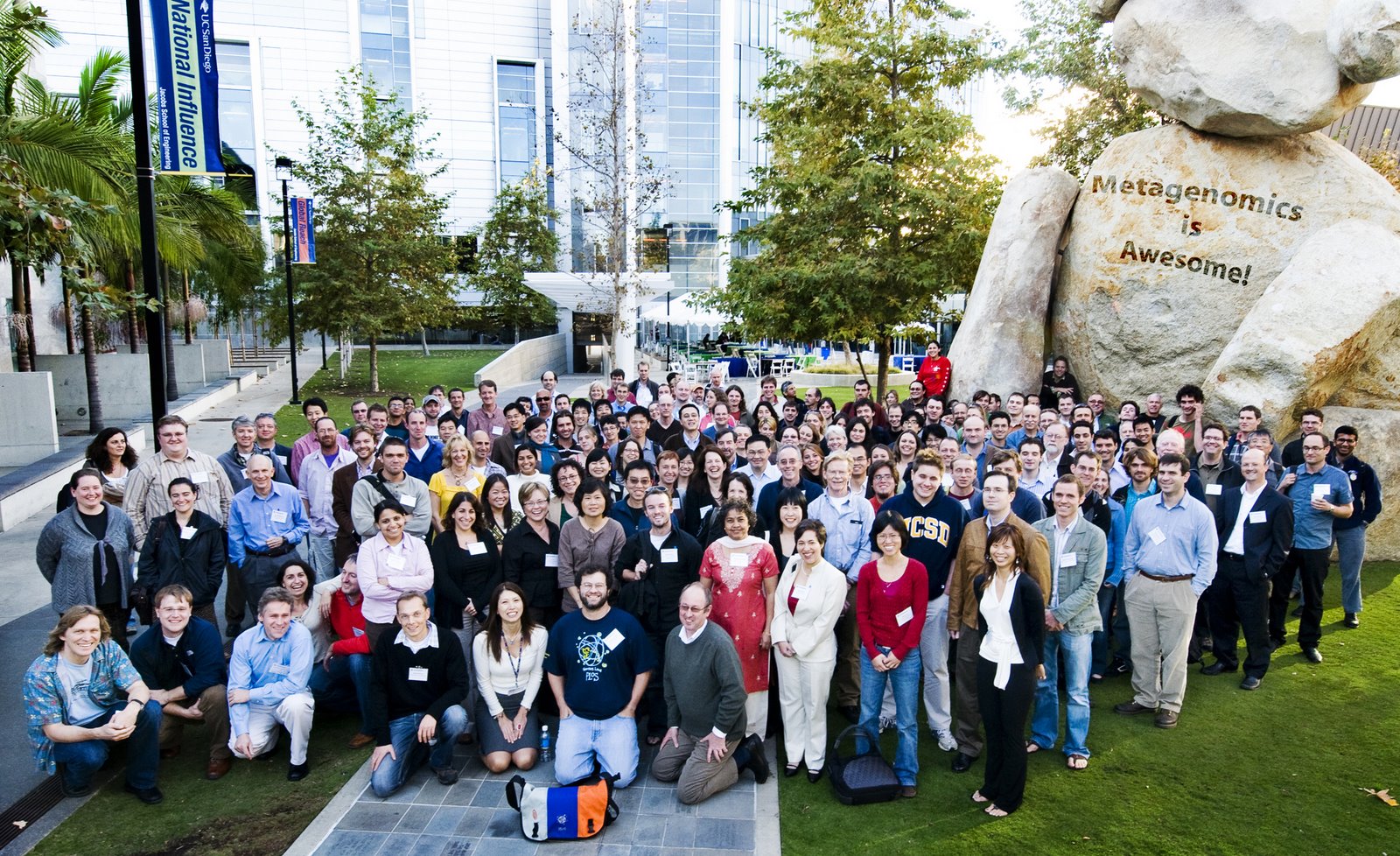
I may see PLoS even when it is not there, but in this picture, which was the group photo for the Metagenomics 2008 meeting at CalIT2, I weaseled my way to the front hoping to get my PLoS bag and PLoS shirt into the picture. And looky there – it worked.

Woodland Native Dustin Pedroia Wins AL MVP Award

As a Boston native, one of the worries I had moving out to Davis a few years ago related to being too far from the RedSox, Sure they come to Oakland and sure my brother has season tickets to the A’s mostly to get RedSox tickets, but California is really far from Fenway Park. Well, at least there are lots of RedSox fans around here, especially if I go up to Woodland. Woodland, if you do not know, is the home town of the newest RedSox superstar, Dustin Pedroia, who nearly carried the Sox into the World Series and today was awarded the American League MVP Award. Way to go Dustin and thanks Woodland for helping out my team.

Visit to the Raptor Center and Putah Creek

Just thought I would share some pics from a nice outing we had yesterday. We went to the UC Davis Raptor Center for their open house and then went for a walk along Putah Creek.

http://picasaweb.google.com/s/c/bin/slideshow.swf