Attention – all interested in synthetic biology – DARPA is interested, big time

For those interested in synthetic biology, check out the new DARPA call for proposals: Living Foundries: Advanced Tools and Capabilities for Generalizable Platforms (ATCG) – Federal Business Opportunities: Opportunities

And check out the “teaming” site trying to bring together groups and people with diverse backgrounds and interests. Kudos to Alicia Jackson at DARPA and DARPA in general for recognizing the importance of synthetic biology.

I note – Alicia Jackson’s announced this push at the Synthetic Biology meeting at Stanford earlier in the summer:

For some other information about this see:

Figuring out FigShare (@FigShare) & Digging into Digital Science (@digitalsci) #OpenData

Digital Science I do not really know much about but am learning because, well, a big supporter of open science, Kaitlin Thaney (who I note, is also a friend), moved there relatively recently and I want to figure out what she does and what they do.
Digital Science has some detail in the “about” section on their home page. Some key points:
Digital Science provides software and information to support researchers and research administrators in their everyday work, with the ultimate aim of making science more productive through the use of technology. As well as developing our own solutions, we also invest in promising start-ups and other partners, working closely with them to help them realise their full potential.
We are a business unit of Macmillan Publishers Ltd. and our activities build on the reputation for editorial and technological excellence of its sister company, Nature Publishing Group (NPG).

So basically they partner with and/or acquire companies that are playing with new technologies for communicating science. OK. I can wrap my brain around that at least for now. Whatever Digital Science does is not the point of my post here though. FigShare is.


FigShare is an interesting take on the movement to get people to share and release more unpublished/prepublication data sets. From their website:

FigShare is is a permanent, citable archive for pre-publication research and preliminary findings.

FigShare is the first online repository for storing and sharing all of your prelimonary findings in the form of individual figures or datasets. Post preprint figures on FigShare to claim priority and receive feedback on your findings prior to formal publication.

So in essence FigShare is trying to be an ArXiv for data sets (and figures presenting summaries of data).

One very nice thing – under FigShare data sets are published under a CC0 license which in essence puts the data into the public domain. And Figures and Media are published under a CC BY3.0 license which is pretty broad (attribution required).

They also emphasize a goal of getting people to deposit so-called negative results (which might be hard to publish in a traditional paper I suppose). However, it seems that this system is really for any type of prepublication release of data or media or figures.

Lots of cool things happening these days in terms of data sharing efforts.  Most of it I am still learning about so maybe I should not even try to summarize it.  But if others out there want to post links to other open data efforts that would be great.

Anyway – the Digital Science and FigShare thing caught my eye and just thought I would dig a little into them and post a few details.

UPDATE: Decided to post some Figures from Fig Share for people to check out:

From http://figshare.com/figures/index.php/File:Gkj042f1.jpg

Phylogenetic tree of the isolates in this outbreak together with some other PRRSV strains with known genome sequences. Kegong Tian, Xiuling Yu, Tiezhu Zhao, Youjun Feng, Zhen Cao, Chuanbin Wang, Yan Hu, Xizhao Chen, Dongmei Hu, Xinsheng Tian, Di Liu, Shuo Zhang, Xiaoyu Deng, Yinqiao Ding, Lu Yang, Yunxia Zhang, Haixia Xiao, Mingming Qiao, Bin Wang, Lili Hou, Xiaoying Wang, Xinyan Yang, Liping Kang, Ming Sun, Ping Jin, Shujuan Wang, Yoshihiro Kitamura, Jinghua Yan, George F. Gao. FigShare. Retrieved 07:18, September 9, 2011

There are of course, lots more ….

Wondering when doctors offices are going to have charts on the microbiome

P198

Garage science: why skyping in to a meeting at 2:30 AM can be, well, interesting #SOLO11

Well, that was in a way fun.  I was a part of a discussion panel for the Science Online London 2011 meeting.  However, I did not go to London … I did it from my garage.  More about this below:

I got an email many months ago inviting me to participate in a panel discussion for a Science Online Meeting in London.  The discussion was to focus on the NASA arsenic life story and how this related to open science issues.  Now even though the one and only Kaitlin Thaney invited me, I alas said “it’s going to be hard for me to get to London at that time” and eventually we settled on the idea of me skyping in for the panel.

And I sort of forgot about this for a bit.

And then Joerg Heber emailed me with some comments about the panel and there was an email discussion among the panelists about details.  And in the midst of all of this Joerg pointed out that the panel was at 10:15 AM London time.  All along I had thought it was going to be in the evening in London.  10:15 AM London time is 2:15 AM California time.  And thus I started to freak out a little bit.  How was I going to pull this off?  I have two young kids.  And my house is very open in design so there is nowhere to go where people can’t hear you.  I would wake up everyone if I talked on a panel from inside my house …  hmmm

Anyway – here are some twitter posts that will give you a feel for how things played out from a mechanical point of view:

silentypewriter Ed Gerstner
Getting psyched for panel discussion with @ivanoransky @rosieredfield @phylogenomics @joergheber at #solo11bit.ly/rtSwpY2 Sep

phylogenomics Jonathan Eisen
Perils of an open house design; am skyping in to #scio11 panel from home at 2:15 AM but have to do it from garage to avoid waking up kids
2 Sep

kristiholmes Kristi Holmes
@phylogenomics I gave an online talk last year @ ORCID participants meeting in almost the same manner (3am local time) #coffeeisessential2 Sep

phylogenomics Jonathan Eisen
@kristiholmes the cricket in the background will be fun
2 Sep

phylogenomics Jonathan Eisen
Perils of an open house design; am skyping in to #solo11 panel from home at 2:15 AM but have to do it from garage to avoid waking up kids
2 Sep

ryneches Russell Neches
@phylogenomics You have a hot tub now. You should phone it in from there, like a movie villain.
2 Sep

sjcockell Simon Cockell
Skyping in @phylogenomics for the panel session now…twitpic.com/6eswaa 2 Sep

lualnu10 Marisa Alonso Nuñez
3 present speakers and the 4th one on skype (it’s 2:30 am for him) lol #solo11 2 Sep

LouWoodley Lou Woodley
“I don’t think you want my video” – big star @phylogenomicsskype-ing in for panel discussion on linking with the literature #solo112  Sep

rmounce Ross Mounce
“I dont think you want my video” @phylogenomics LOL! (skyping in to #solo11 at 2am from the garage)
2 Sep

vibjpatel Vibhuti J. Patel
Truly online conferencing at #solo11 – Skyping in a panellist from California for the discussion on Linking with the Literature #arseniclife 2 Sep

@ryneches Russell Neches
@phylogenomics Right. VILLAIN. Get yourself a chunky cordless phone and some dudes in sunglasses who stand around looking menacing.
2 Sep via web

phylogenomics Jonathan Eisen
This is what skyping from your garage at 2:30 AM in California looks like for all you #solo11 folks post.ly/33cSm 2 Sep

kaythaney Kaitlin Thaney
Dedication 🙂 RT @phylogenomics: This is what skyping from your garage at 2:30 AM in California looks like #solo11 post.ly/33cSm 2 Sep

That’s right … I skyped in from my garage.  In my pajamas.  And thus I refused the video connection.  But other than being exhausted the rest of the day, I think things worked out well.   I will post later with details of the panel and the SOLO meeting since there are some good reports out there.  And I hope audio/video will be posted some time too.

Some links about the meeting:

What is a nice chloroplast like you doing in a parasite like that?

Cool new paper from Joe Derisi’s lab: PLoS Biology: Chemical Rescue of Malaria Parasites Lacking an Apicoplast Defines Organelle Function in Blood-Stage Plasmodium falciparum. by Ellen Yeh and Joseph L. DeRisi. doi: 10.1371/journal.pbio.1001138

In it they use some experimental techniques to try and track down the elusive function of the apicoplast in Plasmodium falciparum, the causative agent of malaria.  The apicoplast is an organelle that is evolutionarily derived from chloroplasts (and thus derived originally from cyanobacteria).  Due to it’s cyanobacterial origins many have thought that it might serve as a good target for drugs to try and kill Plasmodium species because in theory such drugs if specific should not have significant detrimental effects on hosts like humans due to our lack of known important cyanobacterial associates.

Here is their abstract:

Plasmodium spp parasites harbor an unusual plastid organelle called the apicoplast. Due to its prokaryotic origin and essential function, the apicoplast is a key target for development of new anti-malarials. Over 500 proteins are predicted to localize to this organelle and several prokaryotic biochemical pathways have been annotated, yet the essential role of the apicoplast during human infection remains a mystery. Previous work showed that treatment with fosmidomycin, an inhibitor of non-mevalonate isoprenoid precursor biosynthesis in the apicoplast, inhibits the growth of blood-stage P. falciparum. Herein, we demonstrate that fosmidomycin inhibition can be chemically rescued by supplementation with isopentenyl pyrophosphate (IPP), the pathway product. Surprisingly, IPP supplementation also completely reverses death following treatment with antibiotics that cause loss of the apicoplast. We show that antibiotic-treated parasites rescued with IPP over multiple cycles specifically lose their apicoplast genome and fail to process or localize organelle proteins, rendering them functionally apicoplast-minus. Despite the loss of this essential organelle, these apicoplast-minus auxotrophs can be grown indefinitely in asexual blood stage culture but are entirely dependent on exogenous IPP for survival. These findings indicate that isoprenoid precursor biosynthesis is the only essential function of the apicoplast during blood-stage growth. Moreover, apicoplast-minus P. falciparum strains will be a powerful tool for further investigation of apicoplast biology as well as drug and vaccine development.


The author summary is a bit nicer in my opinion:

Malaria caused by Plasmodium spp parasites is a profound human health problem that has shaped our evolutionary past and continues to influence modern day with a disease burden that disproportionately affects the world’s poorest and youngest. New anti-malarials are desperately needed in the face of existing or emerging drug resistance to available therapies, while an effective vaccine remains elusive. A plastid organelle, the apicoplast, has been hailed as Plasmodium’s “Achilles’ heel” because it contains bacteria-derived pathways that have no counterpart in the human host and therefore may be ideal drug targets. However, more than a decade after its discovery, the essential functions of the apicoplast remain a mystery, and without a specific pathway or function to target, development of drugs against the apicoplast has been stymied. In this study, we use a simple chemical method to generate parasites that have lost their apicoplast, normally a deadly event, but which survive—“rescued” by the addition of an essential metabolite to the culture. This chemical rescue demonstrates that the apicoplast serves only a single essential function, namely isoprenoid precursor biosynthesis during blood-stage growth, validating this metabolic function as a viable drug target. Moreover, the apicoplast-minus Plasmodium strains generated in this study will be a powerful tool for identifying apicoplast-targeted drugs and as a potential vaccine strain with significant advantages over current vaccine technologies.

Also see their press release here.

Basically they are trying to use various experimental tricks to figure out which functions of the apicoplast are essential.  Many theories have been proposed over the years as to what the apicoplast is doing.  But few have gained significant evidence.  This paper is an important contribution because it suggests that one pathway in particular is most functionally important: the isopentenyl pyrophosphate (IPP) synthesis pathway.  See their model below:

Figure 5. Model of apicoplast function.
(Top) The essential function of the apicoplast is the production of isoprenoid precursors, IPP and DMAPP, which are exported into the cytoplasm and used to synthesize small molecule isoprenoids and prenylated proteins. Parasites that are unable to synthesize isoprenoid precursors either due to inhibition of the biosynthetic pathway by fosmidomycin or loss of the apicoplast following doxycycline inhibition can be chemically rescued by addition of exogenous IPP (red). The exogenous IPP enters the host cell through unknown membrane transporters and fulfills the missing biosynthetic function. (Bottom) Reaction scheme for MEP pathway biosynthesis of IPP and DMAPP with the enzymatic step inhibited by fosmidomycin indicated.

Anyway – I have always been fascinated by apicoplasts because they are so weird.  They reflect a strange evolutionary history of Apicomplexans in that this is a eukaryotic lineage that at some point brought into itself an entire photosynthetic algal cell as a symbiont.  And for reasons still unknown (if there are reasons …) the chloroplast of the algal symbiont was retained while most of the rest of the symbiont was ditched.  So that the resulting cells looked something like this:

From http://wiki.ericmajinglong.com/index.php?title=A_special_case:_The_apicomplexan_plastid

Evolution is indeed very weird.  And once it was discovered that the apicoplast was in fact derived from chloroplasts (this was discovered using molecular phylogenetics) (e.g., see http://www.sciencedirect.com/science/article/pii/016668519490149X) people have been wondering if it might make a good drug target.  But people have also been wondering – what do Apicomplexans do with a chloroplast like organelle when they do not photosynthesize.  So the Derisi paper is interesting both from a drug treatment point of view but also from an evolution point of view.

Anyway – here are some other links worth looking at:

My science communication hero/heroine of the month – Dr. Kiki @drkiki

Been working on revising my lab’s web site and was looking for some videos of talks I have given online to post there.  And I discovered/rediscovered this video of an interview I did for Dr. Kiki’s Science Hour.  Here it is:

NOTE – AT LEAST TEMPORARILY REMOVING THE VIDEO DUE TO MALWARE INFECTION OF TWIT.TV SITE

Now I know – this is over a year old. But I just watched the full video. Not so bad I think.

As many of you know, I like to talk.  And talk.  And talk.  But I would like to say that as an interviewer, Dr. Kiki is pretty frigging awesome.  Don’t know how she does it.  But I am going to post this video on the new lab page and point people to it if they want to know what my lab does and what I am interested in.

But enough about me.  I want to thank Dr. Kiki for this great interview by saying a little bit about her.  Or, well, her work in science communication.

As some of you may know, I listen to podcasts of TWIS – This Week in Science frequently on my bike rides to work.  And I really recommend anyone/everyone out there give it a whirl.  It is sort of like Science Friday but it is a bit edgier, a bit funnier, a bit goofier, and a bit sciencier (is that a word?)  Dr. Kiki and Justin on it are great and it is so good that I frequently sit outside my building listening to the end of a show if I take the short ride to work which is less than an hour.  So if you like Science – you really should check out the TWIS web site and find some way to listen such as what I do by subscribing to their podcasts at iTunes.

And I guess now I will be checking out “Dr. Kiki’s Science Hour” more after rewatching this video.  There are many many more shows at twit.tv/kiki.  I have not checked out as many as TWIS shows but the ones I have watched are great.

And if you want to follow her more directly check out her Blog: The Bird’s Brain, or her twitter feed  (@drkiki)  or her  Google+ feed.

Very proud that she is a UC Davis alum … and just want to say thanks to her for giving me a video I can share with others that says more about me and my lab than almost anything I have written.

Fun with Pubmed central – first paper describing #HeLa cells – Note @rebeccaskloot

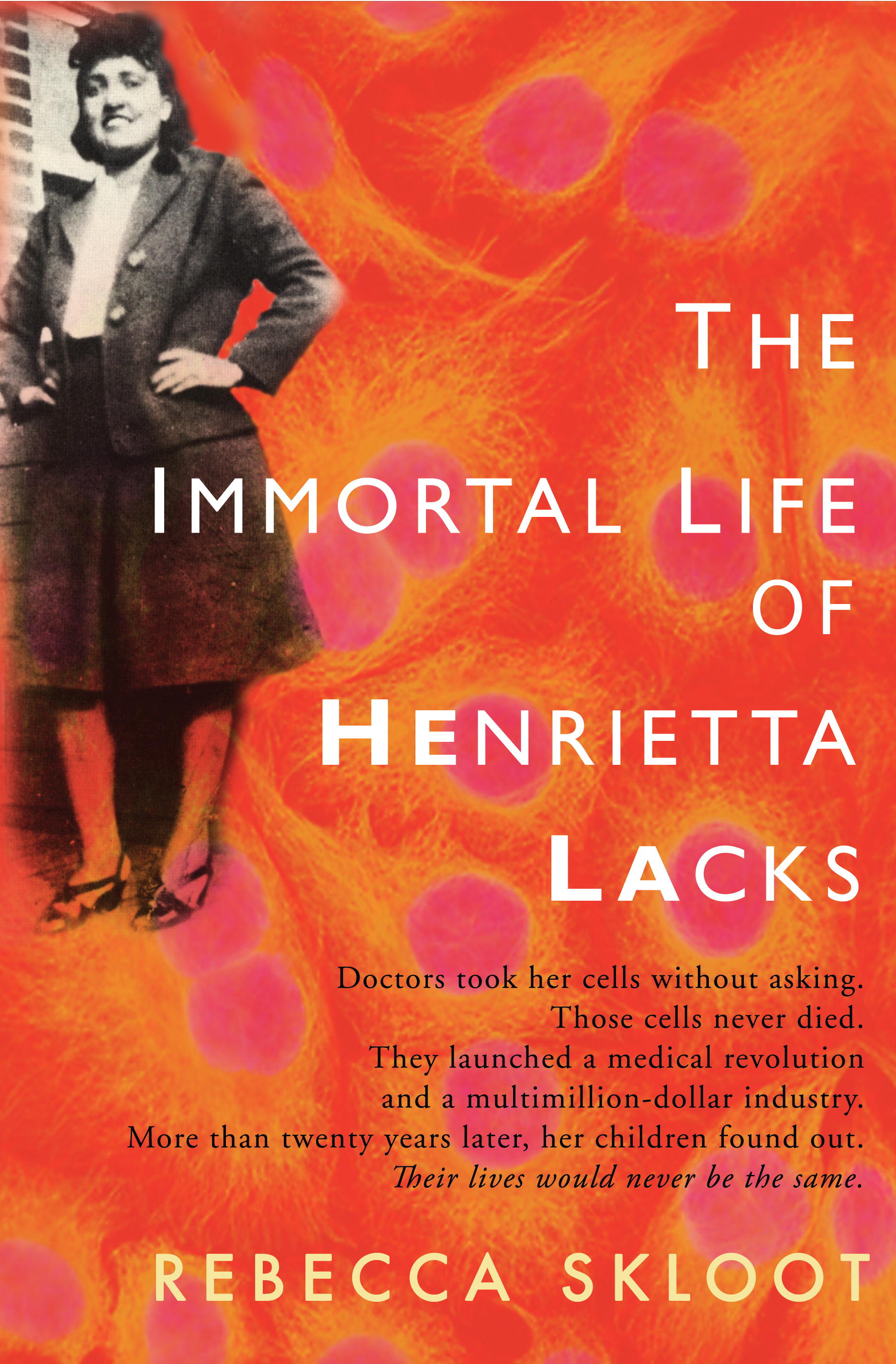
Last year, Rebecca Skloot came to Davis to talk about her book “The Immortal Life of Henrietta Lacks“.  Note – if you have not read the book – what f*$ing rock have you been hiding under?  It is in my opinion the best non fiction book I have ever read.  Seriously.  Not the best science book. The best non fiction book of any kind.  And I am not alone in this feeling as it has won a bazillion positive reviews and awards.   In summary – it tells three stories – the story of the isolation of HeLa cells, the story of the woman from whom those cells came, and the story of Skloot learning the other two stories.

Anyway – I somehow managed to get her to come to UC Davis to give a talk last year just as the book was going viral.  In preparation for Skloot’s visit I decided to do some sort of “open access” schtick and looked into how many papers about HeLa cells were in Pubmed Central.  Pubmed Central is a database of papers for which the full text is available at no charge.  After this mini-research and after interacting with Rebecca over the last year and seeing the well deserved recognition of her book, I have been a bit fascinated about how much of the literature surrounding studies of HeLa cells is openly and/or freely available.

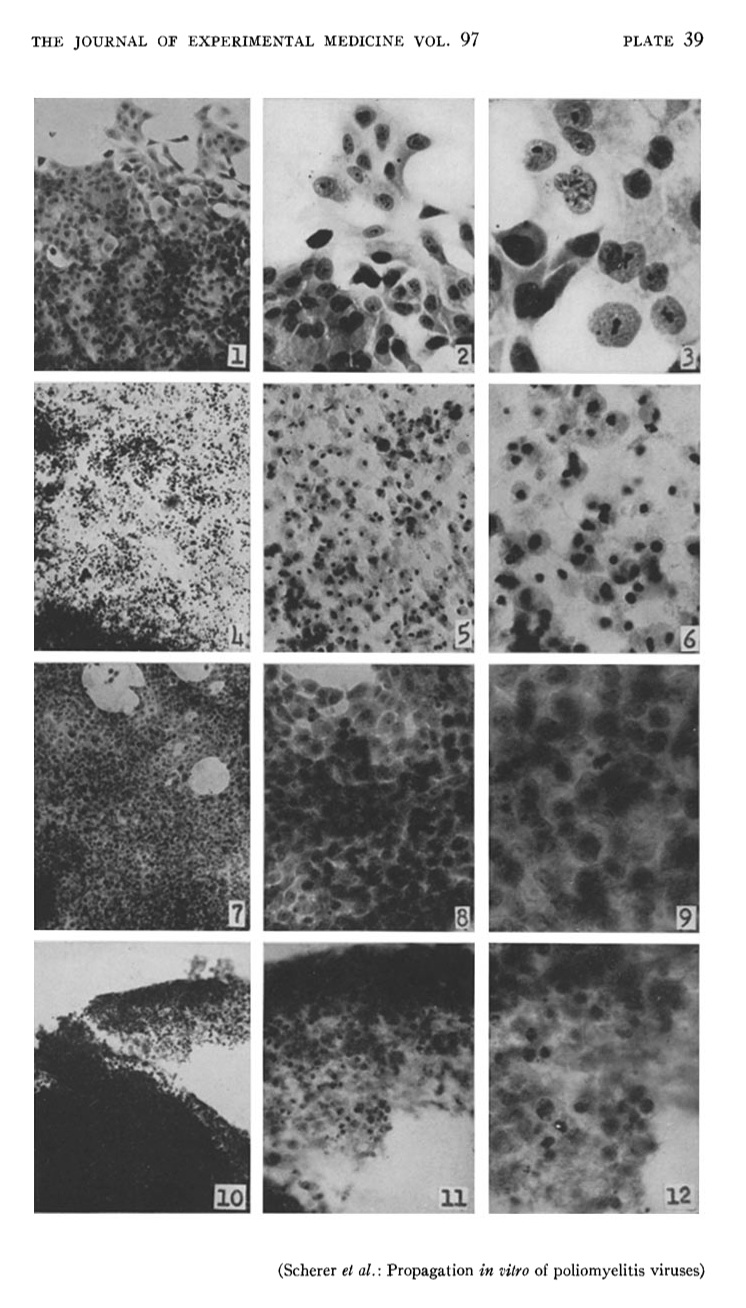
So today I decided to see what was the earliest HeLa paper that was freely available on PubMed Central.  And I managed to find a good one: Studies on the propagation in vitro of poliomyelitis viruses. IV. viral multiplication in a stable strain of human malignant epithelial cells (strain hela) derived from an epidermoid carcinoma of the cervix. William F. Scherer, Jerome T. Syverton, and George O. Gey.  J Exp Med. 1953 May 1; 97(5): 695–710.

I believe this was the first full paper published discussing HeLa cells.  Nice short title by the way. Anyway – good to see it in Pubmed Central.

I note  – I could not find in Pubmed Central the meeting abstract about HeLa cells which was published in 1952 but I did find it from Cancer Research’s online archive here.  I have copied the abstract below, for you HeLa history buffs out there:

TISSUE CULTURE STUDIES OF THE PRO-
LIFERATIVE CAPACITY OF CERVICAL
CARCINOMA AND NORMAL EPITHE-
LIUM. George O. Gey,Ward D. Coffman*
and Mary T. Kubicek *(Departments of
Surgery and Gynecology, Johns Hopkins
Hospital and University, Baltimore 5, Md.

This is a report of an evaluation in vitro of the
growth potential of normal, early intra-epithelial,
and invasive carcinoma from a series of cases of
cervical carcinoma. Comparable cytological and
tissue culture studies were actually carried out on
selected biopsies of normal and neoplastic areas of
the same cervix. Thus far, only one strain of epi-
dermoid carcinoma has been established and
grown in continuous roller tube cultures for al-
most a year. It grows well in a composite medium
of chicken plasma, bovine embryo extract, and
human placenta! cord serum. The autologous nor-
mal prototype is most difficult to maintain under
comparable cultural conditions. Most of the tissue
from other cases showed rapid keratinization of
the cells grown in cultures whether from normal
or neoplastic areas. Some of the hormonal aspects
of the problem will be discussed.

Anyway – if you are interested in HeLa and/or The Immortal Life of Henrietta Lacks, you may find it interesting to check out these early papers on the topic such as the ones described above.  Here are a few more that are from the early era and are freely available:

Pubmed Central is a rich resource not just for accessing scientific papers but for learning about science history too.  It is a good thing that articles in Pubmed Central are available at no charge and here’s hoping that sometime soon that past and present and future science papers will be more readily available to all.

UPDATE ———-
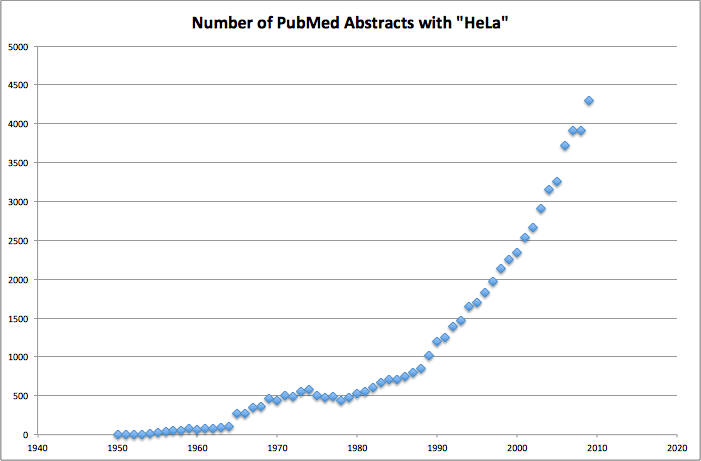
John Hogenesch from U. Penn made a nice figure of relevance and agreed to let me post it:

And he comments “You can see several things, Nixon’s “war on cancer” in the early 70s and the dawn of the cell/molecular biology age in the 80s and expansion in the 90s.”

Thanks John …

Tom Sharpton talking in lab meeting

Sharpton discussion classifying Metagenomic reads into functional diversity