PBGG Seminar
“Messages from the Arctic: Transcriptome analysis of an Arctic mustard flower color polymorphism”
Speaker: Dr. Justen Whittall
Santa Clara University
Friday, October 19, 2012
12:10 – 1:00 PM
1022 Life Sciences
Host: Daniel Fulop
PBGG Seminar
“Messages from the Arctic: Transcriptome analysis of an Arctic mustard flower color polymorphism”
Speaker: Dr. Justen Whittall
Santa Clara University
Friday, October 19, 2012
12:10 – 1:00 PM
1022 Life Sciences
Host: Daniel Fulop
Interesting story in thge BBC News on a paper from PLoS Pathogens: BBC News – Faecal transplant clue to treating gut bug (seems that the article has disappeared – maybe they jumped the Embargo? — anyone — found another version here). In the work, researchers from the Sanger Institute infected mice with Clostridium difficile and then treated them with different combinations of microbes isolated from mouse feces. In the end they are reported to have identified a combination of six strains that was highly effective in clearing the C. difficile infections. I say “reported to have …” because I cannot find the PLoS Pathogens paper, again suggesting to me that the BBC story may have somehow jumped the embargo. Will post more when more comes out.
Very quick post here. This is worth a read: BioTechniques – DNA Extraction: Overcoming Obstacles in Microbial Studies. From their summary:
“What are the most efficient methods to extract microbial DNA that accurately represents the community it is isolated from? Janelle Weaver reports on efforts to identify the best methods for DNA extraction from unknown frontiers in the human body and across the globe.”
It discusses among many things this fascinating paper: Flores GE, Henley JB, Fierer N (2012) A Direct PCR Approach to Accelerate Analyses of Human-Associated Microbial Communities. PLoS ONE 7(9): e44563. doi:10.1371/journal.pone.0044563
Note – I found out about this on the Twitter
@dr_bik @noahfierer Great paper. We wrote about this paper and similar efforts in a #metagenomics feature this month: bit.ly/RJytjr
— BioTechniques (@MyBioTechniques) October 18, 2012
//platform.twitter.com/widgets.js
On a related note see the paper from my lab on a metagenomic simulation we did a few years ago …
Today is the Joint Seminars in Molecular Biology lecture series.
Dr. Harris A. Lewin
Vice Chancellor- Research
University of California, Davis
“Chromosome Evolution”
Thursday, October 18, 2012
4:10 p.m.
1022 Life Sciences
Lewin_MtgNotice (2).doc
Just out as a provisional PDF.
Sifting through genomes with iterative-sequence clustering produces a large, phylogenetically diverse protein-family resource
Thomas J Sharpton, Guillaume Jospin, Dongying Wu, Morgan GI Langille, Katherine S Pollard and Jonathan A Eisen
BMC Bioinformatics 2012, 13:264 doi:10.1186/1471-2105-13-264
Abstract:
Background New computational resources are needed to manage the increasing volume of biological data from genome sequencing projects. One fundamental challenge is the ability to maintain a complete and current catalog of protein diversity. We developed a new approach for the identification of protein families that focuses on the rapid discovery of homologous protein sequences.
Results We implemented fully automated and high-throughput procedures to de novo cluster proteins into families based upon global alignment similarity. Our approach employs an iterative clustering strategy in which homologs of known families are sifted out of the search for new families. The resulting reduction in computational complexity enables us to rapidly identify novel protein families found in new genomes and to perform efficient, automated updates that keep pace with genome sequencing. We refer to protein families identified through this approach as “Sifting Families,” or SFams. Our analysis of ~10.5 million protein sequences from 2,928 genomes identified 436,360 SFams, many of which are not represented in other protein family databases. We validated the quality of SFam clustering through statistical as well as network topology–based analyses.
Conclusions We describe the rapid identification of SFams and demonstrate how they can be used to annotate genomes and metagenomes. The SFam database catalogs protein-family quality metrics, multiple sequence alignments, hidden Markov models, and phylogenetic trees. Our source code and database are publicly available and will be subject to frequent updates (http://edhar.genomecenter.ucdavis.edu/sifting_families/).
Will try to write more on this soon but am in the middle of teaching a 700 person course so a bit overwhelmed with other things.
Thanks for the Gordon and Betty Moore Foundation for support for this work.
A student in my Intro Bio class is interested in learning more about the origin and evolution of the genetic code. I am looking for some relatively recent papers to suggest to her. I have found the following:
Other suggestions wanted …
—————————
A suggestion from Twitter
http://gladstone.interviewexchange.com/jobofferdetails.jsp?JOBID=35377
***
The Gladstone Institutes is an independent, not-for-profit research institution affiliated with the University of California San Francisco (UCSF), contributing to the health and well being of all people through medical research, education, and outreach in the areas of heart disease, HIV/AIDS, and neurological disease. Gladstone is composed of three separate institutes and approximately 350 employees. Our employees receive exceptional benefits. We are located in an award winning building adjacent to UCSF’s Mission Bay Campus. Gladstone has consistently ranked as one of the top places to work in academia in the United States. The Gladstone Bioinformatics group provides an active environment for developing solutions from experimental design to analysis and visualization.
Job Description:
We are recruiting a staff scientist to support the bioinformatics needs at Gladstone. Main duties will involve developing and maintaining scientific databases and performing data analysis of large-scale genomic data. Primary projects will include developing tools for analysis of metagenomics data (from human body sites and environmental samples) and designing pipelines for next-generation human genomics and epigenomics research. The candidate will interact with labs spanning all Gladstone Institutes.
Requirements:
The candidate should have a BS/MS in Bioinformatics, Computer Science or similar field and at least 2 years experience with MySQL or other relational database software and scripting languages (e.g., Perl, Python, shell scripting). Experience with analysis of large biological datasets, including developing pipelines for analysis using a scripting language in a Linux environment is required. Knowledge of programming languages (e.g., Java, C/C++) and best practices is also important. Additional useful experience includes the ability to work in a distributed computing environment using a queuing system such as SGE or PBS and a demonstrated ability to create data visualization tools. We need a good communicator who can work across disciplines, and a self-starter who can work effectively on projects with long development times. Please address how your experience fulfills these requirements in a cover letter and/or resume.
Candidates with relevant expertise who wish to join Gladstone’s mission of preventing, treating and curing some of the world’s most relentless diseases should send their curriculum vitae and contact information for three references.
BAY AREA BIOSYSTEMATISTS (BABS) MEETING
Thursday evening, 25 October 2012
at UC Davis, 2346 Storer Hall (lecture in 1322 Storer Hall)
“PHYLOGENETIC ANALYSIS OF SPECIES INTERACTIONS”
Species interactions, from predation to symbiosis, play an important role in shaping the evolutionary histories of focal taxa. Therefore, it is essential that analyses of such interactions be conducted in a phylogenetic framework. Join us for two stimulating talks on this topic, along with plenty of discussion, leavened by pizza and beer.
Featuring presentations by…
D. LUKE MAHLER, Postdoctoral Fellow, UC Davis
Ecology and Macroevolution in Island Lizards: Have Species
Interactions Left a Mark on Phylogenetic Patterns of Trait Evolution in Anolis?
SANTIAGO RAMIREZ, new faculty member in Evolution & Ecology, UC Davis
Phylogenetic, Comparative, and Genomic Approaches for Studying Coevolution in a Plant-Pollinator Mutualism
Schedule and venue:
5:30 pm: social gathering with beverages (beer and soft drinks) and informal pizza dinner: cost ca. $10, to be collected at door, 2346 Storer Hall, UC Davis campus.
7:00 – 9:00 pm: talks, followed by discussion, in 1322 Storer Hall (1st floor lecture auditorium).
Reservations required for beverages and dinner (but not the talk). Please email reservations to Phil Ward psward@ucdavis.edu by Tuesday, October 23
For a map of UC Davis campus:
http://campusmap.ucdavis.edu/?buildingselect=-1
Parking is available in the West Entry Parking Structure, immediately west of Life Sciences. If coming from the Bay Area take the Hwy. 113 exit off I-80, and then the first exit off Hwy 113, which is Hutchison Drive. This will bring you directly to the parking garage. Or, as Google Maps would say:
All are welcome, members or not. If you want to join the
Biosystematists, sign up for our mailing list at:
https://calmail.berkeley.edu/manage/list/listinfo/babs-l@lists.berkeley.edu
See you in Davis!
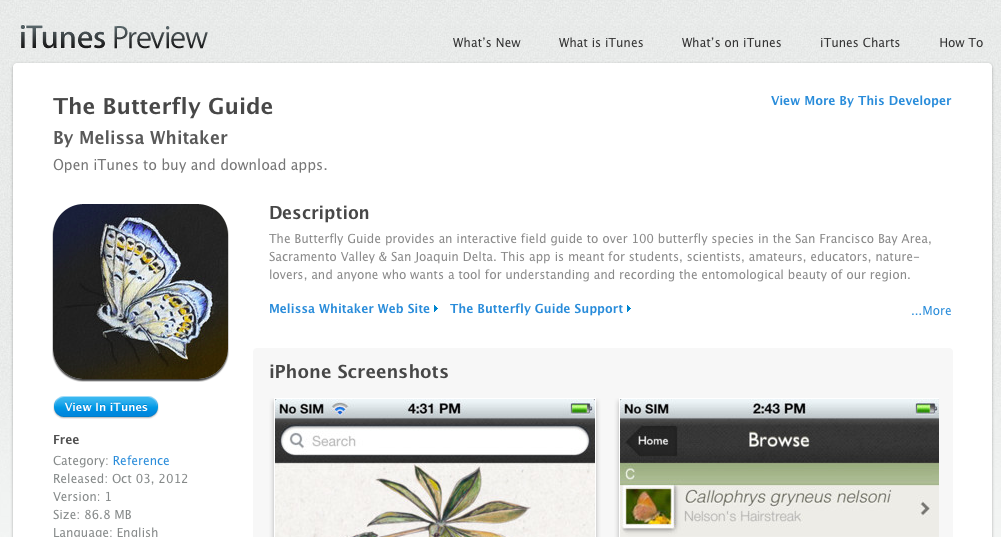
So cool – check out this Free App The Butterfly Guide for iPhone 3GS, iPhone 4, iPhone 4S, iPhone 5, iPod touch (3rd generation), iPod touch (4th generation), iPod touch (5th generation) and iPad on the iTunes App Store
From Melissa Whitaker who is a PhD student in Art Shapiro’s lab at UC Davis and who comes to my lab meeting occasionally since she is also interested in microbes associated with butterflies …
I have just joined an advisory group for the UC Davis Magazine and I am really happy with their new direction. They are trying to make the magazine a little less “UC Davis is awesome” and more “Here are some interesting things to think about, with a UC Davis angle”. The new Fall Issue is a good example of this. There is for example a nice article by Sasha Abramsky about student involvement (or the lack thereof it). Plus there is a little video interview to go with the article. Perhaps even more “interesting” is the article on the future of higher education by Clifton Parker. Not exactly a glory piece about UC or UC Davis. Anyway … just thought I would put this out there. Any opinions on the magazine please send them my way – the staff there seem great and really interested in feedback.