Retraction – I was buzzing off about bees before my time

Recently I wrote a post about the recent study on bees associated with colony collapse disorder. After receiving a well thought out email from one of the authors on the study I have decided to retract my blog and apologize to the authors of the bee study. I rushed out my blog without really considering the evidence and the data very carefully and accept that I screwed this one up big time. The study is much more complex and comprehensive that I led people to believe. In part this was due to lack of detail in the actual manuscript but alas most of the fault lies with me – in not trying to contact the authors for more detail before mouthing off.

So I am giving myself a new award – the genomic jerk award. Hopefully there will be no more recipients.

Quality Genomic Reporting Award – Seeking Nominations

Well, Genome Technology magazine got on my case for being a bit too snarky with my “awards” saying

If Jonathan Eisen Offers You an Award, You Probably Want to Decline

Fair enough. I can be both passive aggressive and just plain aggressive about my opinions on how things should be done out there. And yes I have ended up focusing frequently on the negative (which is the case for both the awards I have begun dishing out here – the Adaptationomics Award and the Overselling Genomics Award). Plus, my giving out the latest award has taken away a bit from what should be an enormous positive vibe for the latest Wolbachia paper by Julie Dunning Hotopp and Jack Werren and colleagues, which is a spectacular piece of science.

So I have decided to try and be positive (occasionally) and have created a new award to give out – the Quality Genomic Reporting Award.

This award will be given to news articles (or blogs occasionally) written for the general public (e.g., in newspapers or news magazines) that do a good job of covering a scientific study involving genomic data.

At first, I wanted to give the award to HENRY FOUNTAIN for his article in the NY Times on September 4, 2007 entitled: “When Bacteria Transfer Genes to Invertebrates and Spread From There.” This would have been ironic since this story is about the same scientific study that led me to give out the first Adaptationomics Award a few days ago (also see Larry Moran’s discussion on his Sandwalk blog and Evolgen‘s).

I confess, when I saw the NY Times had an article in this Tuesday’s Science Times about this Wolbachia story, I expected to find the same stuff that I went after in the Adaptationomics award and I was expecting an easy blog topic. But on first glance, Fountain seemed to do a pretty good job. For example he reports:

The researchers looked for Wolbachia genes in the genomes of more than 24 invertebrates, including wasps and nematodes, and found it in 8.

Thus providing a level of detail normally missing from genomic reporting. In addition, he does a good job of setting up the story:

But lateral gene transfer between bacteria and multicellular organisms has been assumed to be exceedingly rare, for the reason that most cells in a higher organism are somatic; their genetic material does not get passed on.

Alas though the story is good, it does contain some bits I am not keen on. For example, he reports that

This genome-within-a-genome involves Wolbachia pipientis, a bacterial parasite that is one of the most prevalent in the world, infecting close to three-quarters of all invertebrate species, typically in the reproductive cells

This is a bit misleading. The statement that Wolbachia infect 3/4 of all inverts is not really accurate. It would be better to say “some researchers estimate that Wolbachia infects up to 3/4 of all inverts.” The research that I know of on Wolbachia prevalence in different species has focused on surveys of insects and arthropods (which are only a subset of invertebrates). And these studies have given conflicting results with some showing 20% of species surveyed being infected and others showing up to 70%.

But this is a minor quibble. And I was still getting ready to give Fountain the award. But then it ends the article with a quote by Jack Werren that fits into the Adaptationomics paradigm for the award I gave a few days ago:

“It’s happening frequently enough,” he added, “that it’s inevitably going to be leading to the evolution of new genes.”

Sure Werren might be right. And, in case people thought I was saying otherwise – he is more than welcome to state his opinion about things and give his insight even when evidence is not there. That is after all part of what makes science fun and interesting. And I should make clear, this is NOT meant to disparage the science in the Wolbachia paper. But when a scientist makes such a statement, it would be good for reporters to at least say specifically the speaker is predicting something that is not yet known. That is, just try to clarify what was supported by evidence and what was more of a jump.

So alas – this article is not going to get my Quality Genomic Reporting Award, even though overall it is pretty good. But pretty good is not good enough. So if anyone out there has good candidates for the award, let me know and I will keep looking too.

Metagenomics 2007 presentations available

For those interested in metagenomics, the Metagenomics 2007 meeting (also see Konrad’s blog) has posted video and pdf’s of most of the presentations. You can get everything at the CAMERA web site here. I have posted links and titles below:

Larry Smarr [video] [PDF]

Masahira Hattori, Tokyo University/RIKEN
Length: 56:30 [video] [PDF]

Paul Gilna, UCSD
Length: 5:55 [video]

Jed Fuhrman, University of Southern California
Length: 1:04:01 [video] [PDF]

Dawn Field, Oxford Centre for Ecology and Hydrology

Length: 27:05 [video] <!–[video]–> [PDF]

Janet Jansson, Swedish Univ of Agricultural Sciences
[PDF]

James M. Tiedje, Michigan State University
Length: 27:09 [video] [PDF]

Breakouts:

Medical Metagenomics
Human Biology
Chair: Trevor G. Marshall, Autoimmunity Research Foundation
Speaker: Peter J. Turnbaough, Washington University
Length: 49:32 [video] [PDF]

Computational Metagenomics
Ontology and Standardization
Chair: Jonathan Eisen UC Davis
Length: 44:18 [video]

Discovering opportunity for Bioenergy
Chair: Phil Hugenholtz, JGI
Speaker: Yuri Gorby, JCVI

Length: 50:45 [video] [PDF]

Modeling the natural world
Chair: Trina McMahon, Univ. of Wisconsin-Madison
Speaker: Patrick Schloss, UMass Amherst

Length: 1:00:36 [video] [PDF]

Evolution and population
Chair: Francisco Rodriguez-Valera, Universidad Miguel Hernández in Alicante

Length: 1:00:36 [video]

John Wooley, UCSD (Moderator); various speakers
Length: 40:47 [video]

Metagenomic analyses of corals
Forest Rohwer, San Diego State University
Length: 21:15 [video] [PDF]

Population structure of microbial communities in the world’s oceans
Mitchell Sogin, Marine Biological Lab, Woods Hole
Length: 41:20 [video] [PDF]

Structural metagenomics: Lessons from the first experimentally characterized GOS proteins
Adam Godzik, Burnham Institute
Length: 46:35 [video]

Detailed view of the architecture and implementation of a metagenomics server
Philip Papadopoulos, UC San Diego/SDSC
Length: 24:27 [video] [PDF

Metagenome sequence data management and analysis
Victor M. Markowitz, Lawrence Berkeley National Lab
Length: 34:25 [video] [PDF]

Developing a software workbench for marine ecological genomics
Frank Oliver Gloeckner, Max Planck Institute for Marine Microbiology
Length: 32:39 [video] [PDF]

The Metagenomics RAST server: Automated analysis of Sanger and 454-type metagenomes
Folker Meyer, Argonne National Laboratory
Length: 17:00 [video] [PDF]

Technologies for metagenomics selection and sequencing
Gautam Dantas, Harvard University
Length: 33:30 [video] [PDF]

Micro-Mar: A database for dynamic representation of marine microbial diversity
Ravindra Pushker, University College Dublin
Length: 32:00 [video]

Conclusion
Kayo Arima, UC San Diego
Length: 2:16 [video]

Too eager for ethanol?

Just a quick one here along the lines of my biofools series. Anyone interested in biofuels should take a look at the LA Times Editorial from Aug 20 titles “Drunk on Ethanol” which discusses many of the negatives of growing corn for ethanol and of other aspects of the crop to ethanol pipeline. Also check out the letters to the editor following up on the piece (one of them by my sister, Lisa Coffman, Executive Director of the California Water Impact Network). My personal biggest concern is the environmental damage that could come from increased use of plants to produce ethanol. Such damage includes the conversion of rainforests into sugar cane plantations, the use of more and more pesticides and herbicides and fertilizers to go onto less useful land, and the excessive use of an already limited resource – water. Yes, if you do the calculations in certain ways, ethanol seems like a great idea. And it is certainly true that if we are going to make ethanol from crops we could do it more efficiently. But the way it is being done now – with corn sucking up water like their is not tomorrow we are heading down a bad path.

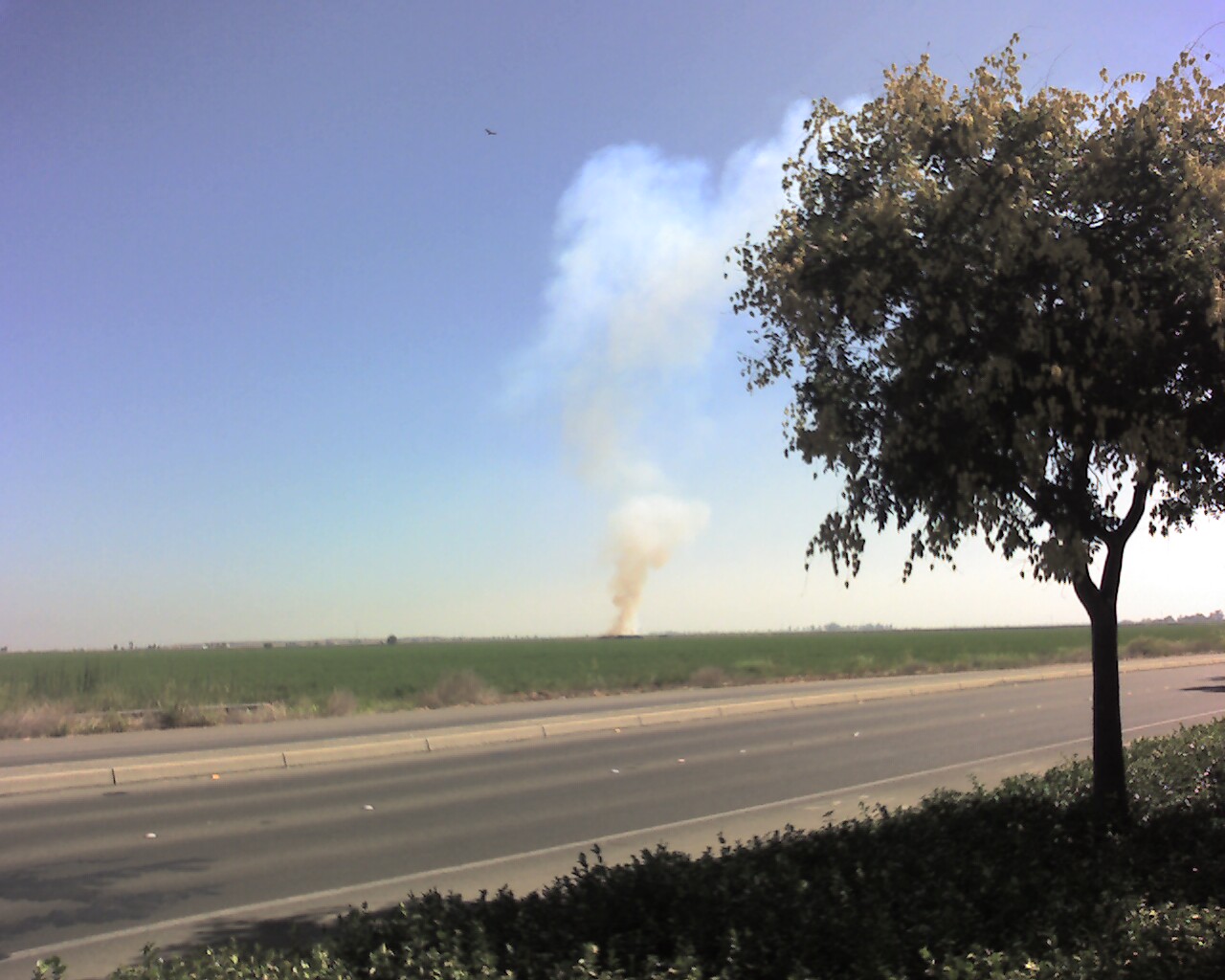
What would make more sense is to first make better use of all the wasted biomass from various agricultural systems and from solid waste. Lots of material is still being burned on farms for example (see pictures below of a fire near Davis — these are going all the time, even on “spare the air” days). Sure – one can make lots of money from corn to fuel right now. But that does not make it the right thing to do when there are plenty of sources of biomass being wasted all around us. Lets hope that more of the biofuels projects work on converting leftovers not new crops.

Adaptationomics Award #1 – Wolbachia DNA sneaking into host genomes

Well, I have decided to start a new award. For years I have been fighting against the tide on the tendency for people doing genomics work to resort to silly adaptationist arguments for observations. The argument goes something like this. We sequenced a genome (or did some type of genomics). We made an observation of something weird being present (take your pick – it could be a gene order or a gene expression pattern or whatever). We conclude that this observation MUST have an adaptive explanation. We have come up one such adaptive explanation. Therefore this explanation must be correct.

Gould and Lewontin railed against this type of thing many years ago and others have since. Just because something is there does not mean it is adaptive (e.g., it could be neutral or detrimental). And even if something is adaptive, just because you can think of an adaptive explanation does not mean your explanation is correct.

And this is so common in genomics I have decided to invent a new word – Adaptationomics. And I am giving out my first award in this to Jack Warren Werren and colleagues for their recent press release on their new study of lateral transfer in Wolbachia (plus it lets me plug their new study which is pretty ^$%# cool).

Basically, in their study (led by a past colleague of mine from TIGR, the brilliant up and coming Julie Dunning Hotopp) they showed that there have been multiple lateral transfers of DNA from Wolbachia (which are intracellular parasites that can infect germ cells) into invertebrates. Furthermore they showed that that the DNA transfered to the host genome is not completely transient and that in many cases it is passed on to future generations. This is interesting because it is the first report of strong evidence for such “stable” transfers from bacteria into multicellular species. Of course, one could say that this finding is not that surprising given that Wolbachia infect germ cells and given that DNA transfer from organellar genomes to nuclear genomes is quite common. But Wolbachia are not organelles and since it appears that their DNA can readily move into genomes of multicellular species, this opens up a new window into our understanding of gene transfer.

This of course does not mean that the DNA is anything but “junk” in terms of functions in the host genome. And this is where the adaptationomics comes in. One of the press releases associated with the paper has a bit of an outrageous adaptationomics claim that I would like to counter. In response to their finding of a nearly complete Wolbachia genome in the nuclear genome of a fly Warren Werren says

The chance that a chunk of DNA of this magnitude is totally neutral, I think, is pretty small, so the implication is that it has imparted of some selective advantage to the host.

And Dunning Hotopp in a Nature article says:

The discovery also hints that the bacterial genome must have provided some sort of evolutionary advantage to its host. “You’re talking about a significant portion of its DNA that is now from Wolbachia,” says Julie Dunning Hotopp, a geneticist at the J. Craig Venter Institute in Rockville, Maryland, who led the study. “There has to be some sort of selection to carry around that much extra DNA.”

This notion that the DNA MUST have an beneficial function is pure adaptationomics. Consider the movement of DNA from organellar genomes into the nucleus. Such movement occurs at an incredibly high rate and the DNA seems to be maintained in the host genomes for millions of years. For example, when we were sequencing the Arabidospsis genome, we found at least one if not more whole copies of the mitochondrial genome embedded in the nuclear genome and we concluded this was likely a non adaptive event. That is, the mt DNA was not conferring some advantage on Arabidopsis plants. There is extensive work on what are called “numts” (nuclear mitochondrial DNA) in humans and other species that makes similar conclusions – the mtDNA in the nucleus is basically junk but it is maintained for long periods of time. Sure, occasionally, the DNA confers some selective advantage. But this is a very rare event and one cannot infer that some DNA is advantageous simply because it is present. This is especially the case for eukaryotes which are generally more able than bacteria to maintain DNA that confers little selective benefit.

So I would argue that WarrenWerren and colleagues appears to have fallen for the adaptationomics trap – they want to believe these Wolbachia DNA inserts confer some selective advantage. But there is no need to assume this simply because the DNA is there.

Anyway – as is the case more and more. Read the paper. Ignore the interviews and the press releases.

Calling for a Boycott of of AAP – Association of American Publishers

If you have not seen the wonderful news about the latest anti Open Access initiative called PRISM, well you should surf around the blogosphere a bit. PRISM is a group started by the AAP – the Association of American Publishers that – there is no nice way to put this – is a sad stage in the evolution of publishing. Basically, it is a Macarthy-Era ripoff where Open Access is the new evil that communism once was. And everything wrong with the world is in essence blamed on the Open Access movement. For more detail on PRISM, and what is wrong with it, including the pirates use of copyrighted material, see some of these links:

I think academics and the public need to fight back against this attempt to mislead the public about the issues surrounding Open Access publishing. And one way to fight back is to recommend that the members of AAP drop out or request termination of the PRISM effort. So here is a list (see below for the full list) with links of the members of AAP. If you are involved or have connections to any of these groups, consider writing or calling them and suggesting they reconsider involvement in AAP. Look, for example at all the University presses. If they do not back out of PRISM we should consider launching a boycott of AAP members.

Full list of AAP from the AAP web site:

Absey & Company, Inc.

Academic Innovations

Academic Learning Company, LLC

Academy 123, Inc.

Academy of Management

Aequus Technologies Corporation

Al-Basheer Publications and Translations

Algora Publishing

American Academy of Pediatrics

American Academy Ophthamology

American Association of Cancer Research

American Association of Pharmaceutical Scientists

American Chemical Society

American Foundation for the Blind

American Geophysical Union

American Institute of Aeronautics and Astronautics

American Institute of Physics

American Mathematical Society

American Medical Association

American Psychiatric Publishing, Inc.

American Psychological Association

American Scholars Press, Inc.

American School of Classical Studies at Athens (The)

American Scientific Publishers

American Society of Clinical Oncology

Ames On-Demand

Apex CoVantage

Apex Learning, Inc.

Appalachian Trail Conference

Ardor Scribendi, Ltd.

ASIS International

Association for Computing Machinery (ACM, Inc.)

Association of Research Libraries

Athena Media, Inc.

Atypon Systems, Inc.

AV Book Publishers, Inc.

Avon Books/Harpercollins Publishers

Banta Company

Barnhardt & Ashe Publishing, Inc.

Barricade Books, Inc.

Baseline Development Group

Baydell & Brewer, Inc.

BBC Motion Gallery

Beacon Group, The

Beacon Publishing Services

Berkery, Noyes & Co.

Berkshire Publishing Group, LLC

Black Dome Press Corp.

Blackwell Publishing

Bloomberg Press

Booklight, Inc.

Books International, Inc.

Booktech.com

British American Publishing

Brookings Institution (The)

Brown Publishing Network, Inc.

Cadmus Professional Communications

Cambridge University Press

Capitol Books

CAST

Castle Connolly Medical Ltd

Caxton Printers

CFA Institute

Children’s Book Press

City Lights Books

Cold Spring Harbor Laboratory Press

Colorado Independent Publishers Association

Columbia University, DKV

Consumer Reports

Cornell Maritime Press

Cornell University Press

Council on Foreign Relations Press

Council on Library and Information Resources

Cover Publishing Co.

CQ Press

CrossRef

D2B Group, Inc.

Dana Press, The

Douglas & McIntyre

Eaglemont Press

Earthquake Engineering Research Institute

Educational Concepts

Element LLC

Elsevier Science Inc.

Emida International Publishers

Ernst & Young, LLP

F.A. Davis Company

Federation of American Societies for Experimental Biology

Feminist Press (The)

Focus Publishing/R. Pullins Company, Inc.

Fordham University Press

Fulcrum Publishing

Gallaudet University Press

Genesis Press, Inc. (The)

Gival Press, LLC

Globe Pequot Press, Inc.

Great River Technologies

Grolier Educational

Grove/Atlantic, Inc.

Grove’s Dictionaries/Holtzbrinck

Hachette Book Group USA

Haiduk Press

Hammond, Inc.

Hampton-Brown Company, Inc. (The)

Hannacroix Creek Books, Inc.

Harcourt, Inc./Reed Elsevier

Harlequin Enterprises Ltd.

HarperCollins Publishers

Harvard Business School Press

Harvard University Press

Harvest House Publishers

Health Affairs/Project Hope

Hearst Book Group

Heinz Center (The)

Henry Holt & Co.

Hispanex, Inc.

Houghton Mifflin Co.

Howard University Press

Human Factors and Ergonomics Society

Hyperion

Impact Publishers, Inc.

Info Sys Technologies, Ltd.

Ingram Book Company

Institute for Electrical and Electronics Engineers, Inc. (IEEE)

Institute for International Economics

Institute for Scientific Information

Institute of Physics Publishing

Instrumentation, Systems, and Automation Society (The)

iUniverse

The Institute, Inc.

J. Paul Getty Trust Publications

James A. Rock & Company Publishers

John Wiley & Sons, Inc.

Johns Hopkins University Press (The)

Jordan Publishing House

Journal of Rehabilitation Research Development

Keene Publishing

Key Education Publishing Company LLC

KidBiz 3000

Kirchoff/Wohlberg, Inc.

Knovel.com

LAD Publishing Company

Lattice Press

League of American Poets

Leapfrog Enterprises Inc.

Learning.com

Liberty Fund, Inc.

Library of Congress Publishing Office (The)

Lidenmeyr Book Publishing Papers

Lippincott Williams $ Wilkins Journals

Literary Architects

Little Moose Press

Lousiana State University Press

Love Publishing Company

Luxury Travel Books

Lynne Rienner Publishers, Inc.

MacAdam/Cage Publishing Inc.

Mage Publishers, Inc.

Mark Logic Corporation

Market Data Retrieval

MarketingWorks, Inc.

Markus Wiener Publishers

Massachusetts Medical Society/New England Journal of Medicine

Math Teachers Press, Inc.

Mazer Corporation (The)

McGraw-Hill Companies (The)

Medical Group Management Association

Melville House Publishing

Meta Comet Systems

MG Taylor Corporation

Microsoft Corporation

Midland Information Resources

Minnesota Historical Society Press

MIT Press (The)

Modern Language Association of America

Momentum Books, LLC

Mondo Publishing

Mooring Field Books, Inc.

Morgan & Claypool Publishers

Morgana Press LLC

Moseley Associates, Inc.

Music Together, LLC

National Academy Press

National Computer Systems/Pearson

National Education Standards

National Geographic Society

National Learning Corp.

National Publishing Co.

National Science Teachers Association (NSTA)

Nature America

New England Journal of Medicine

New Press (The)

New York Botanical Garden (The)

New York University Press

Newmarket Press

Oak Knoll Press

Overlook Press (The)

Oxford University Press

P. H. Glatfelter Company

Pan American Health Organization

Pangaea

Paratex, LLC

Parmenides Publishing

Pearson Education

Pelican Publishing Co., Inc.

Penguin Putnam, Inc.

Pennsylvania State University Press (The)

People’s Publishing Group

Peter Li Education Group

Posterity Press, Inc.

Pillsbury Winthrop Shaw Pittman, LLP

Posterity Press, Inc.

Princeton University Press

ProQuest Information

Pub Smarts, LLC

Publish America, Inc.

Publisher’s Group Incorporated

Publishing House Research

Publishing Illuminations

Publishing Works

Quarasan Group, Inc. (The)

R R Donnelley

R.R. Bowker

Rainbow Books, Inc.

Rand

Random House, Inc.

Ray of Light Publishing Company, Inc.

Reader’s Digest Association

ReadHowYouWant.com

Recording for the Blind and Dyslexic

Red Rock Press

Reed Reference Publishing

Resolve Corporation

Resources for the Future/RFF Press

Rockefeller University Press

Rosetta Solutions, Inc.

Rowland Reading Foundation

Saferock USA, LLC

Sagaponack Books

Sage Publications, Inc.

Scholastic, Inc.

Scholatic Testing Services, Inc.

Scientific American/St. Martin’s College Publishing Group

Sea Hawk Publishing

Seven Locks Press

SGI-USA

Sheridan House, Inc.

Simon & Schuster

Six Red Marbles LLC

Soft Skull Press

Springer Publishing Co.

Springer-Verlag New York, Inc.

St. Martin’s Press

Stanford University Press

Stoeger Publishing

Swan Isle Press

Teachers College Press

Thames & Hudson, Inc.

Thieme New York

Thomson Learning

Tichenor Publishing

Tighe Publishing Services, Inc.

Too Far

Tribune Education

Tupelo Press

Turtle Books

The University of Hawaii Press

UAHC Press

University of California Press

University of Chicago Press

University of Illinois Press

University of Tennessee Press

University of Texas Press

University Press of Kentucky

van Tulleken Company (The)

Vantage Press, Inc.

Veronis, Suhler & Associated, Inc.

Victory Productions, Inc.

Virginia Museum of Fine Arts

Viz Media, LLC

Von Hoffmann Corporation

Walford Press

Wesleyan University Press

Western Economic Association

White Rhino Press

Whitston Publishing Company, Inc.

Wiggin and Dana LLP

William Morrow & Co., Inc./HarperCollins Publishers

Willow Creek Press, Inc.

Wooster Book Company

Words & Numbers.com

Workman Publishing

World Bank Group

Worth Publishing, Inc.

Xerox Corporation

Yale University Press

PRISM – Partnership for Research Integrity in Science and Medicine – Seems like a spoof but it is real, and sad

I just came across this web site for something called the “Partnership for Research Integrity in Science and Medicine.” I looked through it an thought – this must be a spoof. A good April 1 joke about the dinosaurs of the publishing industry. The reason it seems like a joke is well, the stuff there is so incredibly inane as to make one laugh. In essence the whole site is an anti Open Access site. They are against Open Access to publications it seems because Open Access does things like

  • “undermines the peer review process.” Yes that’s right. If an article is freely available for all to read, that must mean that peer review has been compromised. Nevermind that openness in other areas (e.g., politics, law, etc) is well established to promote critical review (anyone heard of freedom of the press). But apparently in science, openness is bad.
  • “opens the door to scientific censorship”. Yup. Making publications freely available apparently means that you will stifle communication. Again, the logic here is completely silly – how on earth is openness connected to censorship?
  • “undermining the reasonable protections of copyright holders.” Yup, the publishers of scientific articles, who do not deserve the copyright to articles in the first place, are now saying that because they have stolen the copyright from many scientists, now we should defend them because they have the copyright. Kind of like saying that someone who steals some money should not give it back because of finders keepers rules.

I could go on and on about the silly stuff there … but lets just say that everything on the site seems like a spoof. But alas, it is not. PRISM is for real. It is the last gasp of a dying breed – publishers who refuse to do what is the right thing for science and society. Yes, I understand there are some issues with Open Access that still need to be solved. But this McCarthy like tone of PRISM – basically equating openness with evil and godlessness is ridiculous. I think this is a sad day for the people behind PRISM – the AAP (Association of American Publishers). I am sure they have done some good things over the years. This is certainly not one of them and a good sign that anyone out there with any common sense who might be involved in AAP should get out or fight for change within the institution.

For more on Prism see

Anyone else having gmail spam filtering issues?

Over the last week I have had a sudden increase in missing email messages, both from me and to me. Only by luck did I figure out that at least the missing incoming messages are being placed into the spam folder by gmail, which I run all my messages through since in the past their spam filter has been phenomenal.

The incoming messages included diverse messages – some with the word “FWD” in the subject line but some appearing as normal as can be.

Anyone else out there experiencing a sudden increase in missing email?

Save the Bay Delta

Just a quick one here. I am appalled by some of the discussions of water resources out here in the Central Valley in California. I know there is a long history here relating to the allocation of water but we are risking destroying an incredible ecosystem in the Bay Delta by dishing out water rights like they are candy (not to mention the pollution, pesticides, antibiotics and other crap (literally) we allow to flow into the Delta. So here is a plug for a petition being circulated relating to one of the latest US Bureau of Reclamation activities in this area.

Overselling Genomics Award #2

Well, all I can say is “Aaaaargh” again. So I am awarding my second overselling genomics award to a Press Release from U. Florida entitled Conquest of land began in shark genome” relating to a paper in PLoS One on shark development . The press release centers on a reported finding that

Using molecular markers to study the formation of skeletal cartilage in embryos of the spotted catshark, UF scientists isolated and tracked the activity of Hox genes, a group of genes that control how and where body parts develop in all animals, including people.

Now admittedly, this is not genomics here – but the press release just had to use genomics in the title so my automated google search for “genome” and “evolution” picked it up. So – why do they get the overselling award? Read more in the press release:

The finding shows what was thought to be a relatively recent evolutionary innovation existed eons earlier than previously believed, shedding light on how life on Earth developed and potentially providing insight for scientists seeking ways to cure human birth defects, which affect about 150,000 infants annually in the United States.

Yes that is right, this genome-ish gene expression study in sharks is going to help cure human birth defects (note the paper in PLoS One seems entirely reasonable … this is another case of press releases being disconnected from the science – and is another reason to support OA publications because here you can actually all go and read the paper and ignore the press release).

In addition, the press release says

“We’ve uncovered a surprising degree of genetic complexity in place at an early point in the evolution of appendages,” said developmental biologist Martin Cohn, Ph.D., an associate professor with the UF departments of zoology and anatomy and cell biology and a member of the UF Genetics Institute. “Genetic processes were not simple in early aquatic vertebrates only to become more complex as the animals adapted to terrestrial living. They were complex from the outset. Some major evolutionary innovations, like digits at the end of limbs, may have been achieved by prolonging the activity of a genetic program that existed in a common ancestor of sharks and bony fishes.”

Now I accept that the specific details of Hox gene expression here might have been surprising but what friggin evolution textbook are these people reading if they are surprised that there is not a chain of life going from less complex to the pinnacle of complexity in humans? Hopefully not mine.