This is a post in my continuing series of the “Story Behind the Paper.” series. This post is from Benjamin Schwessinger, Pamela Ronald, Rory Pruitt, Anna Joe, and Ofir Bahar.
A Phoenix Rises from the Ashes: A new discovery emerges from the 2009 retraction.
 |
A phoenix depicted in a book of legendary creatures by FJ Bertuch (1747–1822).
Via Wikipedia Commons – based on this |
This is the story behind our report published today in Science Advances.
The Background
In Science Advances we report that one class of bacteria produces a previously undescribed, and long sought after, molecule recognized by plants carrying a specific receptor.
The story began in the 1970s, when Professor Gurdev Khush and colleagues demonstrated that a wild species of rice was immune to most strains of the Gram-negative bacterium Xanthomonas oryzae pv. oryzae (Xoo), causal agent of a serious disease of rice globally. In the 1990s Ronald began studying the rice/Xoo interaction. Because both rice and Xoo are genetically tractable, the rice/Xoo biological system proved to be an excellent system for studies of the molecular mechanisms governing the plant immune response. In 1995, two postdoctoral fellows in Ronald’s lab at the University of California, Davis- Guoliang Wang and Wenyuan Song-reported that this rice immune response was controlled by a single receptor kinase, called XA21.
The predicted structure of the XA21 protein, with a predicted leucine rich repeat extracellular domain and an intracellular kinase domain, suggested that XA21 could sense a secreted microbial molecule and then activate an immune response.
A few years after the discovery of the XA21 receptor, the fly Toll and mouse Toll-like receptors (Tlr4) were shown to share striking structural similarities with XA21 and other plant receptors. The animal receptors also recognized and responded to microbial molecules. Together these discoveries demonstrated that plants and animal use similar mechanisms to protect against infection. Professors Bruce Beutler and Jules Hoffman were awarded the 2011 Nobel Prize in Physiology or Medicine for their important work.
The Ronald laboratory then spent twenty years trying to identify the microbial molecule that is recognized by XA21. The research led to the identification of a number of microbial genes that are required for activation of XA21-mediated immunity (rax genes). These genes encode a tyrosine sulfotransferase, RaxST, and three components of a predicted type 1 secretion system: a membrane fusion protein, RaxA; an ATP-binding cassette transporter, RaxB; and an outer membrane protein, RaxC. raxST, raxA, and raxB are located in a single operon (raxSTAB). Based on these findings, we hypothesized that the activator of XA21-mediated immunity is a tyrosine sulfated, type 1-secreted protein.
We were excited about this idea because sulfation has emerged as an important posttranslational modification controlling receptor-ligand interactions. It is a common posttranslational modification of eukaryotic proteins and plays important roles in regulating development and immune responses. The importance of this area of research to biology and medicine is reflected in the recent report of a novel drug that blocks HIV infection. To achieve this breakthrough, the researchers exploited the observation that HIV binds tyrosine sulfated amino acids for cell entry (Gardner et al., 2015).
Despite a clear model and diverse supporting data suggesting that Xoo secretes a sulfated peptide, the identity of this molecule remained elusive.
In 2009, the Ronald laboratory reported that XA21 recognized a sulfated peptide. However we later discovered major errors in this work and in 2013, we retracted the paper. We discussed these mistakes in several lectures, post and articles including a Keystone symposium, Scientific American, Nature, and Schwessinger’s blog (here and here). The process with which we addressed the problems was highlighted as “Doing the right thing” by Retraction Watch, a blog that reports on retractions of scientific papers. The retraction was included as one of the top 10 retractions of 2013.
The new Discovery
Today, in Science Advances, we are delighted to report the identification of the microbial molecule that activates XA21-mediated immunity. As predicted, it is a tyrosine-sulfated protein. We named this microbial protein RaxX.
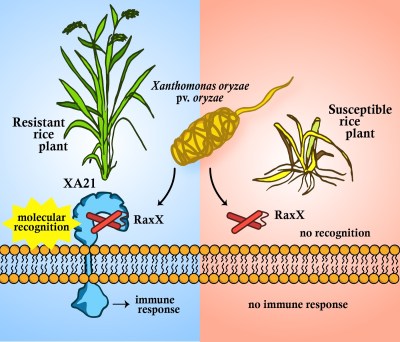 |
| The rice immune receptor recognizes the bacterial molecule RaxX and initiates an appropriate immune response. Illustration by Kelsey Wood.
|
To isolate this molecule, postdoctoral fellow Rory Pruitt systematically created bacterial mutants carrying deletions near the RaxSTAB operon. He showed that one of the deletion mutants lost the ability to activate the XA21-mediated immune response. The deleted region encodes a small open reading frame that we named RaxX. Xoo strains lacking RaxX and Xoo strains that carry mutations in the single RaxX tyrosine residue (Y41) are able to evade XA21-mediated immunity. Postdoctoral fellow Anna Joe, together with collaborators at the University of Texas, Austin and at the Joint Bioenergy Institute in Emeryville, showed that Y41 of RaxX is sulfated by the prokaryotic tyrosine sulfotransferase RaxST. Postdoctoral fellow Benjamin Schwessinger, graduate student Nick Thomas and collaborators showed that sulfated, but not nonsulfated, RaxX triggers hallmarks of the plant immune response in an XA21-dependent manner. A sulfated, 21–amino acid synthetic RaxX peptide (RaxX21-sY) is sufficient for this activity. Xoo field isolates that overcome XA21-mediated immunity encode an alternate raxX allele, demonstrating the co-evolution of host and pathogen. RaxX is highly conserved in many Xanthomonas species.
Our results indicate that the presence or absence of sulfation is decisive for the ability of RaxX to trigger XA21-mediated immunity.
The new insights gained from the discovery and characterization of RaxX may be useful for the engineering of resistant crop varieties and for the development of therapeutic reagents that can block microbial infection of both plants and animals.
 |
| The rice XA21 receptor kinase, the first innate immune receptor discovered in plants or animals, provides resistance against Xanthomonas oryzae pv oryzae through recognition of RaxX, a tyrosine-sulfated protein secreted by the bacterium.
Illustration by Maurice Vink |
Notes on the publication process
“The scientific life is the most complex of all to write about. In the case of scientists, impulse becomes compulsion”. — Carol Shields
After we discovered mistakes in our previous paper, we spent several years correcting the scientific literature both by retracting the original Science paper (Lee et al. 2009) and by following up with publications to further correct the literature (Bahar et al. 2014). We made extra efforts to control the results in this current report.
Wrestling with the retraction and discovering the new molecule in rapid succession was an enormous challenge. Here we share some of the lessons learned.
Pamela Ronald, Professor, Department Plant Pathology and the Genome Center, UC Davis; Director of Grass Genetics, the Joint Bioenergy Institute:
I would not wish a retraction on anyone. Scientists are supposed to catch their mistakes before publication. Still, I am astonished to conclude that the process has in some ways been positive.
On an administrative level, the lab is running more efficiently. I have instituted new practices for the lab: created duplicate stocks of key strains (validated and maintained by the lab manager), mandated electronic notebooks for each lab member and required that all new assays be independently validated by three independent researchers before publication.
But the best part of this bad situation has been working with this particular team. It has been an immense privilege to watch each person work through the situation in their own way, collaborate, and make new discoveries. Respect for each other and for the scientific process was paramount. After figuring out what went wrong (no easy task), they tried not to look back. They did not give up, even when it would have made sense to do so. Their persistence and optimism in face of this daunting challenge buoyed all of our spirits. I will always be in awe of their work and will always be grateful.
Equally stunning was the supportive and kind response from the scientific community. We received many letters of encouragement – even from complete strangers. It helped us keep going.
There are still hills to climb. Some scientists may be extra skeptical of results from my lab for a long time to come. For example, in a critique of our submission, one of reviewer’s asked, “how do we know the strains weren’t mixed up again this time?”
Rory Pruitt, postdoctoral scholar in the Ronald lab.
I was only a few months into my postdoc when I became convinced that the majority of the Ax21 story was incorrect (Ax21 was the proposed elicitor of XA21-mediated immunity in the retracted papers). My mind was filled with questions. How could this happen? What results can I believe? Admittedly, the biggest question that hounded me was “Should I be looking for a new job?” There were a few key factors that led to my decision to stay in the lab. I think these factors were also critical to this story working out as a “success.”
Early on, I went to Pam with some of my doubts. It was terrifying to approach my new boss and I say I didn’t believe some of her published work (including a Science paper!). But I needed to know that I could be honest with her and not feel pressured into only showing results that fit the established model. Pam listened to my concerns and those of others in the lab. Most importantly, she showed that she was committed to getting the story right and correcting the literature if need be.
In addition to Pam, there was a great team of postdocs and graduate students who were equally devoted to correcting the science. At times it seemed a long, painful process with little reward (there’s not a good space on a CV for working towards a retraction). Nevertheless, it needed to be done so that we and other labs could move forward. I was encouraged by Ofir, Ben, and others who worked persistently on this.
A final factor in my decision to stay is the prospect of new discovery. If Ax21 isn’t the activator of XA21-mediated immunity, what is? Maybe we can find it! It’s that hope of new discovery that keeps us coming back to the lab bench. My postdoctoral experience has had some highs and lows, but I am glad I stuck it out. With persistence, enthusiasm, and a good team committed to reliable science, we were able to not only correct earlier mistakes but also move forward.
Benjamin Schwessinger, former Ronald Laboratory postdoctoral scholar and now independent research fellow in Australia, at the Australian National University in Canberra.
You have much to lose as an early career researcher if you are thrust into a situation where results cannot be reproduced. In a hyper competitive environment irreproducible results you are trying to build on are a big problem, no matter how smart, privileged, and gifted you are. Lengthy delays in publishing as a postdoc can cause great harm to a career. Here are the main factors that made us successful in the face of adversity.
(Be lucky) have your own funding
Your own funding makes you financially and also scientifically more independent. It ensures your academic freedom. I was grateful to have been supported independently by the Human Frontier Science Program. It made me bolder and braver in speaking out. I was able to choose to stay or go. Because of the team I believed in I decided to stay!
Get confidential outside advice
Getting some outside confidential impartial advice on how to approach this problem is very important. Many senior figures have most likely seen similar cases in the past and have more insight. Following through with this advice is a total different matter. I decided to stay!
Collaborate
Work through it together as a team. Build on each other’s strength and talk about all possibilities. Repeat each other’s experiments with all required controls. Invite well respected figures in the field to independently test (and confirm) core experiments.
Admit mistakes and retract
Everyone makes mistakes. They are part of the scientific discovery and science has to be self-correcting. Retractions are an integral part of this process. Not to retract is NOT an option! It obstructs all future progress in the subject matter.
Follow the data
Do controls, repeats, and repetitions of conclusive experiments. Seeing is better than believing.
Ofir Bahar, former Ronald Laboratory postdoctoral scholar and now principal investigator, Plant-Microbe Interaction Research Group, the Volcani Center, Israel,
I remember the day, early 2013, when we were driving back to Davis from a happy and relaxed baby shower at Benjamin’s place in Oakland, Rory mentioned to me “you know, I deleted an upstream and a downstream region to raxSTAB. The downstream mutant was no different than wild type, but the upstream mutant forms long lesions on XA21 plants…”
This was the turning point; I immediately knew this was a big discovery and a major break through for the lab.
But before that moment, we were a bunch of enthusiastic post docs that just loved doing science. We wrote these nice proposals to get our fellowships, based on the amazing story of the rice immune receptor XA21 and its (thought to be) elicitor Ax21.
It was a fascinating story we were all so excited about having read it in Science. Of course we joined the Ronald lab to follow up on this initial discovery, but well… the building upon part did not work as we all might have wished. We had to dig deep, real deep, to figure out what was going on and what went wrong before our arrival to the lab. So, a year….. year-and-a-half in our new positions we finally reached the ultimate conclusion that there was a big hole in the model – there’s no elicitor! Or, there is, but it’s not Ax21 and we don’t have a clue what the identity of this molecule might be. It felt like we were thrown back 10 years, to 2004 with the da Silva paper just published describing the requirement of the three Xanthomonas genes RaxST, RaxA and RaxB for XA21 immune activation.
Those were ‘dark ages’ and difficult times. Understanding that most of the time you invested so far was, at least in practical terms (e.g. publications), for nothing, and that there is no biological model to work on, but that it needs total reboot. To be honest I was feeling a bit worried at that time for my scientific career. But then, a series of exciting discoveries (including some that are not published yet) gave me hope again. Well… isn’t this how science goes, bad, bad, bad, bad, good, bad, bad, bad, good and so on. I remember Pam telling me: “you know why I love a big group? There has got to be some positive results coming all the time”
Later, a few months after Rory shared with me his finding, we already knew what it was, and we were very certain, this is the ONE. Unfortunately, or luckily, I got a position offered at my home country and I gladly accepted it. So I actually wasn’t there for the flower stage (you know… the decorations), but I was very happy to have been there when the bud of this beautiful flower to be emerged. Every time I think of this story its like, WOW, can you believe all this has happened in just 3-4 years, unbelievable.
My lesson is, never lose hope, be critical, believe it when you see it, work on multiple projects, enjoy science and openly share science
Anna Joe, postdoctoral scholar in the Ronald lab.
I was in my final year grad school and looking for a postdoc position in early 2013. The Ronald lab was on the top of my wish list because I was fascinated by the Ax21 story in Science 2009. But just before I applied for a position in the Ronald lab I learned that something went wrong with Ax21 and that the original paper would be retracted. Many thoughts crossed my mind. Main one was “Do I still want to join the Ronald lab?”. Actually it was easy to answer the question once I spoke with Pam about it and talked with her lab members during the visit for my formal interview. “Yes, I’d like to work in the lab which just retracted two papers”. This for sure sounds crazy to most people. However, the whole experience of my visit gave my many reasons to join the Ronald lab. Correction of errors is a part of science (I knew this because I also had difficult time to track down a mix up plants problem before) but not many people are brave enough to admit mistakes. Pam and all lab members honestly, clearly stated to me what the errors were and how they verified the problems. They communicated well with each other, shared idea freely and respected other’s opinions. Their open mind and transparency attracted me.
On top of that I was very curious about the unexplored, new Xa21 activator. All other lab members might have felt the same curiosity and channeled its energy to continuously work through the problems during last several years. Although I did not share the “dark period”, I could see everybody in the lab was persistent with the common effort to correct the science. I experienced incredibly good teamwork and great collaboration. All of those are the driving force of our success. Finally, I’d like to mention that we could not make it without the support and encouragement from the scientific community. Many scientists shared their thoughts and advice and were rooting for us. Most collaborators unhesitatingly complied with our requests for assistance. They helped us not only “do the right thing”, but also do better science.







 Tariq Abu-Jaber
 Phil Polakoff,
  Steven Stack,
 Stanley Huff,

 Stephen Warren
 Gowtham Rao,


