At #UCDavis 4/23 3PM Steve Quake on “Single Cell Genomics”

Thursday, April 23, 2015

3:00PM – 4:00PM

1005 GBSF

The David L. Weaver Endowed Lectures in Biophysics and Computational Biology present:

Professor Stephen Quake

Lee Otterson Professor,

Bioengineering and Applied Physics, Stanford University

Investigator, Howard Hughes Medical Institute

“Single Cell Genomics”

An exciting emerging area revolves around the use of microfluidic tools for single-cell genomic analysis. We have been using microfluidic devices for both gene expression analysis and for genome sequencing from single cells. In the case of gene expression analysis, it has become routine to analyze hundreds of genes per cell on hundreds to thousands of single cells per experiment. This has led to many new insights into the heterogeneity of cell populations in human tissues, especially in the areas of cancer and stem cell biology. These devices make it possible to perform “reverse tissue engineering” by dissecting complex tissues into their component cell populations, and they are also used to analyze rare cells such as circulating tumor cells or minor populations within a tissue. We have also used single-cell genome sequencing to analyze the genetic properties of microbes that cannot be grown in culture – the largest component of biological diversity on the planet – as well as to study the recombination potential of humans by characterizing the diversity of novel genomes found in the sperm of an individual. We expect that single cell genome sequencing will become a valuable tool in understanding genetic diversity in many different contexts.

Dr. Quake studied physics (BS 1991) and mathematics (MS 1991) at Stanford University, after which he earned a doctorate in theoretical physics from Oxford University (1994) as a Marshall Scholar. He then returned to Stanford University, where he spent two years as a postdoc in Steven Chu’s group.He joined the faculty of the California Institute of Technology in 1996, where he was ultimately appointed the Thomas and Doris Everhart Professor of Applied Physics and Physics. At Caltech, Quake received “Career” and “First” awards from the NSF and NIH and was named a Packard Fellow.These awards supported a research program that began with single molecule biophysics and soon expanded to include the inventions of single molecule sequencing and microfluidic large scale integration, and their applications to biology and human health. He moved back to Stanford University in 2005, where he is now the Lee Otterson Professor and an investigator of the Howard Hughes Medical Institute.

Dr. Quake is a fellow of the American Academy of Arts and Sciences, the National Academy of Inventors, the National Academy of Sciences, the National Academy of Engineering, the Institute of Medicine, the American Institute for Medical and Biological Engineering and of the American Physical Society.

Reception to follow

Please call (530) 754-9648 or see http://genomecenter.ucdavis.edu for further information and http://www.genomecenter.ucdavis.edu/endowments/dr.-david-weaver for information on previous lectures

The lecture is free and open to the community. The series honors the memory of David L. Weaver, a distinguished biophysicist and professor at Tufts University for whom the endowment was established in 2006. Its objective is to bring prominent scientists to UC Davis whose original research has been widely recognized as having a major impact in the fields of Biophysics and Computational Biology.

Weaver Annoucement_Quake.doc

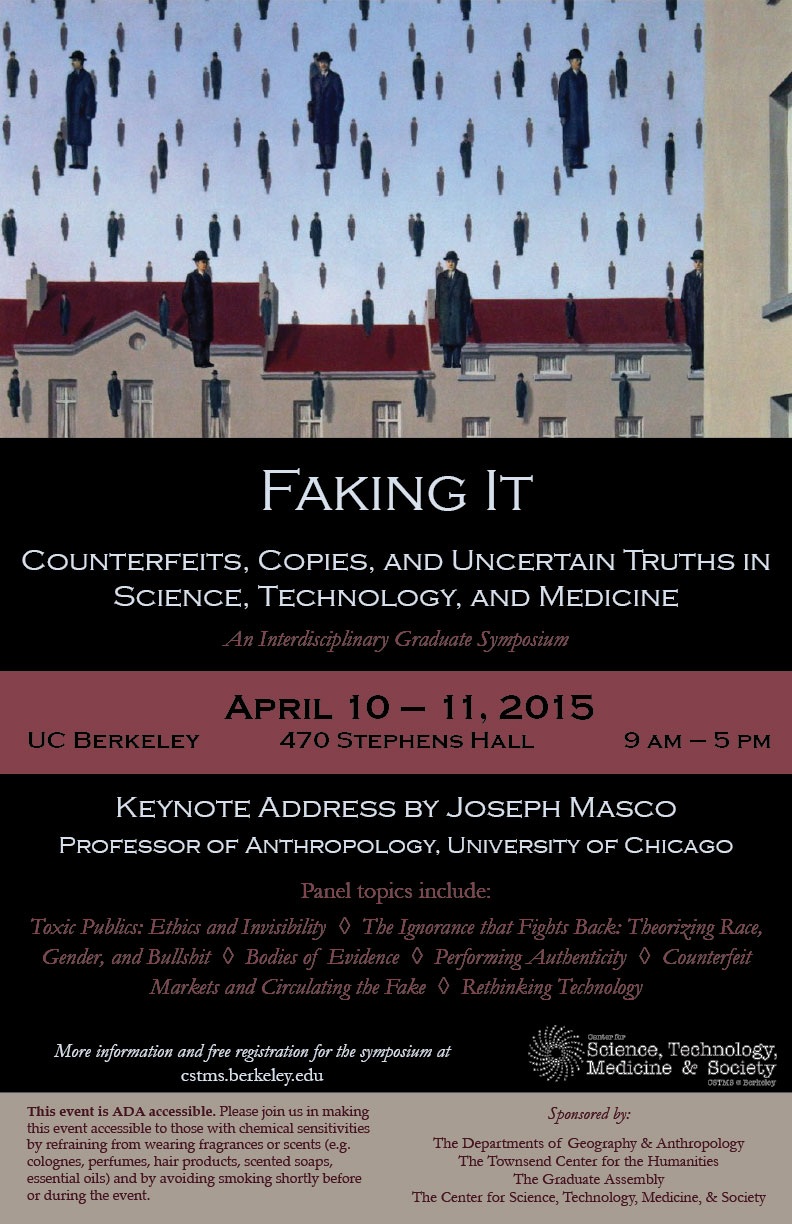
“Faking It” Symposium at #UCBerkeley 4/10-11

The Center for Science, Technology, Medicine, & Society announces our annual Graduate Student Organized Symposium

Faking It: Counterfeits, Copies, and Uncertain Truths in Science, Technology, and Medicine

Friday – Saturday
10 Apr – 11 Apr 2015

470 Stephens Hall

We invite colleagues to join us for a two day symposium at the University of California, Berkeley on “faking it”–here construed broadly as fudging, imitating, juking, playing the trickster, pretending, feigning, re-creating, manipulating, falsifying. Our aim is to bring together a wide variety of scholars whose work, in some way, touches upon this issue. We invite colleagues to consider any aspect of the practices, epistemologies, ontologies, and politics of faking, copying, counterfeiting, or quackery. We seek to amplify and incubate a growing attention to the theory and practice of fake truths on Berkeley’s campus and beyond.

Keynote address: Joseph Masco, University of Chicago

More information and registration (free) can be found here:
http://cstms.berkeley.edu/current-events/faking-it-counterfeits-copies-and-uncertain-truths-in-science-technology-and-medicine/

Glyphosate, Roundup, GMOs and the microbiome part 1: crowdsourcing literature

For many reasons I have been interested for the last few years in how agricultural practices affect microbiomes.  For example in regard to crops, how do farming practices affect the microbiomes of the plants, the microbiomes of the soil and area around the plants, and the microbiomes of organisms (including humans) who make use of the plants?

I won’t go into all the detail right now for why I am interested in this topic but for some examples of my work in this area see The microbes we eat abundance and taxonomy of microbes consumed in a day’s worth of meals for three diet types and Structure, variation, and assembly of the root-associated microbiomes of rice.

Anyway, the reason I am writing this now is that tomorrow I am “testifying” to a NRC Committee about this topic and some related topics.  The presentation will be shown live online (register here).  And I thought, in the interest of openness, I would post some of what I am thinking about here before hand.

One of the key topics for tomorrow is something I have been snooping around at for a few years – how does glyphosate (the key ingredient of RoundUp and a widely used herbicide) affect microbiomes?  I am interested in this from both a scientific point of view (I think it is an interesting topic) and also from a “public policy / education” point of view.  I think this is a really good topic to have a public discussion of “microbiomes” and both the importance of microbial communities and the challenges with studying them.  So a few years ago I started thinking about working on this and developing a “Citizen Science” project around it.  And, well, I am still working on that idea and probably will be trying to launch something in the near future.  As a first start I thought it would be good to start to engage the community (researchers, teachers, the public, etc) in a discussion of this topic.  So .. this is the beginning of that I guess.

Some questions I think are interesting:

  • Does glyphosate affect plant microbiomes?
  • Does glyphosate affect soil microbiomes?
  • Does consumption of plants treated with glyphosate affect the microbiomes of the consumer? 
    • Directly (e.g., by glyphosate itself being in the food and directly affecting microbomes”
    • Indirectly (by glyphosate affecting the microbiome of the food which in turn affects the microbiome of the consumer)
  • If glyphosate affects any of these microbiomes above, are these significant affects (e.g., in terms of health)?
Now I am not the only person who is interested in this topic.  In fact, there have been many people looking into these and related topics for years.  Some of the things I have seen on this topic in the popular press and the scientific literature are, well, not good science.  And some of the things I have seen are fascinating and well done. 
So as a first step in looking into this, I scoured the literature for papers of interest.  And that is really why I am writing this.  I created an open collection of the papers I have found with the Zotero reference collection system.  See this link for the collection.  And if you know of any other papers truly related to this topic, please add them to the collection (learn more about Zotero here).  I do not profess to know everything about this topic.  But I think it is interesting and possibly important.  

#UCDavis Provost’s Forum- Alessandro Duranti – 4/16

Received this email about a talk by Alessandro Duranti on "How disruptive can we be? Intended and unintended effects of changing academic practices"

Dear UC Davis Faculty, Staff, Students, and Community Members,

We are delighted to announce that the next lecture in the 2014-2015 season of the Provost’s Forums on the Public University and the Social Good will take place on Thursday, April 16, 2015.

The third lecture of the season features Alessandro Duranti, Distinguished Professor of Anthropology and Dean of Social Sciences at UCLA. His research projects have focused on the role of verbal and visual communication in political arenas, everyday life, and music performance and rehearsals. Dean Duranti will review a number of projects and initiatives at UCLA that have to some extent disrupted traditional views of collaboration in research and teaching; how to engage a non-academic audience; the separation between basic and applied research; the goals of graduate education; and the role played by alumni and donors in helping students along their career paths. In each of these areas, Dean Duranti will use examples of success and failure to assess some intended and unintended effects of experimentation. The goal of his presentation is to stimulate a productive conversation with faculty, students, staff, alumni, and friends of the UC system about the best ways to face a number of pressing challenges—including a rapidly changing job market, institutional competition from private universities, and current political realities in California.

The event will begin at 3 p.m. in the Multipurpose Room of the Student Community Center and will end at 4:30 p.m. There will be an hour-long reception with light refreshments directly following the end of the lecture. The event is free and open to the public.

For more details on this event please see the attached flyer, visit the Provost’s Forums website, or contact Casey Castaldi. In addition, please forward this information to any interested parties, as all events are open to the public.

We look forward to seeing you at this exciting event!

Duranti 4.16.15.pdf

Ann Reid at SkeptiCal 6/6 “OMG Virus! Flu, Ebola, Measles, and When You Really Should Be Afraid”

Just got this email and thought some of the talks would be of interest. Note – I love Ann Reid – having worked with her when she was at the American Academy of Microbiology. She is simply awesome.

————–

Dear northern California friends of NCSE,

NCSE’s executive director Ann Reid will be speaking on “OMG Virus!
Flu, Ebola, Measles, and When You Really Should Be Afraid” as part of
SkeptiCal 2015, the Northern California Science and Skepticism
Conference, held all day on June 6 at the Oakland Asian Culture
Center, 388 9th Street #290 in Oakland.

A description of her talk: “Ebola, influenza, bird flu, SARS, HIV,
West Nile, Hantavirus, measles — one could go on. Each of these
viruses has, at one time or another (or in some cases repeatedly),
been the subject of breathless front-page scare headlines. Fear, after
all, grabs our attention. And fear, when it comes to viruses, can be a
highly appropriate response. But our fears are often disproportionate
to the actual degree of risk. Furthermore, because fear is a highly
effective tool for manipulation, emphasizing — sometimes exaggerating
— risks plays a big part in public communications about viruses. So
what’s a layman to do? When is it appropriate to be afraid, and what
kinds of precautions are reasonable? Three case studies will
illustrate the complicated ways that fear can get in the way of a
clear-eyed view of how much risk a virus poses, and what a reasonable
person should do about it. First, the 1918 influenza virus killed
between 20 and 50 million people worldwide. What made it so lethal,
and are warnings that bird flu could cause a similar outbreak
justified? Second, how concerned should we be about Ebola, and what is
an appropriate response? And finally, how has fear of vaccination
superseded fear of the diseases it prevents?”

Also speaking at the conference will be plenary speakers Peggy G.
Lemaux on “Angst in the Grocery Aisle,” Natalie Batalha on “Toward
Other Earths, Other Life,” and John P. A. Ioannidis on “Reproducible
Research: True or False?” and breakout speakers Ron Hipschman on
“Science (in) Fiction,” Isil Arican on “International Skeptical
Activism,” Kenzi Amodei on “Your Inner Simulator,” and Frank Mosher on
“Workshop for Producing Skeptical Children.” Plus there’ll be
entertainment from Robert Strong the Comedy Magician.

Tickets are available now. If purchased before May 1, regular tickets
are $35.00, $25.00 for students. For further details and to purchase
tickets, visit:
http://www.skepticalcon.com/

At #UCDavis “Dengue control: from spray ’em and slay ’em to rear and release” #Wolbachia

Thursday April 9 366 Briggs
12:10

“ Dengue control: from spray ‘em and slay ‘em to rear and release”.

Prof. Scott Ritchie
James Cook University in Cairns, Australia
Chief medical entomologist of Scott O’Neill’s Wolbachia-based program to control the spread of dengue (http://www.eliminatedengue.com/program ).

At #UCDavis 4/6 Timothy Smith: Applications of next generation sequencing in animal science

“Applications of next generation sequencing in animal science”

Speaker: Timothy Smith

Research Chemist

US Meat Animal Research Center

Monday, April 6, 2015

4:10-5:00 PM

1022 Life Sciences

Workshop at #ucdavis: 04/21, mothur and multivariate statistics for amplicon analysis.

Who: Tracy Teal (tkteal@datacarpentry.org)
When: April 21, 2015.
Times: 9am-5pm .
Where: 2030 Valley Hall, UC Davis campus.

Description:

We will be running a mothur workshop focused on analyzing MiSeq
amplicon data. This workshop is intended for anyone new to amplicon
analysis or mothur or those want to more efficiently analyze MiSeq
data. We will work with sample data in this workshop and follow the
standard SOP, but by the end you should be able to do these analyses
with your own data. We will show you how to run mothur using cloud
computing and some multivariate statistics for analysis of OTU-based
community data.

This workshop is open to everyone, including graduate students,
postdocs, staff, faculty, and community members. We have reserved
space for UC Davis VetMed affiliates; please contact the lead
instructor if you are affiliated with the SVM.

More at:
http://dib-training.readthedocs.org/en/pub/2015-04-21-mothur.html

Registration link:
https://www.eventbrite.com/e/mothur-workshop-registration-16380968919

Seminar at #UCDavis 4/3: Cheemeng Tan – From minimal cells to reconfigurable systems

The Genome Center Systems and Synthetic Biology Seminar Series present:

Title: From minimal cells to reconfigurable systems

Speaker: Cheemeng Tan
Assistant Professor
Department of Biomedical Engineering
UC Davis

Date: Friday, April 3rd, 2015, 10am – 11am
Location: 1005 GBSF

Abstract:
Reconfigurability refers to the ability of natural systems to dynamically change their properties, including spatial distribution of cells, cellular structures, and organization of cellular networks. While cells achieve such reconfigurability with relative ease, synthetic biological systems are primarily engineered and studied using the classical paradigm of engineered systems, in which circuit components are connected through static biochemical wiring. Can we take advantage of reconfiguration mechanisms of natural cells to create a new class of reconfigurable synthetic systems? What are the tradeoffs between versatility and fidelity of reconfigurable biological systems? To address the questions, my lab uses synthetic biology approaches to investigate the reconfigurability of natural cells. I will discuss our effort in creating reconfigurable cellular dynamics using synthetic gene circuits, as well as controlling population dynamics using artificial cells. Our results will challenge the classical paradigm of synthetic biology, which has focused primarily on fixed topology of intracellular gene circuits. Furthermore, our results will establish the foundation toward reconfigurable synthetic systems that can be switched between distinct functions and dynamics using external signals.

Four simple tools to promote gender balance at conferences – guest post from Julie Pfeiffer @jkpfeiff

Guest post from Julie Pfeiffer.

Julie Pfeiffer
Associate Professor of Microbiology
University of Texas Southwestern Medical Center
https://twitter.com/jkpfeiff
http://www4.utsouthwestern.edu/pfeifferlab/Index/Home.html


Four simple tools to promote gender balance at conferences 


1. Know that you are biased. Identify your biases.

We all have biases and many of them are unconscious. You can discover your own biases using online social attitude tests developed by Project Implicit, a non-profit organization affiliated with Harvard University. The Gender-Science Implicit Association Test is particularly relevant here. It turns out that I have moderate bias linking science with males, as well as other biases. Knowing this fact has been extremely important. It is very difficult to alter unconscious bias, but it is easy to understand that you are biased and edit your actions accordingly. For example, if I need to make a list of potential speakers or authors quickly, the list will be of senior men from the United States. The key is to spend time EDITING the list to ensure diversity.

2. Keep track of numbers.

Most individuals in leadership positions are not seeking to exclude women or other groups from plenary talks, career opportunities, etc. Instead, they simply forget to count. They forget to keep track of gender ratio and other types of diversity. They forget to edit. When leaders/organizers have diversity in mind, diversity is relatively easy to achieve. Two examples illustrate this point:

1) Vincent Racaniello is President of the American Society for Virology and his goal was to put together an outstanding and diverse group of plenary speakers for the annual meeting in 2015. He asked for speaker suggestions via emails and Twitter (https://twitter.com/profvrr). He made a list and he edited it. The result? The best representation of female scientists at a conference I have ever seen— 50% of the plenary speakers at ASV this year are female.

2) The Associate Editors at the Journal of Virology choose topics and authors for short reviews called “Gems”. The goal was to have high diversity in several areas including author gender, author career stage, author location, and topic. To keep ourselves on track to achieve this goal, we included several extra columns in our author/topic spreadsheet: Female? Non-USA location? Junior PI? This simple reminder in the spreadsheet has helped us select relatively diverse authors and topics: ~30% are female, ~30% are Assistant Professors, and ~20% are at institutions outside the United States.

3. Create lists and ask people for suggestions. 


Trying to come up with names of female scientists de novo can be a challenge. A few months ago, Carolyn Coyne, Erica Ollmann-Saphire, and Clodagh O’Shea made a list of as many female virologists as they could. Over wine, they devised a list of 70 names. We have circulated this list to many of our colleagues and tweeted a request to send missing names. The list is now at 349 and is publicly available (please tweet missing names to https://twitter.com/jkpfeiff). It is much easier to think of diverse options for speakers and authors by using a pre-existing list. Virologists with this list can no longer claim that they “couldn’t think of a female speaker”. Each field could benefit from a list like this, which could also include other underrepresented groups. Several of these lists exist, as has been highlighted on this and other blogs.

4. Speak up and enlist the help of supportive senior faculty.

Expressing concern to conference organizers about low speaker diversity can go a long way. While it may be difficult to change the speaker list close to the conference date, mentioning the lack of diversity could change the future landscape of the conference. I have an example from my own experience: I created an international shitstorm that had a great outcome. In year three of my faculty position I was considering whether to attend a major conference, so I checked the speaker list to help make my decision. Zero of 18 plenary speakers were female. I decided not to attend. Instead, I emailed the conference organizer to express my disappointment with the complete lack of female plenary speakers. His response, over several emails, was less than supportive:

“…. Finally, the gender, race, religion has never been, to my opinion, valuable ways to select presenters of scientific works. The selection of the Plenary Lectures has been made by the Organizing Committee, that comprises a woman, based on the topic, then the best possible speaker on the topic…. I am aware of the current debate in our societies about “minimum numbers”. I do not think they would help the cause of women in science.”

While this organizer was not supportive or responsive to my speaker suggestions, five senior (famous) faculty members in the field were hyper-supportive. Upon hearing this story, they each contacted the organizer and expressed their concern about the lack of diversity. It was too late to change the program for the conference that year. However, in every subsequent year, the plenary speakers at this conference have included women and other underrepresented groups. So, it’s possible that a simple email from a young scientist can make a difference, particularly with the help of senior faculty.