Destination PhD

I recently had the opportunity to sit in on an exit seminar for a PhD candidate in my department (there was free food). The student began the seminar by detailing the hardships that they had faced throughout the completion of their dissertation which included smelly undergrads, dry eraser makers running out of ink and finding funds to go abroad for their field seasons (a common enough issue).

Field site #1: Resort on an island in the Caribbean

Travel to exotic destinations was key to the students dissertation since the student believed that resorts in exotic locations would have different, more exotic, microbes when compared with basic hotels in non-exotic locals (all of central USA). Although, the student had no preliminary data or any concrete hypotheses, the broader impacts of investigating tourist destinations and finding potential microbial health risks was significant enough for the student to find just enough funding for the project (quite an amazing feat in this day and age). Funding was obtained from the 99% Foundation, a group founded by the middle class to study the lifestyles of the rich and famous.

Field site #2: Ski resort in Switzerland

During the exit seminar, the student also discussed what inspired the project:

“I wanted to perform research that really meant something and that would provide great insight for human health. I wanted my research to be able to help solve global problems like reversing climate change, curing cancer, and finding a real fountain of youth. However even more than that, I wanted to do some traveling and couldn’t afford it; I’d never been to the Maldives or Switzerland before and I really wanted to go. Plus, this meant I could do all my field research over spring break.”

The student’s dedication to science is just admirable.

4.-The-Hilton-Maldives-Resort-and-Spa.jpg
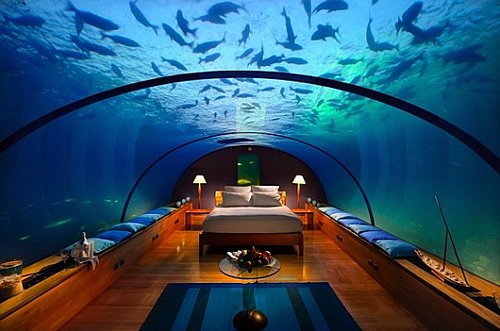
Field site #3: Underwater resort in the Maldives

The student spent the rest of the seminar detailing the results of this exotic resort microbial study. Surprisingly, there were a lot of microbes shared between exotic resorts and non-exotic hotels (lots of E. coli) and the student didn’t find anything of any real interest or importance (just a little bit of platypus DNA, note: not a microbe). However, the student believes this was likely due to the limited scope of the project. They were only able to get enough funds to visit four exotic resorts and did not due to time constraints (spring break is only a week long) to collect replicates. The student is currently looking for additional funding to expand the study to include additional resort locations (ex. LotR filming locations in New Zealand). The student is also interested in performing a time series at one of the resorts which would require the student to remain at the resort for a prolonged period of time – an extreme emotional and financial hardship. The student would also like to expand the project to include cruise ships.

Field site #4: Isolated resort in Jamaica

Listening to this student (and eating free cookies) made me really proud of my department and the exemplary research that is going on. This exit seminar stressed the importance of funding novel  hypothesis-less research projects that have the potential to generate lots and lots of superfluous data and that focus on really interesting, but uninformative, locations. Best of luck to this student in their future endeavors! If you need any help sampling, let me know!

Painful, kind of hilarious, typesetting error in a #PLOSOne paper from my lab – should I try to get it fixed?

Saw this tweet:

//platform.twitter.com/widgets.js
So I went and found the paper.

Wu D, Jospin G, Eisen JA (2013) Systematic Identification of Gene Families for Use as “Markers” for Phylogenetic and Phylogeny-Driven Ecological Studies of Bacteria and Archaea and Their Major Subgroups. PLoS ONE 8(10): e77033. doi:10.1371/journal.pone.0077033

And discovered what he was pointing to

Then I looked at the Pubmed Central version of the paper and it was the same.  So I wnet and found the arXiv version of the paper and it looked correct.

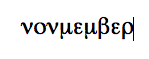
So apparently, PLOS One somehow replaced “nonmember” with


Brutal.  And even worse, this may have been there all along and I missed it.  So I responded:

//platform.twitter.com/widgets.js And then Michael Hall pointed out another mistake.

//platform.twitter.com/widgets.js

//platform.twitter.com/widgets.js

//platform.twitter.com/widgets.js

Aaargh.  And funny too.  So now the question I guess is – should I fix it? And if so, how do I do that?

//platform.twitter.com/widgets.js

Calling attention to meetings with skewed speaker gender ratios, even when it hurts, part 2

A few weeks ago I gave a talk at the Future of Genomic Medicine 2015 (aka #FOGM15) meeting.  The talk seemed to go over well.  I talked right after Martin Blaser in a session on “The Microbiome”.  I posted my slides and then a video of my talk as well as notes from the meeting: see My microbiome talk at #FOGM15 – the perils (and fun I guess) of redoing one’s talk at the last minute.  And I met some really interesting people at the meeting and enjoyed most of the talks I went to.

But alas, one thing stuck in my head from this meeting.  One single Tweet from someone out there threw me for a loop:

//platform.twitter.com/widgets.js
And this let to a bit of soul searching on my part.  Some of the conversations on Twitter are captured in this Storify:

Which I guess culminated in a post to the organizers of the meeting

//platform.twitter.com/widgets.js

Then, when I left the meeting I went to say goodbye to the organizers.  And, well, one of them did not take too kindly to the critique of the meeting, saying that they were doing a better job than other healthcare meetings.  I disagreed and said I thought they could do much better, but I had no numbers to cite at the time and the conversation ended there.

So on the way to the airport I started digging around for some numbers and I found some great resources – especially this from Rock Health.

And for the last few weeks I have continued to fester wondering – well – should I post more about this?  Should I dig into the gender ratio of the FOGM meetings in more detail?  Well, why do it?  Because I think it is important to know how meetings perform in terms of diversity.  Why not do it?  Well, I like Eric Topol and the other organizers.  And the meeting has many strong points.  But, as I wrote a few days ago – sometimes one needs to call attention to meeting gender ratio issues, even when it hurts.  

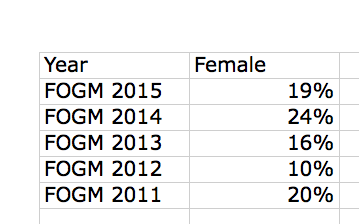
So then I decided to dig a little deeper and look at past versions of the “Future of Genomic Medicine”.  And, well, when I did this, things just do not look so good (detailed analysis is at the end of the post). (Note – for the numbers i counted all presenting slots – session chairs, keynotes, welcomes, etc.  The numbers are not much different if one counts just “talks”).

If one compares these meetings to the ones catalogued by Rock Health, the FOGM meetings are at the low end.  Not the worst certainly.  But definitely not something to be proud of.  And certainly something that could be improved upon enormously.  So I repeat the Tweet I posted during the meeting, and I stand by it, even if it means I am unlikely to be invited back and even if it means pissing off some big shots in the world of genomics …

If you are running a meeting, please consider the ways in which bias may creep into the speaker and session chair slots.  If speakers come from invitations, perhaps the invitation list is biased.  Perhaps certain types of people are more likely to say no to invitations.  Perhaps the timing of the meeting (e.g., on weekend) may lead certain types of people to not be able to participate.  Perhaps the meeting does not provide enough travel funds or child care or the right kind of schedule.  There are so many things that can lead to bias – from explicit bias against certain groups to very subtle implicit biases.  Consider inviting people from diverse career stages, which can open up speaking slots to more women and underrepresented minorities.  Consider providing child care.  Consider asking people why they say no to invitations to try and understand what is going on if many people say no.  Consider asking for help in finding speakers covering the diversity in the field.

If you do all these things, and the meeting still does not have diverse speakers, well, try some other things.  Keep trying to figure it out.  There are resources out there that can help.  Read things like Some suggestions for having diverse speakers at meetings (by me) and Ten Simple Rules to Achieve Conference Speaker Gender Balance (by Jenny Martin) and Increasing Diversity at Your Conference by Ashe Dryden (which is just completely awesome) and How To Create A More Diverse Tech Conference … and Would I attend my own conference? – O’Reilly Radar by Sarah Milstein.

Why is this important?  Well, speaking at a meeting is important for people’s careers.  It helps in merit and promotion and tenure cases.  It helps get their work recognized and known.  Speaking at a meeting is also good practice for speaking at other meetings.  Having diverse speakers also is important in terms of providing role models to attendees.  And having diverse speakers helps a meeting not just be about the same old, white, men talking about their ideas.  Or, in other words, it makes a meeting more, well, diverse.  And almost certainly more interesting.  And so on.  Diversity of speakers at meetings is important for 100s of reasons.  And don’t just focus on one aspect of diversity.  I post a lot about women speakers because, well, it is easy to make a reasonable guess as to whether a person is male or female.  But there are MANY other aspects of diversity to consider (see Increasing Diversity at Your Conference by Ashe Dryden (which I referenced above and which really is awesome).

Anyway – if you are organizing a meeting, make sure to think about these issues.  And do something about them.  And if you are invited to a meeting, look at the speaker list (if it is available) and consider saying no to speaking if the meeting has diversity issues (see a post of mine about doing this here: Turning down an endowed lectureship because their gender ratio is too skewed towards males #WomenInSTEM).

And if you are considering attending a meeting, consider diversity of speakers when deciding whether or not to attend.  Meetings with high diversity of speakers should be supported.  Meetings with poor diversity relative to possible candidate speakers (e.g., who is in the field) should be avoided, shunned, and called out.  We need to force change upon some fields and the only way will be to call out the bad apples.  Mind you, it is not possible to know WHY a meeting has a skew in terms of diversity of speakers.  Thus one additional thing to consider is whether something is a consistent pattern.  For example see my post about meetings from the National Academy of Sciences Sackler Colloquia – Apparently, the National Academy of Sciences thinks only one sex is qualified to talk about alternatives to sex #YAMMM. Sadly it seems to me that the FOGM meetings have a consistent pattern of poor representation of women among the presenters.  Unless the organizers commit to changing this, I think people should not attend this meeting in the future.

//platform.twitter.com/widgets.js


Detailed analyses of these meetings are below.

People I have identified as males are labelled in yellow.  People I have identified as females are in green.  I realize that this is an imperfect thing to do.  I may make mistakes in my inferences.  And dividing people into two categories is not representative of the true diversity in the human population.  But I still think this is a useful, informative thing to try to do.


2015 FOGM (schedule is from the one sent around to participants on 3/4/15)

  • Welcome
    • Eric Topol
    • Pateint #1 – Eunice Lee and Nilesh Dharajiya
    • Francis Collins
  • Session 1
    • Moderator Ali Torkamani
    • Diana Bianchi
    • Evan Muse
    • Stephen Quake
    • David Hoon
  • Session 2
    • Moderator Ali Torkamani
    • Mark McCarthy
    • Christopher Austin
    • George Yancopoulos
  • Session 3
    • Moderators Nathan Wineinger and Andrew Su
    • Atul Butte
    • Eric Schadt
    • Andrew Su
    • Joe Pickrell
  • Welcome Day 2
    • Patient #2
    • Eric Topol
  • Session 4: 
    • Moderator Ali Torkamani
    • Cristian Tomasetti
    • Nazneen Rahman
    • Roni Ziegler
  • Session 5
    • Moderators Kristin Baldwin and Fyodor Urnov
    • J. Keith Joung
    • Fyodor Urnov
    • TBD
    • Kristin Baldwin
  • Session 5
    • Moderator Kristian Andersen
    • Martin Blaser
    • Jonathan Eisen
    • Stephen Steinhubl
  • Session 6
    • Moderator David Goldstein  (he did not show up)
    • Elizabeth Worthey
    • Ali Torkamani
    • Seth Mnookin
    • Virginia Hughes
All speaker and session chair slots

  • Male: 30 (81%)
  • Female: 7 (19%)

Just speakers

  • Male: 23
  • Female: 6

2014 – Future of Genomic Medicine VII –  schedule from here

  • Welcome
    • Chris Van Gorder, FACHE
    • Eric J. Topol, MD
    • Patient / Family #1
  • Session 1
    • Frank McCormick
    • Bert Vogelstein
    • Elaine Mardis
    • Robert Nussbaum
    • Sarah Jane Dawson
    • Michael Pellini
  • Session 2
    • J. Craig Venter
    • Eric Topol 
    • Al Gore
    • Heidi Rehm
    • Muin Khoury
  • Session 3
    • Moderator Katrina Kelner
    • Leonid Kruglyak
    • Carl Zimmer
    • Magdalena Skipper
    • Chris Gunter
  • Session 4
    • Patient / Family #2
    • Athur Beaudet
    • Jay Shendure
    • Howard Jacob
    • Hakon Hakonarson
    • David Epstein
    • Nir Birzalai
    • Ali Torkamani
    • Jeffrey Hammerbacher
  • Session 5
    • Michael Specter
    • Jessica Richman
    • Andrew Feinberg
    • Russ Altman
    • Anne Wojcicki
    • Harry Greenspun
    • Zubin Damania

Speakers

  • Male: 25 (76%)
  • Female: 8 (24%)

2013 – Future of Genomic Medicine VI – schedule from here

  • Welcome: Eric Topol
  • Patient / Family #1
  • Session 1:
    • Michael Snyder
    • William Gahl
    • Howard Jacob
    • Ali Torkamani
    • Gholson Lyon
    • Cinnamon Bloss
    • Misha Angrist
  • Session 2
    • Evan Eichler
    • Eric Schadt
    • Katrina Armstrong
    • George Weinstock
  • Session 3
    • Joe Ecker
    • Stephen Kingsmore
    • Stephen Quake
  • Session 4
    • Patient / Family #2
    • Siddhartha Mukherjee
    • Elaine Mardis
    • Daniel D. Von Hoff
    • Randy Scott
    • Susan Desmond Hellman
    • Elias Zerhouni
    • Janet Woodcock
  • Session 5
    • Peter Vesscher
    • David Goldstein
    • George Church
    • Jonathan Eisen
    • Atul Butte
    • AJ Jacobs
    • Neil Risch
    • Lonny Reisman
    • Daniel MacArthur

Speakers

  • Male: 26 (84%)
  • Female: 5 (16%)

2012 Future of Genomic Medicine V – schedule from here

  • Welcome
    • Chris Van Gorder, FACHE
    • Eric J. Topol, MD
  • Joseph Beery and Family
  • Moderators: Samuel Levy, PhD and Eric J. Topol, MD
    • Samuel Levy, PhD
    • Matthew J. Price, MD
    • Julie Johnson, PharmD
    • Michael R. Hayden MB, ChB, PhD
    • William E. Evans, PharmD
  • Moderators: Evan Eichler, PhD and Sarah Murray,
    • Evan Eichler, PhD
    • Christofer Toumazou, PhD
    • Siddharta Mukherjee, MD, PhD
    • Sarah Murray, PhD
  • Moderators Nicholas Schork, PhD and Bradley Patay, MD
    • Hakon Hakonarson, MD, PhD
    • Isaac Kohane , MD, PhD
    • John A. Todd, FRS, PhD
  • Moderators Eric J. Topol, MD and Nicholas Schork, PhD
    • Howard J. Jacob, PhD
    • Joseph G. Gleeson, MD
    • Stanley F. Nelson, MD
    • Lynn Jorde, PhD (note – originalled labelled as female – corrected thanks to comment from Bruce Rannala)
  • Eric J. Topol, MD
  • Moderators: Aravinda Chakravarti, PhD and Richard Klausner, 
    • Aravinda Chakravarti, PhD
    • Joseph Nadeau, PhD
    • Nicholas Schork, PhD
    • Hakon Hakonarson MD, PhD
  • Moderator Eric Topol
    • Matthew Herper
    • Daniel B. Vorhaus, JD, MA
    • Issam Zineh, PharmD, MPH
  • Moderators: Elaine Mardis, PhD and Jeffrey Trent, PhD
    • Richard D. Klausner, MD
    • Thomas J. Hudson, MD
    • Jeffrey M. Trent, PhD
    • Daniel D. Von Hoff, MD
    • Elaine R. Mardis, PhD
  • Moderators: Samuel Levy, PhD and Fred Gage, PhD
    • Fred H. Gage, PhD
    • Bruce D. Gelb, MD
    • Joseph C. Wu, MD, PhD
All speaker and session chair slots

  • Male: 44 (88%)  45 (90 %)
  • Female: 6 (12%) 5 (10 %)

Just speakers

  • Male: 31 32 (91.4%)
  • Female: 4  3 (8.6%)

2011 Future of Genomic Medicine IV – schedule from here

  • Session 1: Moderators: Sarah S. Murray, PhD and Eric J. Topol, MD
    • Hannah A. Valantine, MD
    • Geoff Ginsburg, MD, PhD
    • Steve Shak, MD
    • Cinnamon S. Bloss, PhD
    • Matthew J. Price, MD
  • Session 2: Moderators: Bradley Patay, MD and Nicholas J. Schork, PhD
    • Kevin Davies, PhD
    • Thomas Goetz, MPh
    • Melanie Swan, MBA
  • Session 3: Moderators: Samuel Levy, PhD and Nicholas J. Schork, PhD
    • Kári Stefánsson, MD
    • Aravinda Chakravarti, PhD
    • Howard J. Jacob, PhD
    • Sarah S. Murray, PhD
    • James R. Lupski, MD, PhD
    • Nicholas J. Schork, PhD
    • Stephen L. Hauser, MD
    • David R. Bentley, D.Phil, F.Med.Sci.
  • Keynote: Juan Enriquez, BA, MBA
  • Session 4: Moderators: Robert L. Strausberg, PhD and Samuel Levy, PhD
    • Robert L. Strausberg, PhD
    • Elaine R. Mardis, PhD
    • Thomas J. Kipps, MD, PhD
    • Samuel Levy, PhD
    • Daniel D. Von Hoff, MD
    • Dennis A. Carson, MD
  • Session 5: Moderators: Eric J. Topol, MD and Bradley Patay, MD
    • Eric J. Topol, MD
    • Amy Harmon
    • Misha Angrist, PhD
  • Session 6: Moderators: Sarah S. Murray, PhD and Samuel Levy, PhD
    • Hakon Hakonarson, MD, PhD
    • Mark McCarthy, MD, F.Med.Sci.
    • Karen Mohlke, PhD
    • Stephen S. Rich, PhD
    • Philippe Froguel, MD, PhD
    • Muredach P. Reilly, MB, MS

All speaker and session chair slots

  • Male: 35 (80%)
  • Female: 9 (20%)

How to keep up with microbial ecology and the built environment: microBEnet is your place

Just posting a wrap up of posts on microBEnet (where I blog frequently as do many other folks that work on something related to microbial ecology, the built environment, or the intersection of the two).  microBEnet is really becoming a central place to find out what is going on in the world of microbial ecology and the built environment.  And I love that we are getting more and more posts from outsiders about their work, their meetings, their ideas and more.  Anyway – here is a wrap up of the posts for the last month.  If you are interesting in joining microBEnet and writing posts about relevant topics, let me know.

Jenna Lang (staff scientist in my lab) — meeting reports from a Planetary Protection meeting

My posts:

Alexander Sczyrba on the Critical Assessment of Metagenome Interpretation (CAMI)

Elisabeth Bik from Stanford roundups from Microbiome Digest
David Coil (a staff scientist at UC Davis in my lab)
Linsey Marr of Virginia Tech
Rachel Adams – post doc at UC Berkeley
Ben Kirkup of the  Naval Research Laboratory
Embryete Hyde from UCSD

Brent Stephens of the Illinois Institute of Technology

Curator, Professor, and Director of Comparative Biology Initiative Position at the American Museum of Natural History

Interesting …

Dear Colleague,

We are pleased to announce a search for a new senior scientific and leadership position (Curator, Professor, and Director of Comparative Biology Initiative) at the American Museum of Natural History. Please pass the attached posting along to anyone you think might be interested; applications and nominations are both encouraged.

Thank you,

John J. Flynn

Frick Curator, Professor, and Dean of the Richard Gilder Graduate School

On behalf of the AMNH Senior Curator-Director Search Committee

Senior Search:

Curator, Professor, and Director of Comparative Biology Initiative

American Museum of Natural History

The American Museum of Natural History (AMNH) in New York invites applications and nominations for an outstanding scholar at the Full Curator & Full Professor level with internationally-recognized research and leadership credentials, and demonstrated, ongoing high-impact research productivity and grantsmanship, to provide innovative leadership for a new museum-wide initiative in comparative biology. This initiative will incorporate the work of multiple investigators at the Museum and at collaborating institutions in genomics (including eukaryotic [including microbial] genomics, metagenomics, phylogenomics, transcriptomics, etc.), phenomics (large-scale phenotypic analysis) and bioinformatics/computational biology, aimed at understanding the evolution and relationships of organisms in ways that clarify and illuminate the architecture of life. The successful candidate for this position should show experience and interest in managing large–scale, interdisciplinary, collaborative, multi-institutional projects and is expected to qualify for and be appointed as a tenured full curator in either the Division of Invertebrate Zoology or Vertebrate Zoology, and as a full professor in the Richard Gilder Graduate School at the AMNH. We seek a creative, active, broad-based researcher and dynamic academic leader who interacts well with others and who will utilize the extensive resources the Museum has to offer in the way of collections, research instrumentation and laboratories, interactions with Museum colleagues and collaborations with area organizations (including the New York Genome Center, area universities, New York Botanical Garden, and others), teaching and mentoring, exhibition, and public education.

We particularly seek applications from, or nominations of, candidates with a compelling vision for the future trajectory of their science, and for comparative biology in general, and whose research addresses fundamental, cross-disciplinary questions. In addition to the above-noted expectations for high productivity and grantsmanship, the successful candidate will have outstanding communication skills in engaging diverse communities and demonstrated capabilities in management of collaborative projects and decision-making. Experience in interacting with governmental and non-governmental agencies and in fundraising are highly desirable, as are collection-based, field-based and/or computational research. Other responsibilities or opportunities include advising graduate students and postdoctoral fellows, offering courses in the Comparative Biology Ph.D. Program of the Museum’s Richard Gilder Graduate School, institutional service, development activities, and participating in Museum-sponsored exhibits and educational programs.

In addition to applications, we invite recommendations or nominations of potential candidates, and request that these include a resume and contact information for the nominee. Nominations or applications can be submitted to seniorcuratorsearch. Applicants should submit the following materials electronically, preferably as PDF files, via a single email message to seniorcuratorsearch (Subject line: 2015 Senior Curator IZ-VZ Search Committee: your name): 1) a cover letter in which you indicate your interest, experience, and qualifications for the position; 2) a curriculum vitae; 3) PDF files of up to five recent publications; and 4) names and contact information for five referees who can comment on leadership, scientific and other skills and accomplishments noted above (to be contacted by the Museum only at the time of arranging an interview or for the process of tenure review in the case of a potential appointment). Inquires should be directed to John Flynn, Chair of the Search Committee and Dean of the Richard Gilder Graduate School: dean-rggs. Applications or nominations should be received by April 2, 2015.

Employer Information:

The American Museum of Natural History is one of the world’s preeminent scientific and cultural institutions. Since its founding in 1869, the Museum has advanced its global mission to discover, interpret and disseminate information about human cultures, the natural world and the universe through a wide-ranging program of scientific research, education and exhibition. The Museum’s research collections include more than 33 million natural history and cultural objects, and AMNH scientists undertake more than 100 expeditions annually. Science at the Museum includes five academic divisions, the Richard Gilder Graduate School, Sackler Institute of Comparative Genomics, 1 million specimen-capacity Ambrose Monell Cryo Collection, Center for Biodiversity and Conservation, high performance computational facilities, Microscopy and Imaging Facility, Southwest Research Station, the largest independent natural history library in the Western Hemisphere, membership in the New York Genome Center, and an array of other scientific facilities and resources.

The American Museum of Natural History is an Equal Opportunity/ Affirmative Action Employer. The Museum encourages Women, Minorities, Persons with Disabilities, Vietnam Era and Disabled Veterans to apply. The Museum does not discriminate due to age, sex, religion, race, color, national origin, disability, marital status, veteran status, sexual orientation, or any other factor prohibited by law.

If special accommodations are needed in applying for this position, please contact the Office of Human Resources at hrdesk or 212-768-5108.

Senior curator-director job ad final for posting 2-17-15 .pdf

Calling attention to poor speaker gender ratio – even when it hurts

So I saw this Tweet earlier today

//platform.twitter.com/widgets.js
And that sounded very interesting. So I clicked on the link to check out the Plant Breeding for Food Security: The Global Impact of Plant Genetics in Rice Production A symposium honoring Dr. Gurdev Khush symposium.  And, then I went to the program.  And sadly I saw something there that was not to my liking.  The speakers were almost all male (men labelled in yellow, women in green)

  • Welcome to the Khush Symposium (Alan Bennett)
  • The Plant Breeding Center (Charles Brummer)
  • The Confucius Institute (Glenn Young)
  • Global food production – challenges and opportunities (Ken Cassman) Food production, technology and climate (David Lobell)
  • Panel – Impact of Gurdev Khush on plant genetics and food security Tomato genetics
    • (Dani Zamir)
    • (Pam Ronald)
    •  (Gary Toenniessen)
    •  (Gurdev Khush)
  • Lunch; The California Rice Industry (Kent McKenzie)
  • The rice theory of culture (Thomas Talhelm)
  • Recent advances in rice productivity and the future (David MacKill)
  • Hybrid rice technology contributions to global food security (Sant Virmani)
  • Super green rice (Qifa Zhang)
  • Tackling the wheat yield barrier (Matthew Reynolds)
  • African Orphan Crops – inspiration and execution (Howard Shapiro/Allen Van Deynze)

If this was a symposium outside UC Davis the first thing I would do would be to post about it.  To Twitter or my blog or both.  And to critique them.  Why?  Because there is a bad history in STEM fields of having meetings and conferences have under-representation of women as speakers.  And this has become a passion of mine and I write about it a lot.  But I hesitated.  Why?  Because this was from UC Davis and many of the people involved are friends / colleagues.  I did not want to anger them, or embarrass them.  And I don’t think there is any intentional bias here by any means.  But, if I am going to critique people outside UC Davis, it seems like I should also apply the same standards to people inside UC Davis and to colleagues and friends.

So I posted to Twitter a response:

//platform.twitter.com/widgets.js
But that did not seem sufficient.  So I wrote up this post.  Underrepresentation of women as speakers is a serious issue in STEM fields.  And it is solvable (e.g., see Some suggestions for having diverse speakers at meetings by myself and the wonderful Ten Simple Rules to Achieve Conference Speaker Gender Balance by Jennifer Martin).

Now – do I know who the possible speakers were for this symposium?  No – I don’t really know the field.  Is it possible that there just are no women in the field?  Sure.  But I would bet anything that is not the case here.  Having a meeting where the ratio of speakers is 16:1 male: female sets a bad example.  UC Davis and the organizers of this meeting can do better.  And though this will possibly hurt me in various ways (I already got grief from one person who I will not name for the Tweet), I think it is critical that we call out examples such as this.

And finally I note – I have taken on the issue of women at STEM conferences and meetings because, well, it is easy to identify cases where the numbers are anomalous and it is relatively easy to solve.  But it is also important that we consider other aspects of diversity of speakers (age, ethnicity, career stage, etc).  It is important to have diversity of speakers at meetings for many many reasons.  Speaking is a career building opportunity.  Speakers serve as role models for others.  Diverse points of view are important to have represented.  Bias – whether simplicity or explicit damages the whole practice of science.  And more.  Yes, we need to work on many aspects of diversity in STEM fields.  Improving the diversity of speakers at meetings is but one part of this.  But it is an important part and it is relatively easy to do.  So just do it.  And call attention to it.  Even if it hurts.

UPDATE 3/25 11:29 AM

The meeting organizers have responded on Twitter

Storify of some responses here

//platform.twitter.com/widgets.js

Treponema are not "ancient" but absence from some human’s guts is very interesting

So I saw some Tweets today that caught my attention, discussion news stories about “ancient” bacteria being missing from some human’s gut microbiomes:

//platform.twitter.com/widgets.js

//platform.twitter.com/widgets.js

These refer to a sadly inappropriate headline in Science

What is wrong with this?  Well, there are no “ancient” bacteria around today.  They are all modern.  I am not even sure what they were trying to say.  Just a really bad evolution argument I guess.  I pondered giving Science a Twisted Tree of Life Award which I give out for exactly this kind of thing –  but decided first to dig into the science here and gloss over the bad evolution headline.

And it turns out – what the news story is about is in fact interesting – a new paper out in Nature Communications:  Subsistence strategies in traditional societies distinguish gut microbiomes.

The paper is freely available and has some really interesting material in it.  They key to me – at least related to this “ancient” bacteria claim is the following part of their abstract:

As observed in previous studies, we find that Treponema are characteristic of traditional gut microbiomes. Moreover, through genome reconstruction (2.2–2.5 MB, coverage depth × 26–513) and functional potential characterization, we discover these Treponema are diverse, fall outside of pathogenic clades and are similar to Treponema succinifaciens, a known carbohydrate metabolizer in swine. Gut Treponema are found in non-human primates and all traditional peoples studied to date, suggesting they are symbionts lost in urban-industrialized societies.

And then some further detail in the paper:

Although Spirochaetes have been previously reported from the gut microbiome of non-human primates and ancient human populations, they have only been observed in high abundance among extant human populations with non-Western lifestyles, such as a traditional community in Burkina Faso and a hunter-gatherer community in Tanzania. As such, they may represent a part of the human ancestral gut microbiome that has been lost through the adoption of industrial agriculture and/or other lifestyle changes. 

So they don’t go into the full detail here but what I think they are saying is that they infer that human ancestors had Spirochaetes (based on the finding of it in non human primates and some human populations).  And thus they further infer that human populations (e.g., the people they studied in Oklahoma) that do not have these Spirochaetes have “lost” them.

I note – I think this terminology of “loss” they are using is not quite right here in a way.  Saying that these Spirochaetes have been lost implies to me that they are heritable.  But they do not in fact show that.  It could be that these are related to diet or environment in some way – something shared by some human populations and non human primates, for example.  And thus the absence from some “Westernized” populations could be more of an environmental thing than a “loss” in the past.


In a similar way, we could say that Westernized humans have “lost” the ability to be skinny (since obesity is high in many such populations).  Non human primates have such abilities and so do some non Westernized populations.  But “losing skinnyness” does not seem quite right since we do not know exactly why obesity is higher in Westernized populations.  I think it would be better in such cases to say something like “do not show an ancestral trait” (the ancestral trait here being skinnyness) and to not use “lost” until we know more about what is going on.  Similarly, I think saying some human populations have “lost” these Spirochaetes is not quite right.

Nevertheless, the absence (or at least, low levels) of these Spirochaetes from some human populations is certainly interesting.  And given that the presence of such Spirochaetes does appear to be an ancestral trait, the absence is even more interesting.  And thus this paper here, which details some of the genomic features of these “missing” Spirochaetes is definitely worth paying attention to.

In addition, I note – the findings in this paper serve as an additional justification for projects to generate genomic data from across the phylogenetic diversity of microbes.  Consider for example their Figure 6 and 7 which show that the most closely related Treponema species and the ones with the most similar genomes to these human Spirochaetes are those from Treponema succinifaciens and Treponema brennabornese.

Both of those genomes were generated by the Genomic Encyclopedia of Bacteria and Archaea project which I coordinated with the DOE-JGI and DSMZ.  See the paper on one of them: Complete genome sequence of Treponema succinifaciens type strain (6091T) and the posted data on the other.

We argued that we needed to sequence reference genomes from across the tree of life because this would help inform studies of uncultured microbes from diverse ecosystems.  Little did I know that one of the key ecosystems we would help inform would be the human gut.

Certainly more needs to be done in regard to these Spirochaetes.  Why are they at low levels or missing from some Westernized populations?  What do they do in other populations?  Would they be helpful if they were reintroduced to populations that do not have them?  So many questions actually.  But despite the misleading news article headline, this paper seems to me on first glace at least to in fact be quite interesting.

I made a Sorify of some comments

The ChuckNorrisMicrobiome will get you, and you, and you …

Some Saturday fun …

Overselling the microbiome award: Dr. Raphael Kellman at MindBodyGreen

Well this article by Dr. Raphael Kellman has just lots of overstatements about the microbiome: Why The Microbiome Is Your Key To Glowing Skin & Healthy Weight

For example, he writes:

Have you and your boyfriend or girlfriend ever gone out for a feast of delightfully unhealthy proportions only to then find yourselves picking fights with one another once you’re back home and digesting?  Fueling your body with unhealthy bacteria, and then feeding it with more unhealthy bacteria, is a sure-fire way to destabilize your mind-body connection. Instead, focus on supporting the positive bacteria in your belly with fermented foods like yogurt, sauerkraut, and kefir and watch your spirits soar.

This implies that somehow the microbome has some role in such situations and in mediating the relationships between two people.  And it implies that that can be fixed with fermneted foods.  And this is without any shred of evidence …

Then there is a discussion that makes the microbome sound like the master controller of all that is human:

Our bodies are cohesive entities, yes, but within each there are several languages spoken. 

The microbiome works like a translator for all of these systems, deciphering and decoding so that one process can communicate with the other for more efficiency and effectiveness (helping our systems to work as a team instead of independently alongside one another).

And then there is evidence free claims about fatigue and the microbiome

I’ve found that this kind of unexplained fatigue is often linked to a lack of diversity in the microbiome and can be remedied, despite what conventional medicine says

Whenever someone critiques “conventional” medicine and then presents no evidence for their claims, one should be wary, very wary.

And it ends with

Your inner ecology, your microbiome, is influential on your physical health, and that shows through glowing skin, a balanced weight and a youthful essence.  

So – if you want to be youthful and glowing and have good sex and relationships and get rid of your fatigue and fix your automimmune disorders and obesity and connect all of your systems together, all you have to do is fix your microbiome.  Simple.  Oh and how do you do that?  Why funny you asked, because I am selling this new book on the Microbiome Diet to solve all your problems.  Ridiculous.  And dangerous.

And thus I am giving out an Overselling the Microbome award to Dr. Kellman.

Some silly microbome ideas from @DeepakChopra and @rudytanzi

Well, just got to reading this: Big Idea 2015: Medicine, Wellbeing, and the Microbiome | Deepak Chopra MD. Yes, it was from December 2014 but I could not get up to reading it then because I saw some of the comments online about it and it seemed off.  But anyway I caught up to it today.  It has many inaccurate and misleading statements about microbes and microbiomes I just felt like I had to post something.  Some of the problemmatic parts are below with comments.

Let’s start gently.  As with many other stories on the microbiome, this article quotes the oft cited “fact” of a 10:1 ratio of microbial cells to human cells.

By some estimates the body has between 35 and 100 trillion cells with only 1 in 10 belonging to tissues and organs and the rest belonging to the microbiome.

This has been refusted by a great article in the Boston Globe by Peter Andrey Smith in September 2014 (long before this was published): Is your body mostly microbes? Actually, we have no idea.  Yes, I and many others cited this 10:1 ratio before the Globe.  But seeing it cited in this from December 2014 suggests Chopra and Tanzi aren’t really paying attention to microbiome science.

The next comment I find a bit off is the follwing:

Our personal human genome also determines the composition of our microbiome, which in turn can influence metabolism and propensity for weight gain.

Sure.  Our genes influence out microbiome.  But “determines the composition” is way to strong a statement.

But the things that got to me most were many of the comments supposedly about evolution.  I list some of them below:

  • This varying ecosystem isn’t populated by foreign invaders and pathogens but by colonies closely connected to human evolution.
    • I don’t even know what this is supposed to mean.  These are not “colonies” first of all.  And second, what does “connected to human evolution” even mean?  And wouldn’t pathogens be connected to human evolution?
  • The microbiome interfaces between the human body and the outside world in complex ways, but the gist is that human DNA has evolved in cooperation with microbial DNA. This fact is more important than the interactions that cause diseases created by invading bacteria and viruses.
    • Re “human DNA has evolved in cooperation with microbial DNA“.  Well, sure.  Some of the microbes we live with are mutualists. But most likely only a limited number of mutualistic interactions are going on.  This sounds like a Gaia type of model, with no evidence.  
    • And then “This fact is more important than the interactions that cause diseases created by invading bacteria and viruses.”  Really?  More important than the plague?  Than malaria? Aids?  Cholera.  TB? Worms? And more.  This sounds really silly.
  • Mitochondria actually have their own genomes inherited from the mother without change.
    • Umm – no mitochondria mutate and change, well, all the time.
  • Some of the most archaic microorganisms on Earth survive today in our microbiome.
    • This is without any justification.  First of all – what does “most archaic” mean?  And second, if it means what I think it means (organisms that have features like those from billions of years ago) – well – no – the human microbiome does not have a lot of such organisms.  This is just complete hooey.  
  • It would appear that the genome and the microbiome cross-talk, a conversation that has been continuing for billions of years with no signs of stopping.
    • What does this even mean?  In what way has the human microbiome been interacting with the human genome for billions of years.  In what way have human ancestors been interacting with microbiomes for billions of years?

Yes, the microbiome is important.  But this “essay” is filled with nebulous pseudoscientific comments about the microbiome all, apparently, to sell an upcoming book and related activities

“In an upcoming book we are co-authoring, Super Genes, we will present the latest findings as well as a lifestyle program devoted to what we call Self-Directed Biological Transformation”

Right now, I don’t think Chopra and Tanzi show any evidence they really understand the microbiome .. doesn’t bode well for their book and lifestyle program.