Horizontal gene transfer into humans? I am not convinced. Full text of my comments to reporters here

Some news stories about a new paper claiming evidence for horizontal gene transfer into humans and other chordates. I got asked by many reporters about it and some used some of my email comments in their articles.

See for example

 Here is the full text of my responses:


“got asked by another reporter to comment on this

so – have seen the paper 

it is interesting .. but I am not overwhelmed by what they present in the paper itself. For example, the HAS story seems really incomplete as presented (e.g., the Figure showing the tree does not have all the HAS1, HAS2, HAS3 genes even though they imply they studied that). “


I have been looking through the supplemental information. I find it impossible to judge the quality of this paper without being able to see the alignments they used for each phylogenetic tree. I cannot find alignments for the trees even after going to their Figshare site with the trees. I therefore think there is not much to say about the paper until being able to see those. 

Without seeing the alignments I offer multiple alternative hypothesis for their findings

  1. They have identified genes for which they are unable to produce reasonable alingnments. Alignments are central to phylogenetic analysis and if their alignments are poor quality then the trees will show all sorts of anomalies that have nothing to do with phylogenetic history. By scanning through 1000s of genes and flagging those with unusual patterns they may be selectively identifying genes for which producing good alignments between species is tough. I note – clustalw is a bit notorious for not producing idea alignments in some cases.
  2. I do not buy their arguments for why gene loss is not a possible explanation. They need to present more detail on how many gene losses would be required for each gene family under consideration and then present some evidence for why that # of gene losses is less likely than HGT.
  3. They have not even considered as far as I can tell, the possibility of divergent evolution (as opposed to gene loss) in many taxa which could lead to them being unable to identify homologs in some species
  4. I am not convinced by the arguments against long branch attraction as an explanation for some of the tree patterns.
  5. Related to alignments they need to show which regions of alignments they excluded from phylo
  6. Convergent evolution could also explain some of the patterns they observe.
  7. I could go on. I am NOT saying that HGT into chordates is impossible. It seems plausible. But it is up to them to exclude other MORE plausible alternatives and I just do not think they have done that.

Reporter: asking if it was OK to quote me

Yes it is OK to quote from me. I would like to reiterate – I am not saying they are wrong. Just that I would like to see (1) all the data (e.g., alignments) that unreels their conclusions and (2) them do more to exclude other possibilities.


Reporter asking what other analyses could they do

So – I don’t want to be difficult, but it is their job to figure out how to do such tests before claiming they have strong evidence for HGT. 

In general, this is pretty typical of claims of HGT. Many researchers show evidence that is consistent with the occurence of HGT (which they did here) but few actually explicitly test alternative hypotheses such as gene loss, bad alignments, convergence, divergence, contamination, random noise, and more. I think their work is certainly interesting, but they just have not tested all of these alternatives. And I personally have grown a bit tired of pointing out how people can do better controls for their papers.


Reporter asking about initial impressions:

I see little here that is particularly convincing evidence for HGT …


My follow up email

Note – I am not saying that this is a bad paper — just that I am not overwhelmed by their evidence and especially by what they put in the paper. 

For example, the HAS1 gene story seems incomplete.  Figure 3 seems to show just HAS1 but in the text the say they show the same thing for all HAS genes.  And the tree they show shows a tiny subset of all the available sequences (e.g., HAS1 HAS2 HAS3 and fungal and bacterial homologs).  They claim that they now have proof that HAS1 was transferred near the base of chordates but I just don’t see how they tested alternative hypotheses …


Some related links:

Also here are some presentations from many years ago with some discussion of HGT

Probiotics for athletes? Possible someday, but right now – I (and others) don’t think so

Nice article in Outside Magazine by David Despain: Should You Be Taking Probiotics? | Performance Plate | OutsideOnline.com.  The article has comments from me, Peter Turnbaugh and Ellen Silbergeld.  The article discusses some of the overhyped claims about probiotics and athletic performance and even mentions my Overselling the Microbiome award.  I like in particular the following paragraph:

The biggest issue scientists currently have with probiotics, however, doesn’t have to do with athletes. Instead, it has to do with the initial hypothesis that we need them in the first place, says Ellen Silbergeld, a professor of Johns Hopkins Bloomberg School of Public Health. Because there’s still no real understanding of what makes “healthy” or “poor” microbiomes, there’s no real understanding of how or if we should cultivate them.

UC Davis Postdoctoral Research Symposium May 14

POSTDOCTORAL RESEARCH SYMPOSIUM

May 14th 2015
Memorial Union, UC Davis

We invite all UC Davis postdoctoral researchers to register for a 10-min talk or a poster. Awards will be given to the best talks and posters.

Deadline for abstract submission: March 27th

The entire campus community is welcome to attend for free. Lunch is provided for registered participants.

Register at
https://sites.google.com/site/ucdavisprs/home

PRS-poster.pdf

Teaching with Wikipedia 3/13 at #UCDavis

Teaching with Wikipedia

Friday March 13, 2-3pm

165 Shields Library (Shields Library Instruction Lab, http://lib.ucdavis.edu/dept/instruc/maps.php?map=lil)

Description:

Students use Wikipedia — but have you ever thought of asking them to contribute content to Wikipedia? In this short workshop, LiAnna Davis and Jami Mathewson from the Wiki Education Foundation (http://wikiedu.org) will explain best practices for using Wikipedia as a teaching tool. In contributing content to Wikipedia, students gain skills in media literacy, fact-based writing, research, collaboration, and critical thinking. You’ll learn how Wiki Ed can support you and your students in this innovative service learning assignment.

http://calendar.ucdavis.edu/event_detail.lasso?eventID=16650

Seminar at #UCDavis 3/11 4PM: Biogeography and ecological role of thermophillic archaeal nitrifiers

MIC 291: Selected Topics in Microbiology

Work-in-Progress Seminars

Dr. Jose de la Torre
(San Francisco State University)

"Biogeography and ecological role of thermophillic archaeal nitrifiers"

Wednesday, March 11, 2015

4:10 pm

1022 Life Sciences

de la Torre 3-11-15.doc

Today’s gender biased meeting-GlycoCom2015-sponsored by @generalelectric @ualberta #YAMMM

Got pointed to this via a Tweet:

//platform.twitter.com/widgets.js The Tweet pointed to this meeting: Home – Glycomics Official Website of GlycoCom Conference 2015 in Banff, Alberta, Canada.  Lame.  14:1 ratio of men: women speakers.  Just completewly lame.

Confirmed Speakers

  • Richard Cummings, Emory University School of Medicine
  • Paul DeAngelis, University of Oklahoma and Caisson Biotech LLC
  • Donald Jarvis, University of Wyoming and GlycoBac LLC
  • Nicole Koropatkin, University of Michigan Medical School
  • Mario Feldman, Washington University, St. Louis and VaxAlta Inc.
  • Gordon Lauc, University of Zagreb
  • Todd Lowary, Alberta Glycomics Centre and University of Alberta
  • John Magnani, GlycoMimetics Inc.
  • Glenn Prestwich, University of Utah and GlycoMira Therapeutics Inc.
  • Peter Seeberger, Max Plank Institute
  • Tadashi Suzuki, RIKEN Global Research Cluster
  • Ajit Varki, University of California, San Diego
  • David Vocadlo, Simon Fraser University and Alectos Therapeutics Inc.
  • Michael Wacker, GlycoVaxyn AG
  • Robert Woods, Complex Carbohydrate Research Center & Glycosensors & Diagnostics, LLC

The University of Alberta and GE and the other sponsors should be embarassed by this.  

My microbiome talk at #FOGM15 – the perils (and fun I guess) of redoing one’s talk at the last minute

Just got back from the Future of Genomic Medicine 2015 meeting where I gave a talk about microbiomes.  My original plan was to talk about the need for evolutionary and ecological approaches to microbiome studies but I changed my mind a few days before the meeting and decided to switch to talking more about citizen microbiology.  I did this because the meeting has a lot of people who think about digital and wearable technology and public engagement in the audience and it just seemed like a good chance to introduce them to the growing personal/citizen microbiology movement.

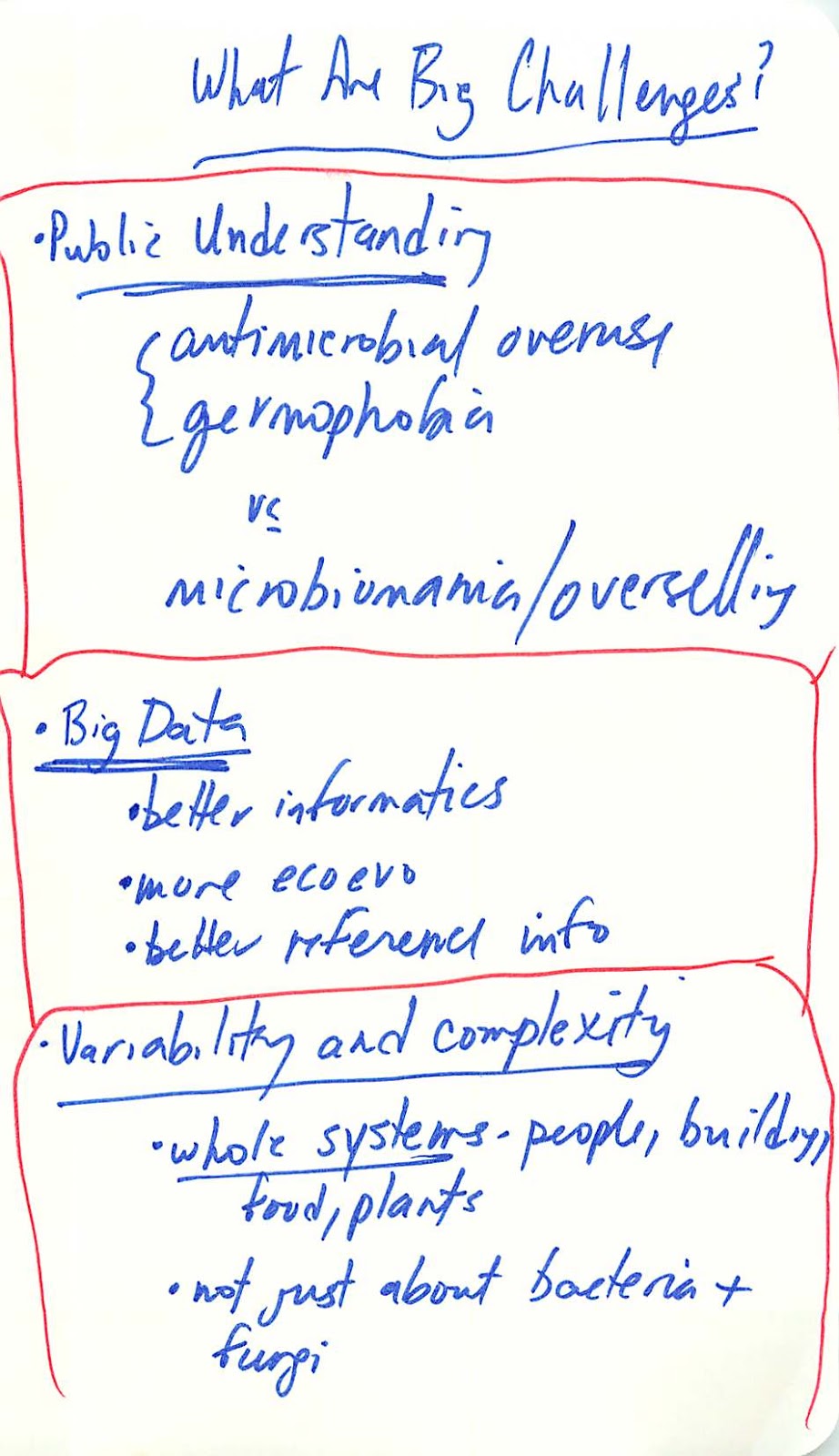
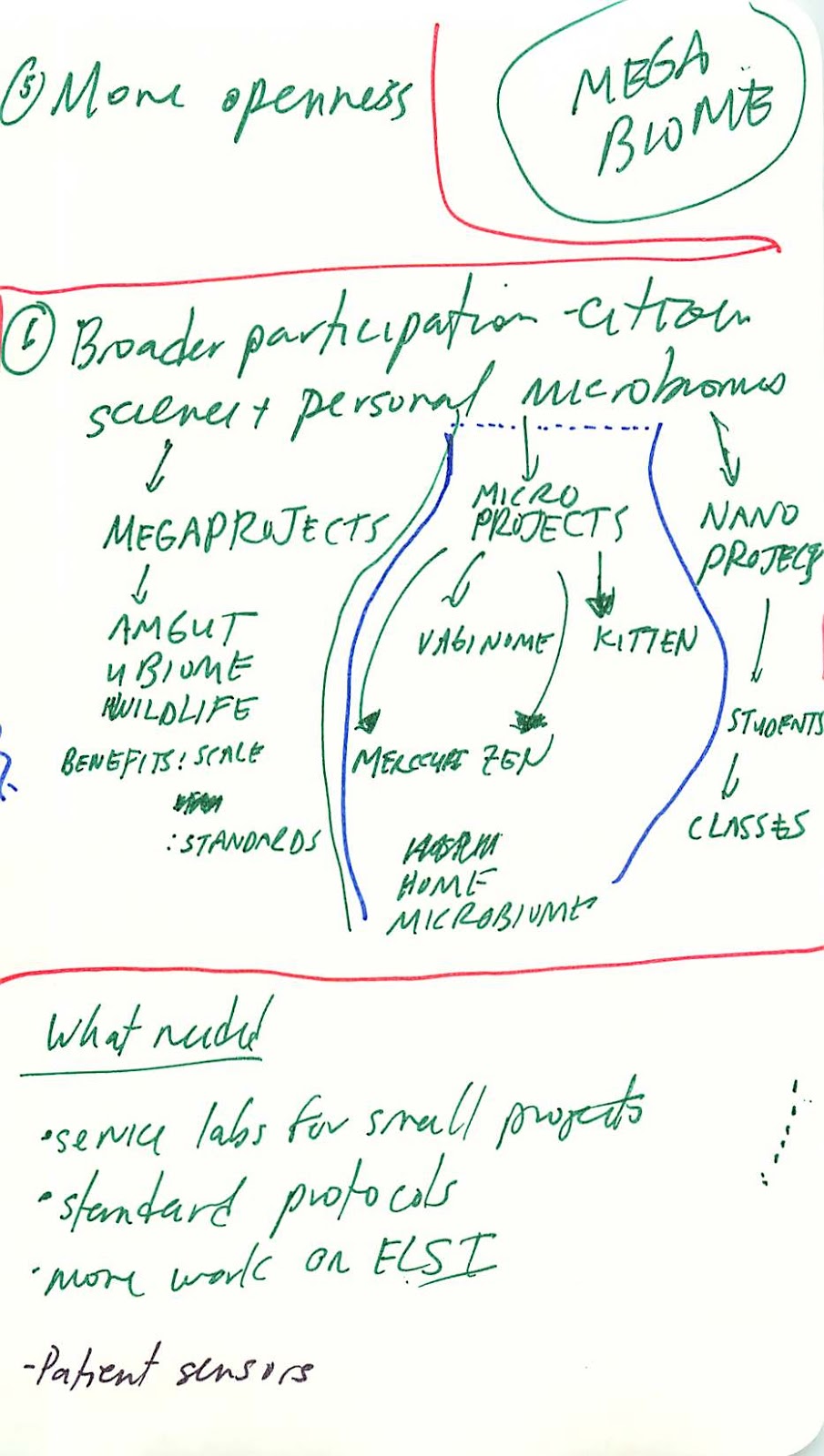
To help prep for my talk I emailed some colleagues who work on Citizen Microbiology (including a few in my lab like Jenna Lang and David Coil) and asked them if they had any slides I could pilfer.  And then I started drafting an outline of my talk (I draft all my talks by hand with pen and paper). Here are my handwritten notes

 I realized I would not likely be able to focus enough at home to work on the talk so I kind of waited until heading down to San Diego on Wednesday (talk was on Friday).

I got in pretty late and worked a little on my talk before going to bed.  I also emailed the organizers of the meeting to say I was changing the topic of my talk a bit and asked if they could change the online program which they did.  Eric Topol in response to my saying I wanted to talk about citizen microbiology and personal microbiomes very wisely suggested that I talk about my vision for the future of microbiome research.  I (lamely) had been so focused on Citizen Microbiology that I had not been thinking much about the bigger picture.  But once he suggested this notion my talk really congealed (in my head and on paper at least).  It is interesting to me how one simple suggestion from someone with vision and perspective can transform one’s thought process so much …

Anyway, the next day I headed over to the meeting venue (by the beach – life is rough in San Diego).  I got there in time to hear Francis Collins’ talk.  I spent the day sitting outside in the outdoor tent viewing area, pondering my talk and listening to the talks of others. Lots and lots of interesting things presented there.  More about this later I hope.  Anyway – that evening I worked on my talk some more, headed down to the hotel bar for a bit and then worked on my talk some more.  And eventually went to sleep.  Friday I spent much of the AM working on my talk in the outdoor tent (while listening to the talks though this time not watching them on the screen since I was a bit too far away from it).  And voila – only 30 minutes before the PM session was to begin I finished the prep.  I do not like to do this normally but I just felt like my talk would be much better if I re-conceived it and I had to make all new slides pretty much for the whole talk (other than the few I pilfered from colleagues).

I note – I was talking after Marty Blaser and figured I would not have to introduce the human microbiome at all and also that he would give an overview of the risks that come from disturbing the microbiome.  Anyway, I gave my talk, and recorded the slideshow with Camtasia.  Below are my slides, the video slideshow, and a Storify of the Tweets others posted during my talk.
As is frequently the case, afterwards I felt I was too rushed and that it was not the best talk I have ever given. But that being said, I like the general outline and some of the concepts and figured I should share, warts and all. My biggest regret after talks which I have rushed a bit in preparing is that I usually do not do a great job in mentioning who did all the work I refer to. I try to put people’s pictures and names on all slides and references but I don’t always get this done in time and I worry I screwed this up for a few topics here. Oh well, life goes on …

Here is a slideshow with Audio (which I recorded via Camtasia)

Here is the Slideshare posting of my slides

Today’s YAMMM – The British Society for Plant Pathology

Well, this is not the most egregious example of a mostly male meeting but it still has some issues: The BSPP – The British Society for Plant Pathology 2015 meeting.  Nine speakers.  Seven male.  And this in a field with plenty of excellent female researchers.

Cassava brown streak disease
(1) James Legg – IITA Tanzania
(2) Stephan Winter – Leibniz Institute DSMZ Germany
(3) Maruthi Gowda – Natural Resources Institute, University of Greenwich

Late blight
(1) Bill Fry – Cornell University
(2) Sophien Kamoun – Sainsbury Lab, Norwich
(3) Jonathan Jones – Sainsbury Lab, Norwich

Rice blast
(1) Sarah Gurr – University of Exeter
(2) Lauren Ryder – University of Exeter
(3) Thomas Kroj – INRA, Montpellier, France

But the weirdest part —  it says

“This year, the BSPP President, Prof. Gary Foster, has only chosen a few invited speakers on specific diseases, and wishes the remainder of the talks to be selected from offered papers.”

So does this mean Prof. Gary Foster just picked all speakers?  If so, perhaps Prof. Gary Foster needs to do a little thinking about his possible biases …

New NSF funding opportunity: Cracking the Olfactory Code – An Ideas Lab Activity

Not that I do anything related to olfaction … but this NSF Ideas Lab system at least seems interesting … though not sure how well it actually works. See email I just received from NSF below:
Dear Colleagues,

A new NSF program solicitation (NSF 15-547) is now available:

Cracking the Olfactory Code
— An Ideas Lab Activity

Please see

http://www.nsf.gov/funding/pgm_summ.jsp?pims_id=504773&org=DMS

for details.

Due Date for Preliminary Proposals (required): May 1, 2015

Harold Varmus stepping down from the National Cncer Institute

Begin forwarded message:

From: "Exec Sec1 (NIH/OD)" <EXECSEC1>
To: List NIH-ALL-STAFF <NIH-ALL-STAFF>
Subject: Important Announcement from the Director, NIH – Dr. Varmus to Step Down as NCI Director
Date: March 4, 2015 at 4:41:23 PM EST

Dear Staff,

After nearly five years as director of the National Cancer Institute (NCI), Harold Varmus, M.D., has announced plans to step down from his post at the end of this month. I am deeply indebted to Harold for returning to the National Institutes of Health (NIH) to run the NCI, after having previously served as both the NIH director and president of Memorial Sloan-Kettering Cancer Center.

For the last five years, we at the NIH have had the distinct good fortune of having one of the world’s best minds focused on how to use science to fight cancer. Who better than Harold Varmus, who won the Nobel prize for discovering oncogenes, to lead the charge as we leap forward in our knowledge about the disease? And it’s not just about cancer. Few people in history have had as much influence and impact as Harold in shaping the course of modern biomedical science. Harold, indisputably, is a true giant, and we have been lucky to have him here not once, but twice, to help lead this great agency.

Douglas Lowy, M.D., the current Deputy Director, will serve as acting director for NCI, beginning on April 1.

I ask you to join me in congratulating Harold on a job extraordinarily well done, and wishing him the best for the next chapter of his distinguished scientific career. For more about his plans, please go to http://www.cancer.gov/aboutnci/director/messages/harold-varmus-resignation.

Sincerely yours,

Francis S. Collins, M.D., Ph.D.
Director