Talk: Standardizing Species: Listening to, representing, and universalizing bird sounds in the 20th Century
Author: Jonathan Eisen
Microbe-themed art of the month: Seung-Hwan Oh portraits w/ mold
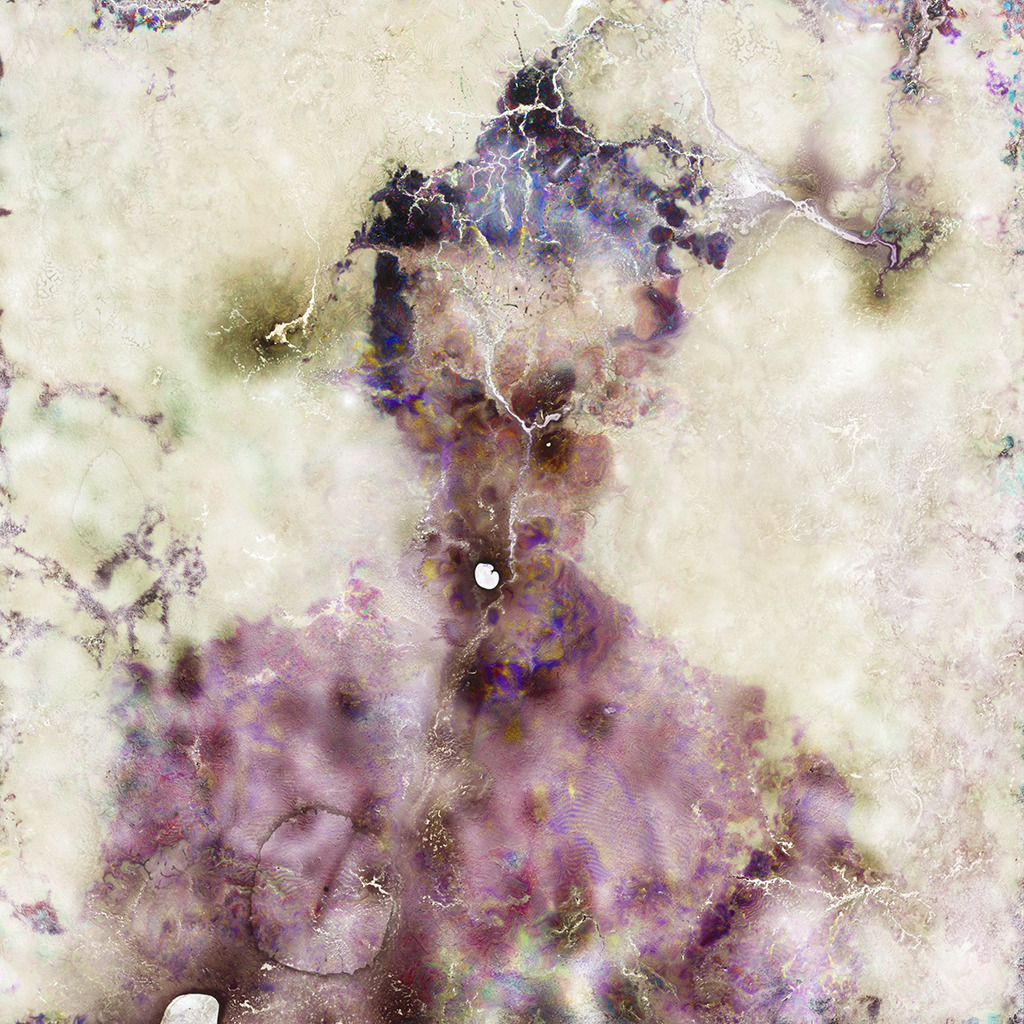
OK this is pretty cool (from a microbe-art-science point of view): An Artist Who Paints Portraits With Mold | WIRED. Seung-Hwan Oh “had to set up a micro-fungus farm in his studio” and he puts film in a warm wet environment (note to self – there could be a new human microbiome aspect of this project depending on what warm wet environment is chosen) and sometimes seeds the system with some mold. And then he lets nature do its work.
See more about his Impermanence works here. (Really – check out the works – they are wild).
At that site the work is described in the following way:
The visual result of the symbiosis between film matter and organic matter is the conceptual origin of this body of work. The process involves the cultivation of emulsion consuming microbes on a visual environment created through portraits and a physical environment composed of developed film immersed in water. As the microbes consume light-sensitive chemical over the course of months or years, the silver halides destabilize, obfuscating the legibility of foreground, background, and scale. This creates an aesthetic of entangled creation and destruction that inevitably is ephemeral, and results in complete disintegration of the film so that it can only be delicately digitized before it is consumed.
Also see his Tumbl page where one can find many other images like this one:
Hat tip to Kate Scow for posting about this on Facebook.
At #UCDavis: the UC #OpenAccess Policy & what it means for you (10/22, 1:30-3 pm)
The UC Open Access Policy and what it means for you (10/22 from 1:30-3pm)
A Discussion with Catherine Mitchell and Dr. Robert Powell on the UC OA policy
Date & Time: Wednesday, October 22, 2014 from 1:30-3:00pm
Location: Shields Library, Nelle Branch Room, 2nd floor (at the far end of the main reading room)
The UC Open Access Policy (http://osc.universityofcalifornia.edu/open-access-policy/ or http://uc-oa.info) was passed by the UC Academic Senate on July 24, 2013, and is going into effect for all UC campuses, including UC Davis, on November 1, 2014. The policy grants UC faculty the right to make their articles freely available to the public by depositing a pre-publication copy in an open access repository. What does this policy mean for faculty at UC Davis?
Come to this talk by Catherine Mitchell of the California Digital Library (CDL), who will describe the tools and services that CDL is developing to support the policy, and Dr. Robert Powell of Chemical Engineering, who will give background on the policy and its passage through the UC Senate. Afterwards a Q&A panel will be held with the speakers, UC Davis librarians and open access researchers to answer questions and discuss the implications of the policy and open access.
This talk is being held during Open Access Week 2014, an annual international event to raise awareness about open access issues.
Kids’ Microbiology Book Review: Germ Stories
I was going through some kids’ books today and found quite a few that I thought were wonderful and thought – well – I should post about some of them. So that is what I am going to do.
The first I want to write about is Germ Stories by Arthur Kornberg with Illustrations by Adam Alaniz and Photos by Roberto Kolter.
I used to read it to my daughter all the time (she is two years older than my son) and then sometimes, when she was older, she would read it to my son. A few things I like about this book:
- It is not all about pathogens – there are sections on yeast, penicillin, gut microbes and Myxococcus (although it is miswritten as Myxobacterium).
- Everything is done as poetry / songs. Some are cheesy, but my kids liked them.
- Each section on a different microbes has a little poem/song, a drawing, and a picture or two as well as a few mini facts (or I guess, micro facts).
- The material is a bit scary / gross at times but not too over the top.
I added this book to a collection I am making via Amazon on “Microbiology Books for Kids“. I will write about some of the other ones at another time.
UPDATE – Wanted other suggestions for good kids’ microbiology themed books …
UC #OpenAccess policy comments wanted from Academic Senate members by 1/7/15
The University invites comments on the proposed draft Presidential Policy on Open Access, which is based on the Academic Senate Open Access Policy for all Academic Senate members adopted on July 24, 2013.
The proposed new policy extends open access rights and responsibilities to all non-Senate members of the UC community who are authors of scholarly articles, including faculty, other academic personnel, students, administrators, and staff. The policy allows non-Senate authors of scholarly articles to maintain legal control over their research articles while making their work freely available to the public. In addition, the proposed policy outlines procedures for implementing the policy for all UC authors, both Senate and non-Senate. Although the policy assumes all authors will make their scholarly articles available to the public, there is a procedure, which authors must undertake proactively, to opt out of the open access process.
The proposal is located on the UCOP Academic Personnel and Programs website, “Policies under review,” under the “Systemwide Review” tab at http://www.ucop.edu/academic-personnel-programs/academic-personnel-policy/policies-under-review/index.html. If you prefer these documents as attachments, please let me know.
Today at #UCDavis: Phillip Romero from UCSF: Data-Driven Exploration of Sequence and Function
Dr. Phillip Romero, UCSF
4:10 p.m. Chemistry in Rm 179
Seminar Title: “Data-Driven Protein Engineering: Learning the Sequence-Function Mapping from Experimental Data”
Harvard, hope and hype: the sad reason behind overselling diabetes stem cell work – raising money
Earlier in the week I got all fired up – not in a good way – about a press release and news stories relating to a new paper from Doug Melton on a insulin producing STEM cell study
Exceptionally disappointed in Doug Melton of @HHMI for publishing new important diabetes paper as #closedaccess pic.twitter.com/DefoWwmiBR
— Jonathan Eisen (@phylogenomics) October 10, 2014
//platform.twitter.com/widgets.js With a little more discussion I just got more angry
.@HHMINEWS and publishes the groundbreaking paper behind a paywall so online the elite can see it #closedaccess pic.twitter.com/ZPriyCdHvY
— Jonathan Eisen (@phylogenomics) October 10, 2014
//platform.twitter.com/widgets.js
.@David_Dobbs @Stephen_Curry @rpg7twit massive hype yet paywall is a big f#*$ you to those who care about diabetics pic.twitter.com/MErZi5pzL7
— Jonathan Eisen (@phylogenomics) October 11, 2014
//platform.twitter.com/widgets.js
@cryptogenomicon @phylogenomics @Stephen_Curry @David_Dobbs @rpg7twit the paper is available at http://t.co/Rt2el9b9W5
— HHMI NEWS (@HHMINEWS) October 11, 2014
//platform.twitter.com/widgets.js I was angry both about the overselling of the implications of the paper and the fact that the paper was not published in an open manner. This was despite the stated goals of HHMI which funds some of the Melton Lab work.
.@Stephen_Curry @David_Dobbs @rpg7twit only 1/5 pubs on Melton HHMI page http://t.co/L1p2BEKrQ6 is free #closedaccess pic.twitter.com/KQDY5ZLjuA
— Jonathan Eisen (@phylogenomics) October 11, 2014
//platform.twitter.com/widgets.js
I was especially upset that much of the press coverage was reporting on an imminent cure for type I diabetes when this was clearly not imminent. Although I note – some coverage was OK. Like these:
… has there been too much hype? NHS cautions that talks of a “cure” for type 1 diabetes are premature http://t.co/MUZiRRWq3F
— Judith Taylor (@Endo_Editor) October 11, 2014
//platform.twitter.com/widgets.js
Risks of overhyping science: Telegraph says “Cure for Type 1 diabetes imminent after Harvard stem-cell breakthrough” http://t.co/hwDTHOZgeR
— Jonathan Eisen (@phylogenomics) October 11, 2014
//platform.twitter.com/widgets.js Another good piece of news – HHMI got Doug Melton to post a copy of the paper on a web site
@cryptogenomicon @phylogenomics @Stephen_Curry @David_Dobbs @rpg7twit the paper is available at http://t.co/Rt2el9b9W5
— HHMI NEWS (@HHMINEWS) October 11, 2014
//platform.twitter.com/widgets.js Although this was kind of hidden
@HHMINEWS @cryptogenomicon @Stephen_Curry @David_Dobbs @rpg7twit tx – is that newly added? can you get link posted w/ all PR/news stories?
— Jonathan Eisen (@phylogenomics) October 11, 2014
//platform.twitter.com/widgets.js
@HHMINEWS @cryptogenomicon @Stephen_Curry @David_Dobbs @rpg7twit not linked from http://t.co/PTauxXWosy or http://t.co/8vmUpQVuBf or others
— Jonathan Eisen (@phylogenomics) October 11, 2014
//platform.twitter.com/widgets.js Another good thing – Paul Knoepfler, a colleague of mine at UC Davis wrote a blog post for his excellent STEM cell blog about the Harvard study and the hype.
@phylogenomics @David_Dobbs @Stephen_Curry @rpg7twit If interested, my take on this paper & media hype http://t.co/6glBEGQo1F
— Paul Knoepfler (@pknoepfler) October 11, 2014
//platform.twitter.com/widgets.js
Thank you @pknoepfler for reality check on very important but overhyped Diabetes Stem Cell study http://t.co/w443cDOGgb
— Jonathan Eisen (@phylogenomics) October 11, 2014
//platform.twitter.com/widgets.js But the hype was still spreading …
Risks of overhyping science: Telegraph says “Cure for Type 1 diabetes imminent after Harvard stem-cell breakthrough” http://t.co/hwDTHOZgeR
— Jonathan Eisen (@phylogenomics) October 11, 2014
//platform.twitter.com/widgets.js So I felt like there was a continued need to say something about this
Ultimately @harvard & Doug Melton bear some responsibility for press overhyping their #diabetes stem cell work pic.twitter.com/8hwwmlsWFf
— Jonathan Eisen (@phylogenomics) October 11, 2014
//platform.twitter.com/widgets.js I even changed a talk I was giving on Sunday to include a discussion of this paper and the hype as, well, a bad thing
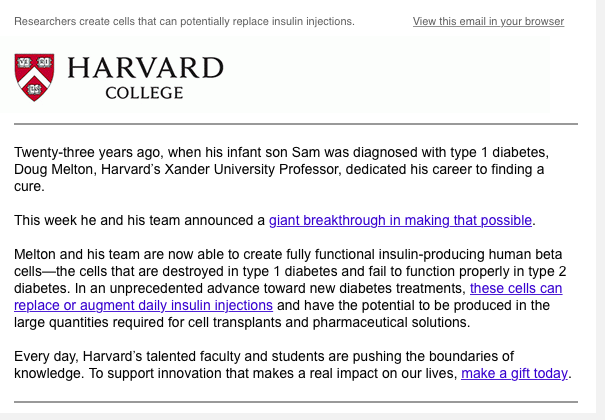
And I thought, and kind of hoped, that this might just go away. And then, many people forwarded me this email from Harvard sent out as part of a fundraising campaign. Most of the people who sent it to me sent it in happiness with the possibility of a cure for type 1 diabetes. Here is the email:
Of for $&*#*# sake. Really. So now Harvard was going to use this as a fundraising tool. And they would oversell it even more:
“A giant breakthrough in making that possible” with “that” referring to “finding a cure”. And then they say “these cells can replace or augment daily insulin injections” without saying that this WAS NOT IN HUMANS. THIS WAS IN MOUSE. $*#($#) DECEPTIVE LYING SCHMUCKS.
And they end this email with “make a gift today.” How about this Harvard. I will make donations to anyone but you until you stop marketing in hope and hype and start being responsible.
UPDATE 10/16/14 8 AM PST
Some of the overhyped statements relating to this story:
Harvard Press Story: “We are now just one preclinical step away from the finish line,” said Melton
Rawstory: Stem-cell cure for Type 1 diabetes ‘on par with discovery of antibiotics’
Telegraph: Cure for Type 1 diabetes iminent
Times of India: Type 1 diabetes cure within reach after breakthrough that could spell end of insulin injections for millions
Seminar at #UCDavis 10/30 – Scott Edmunds on “Open Publishing for the Big-Data Era”
Seminar of possible interest
Thursday, Oct 30th
12:10 PM to 01:30 PM
SS&H 1246
Scott Edmunds
from Gigascience / BGI
"Open Publishing for the Big-Data Era"
For more information see:
http://sts.ucdavis.edu/scott-edmunds-open-publishing-for-the-big-data-era
Additional information below:
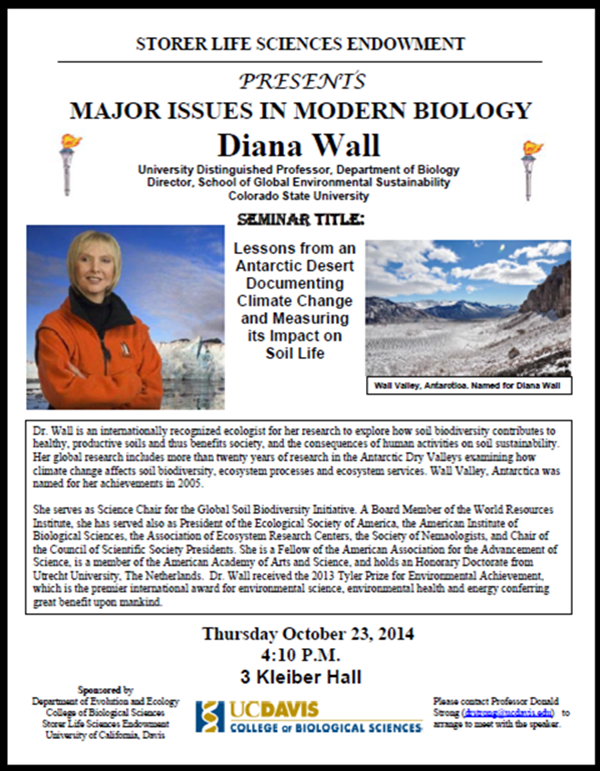
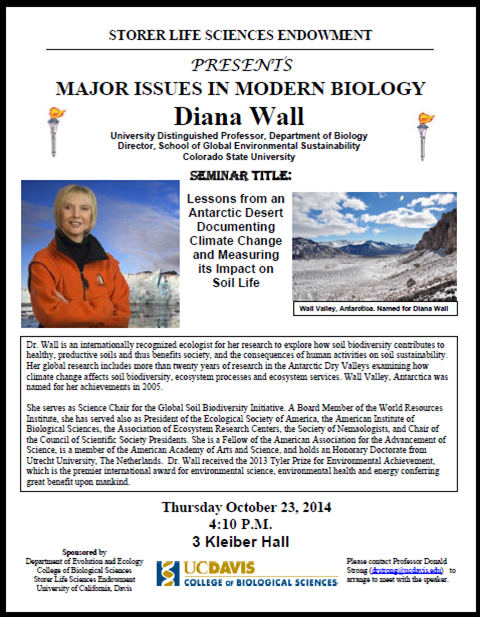
Diana Wall at #UCDavis 10/23 4 PM: Lessons from an antarctic desert …
Talk for UC Davis Pre-Health Meeting (#UCDPHSA): Opening up to Diversity
Sunday I gave a talk at the “12th National UC Davis Pre-Health Student Alliance Pre-Medical and Pre-Health Professions Conference“. I normally try to not give talks on weekends (to spend time with my family) but I made an exception here since this meeting has a strong commitment to issues relating to diversity in health and STEM fields. This mission statement for the meeting reads:
The UC Davis Pre-Health Student Alliance’s objective is to introduce and support academic, admission, and preparatory opportunities for all students interested in health professions with a focus on those underrepresented in healthcare (with regard to gender, economic, social, educational, linguistic, cultural, racial, and ethnic background). We target universities, community colleges and high schools throughout the United States. The UC Davis Pre-Health Student Alliance aims to impact health education, increase diversity amongst the healthcare workforce, and inspire future leaders of healthcare through hosting the largest national pre-health professions conference.
It was that mission statement that got me to ditch my wife and kids Sunday AM (and also much of Saturday PM for a dinner and to work on my talk). I went to a dinner Saturday for some of the speakers with the new Dean of the UC Davis School of Medicine Julie Freischlag. The dinner had about 20 or so people and I met some quite interesting folks there working on various aspects of human and animal health.
And then Sunday AM I got up early, decided to use slides (was not sure) and finished off the slide set I had worked on the night before. I decided that, in the spirit of the meeting, I would talk about two main things – diversity and access. And I planned to tell three stories about my work in this area. I wove in some personal stories since, at the dinner the night before Barbara Ross-Lee (who I sat next to) helped remind me of the importance of making talks personal. So in the end I talked about myself, diabetes, diversity of microbes, antibiotics, diversity in STEM, and open science. I came up with a title I was OK with: Opening up to Diversity.
My talk went well, I think. I am pretty sure it was vbideotaped but not sure where that recording will end up. I did however post my slides to slideshare. See below:
And I also recorded the talk using Camtasia (basically, it allows recording of the screen, the video camera on my computer, and the audio). I posted the recording (without the video feed which shows mostly my neck) to Youtube. See below:
I have scanned in my notes that I made in planning this talk. Figured, why not post them.