#UCDavis College of Biological Sciences New Biology PostDoc Candidates Talks

Cool science education kickstarter of the month: a hundred tiny hands

This looks very cool. And important. 100 tiny hands Kickstarter campaign.

https://www.kickstarter.com/projects/2084593011/a-hundred-tiny-hands-toys-for-your-brilliant-lil-i/widget/video.html

Overselling the microbiome award of the week: Science News on "Bacteria that Trigger Crohn’s"

Well, this is just a terrible, terrible, very misleading headline: Bacteria that trigger Crohn’s disease identified | Science News.  The headline relates to a story by Ashley Yeager on a new paper in Cell Host and Microbe.  The paper is “The Treatment-Naive Microbiome in New-Onset Crohn’s Disease” and it seems very interesting on first glance and very very very careful in the wording about what they have shown in the paper.  And all that care is wasted with news headlines like this.  The paper does not identify any bacteria that “trigger” Crohn’s.  They do identify microbial signatures with various aspects of Crohn’s and find some very interesting things.  But no triggering is shown.  Nor claimed.  And then Science News misleads people into thinking this article will be about what triggers Crohn’s.  Lame.  Annoying.  And a winner of the Overselling the Microbiome Award of the week.

FORCE11 released “Joint Declaration of Data Citation Principles”

The FORCE11 group has released an important document for those interested in scholarly publishing: Joint Declaration of Data Citation Principles – FINAL | FORCE11.  The FORCE part of FORCE 11 stands for “The Future of Research Communications and e-Scholarship” and the group is a collection of some 600+ people interested in this topic.  I am a member of the group and went to one of their first meetings a few years ago.  Definitely worth checking out the Declaration.

Guest post by Lizzy Wilbanks: Story behind the paper "Microscale sulfur cycling in the phototrophic pink berry consortia of the Sippewissett Salt Marsh"

Here’s another entry in the “Story behind the paper series”.  This one is from Lizzy Wilbanks, a co-advised PhD student in my lab (Twitter: @LizzyWilbanks)


A sulfurous symbiosis: Microscale sulfur cycling in the phototrophic pink berry consortia of the Sippewissett salt marsh 

Here’s the story behind my recent publication (with many talented coauthors) on the pink berries, the marvelous, macroscopic microbial aggregates of the Sippewissett.

A bit of background:

The wild microbe rarely eats alone. The microbial world is a jungle far more exotic than those we can see (metabolically and phylogenetically, at least), one rife with fierce competition, intimate cooperation, and intricately inter-dependent food webs. Eavesdropping on the metabolic conversations of uncultured microbes, though, remains a major technical challenge.  It requires tools to navigate the world from the microbe’s-eye view.

     
 Your binoculars just aren’t gonna cut it…  (image source )
In our recent paper, my co-authors and I describe how we were able to tune in to one such metabolic conversation, and look at a nutrient (‘biogeochemical’) cycle on the microbial scale. Here’s the back-story on how this project got started, and why I’m so excited to share our work with you!

Let’s get one thing straightened out:

‘Pink berries’ are a nickname for these pink colored microbial aggregates.  We’re not talking about fruit or frozen yogurt here.
(image source: my own, here, and here)

My first encounter….

I first encountered these eye-popping pink wonders in 2010 when I was as a second year grad student attending the Microbial Diversity summer course at the Marine Biological Laboratory in Woods Hole, MA.  Exploring the nearby Little Sippewissett Salt marsh for our first field trip, I stomped through the marsh grass into a muddy, sulfidic pool.
And people wonder why I think sulfide smells like beautiful summers and nostalgia?
(image source: my own)
Below the surface of the pool’s water, scattered across the sediment, was a truly magnificent carpet of pink blobs. 
(image source: my own)
After a bioinformatics-heavy start to grad school at UC Davis, I was dying to get my hands dirty with some fieldwork.  I was transfixed by the stinky, sulfidic marsh mud and these slimy pink aggregates. 
Me, awfully excited and really “diving-in” to the project.
Can’t remember how many times TA Annie Rowe and others had to fish me out of the mud that summer!

(image source: Melissa Cregger 🙂 
Course directors at the time, Dan Buckley and Steve Zinder, told me that these were the pink berries, balls of uncultured bacteria found in the Sippewissett marsh (and, so far as they knew, nowhere else). Summer students had been looking at the berries ever since the course was founded 40 years ago, they said, and they pointed me towards a pile of old course reports back at the lab.  

Berries: an MBL Microbial Diversity legacy.

These reports (now digitized and freely available) tell the tale of many happy, hard-working summers where students took a crack at these exotic looking blobs during their independent research mini-projects.  One of the most fun parts of this project has been meeting all of these “berry alumni”, both via email and in person, who are now scattered throughout the world. From helpful discussions, to sharing data and suggestions, and even digging up never-published 16S rRNA gene sequences from over a decade ago (thanks Bruce Paster and Jarrod Scott!), the berry-alums have helped lay the groundwork for our project and have been an amazing network of friends and collaborators.  
Our paper is a sequel, 20 years in the making, to the first and only other paper describing the pink berries.  Published in 1993 by MBL summer students Angelica Seitz and Tommy Nielsen with course faculty Dr. Jörg Overmann, this work described the berries as aggregates dominated by uncultured purple sulfur bacteria, anoxygenic phototrophs that oxidize hydrogen sulfide to sulfate (unlike cyanobacteria and green plants that oxidize water to oxygen). By spearing berries with oxygen microsensors, they found that the berries were such hot-spots of microbial activity that all oxygen was consumed just a few micrometers below the surface, creating a haven for anaerobic microorganisms.  
My obviously-not-to-scale cartoon of berry spearing with oxygen microsensors.
The purple sulfur bacteria give the berries their rosy hue with their photosynthetic pigments that have evolved to capture lower-energy, longer wavelength light (compared that used by green phototrophs). 
Peering into the pink berries with a dissection microscope (real color!).
Pink blobs are islands of purple sulfur bacterial cells.

(image source: Verena Salman) 
With the introduction of 16S rRNA gene sequencing to the course in 1997, students discovered that, in addition the conspicuous purple sulfur bacteria, the berries also harbored an abundance of an uncultured species related to sulfate reducing bacteria (sulfate -> sulfide).  The co-occurrence of putative sulfide-oxidizing purple sulfur bacteria and sulfate reducing bacteria spawned the hypothesis that these species might be metabolically interdependent, creating a “cryptic” sulfur cycle within the berries.  
The hypothesis! Purple sulfur bacteria in pink, sulfate reducing bacteria in green.
(image source: my own, modified version of Figure 9 from our paper) 
These sulfate reducing bacteria, though, had remained elusive, uncultured, and their activity, undetected. This intriguing hypothesis about an “intraberry” sulfur cycle and metabolic cooperation (‘syntrophy’) remained untested like so many other questions about the secret lives of uncultured microbes.

Project launch: Team berry 2010

Resolved to work on the pink berries for my mini-project, I banded together with fellow students and co-authors Ulli Jaekel and Parris Humphrey, and with the help of TAs Cristina Moraru and Rebekah Young – formed Team Berry 2010.  We began investigating the pink berries using DNA sequencing (16S, metagenomics), microscopy (FISH, TEM) and other incubation studies. 

The first few weeks at the MBL course were bonanza of microbial excitement for me as a huge metabolism geek.  My mornings were spent trying to drink from the fire hose of information in lecture, followed by afternoons of lab, then dinner, more lab, and finally trying to piece together the day’s ideas over beers.

“Drinking from a fire hose” – another gem from PhDComics

Coming back from Dan Buckley and Victoria Orphan‘s lectures about the uses of stable isotopes in microbial ecology (reviewed here), I wondered if there was a way to use sulfur stable isotopes to track the cryptic sulfur cycle in the pink berries.  Brainstorming with Victoria, we devised a plan to conduct incubations with the pink berries using isotopically heavy sulfate (34SO42-) as a stable isotope label.  The purple sulfur bacteria in the berries had abundant intracellular sulfur reserves, which typically come exclusively from reduced forms of sulfur (e.g. sulfide).  Our hope was that the sulfate reducing bacteria would reduce the heavy sulfate we added to heavy sulfide, which would then be oxidized by the purple sulfur bacterial and incorporated into their cells.

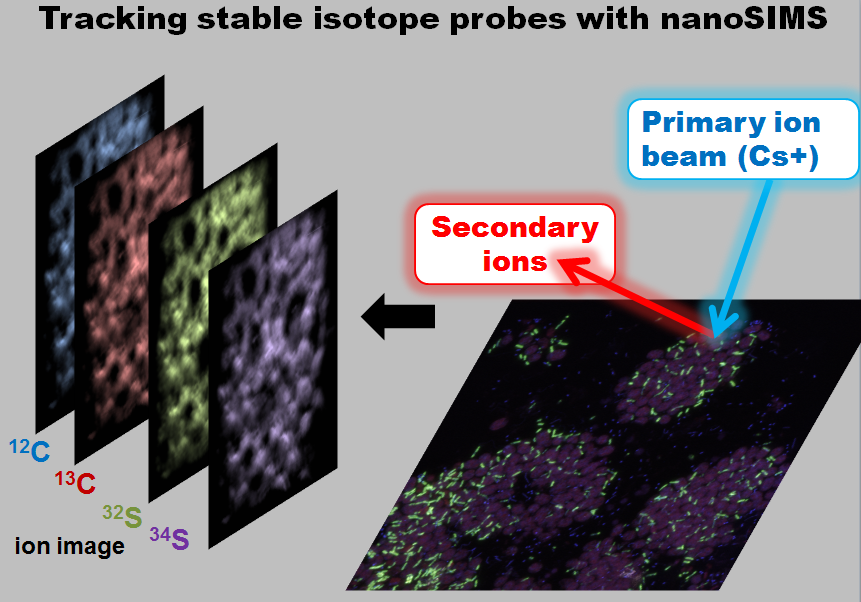
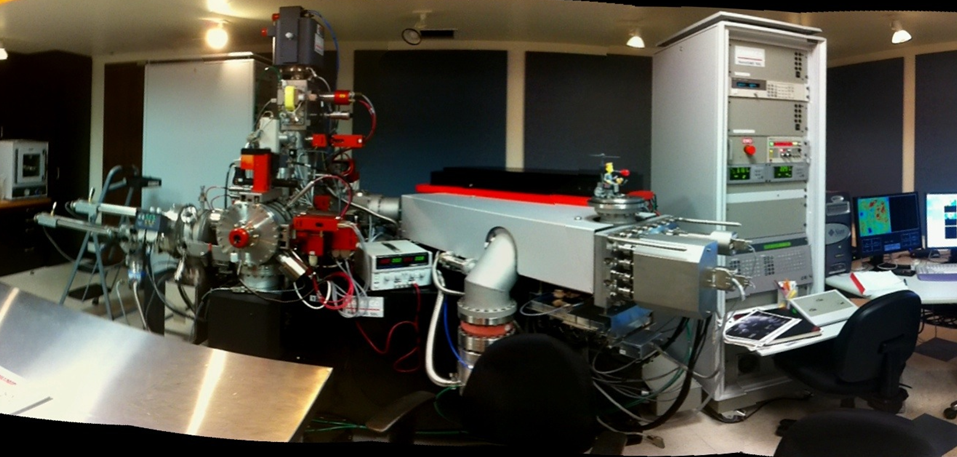
To track the flow of our isotopically labelled sulfur, we planned to image thin sections of the incubated berries using nanometer scale secondary ion mass spectrometry (nanoSIMS), an instrument commonly used by the Orphan lab for studying anaerobic methane oxidizing consortia.

Using the nanoSIMS to blast sections of pink berries with  focused cesium beam (~50nm spot size)
and generate spatial maps of isotopic and elemental abundance.  
(image source: my own)

At that time, there was no precedent in the literature for using 34S-isotope labeling in this way (most stable isotope probing experiments focused on carbon or nitrogen compounds), but Victoria’s group was interested in exploring this area for studying other tightly coupled sulfur-cycling.  The berries were an accessible testing ground. After a madcap two weeks of rush-orders, late nights, midnight berry slicing, and help from so many wonderful, patient TAs, our samples made a cross-country journey to the Orphan lab at Caltech where they, and thankfully the nanoSIMS, survived a minor earthquake.  

The nanoSIMS beast in its subterranean lair @ the Caltech Microanalysis Center.
(image source: my own)

It was a wild ride during those final weeks, but just before the end, we got exciting results from Victoria’s nanoSIMS run that suggested our experiment had worked.  The preliminary nanoSIMS data showed accumulation of our sulfur isotope label (enrichment in 34S compared to controls), and also found evidence for carbon fixation (13C enrichment from labeled bicarbonate additions).

Can’t stop, won’t stop… the side-project that ate my thesis.

After returning to Davis, passing my qualify exam and wrapping up prior projects, I was determined to get back to berries but wasn’t sure exactly how.  Victoria suggested that she could include berries in a collaborative NSF proposal on the biogeochemistry of tightly coupled sulfur cycling consortia (along with David Fike, Greg Druschel and Jesse Dillon).  When their funding came through, it held out the safety net I needed to work on berries full time.  With approval from Victoria and my co-advisers at Davis, I jumped!

Returning as a TA to the MBL Microbial Diversity course in 2011, I had a chance to conduct follow up isotope experiments, and collaborate with course student and co-author Verena Salman on developing species-specific FISH probes to identify the spatial arrangements of the two berry symbiotic.  Since then, I’ve followed up on our initial metagenomic sequencing to reconstruct near-complete genomes for the two berry symbionts, demonstrating the genetic potential for a complete sulfur cycle.

Figure 4 from our paper showing:
the sulfate reducing species (green rods, 16S rRNA gene FISH probe)
snuggled up with their metabolic partners,
the purple sulfur bacteria (pink/purple cocci, autofluorescence),
but not in the exopoylmer matrix with  
other cell types  (blue, DNA stain: DAPI).

In 2012, the final pieces of this project came together during a week of Sippewissett fieldwork with biogeochemistry collaborators  David FikeGreg Druschel, and their groups.  With high resolution geochemistry equipment aboard our homemade raft, we were able to link our existing microbiological measurements with microscale geochemical signatures in the berries.

(image sources: my own)

Conclusions:

Using the pink berries, we demonstrate how an integrative microbiological and microgeochemical approach can be used to decrypt the microbial metabolic partnerships that drive sulfur cycling at the microscale. This methodology, which may ultimately be used to examine more complex ecosystems, offers direct evidence of syntrophic interspecies sulfur transfer. 
For more details on how all these different pieces came together, you’ll just have to check out our paper yourself!   

FAQ:

What do they taste like?
Mostly just salty, and a bit sandy 🙂

Are the pink berries found anywhere else?
Not really!  I’ve looked through the literature and chatted up loads of people, but no one’s ever reported seeing pink berry-type macroscopic consortia of purple sulfur bacteria and sulfate reducers.  There’s a description of a microscopic type pink berry-like aggregates in the chemocline of Lake Cadagno, and interestingly those aggregates’ sulfate reducing isolate (Cad626) is closely related to our PB-SRB1 sulfate reducing species.   Should you find berries somewhere else during your marshly peregrinations, email me!
Have you tried culturing them?
Yes!  My undergraduate students recently confirmed that we have an enrichment culture of the purple sulfur bacterial strain, and are working to purify it, and submit it to a culture collection.  If you’re interested in working on it, I’m happy to send you a sample of the culture.  The sulfate reducer has, so far, resisted my efforts to coaxing it into culture but hasn’t really been a major focus of my project (I’d wager it’s possible).
So wait, why are you studying them again?
  • My naturalist’s answer is: because they’re the pink, charasmatic macrofauana of the microbial world. They’re nifty, and we don’t know what they do. But seriously… 
  • Microbial metabolism is the engine that drives the nutrient (biogeochemical) cycling that shapes the health of both our planet and our bodies.
  • However, many key transformations in these cycles are carried out by microbial consortia over short spatiotemporal scales that elude detection by traditional analytical approaches. 
  • The berries provide a tractable, reproducible model microbial consortia for developing methods to eavesdrop on these otherwise cryptic metabolic conversations between the wild microbes.
  • Understanding the biosignatures (e.g. sulfur isotopic fractionation) produced by microbial communities like the pink berries improves our ability to interpret the rock record and construct models of ecosystem function in both ancient and modern environments.

    Thank you:

    Through this project, I’ve had the privilege of working with truly amazing people and making life-long friends.  The author list and acknowledgement are just the tip of the iceberg in terms of people who have contributed to this project in one way or another.  You all know who you are; I feel so lucky to have gotten to know and work with you. THANK YOU!

    This project was started as grass-roots style, curiosity-driven student research, and as such, the funding for it has been fairly eclectic.  I want to take a moment to acknowledge those organizations that have supported this kind of research and made my work possible.

    Funding to the MBL Microbial Diversity course from:

    • Howard Hughes Medical Institute
    • Gordon and Betty Moore Foundation (#2493)
    • National Science Foundation (DEB-0917499)
    • US Department of Energy (DE-FG02-10ER13361)
    • NASA Astrobiology Institute (NAI)

    Grants to collaborators Victoria Orphan and David Fike from:

    • NSF (EAR-1124389 & EAR-1123391)
    • Gordon and Betty Moore Foundation (#3306)

    Grad-student grants and fellowships supporting my work at UC Davis from:

    • National Science Foundation Graduate Research Fellowship
    • UC Davis Dissertation Year Fellowship
    • P.E.O. Scholar Award
    • NAI/APS Lewis and Clark Fund in Astrobiology
    • NSF Doctoral Dissertation Improvement Grant (DEB-1310168)

    Full citation:

    Wilbanks EG, Jaekel U, Salman V, Humphrey PT, Eisen JA, Faccioti MT, Buckley DH, Zinder SH, Druschel GK, Fike DA, Orphan VJ. (2014) “Microscale sulfur cycling in the phototrophic pink berry consortia of the Sippewissett Salt Marsh.” Environmental Microbiology,  doi:10.1111/1462-2920.12388http://dx.doi.org/10.1111/1462-2920.12388.


    Dean Robert Post 3/14/14 The Constitutional Dimensions of Academic Freedom

    Posting this announcement I got:

    Dear UC Davis Faculty, Staff, Students and Community Members,

    We would like to remind you that the next event in the Provost’s Forums on the Public University and the Social Good, which is co-sponsored with the  Academic Senate’s Committee on Academic Freedom and responsibility, will be held on Friday, March 14, 2014.

    Robert Post, Dean and Sol & Lillian Goldman Professor of Yale Law
    School will speak on the topic of “The Constitutional Dimensions of
    Academic Freedom”.  After his talk, he will be joined by a panel
    comprised of Ralph Hexter, Provost and Executive Vice Chancellor at UC
    Davis, Roberta Rehm, Associate Professor in the Department of Family
    Health Care Nursing at UC San Francisco, and Henry Reichman, Professor
    Emeritus of History at CSU Easy Bay and First Vice President of the
    AAUP and its Committee A on Academic Freedom and Tenure.Prior to assuming his position as Dean of the Yale Law School, Dean
    Post spent twenty years as a professor at the UC Berkeley School of

    Law. His areas of expertise include constitutional law, First
    Amendment law, legal history, and equal protection. He has written and
    edited numerous books, including, For the Common Good: Principles of
    American Academic Freedom (2009), and more recently Democracy,
    Expertise, Academic Freedom: A First Amendment Jurisprudence for the
    Modern State (2012).The event will begin at 2 p.m. in the Vanderhoef  Studio Theatre at
    the UC Davis RobertMondavi Center. It is free and open to the general public. There will
    be a reception with light refreshments directly following the lecture
    in the Yoche Dehe Grand Lobby of the Mondavi Center.

    If you are unable to attend this event, videos of all Provost’s Forums
    lectures are available to the public and can be found on the official
    Provost’s Forums website

    (http://provost.ucdavis.edu/initiatives-and-activities/activities/future/past-events.html).

    Our most recent lecture, “The Public University: What Should We Be
    Doing on Climate Change?”  featuring Professor Naomi Oreskes, is now
    available for viewing along with all of the 2013-2014 season lectures.For more details and information on this event, please see the
    attached flyer, visit our website: The Provost’s Forum on the Public
    University and the Social Good (http://provost.ucdavis.edu/initiatives-and-activities/activities/future/index.html), or contact Casey Castaldi (cvcastaldi@ucdavis.edu).

    In addition, please forward this information to any interested parties, as all events are open to the public. We hope to see you at this important event!

    Robert Post 3.14 Flyer.pdf

    What to do when kicked out of my own lab meeting?

    Thought some would enjoy a bit of comic relief.

    A must read: How to Level the Playing Field for Women in Science by Mary Ann Mason

    This is a must read for anyone interested in Science / Academia: How to Level the Playing Field for Women in Science – Advice – The Chronicle of Higher Education.  By Mary Ann Mason, who is a professor at UC Berkeley and has extensive experience on studying issues relating to women in science and academia.  She details in this article four key things that can be done to reduce the “baby penalty”:

    • Better (and more) child-care options
    • Effective dual-career policies
    • Childbirth accommodations
    • Compliance with Title IX 
    Definitely worth reading.  And worth checking out some of the web material from her including
    (Thanks to Madhu Katti – who posted this to Facebook)

    Another Mostly Male Meeting from UCSD- should be called "Food and Fuel for the 19th Century"

    Well, just when I thought meeting organizers from UCSD had learned their lesson regarding mostly male meetings – this comes along.  Check out “Food and Fuel for the 21st Century” (I was pointed to this by a comment on a blog post of mine). The speakers are

    That a ratio of 18:2 or 10% female.  
    Not that I know the cause of this but here are some other pieces of information to consider.
    The Food and Fuel for the 21st Century Program lists 5 people on their Executive Committee.  Any guesses on the # of these that are men?  Well it is 5.
    Fortunately they have an Advisory Committee too and that must have some women on it right?  Nope.

    Reminds me a bit of the QBio meeting from 2013 organized by many from UCSD which I wrote about last year: Q-Bio conference in Hawaii, bring your surfboard & your Y chromosome because they don’t take a XX.  I note – this years Q-Bio meeting is much better.  But one can ask – does nobody at UCSD think about these issues when planning conferences and Advisory / Executive Committees.  I personally don’t think one should choose women to just choose women.  But as with the Q-Bio meeting from last year, I think there are an enormous number of highly qualified women working on topics directly related to “Food and Fuel for the 21st Century” and thus I am both surprised and disturbed by the gender ratio of this meeting and this organization.

    UPDATE 3/4 7:21 AM

    It took me a bit but I found details on the 2013 symposium from the same group.  The web site for the 2013 meeting is not active as far as I can tell.  However it is available in the Internet Archive.  For example, here is a snapshot from June 1, 2013.  From that snapshot here are the listed speakers

    • David Kramer, Michigan State University
    • Susan Golden, University of California, San Diego
    • Julian Schroeder, University of California, San Diego
    • Stephen Mayfield, University of California, San Diego
    • Steven Briggs, University of California, San Diego
    • Matteo Pellegrini, University of California, Los Angeles
    • Donald Weeks, University of Nebraska–Lincoln
    • Michael Burkart, University of California, San Diego
    • Chancellor Pradeep Khosla, University of California, San Diego
    • Farzad Haerizadeh, Life Technologies
    • Ben Hueso, California State Assembly
    • Bill Gerwick, Scripps Institution of Oceanography
    • Eric Mathur, SG Biofuels
    • James Van Etten, University of Nebraska–Lincoln
    • Fred Tennant, Heliae
    • David Dunigan, University of Nebraska–Lincoln
    • Xuemei Bai, Cellana
    • George Oyler, University of Nebraska–Lincoln
    • Gerry Mackie, University of California, San Diego
    • Mark Hildebrand, Scripps Institution of Oceanography
    • Lawrence Johnson, Salim Group
    • Craig Behnke, Sapphire Energy
    • Rebecca White, Sapphire Energy

    For a ratio of 20:3.

    Nice wrap up from Anna Sharman on Science Publishing topics in February

    Definitely worth checking out this post from Anna Sharman: February highlights from the world of scientific publishing | sharmanedit.  It covers many topics of relevance including new journals, the PLOS Data Policy kerfuffle, and misc. links of interest.