New post from the BioBE Center Blog by dblanken: Mhuireach Awarded A&AA Dissertation Fellowship 2017-2018

Congratulations to Gwynne Mhuireach for winning a Dissertation Fellowship from the School of Architecture & Allied Arts at the University of Oregon!  Her working dissertation title is: Toward a Mechanistic Understanding of Relationships Between Airborne Microbial Communities and Urban Vegetation: Implications for Urban Planning and Human Well-being.  Mhuireach holds an M.Architecture (2012) from the University of Oregon and a B.S. in Biology (Ecology and Evolution Track, 1999) form the University of Washington. She is presently a Graduate Research Fellow at the Energy Studies in Buildings Laboratory and BioBE Center at University of Oregon.  Her anticipated graduation is June 2018.

Recent publication: Urban greenness influences airborne bacterial community composition

Dissertation Abstract: Variation in exposure to environmental microbial communities has been implicated in the etiology of allergies, asthma and other immune-related disorders. In particular, exposure to a high diversity of microbes during early life, for example through living in highly vegetated environments like farms or forests, may have specific health benefits, including immune system development and stimulation. In the face of rapidly growing cities and potential reductions in urban green space, it is vital to clarify whether and how microbial community composition is related to vegetation. The purpose of my proposed research is to identify plausible but under-explored mechanisms through which urban vegetation may influence public health. Specifically, I am investigating how airborne microbial communities vary with the amount, structural diversity, and/or species composition of green space for 50 sites in Eugene, Oregon. My approach combines geographic information systems (GIS) and remote sensing data with passive air sampling and culture-independent microbial sequencing.

Committee members:

  • Dr. Bart Johnson, Professor of Landscape Architecture (Major Advisor & Committee Chair)
  • Dr. Jessica Green, Professor of Biology (Co-Advisor)
  • Roxi Thoren, Associate Professor of Landscape Architecture (Core Member)
  • Dr. Deb Johnson-Shelton, Education/Health Researcher, Oregon Research Institute (Core Member)
  • G.Z. Brown, Professor of Architecture (Institutional Representative)


from BioBE http://ift.tt/2pcXVVZ
via IFTTT

New post from the BioBE Center Blog by kevinvdw: Health + Energy Research Consortium

The Biology and the Built Environment Center (BioBE) and Energy Studies in Buildings Laboratory (ESBL) at the University of Oregon, are pleased to announce the launch of the the Health + Energy Research Consortium!  On May 4-5, 2017, in Portland Oregon, we begin our journey to dramatically reduce energy consumption and maximize human health by conducting research that transforms the design, construction and operation of built environments. This collaboration between innovative industry professionals and academic researchers in the disciplines of architecture, biology, chemistry, engineering, and urban design provides sharp focus to a research agenda that will accelerate the impact of key scientific discoveries.  The Health + Energy Research Consortium builds upon the momentum of ESBL and BioBE to create a new, dynamic, and flexible mechanism for the university to engage with industry in joint research and development ventures – providing intellectual space for the meeting of a wide array of disciplines that play integral roles in fostering improved energy efficiency and health outcomes in the built environment.

At the May 4-5 launch event , we will present the vision for the Consortium, solicit feedback about the proposed research agenda, explain and discuss the financial commitments and value proposition associated with Consortium membership, and discuss synergies with potential member organizations’ goals and objectives.  If you are interested in helping us align the Consortium research vision with the challenges that face our built environment and your industry sector, please contact BioBE Director, Kevin Van Den Wymelenberg.

We would like to acknowledge the generous support for the Health + Energy Research Consortium from the Alfred P. Sloan Foundation.  Registration is required, but the event is available at no charge.

from BioBE http://ift.tt/2pf6r36
via IFTTT

Summer Short Course in Flow Cytometry at #UCDavis

Please share this email with any interested parties or better yet, print the attached flyer and hang it in your lab;

University of California Davis

Summer Short Course in Flow Cytometry

Davis, California

Sponsored by the UC Davis Biotechnology Program and the UC Davis Flow Cytometry Shared Resource

July 17-21, 2017

This comprehensive flow cytometry course is enhanced with interactive laboratory sessions using many of our UC Davis cytometers as well as new instrumentation and software to teach you to a variety of established and new approaches in cytometry. Special guest speakers will introduce new trends in flow cytometry and explain the physical and electronic concepts in light collection and signal processing. Thanks to many generous sponsors, lunches and coffee breaks are provided to promote opportunities for interaction with the instructors and cytometry specialists. Please make plans to join us this summer for another fun week of flow education.

For registration details and fees, please go to the Biotechnology Program’s summer courses page at: http://www.biotech.ucdavis.edu/SummerCourses.html

Course objectives:

· Learn the fundamental concepts of how flow cytometers work

· Discuss best practices in sample preparation for flow cytometry

· Describe standard assays and techniques

· Introduce new cutting edge technologies and applications for single cell analysis and genomics

· Demystify multicolor cell staining, compensation and analysis

Laboratory sessions include:

· UC Davis LSRII: Software setup for successful multicolor acquisition and analysis

· UC Davis Astrios Cell Sorter: Cell sorting fundamentals using the Beckman Coulter Astrios

· Cytometer setup and quality control for consistent performance with the Cytek DxP8 cytometer

· Multispectral imaging flow cytometry using the Amnis FlowSight Imaging Cytometer

· Multiparameter Analysis of Cell Surface Markers, Cytokines, Transcription Factors by Flow Cytometry: BD Biosciences on the LSRII cytometer

· FlowJo basic and advanced flow cytometry data analysis and panel design wizard

· Targeted gene expression in single cells using flow sorting and the Fluidigm BioMark

Special guest speakers:

· Holden Maecker, Ph.D., Director, Stanford University Human Immune Monitoring Core

· Jolene Bradford, Associate Director Flow Cytometry Systems, Molecular Probes, a Division of Invitrogen with ThermoFisher Scientific

· Marty Bigos, Director, Stanford Shared Flow Cytometry Laboratory

· And more!

LabFlier_2017_FlowCourse_bullets.docx

Temp Lecturer position at #UCDavis in Molecular and Cellular Biology

TEMPORARY LECTURER POSITION DEPARTMENT OF MOLECULAR & CELLULAR BIOLOGY UNIVERSITY OF CALIFORNIA, DAVIS

The Department of Molecular and Cellular Biology, University of California, Davis invites applications for non‐tenured positions for Spring Quarter, 2017

BIS102: Structure and Function of Biomolecules

BIS103: Bioenergetics and Metabolism

BIS105: Biomolecules and Metabolism Qualifications: A Ph.D. in Biochemistry, Genetics, Cell Biology or related field

Description: Duties will include teaching in one or more sections of the course Salary: Salary is commensurate with qualifications.

Application Deadlines: Open until 3/24 or filled.

Application Materials: Please send a curriculum vitae, including areas of concentration in undergraduate and graduate studies and teaching experience, plus names, addresses and phone numbers of three references to Dr. Ken Kaplan, kbkaplan

The University of California, Davis is an affirmative action/equal opportunity employer.

MCB Spg 2017 lecturer position.pdf

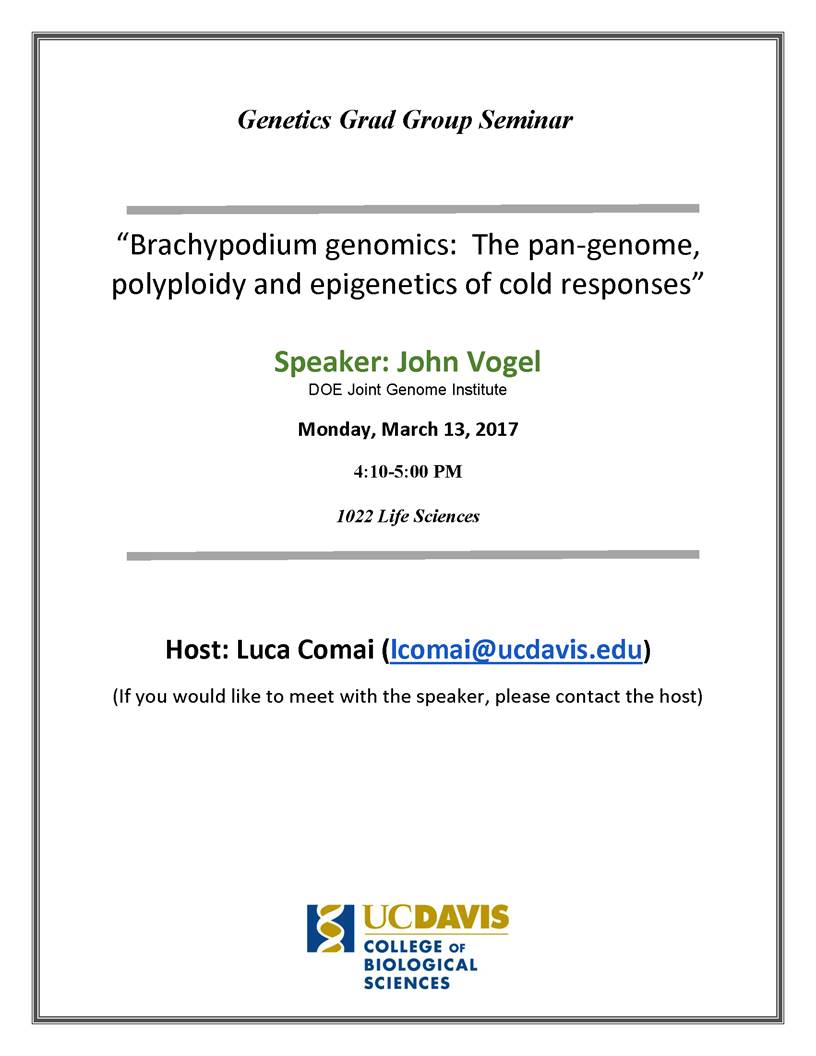
Today 3/13 at #UCDavis John Vogel on “Brachypodium genomics: The pan-genome, polyploidy and epigenetics of cold responses”

“Brachypodium genomics: The pan-genome, polyploidy and epigenetics of cold responses”

John Vogel
DOE Joint Genome Institute

Monday, March 13, 2017
4:10-5:00 PM
1022 Life Sciences

Vogel 3_13_17.pdf

HHMI Announces New Investigator Competition

Of possible interest – was just forwarded this

Dear Colleagues,

I am pleased to share that Howard Hughes Medical Institute (HHMI) has launched a national competition to select new HHMI investigators. We invite researchers to apply who bring original and innovative approaches to the investigation of biological problems in biomedical disciplines, plant biology, evolutionary biology, biophysics, chemical biology, biomedical engineering, and computational biology. Physician scientists are encouraged to participate in the competition. We expect to appoint up to 20 new investigators.

We ask that you encourage appropriate scientists to participate in this open competition. Eligible candidates apply directly without an institutional nomination, and there are no limits on the number of applicants or awardees from any of the over 200 eligible institutions. More information about the HHMI Investigator Program and this competition may be found on our website: http://www.hhmi.org/inv2018.

In brief, candidates must meet the following eligibility criteria at the time of the application deadline:

  • PhD and/or MD (or the equivalent).
  • Tenured or tenure-track position as an assistant professor or higher academic rank (or the equivalent) at an eligible U.S. institution, which would become the host institution.
  • More than 3, but no more than 12, years of post-training, professional experience. To meet this requirement, the applicant’s professional appointment(s) must have begun no earlier than June 1, 2005, and no later than September 1, 2014.
  • Principal investigator on one or more active, national peer-reviewed research grants with an initial duration of at least three years, such as an NIH R01 grant. Mentored awards, career development and training grants do not qualify. Multi-investigator grants may qualify.

The deadline for submission of all application materials is June 27, 2017, at 3:00 p.m., Eastern Time.

The HHMI review process will include evaluation of applications by distinguished scientists, leading to the selection of semifinalists by early 2018. Following further review, finalists will be selected in the spring of 2018, with appointments to begin as early as September 1, 2018. Institutions with finalists who have not previously hosted an HHMI investigator will be required to enter into a collaborative agreement with HHMI.

HHMI welcomes a diverse and broad applicant pool. Individuals from gender, racial and ethnic groups underrepresented in biomedical research at the career stages targeted by this program are encouraged to apply. As an equal opportunity employer, HHMI does not discriminate on the basis of race, color, sex, religion, national origin, disability, age or any other characteristic protected under applicable law.

We appreciate your help in distributing this announcement to colleagues at your institution.

With best regards,

Erin

Erin K O’Shea PhD

President
Howard Hughes Medical Institute

Today at #UCDavis-Nipam Patel “The Evolution of Animal Diversity: Insights from Emerging Model Systems”

Nipam Patel from UC Berkeley

The Evolution of Animal Diversity: Insights from Emerging Model Systems

4:10 in 100 Hunt Hall.

Postdoctoral Fellowship in Marine Biodiversity: Hakai & Smithsonian MarineGEO

was forwarded this announcement

Postdoctoral Fellowship in Marine Biodiversity

Application review begins March 27, 2017

The Hakai Institute and the Smithsonian Institution’s MarineGEO program seek candidates for a Postdoctoral Fellow based at the University of British Columbia to lead a detailed assessment and analysis of biodiversity in coastal benthic habitats of the Calvert Island Marine Station on the Central Coast of British Columbia. Details below and here: https://www.hakai.org/marinegeopostdoc

The position is part of an ongoing research program aiming to understand nearshore biodiversity of this unique region. We seek a Postdoctoral Fellow to lead a detailed biological inventory of this region (‘BioBlitz’), and develop research that takes advantage of this inventory and existing biological datasets to advance our comparative understanding and quantitative estimates of biodiversity in the North Pacific region.

The Fellow’s time will be split equally between leading the “BioBlitz” and complementary biodiversity research, with data analysis/manuscript preparation stemming from these two activities.

BioBlitz

The Fellow will lead the BioBlitz in the summer of 2017, an intensive field characterization and analysis of biodiversity along Calvert Island’s shorelines and representative habitats of British Columbia’ Central Coast region. The BioBlitz will be conducted in collaboration with the Hakai Institute’s group of researchers (Nearshore Marine Ecology, Oceanography, Geospatial groups) and with a team of experts from the BC region, Smithsonian Institution, and around the world. There are two key components of the BioBlitz:

• A two-week, detailed inventory of representative nearshore habitats: seagrass meadows, soft sediment substrates, intertidal rocky reef and kelp forests. These inventories will complement and add taxonomic resolution to on-going interannual and seasonal monitoring of indicator species and functional diversity in these habitats. The Fellow will have the opportunity to specialize in particular methods or habitats of their interest, but will work with a much larger team of taxonomic generalists and specialists to broadly cover the nearshore environment.

• Analysis and comparison of benthic subtidal rocky reef biodiversity using standardized settlement plates (Autonomous Reef Monitoring Structures, ARMS). ARMS have been deployed to sample differences in community structure between kelp forests (dominated by both Nereocystis and Macrocystis kelps) and de-forested urchin barrens in near proximity to the Calvert Island Research Station.

Together, these BioBlitz components aim to integrate taxonomic descriptions of species with genetic analyses and community-level data. Ultimately, this will produce an unprecedented level of understanding and baseline of habitat-associated marine biodiversity in the Northeast Pacific.

Proposed Research

In conjunction with the BioBlitz, there is considerable scope for independent research employing the BioBlitz collections data, and taking advantage of existing nearshore habitat monitoring datasets (seagrass, kelp, soft sediment, rocky intertidal datasets) and oceanographic/atmospheric data.

Using this diverse dataset and collaboration, applicants will propose research questions (1-page document) pertaining to, but not limited to:

• spatial scaling of biodiversity

• habitat connectivity and complexity

• functional and taxonomic diversity; relationships to ecosystem services

• drivers of change in benthic diversity

Research may focus on either specific habitats or taxa, or address comparative, cross-habitat questions. The proposed research should contribute to biodiversity knowledge of the Northeast Pacific region, with global context and comparative relevance through Smithsonian’s MarineGEO global network.

The Fellowship

The Fellow will be supervised by Margot Hessing-Lewis (Hakai Institute), Patrick Martone (UBC Botany) and Mary O’Connor (UBC Zoology), with residency at the University of British Columbia (UBC). They will collaborate closely with other scientists from the Hakai Institute, the Smithsonian Institution (Washington D.C.) and UBC (Biodiversity Research Center and Beatty Biodiversity Museum, Institute for Oceans and Fisheries).

The candidate must have a Ph.D. in biology, marine science, or other appropriate field, experience in marine field ecology, and clear evidence of research achievement and promise. Because the project involves a collaborative partnership, strong organizational, communication, writing, and people skills are essential. Advanced quantitative skills, including analysis of genomic datasets and taxonomic expertise, or community biodiversity data are also a plus.

To Apply

Applications should include (1) a current Curriculum Vitae; (2) a one-page summary of relevant career goals, interests, experience and publications; (3) a one-page proposal of research questions relevant to the stated goals of the research program; and (4) names and full contact information (postal address, email address, and phone number) for two references (we will contact them directly to request letters of recommendation).

Please submit your application electronically as a single PDF document to the three supervisors listed below with the file name and email subject heading ‘Hakai MarineGEO Postdoc application – SURNAME’ with your surname in capital letters.

The position is a Mitacs Accelerate Post Doc, available immediately for up to two years, contingent on satisfactory progress. The stipend is $55,000 per year, plus Mandatory Employment Related Benefits. Additional funds for research and travel related to the BioBlitz will also be provided.

Review of applications will begin on March 27, 2017 and will continue until the position is filled.

The two-year position will start in Spring 2017. Specific start dates will be negotiated with the successful candidate. The BioBlitz is planned for August 2017.

Project supervisors

Dr. Margot Hessing-Lewis
margot
Hakai Institute: https://www.hakai.org/

Dr. Patrick Martone
Patrick.martone
http://www3.botany.ubc.ca/martone/

Dr. Mary O’Connor
oconnor
http://oconnorlab.weebly.com/people.htm

2017_Hakai-MarineGEO_postdoc_ad_final.pdf

FORCE11 Scholarly Communications Institute 7/30 – 8/4

Just got this by email. Could be of interest to some.

2365356e-3102-4822-97b8-85db7f78ea65.jpg

FORCE11 Scholarly Communication Institute

July 30 – August 4, 2017
University of California, San Diego
La Jolla, CA USA

Course Submission Deadline: March 6, 2017

If you are interested in submitting a course for consideration or there is a course you would like to see or attend, please submit your ideas on the course submission form. Your submissions will be reviewed by the Program Committee who will contact you for further information.

Course Submission Form

About FSCI@UCSD

FSCI@UCSD is a week-long program that offers participants training, networking and skills development in new modes of research communication.

The Institute will bring world-leading experts in different aspects of scholarly communication to San Diego to deliver courses that will help participants navigate this new world. Courses are being designed for all levels, from absolute beginners to experts and are aimed at different audiences, including students, researchers, administrators, funders, and information professionals, including librarians and publishers.

Typical topics to be covered at the annual event will include:

Introductory Level

  • Open Access, Open Source, Open Data, What Does this All Mean?
  • Building a Digital Presence: Social Media, Repositories, and the Researcher
  • Research Communications 101: Tools for Improving Scholarly Communication
  • Data and Other Forms of Non-narrative Publication
  • Understanding Research Metrics
  • Open Peer Review: How to give and Receive Criticism

Advanced

  • Copyright, Open Access and Open Data
  • New Metrics and How to Use Them to Build a Research Portfolio
  • Introduction to Open Data Management
  • Implications of OA on Research Publications
  • Making it Work: Knowledge Mobilization, Knowledge Translation, and Popularization

Specialised/Topic Focussed

  • Implementing Successful Open Access, and Open Data Mandates
  • Supporting the Research Lifecycle for Researchers and Administrators
  • Evaluating New Forms of Research Publication
  • Implications of OA on Publication and Collection Building
  • Data Ownership and Copyright Issues
  • Data-informed Strategy for Institutional Leaders
  • Maximizing Impact Across Disciplines
  • Increasing Transparency and Reproducibility in Research Communications

Bookmark the website and watch for further information.

www.force11.org/fsc

Copyright © 2017 FORCE11, All rights reserved.
You are receiving this email because you are a member of FORCE11 or your name was given to us as someone who might be interested in the commuity. You have the option below to opt-out of later mailings.

Our mailing address is: FORCE11P.O. Box 13645
La Jolla, CA 92093

At #UCDavis 3/8 Miriam Martin on “Improving student learning in microbiology through peer-to-peer instruction & a collaboratively-designed intro course”

MIC 291: Selected Topics in Microbiology

Work-in-Progress Seminars

Dr. Miriam Martin
(Dept. of Microbiology & Molecular Genetics)

"Improving student learning in microbiology through peer-to-peer instruction and a collaboratively-designed introductory course"

Wednesday, March 8, 2017

4:10 pm

1022 Life Sciences

Martin 3-8-17.doc