3/9 at #UCDavis Harvey Karten – could be good but “Evolutionary Connectomics?” Noooooooooooooooooooo #BadomicsWord

Just got this by email:

Looks possibly very interesting but "Evolutionary Connectomics" — that is a #Badomics Word / phrase

https://phylogenomics.blogspot.com/p/my-writings-on-badomics-words.html

Reminder next week…

Ted Jones History of Neuroscience Lecture announcement…

Dr. Harvey Karten will be presenting “Evolutionary Connectomics”

Thursday, March 9th at 4pm at the Center for Neuroscience, Rm 113.

Blast form the past – videos from 2002 research cruise at the Galapagos Rift

OK it is only 15 years after the fact but am posting some videos from the  2002 Galapagos Rift Expedition I went on May 24 – June 4, 2002.  It was the cruise honoring the 25th Anniversary of the discovery of deep sea hydrothermal vent ecosystems.

For more information see the web site from Dive and Discover

Here is a playlist with all my videos, some from the cruise and some from the Galapagos Islands where the cruise started / stopped.  I have not edited any of the videos – just digitized everything from the tapes and posted them.  Apologies if anything is, well, inappropriate for any reason.

At #UCDavis 3/1 Elena Bray Speth “Learning biology – & learning how to learn: challenges & strategies for introductory science students”

Received this by email:
Plant Sciences Seminar Speaker

March 1, 2017

Dr. Elena Bray Speth

Associate Professor

Department of Biology

Saint Louis University, Missouri

12:10 – 1:00pm ~ Seminar (3001 PES)

“Learning biology – and learning how to learn: challenges and strategies for introductory science students”

Elena’s research program focus on teaching and learning about complex biological systems in introductory biology. Her program at St. Louis University is funded by NSF. Please visit her webpage at http://www.slu.edu/~espeth/index.html. She will present two aspect of her research: (a) how to promote development of competencies such as modeling and crafting explanations in large introductory biology courses, and (b) what we know about students’ self-regulated learning and study habits, and their relationship to academic achievement. Before moving on to science education, Elena received her PhD from Michigan State University, where she studied molecular biology of plant-microbe interactions.

3/1 at #UCDavis Luis Carvajal-Carmona “An Update on the Genetics and Genomics of Gastric Cancer”

A friendly Reminder!

Please join us for Human Genomics Seminar Series with Luis Carvajal-Carmona, PhD presenting: “An Update on the Genetics and Genomics of Gastric Cancer”

Date: Wednesday, March 1, 2017

Time: 12:00 PM

Location: Center for Health and Technology Building, Rm# 1341

Please see attached Flyer for more details.

This activity is approved for 1.0 AMA PRA Category One Credit.

Lunch will be provided.

For those viewing from offsite, copy this link into your web browser:- http://uc-d.adobeconnect.com/hu-gen-seminar/

Please also see attached schedule for a complete list of speakers for the 2016-2017 Seminar Series below.

HGSS Schedule 2016 – 2017 FINAL.PDF

HGSS Flyer-L Carvajal-Carmona NEW_3-1-17.pdf

#UCDavis chancellor statement on freedom of expression

Just received this from Ralph Hexter the #UCDavis Interim Chancellor. I think it is important and worth sharing.

Dear UC Davis Community,

I have no doubt that the next few years will be ideologically charged ones for many college campuses across the country. As I said at our Fall Convocation on “Inspiring Dialogue,” I cannot recall a moment in my lifetime when the discourse of our national community was more vitriolic and polarized. The situation has in no way moderated since then.

While the state of national discourse may be beyond my power as an individual to repair, here I want to address an issue we have faced more than once in recent years on our campus and about which we can make a difference. Because UC Davis is a public university, our faculty and duly registered student clubs are allowed to invite speakers with diverse perspectives to share their views and insights with the larger community. Consistent with our legal responsibilities, we do not screen these speakers based on the content of their views. We have for many years received demands from individuals in our community to ban invited speakers whose views they found objectionable, and those demands have recently intensified. Again, consistent with our legal responsibilities, grounded in the First Amendment to the Constitution, we do not exercise prior constraint on speech.

We understand that controversial speakers may well inspire protest, and we fully support properly conducted protests. Protesters, too, enjoy free speech protections, but like all expression, protest is subject to time, place, and manner restrictions. Unfortunately, at one event last year, protestors shouted down and for a time physically blocked the audience from observing a speaker. Recently, a student club invited a speaker with views abhorrent to many. On this occasion, protesters managed to prevent the orderly entry of ticketed audience members to the lecture hall so that the the speech was cancelled before it could even begin.

I am mindful that some speakers may be extremely upsetting to members of our community, particularly to those who believe they are targets of the speech. I am mindful as well of our own UC Davis Principles of Community as well as the UC Regents’ Principles Against Intolerance. However, I am also vigilant about our obligation to uphold everyone’s First Amendment freedoms. This commitment includes fostering an environment that avoids censorship and allows space and time for differing points of view. Like most places of higher learning and teaching, UC Davis is a community for all ideas, and our campus is committed to ensuring that all members are allowed to freely hear, express, and debate different points of view. In the incidents I described above, we fell short of permitting free expression and exchange of ideas.

Our First Amendment rights are treasures provided to every member of our American community, but those rights do not include the silencing of speakers or blocking of audiences from hearing speakers. When we prevent words from being delivered or heard, we are trampling on the First Amendment. Even when a speaker’s message is deeply offensive to certain groups, the right to convey the message and the right to hear it are protected. This is essential to our values and to how we move forward in the months and years ahead.

Over the winter break, our offices of student affairs and legal counsel developed a Web page, “Student Expression,” to advise students on how to exercise their rights of expression and to get support for a variety of situations. This follows on the community-wide effort we undertook in 2014 to create a Freedom of Expression policy (PPM 400.01): http://manuals.ucdavis.edu/ppm/400/400-01.pdf. Students, staff, and faculty will find these resources useful.

In the coming weeks, I will be creating a work group of campus representatives – students, faculty, and staff – and key campus constituents to develop recommended practices and policies to ensure invited speakers can deliver their messages unimpeded. I anticipate the work group will provide its recommendations to me by no later than May 31, 2017.

While our Principles of Community “affirm the right of freedom of expression within our community” and commit to “the highest standards of conduct and decency toward all,” these are aspirational goals rather than formally adopted best practices or standards. As I have stated before, the campus community’s shared practice of responding to any idea with respectful and thoughtful engagement can help not only to deepen its collective understanding of important issues, but also to heal divisions, harmonize differences, and promote productive cooperation.

Sincerely,

Ralph J. Hexter
Interim Chancellor


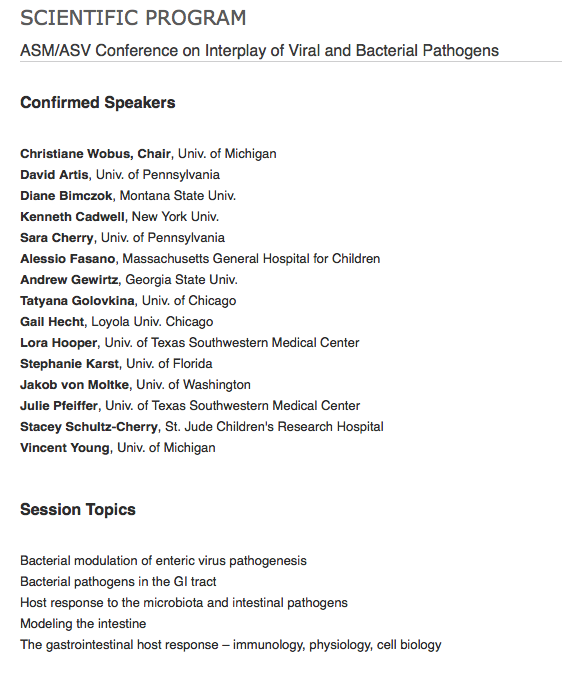
ASM/ASV Conference on Interplay of Viral and Bacterial Pathogens

Forwarded message from Young, Vincent

Hi All,

Just to spread the word, particularly for your trainees— there will be a new conference May 1-4, 2017 that is co-sponsored by ASM and ASV. It will cover many aspects of intestinal biology (see below).

The meeting is trying to build bridges between virology and bacteriology and immunology and host physiology. We are also planning a session on model systems one can use to study the interplay between the various players (e.g. Drosophila, organoids etc). Abstracts can be in any one of those areas, they don’t have to span the whole breadth. The meeting is also for people that want to expand into one of the other areas, make connections and learn about the other topics. We have several features planned to enhance the interaction of students/postdocs with more senior scientists (e.g., poster pitch and science speed networking).

The abstract deadline has been extended to March 7. Importantly, there are 20 travel grants of $500 each available to students and postdocs.

Feel free to spread the news.

Vince

http://conferences.asm.org/index.php/upcoming-conferences/asm-asv-conference-on-interplay-of-viral-and-bacterial-pathogens

At #UCDavis 2/22: Taner Sen on “Biological Databases …”

At #UCDavis 2/21 – Elizabeth Grice “Skin microbiome dynamics in health, perturbation, and wound healing”

Dr. Elizabeth Grice from the University of Pennsylvania will be giving a talk at the Center for Comparative Medicine seminar series on Tuesday, February 21st, at 12PM in CCM 1008. The title of her talk is “Skin microbiome dynamics in health, perturbation, and wound healing.”

At #UCDavis today: Dr. Karen Kapheim “Causes and Consequences of Social Evolution in Bees”

Dr. Karen Kapheim of Utah State University will be giving today’s Ecology and Evolution seminar.

Title: Causes and Consequences of Social Evolution in Bees
Room: 100 Hunt Hall
Time & Date: 4:10pm on Thursday, February 16th. TODAY!

From her website: “Research in the Kapheim lab at Utah State University addresses the evolutionary processes responsible for the diversity and plasticity of complex traits. The primary focus of this research is the evolution of social behavior in bees. We seek to understand the developmental and sociogenomic mechanisms underlying behavior to better understand how it evolves. Our research is integrated across sub-disciplines of biology, including evolutionary biology, behavioral ecology, comparative genomics and transcriptomics, neuroscience, physiology, and metagenomics.”

2/14 at #UCDavis – Easton White “Your time series is (probably) too short “

***** CPB Seminar Reminder for Tuesday, February 14, 2017, 4:10pm in 1022 Life Sciences *****

Speaker: Easton White
Graduate Student, Population Biology Graduate Group, Hastings Lab, UC Davis
Title: “Your time series is (probably) too short ”
Host: Alan Hastings

The entire CPB Seminar schedule for Winter Quarter 2017 is available here.