Not much to say other than that this is awesome: The Beard-ome : Oscillator: “Christina Agapakis”.
Hat tip to Bora

Well, I have been looking around on the web for a bit and figured I should just post to my blog. We are in the market for a used Roche GS FLX sequencer. Anyone know of one for sale? We had planned to buy a new one but with the 3rd generation sequencers coming out soon it seems unwise to spend 500K on a new machine. But I like the current capabilities in the Roche GS FLX, as well as the apparently soon to be released ~1000 base pair reads. So we still would like to have the technology here at UC Davis. So if you know of one for sale, please let me know.
I am teaching a class this spring and as part of the class am having one lecture on “Phylogenetic trees and methods.” I would like to link to (and be able to mix and match material from) some review paper on this topic. So I am searching for something that is Open Access and preferably with a broad Creative Commons license. Anyone know of anything good?
Here are links to the Friendfeed Notes for today
http://friendfeed.com/jgi2010/7104a5aa/rita-colwell-university-of-maryland-solving?embed=1
http://friendfeed.com/jgi2010/f73db47f/joseph-noel-salk-institute-substrate?embed=1
http://friendfeed.com/jgi2010/1d5588e4/adrian-tsang-concordia-university-fungal?embed=1
http://friendfeed.com/jgi2010/4b31edd3/tanya-woyke-jgi-genomic-sequencing-of-single?embed=1
Just got this email – may be of interest to some:
Genome Sequencer FLX Bay Area Regional User Group Meeting
Roche 454 Life Sciences invites you to the Bay Area Regional Genome Sequencer FLX User Group meeting which will be held at Roche Diagnostics in Pleasanton, CA on March 8th and 9th.
We will kickoff the meeting the afternoon of March 8 with interactive sessions with our BioInformatics Specialist Teri Mueller and Regional Applications Consultant Shamali Roy. Bring any questions or ideas you may want to address. Teri will present on the most recent upgrades to our Data Analysis software and Shamali will be available for experimental design advice. This will be a user driven question and answer event scheduled from 1:00-4:00 pm.
Tuesday will feature local scientists presenting their 454 Genome Sequencer FLX work for a variety of applications. Presentations will begin at 10:00 am and conclude at 4:00 pm.
Speakers for the event include
Robert Shaffer, MD – Associate Professor of Medicine and Pathology, Stanford University
Feng Chen, PhD – Group Lead, Technology and Applications, US DOE Joint Genome Institute
Matt Ashby, PhD – President and Chief Scientific Officer, Taxon Biosciences
Henry Erlich, PhD – Vice President Discovery Research, Roche Molecular Systems
This meeting is designed to allow GS FLX users to share experiences and knowledge about the platform, creating a community of users where tips and tools can be shared. Other than a brief introduction by Roche 454, this will be a Science for Scientists event. Please feel free to share this invitation with colleagues.
Come and network with other researchers using Roche 454 technology as well as learn tips ranging from sample management to base calling to whole genome analysis, and much more. This event is free of charge and is open to everyone with an interest in using this exciting technology for accelerating your research and discovery. Lunch will be provided on March 9.
Space is limited and registration is required. To register for the event please RSVP to either courtney.brady@roche.com or goli.shariat@roche.com Please indicate if you will be attending March 8th or 9th or both days.The address for the event is Roche Diagnostics, 4300 Hacienda Drive, Pleasanton, CA 94588. There is a BART station nearby and shuttles to Roche can be arranged.
Normally I spend some time here criticizing bad words used in various areas of science in which I work. Today I am praising a word. The word is bislagiatt and I had never seen it until reading a Wall Street Journal article today. The article (Blame Evolution for Disease – WSJ.com) has some good and bad moments. It presents some arguments for why some human diseases today are in essence side effects of historical natural selection that no longer applies well. Many of the arguments seem OK but smell of adaptationism in reverse – just so stories that may not have a lot of evidence on their side. But the article overall is good and has some nice figures with it. But the best part of the article is the introduction of a new word
“And some body parts that provided a benefit at some time in human history pose challenges today—a phenomenon Texas Tech University geneticist Lewis I. Held Jr. calls “bislagiatt,” an acronym for “but it seemed like a good idea at the time.””
Now that is a perfectly good evolution term. And though I have never seen it used anywhere else, the use in this article I think will lead to it being used more commonly in the field. And thus today I am giving out a new award “Best new evolution word” to “bislagiatt” and to Dr. Lewis Held for at least using it here if not coining it.
Arrg. I am so sick of getting emails from people hawking some blog site saying “We like your blog … if you link to us we will link to you.” Here is an examply I just got
Saw the “The Tree of Life” blog and thought it was great. I wanted to introduce our blog to you. The XXX Blog (http://www.XXXX.com/blog/) has been created as a place where blah blah blah. Would you be interested in reciprocal linking? We will link to you on the XXX Blog http://www.xxxx.com/blog/ and our other blog the xxxxx http://xxx.wordpress.com/. If you are interested feel free to contact us xxx@xxxx.com .
Here is another one:
Greetings:
My latest site is dedicated to xxxxx. If you would like to exchange links I would be more than happy to trade my link in exchange for a reciprocal link on your site. If you agree, please place my link:
TEXT: xxxx
URL: http://www.xxxx.com
Desc. (optional): The top xxxx xxx xxx for your xxx xxx. .
Send link placement and your link information to wrap up the exchange
Thanks
I am sorry but I put up links that I find interesting. And I do not post links in exchange for others posting links to me. Am I somehow missing out on something? I know people are trying to game google hits but I want nothing to do with it.
Just a quick post here to suggest people check out the Carnival of Evolution (#20) being hosted at Skeptic Wonder (see Skeptic Wonder: Carnival of Evolution #20!).
It’s has some juicy evolution posts discussed and (perhaps) best of all has a “phylogenetic” tree based on the postings. I recommend everyone check it out …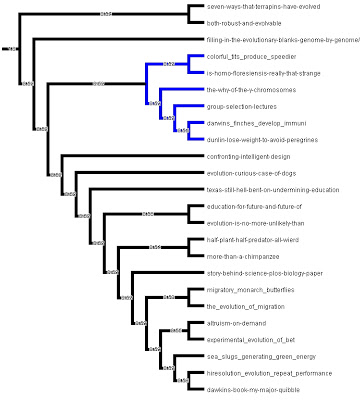

So there is this cool new paper out in PLoS Genetics: Evolutionary Mirages: Selection on Binding Site Composition Creates the Illusion of Conserved Grammars in Drosophila Enhancers. and I have wanted to write about it for a week or so. You see, the paper is about something I have been interested in for most of my career – how the particular processes by which mutations occur can sometimes be biased (i.e., some types of mutations are more common than others) and that these biases can create highly ordered patterns in genomes and in turn that observation of these ordered patters can sometimes be misinterpreted as being the result of adaptation. Mistaken claims of adaptation in genomics are a favorite topic of mine – and let me to create (with tongue in cheek) a new omics word – Adaptationomics.
Anyway – so I really really like this paper. But there is a week bit of a problem in writing about it. You see, it is by my brother, Michael Eisen, a Prof. at UC Berkeley (and a student in his lab Richard Lusk). And, well, I don’t want to say anything wrong or stupid about the paper since, well, my brother will be pissed off. And so I have not written about it yet. But then I realized the best way to write about this one is to simply ask my brother for the “Story behind the science” for the paper, as I have been doing for some other recent papers.
If you want a summary of the paper, here it is in their own words:
Authors summary: Because mutation is a random process, most biologists assume that apparently non-random features of genome sequences must be the result of natural selection acting to create and preserve them. Where this is true, genome sequences provide a powerful means to infer aspects of molecular, cellular, and organismal biology from the signatures of selection they have left behind. However, recent analyses have shown that many aspects of genome structure and organization that have traditionally been attributed to selection can often arise from random processes. Several groups—including ours—studying the sequences that specify when and where genes should be produced have identified common, seemingly conserved, architectural features, based on which we have proposed new models for the activity of the complex molecular machines that regulate gene expression. However, in the work described here we simulate the evolution of these regulatory sequences and show that many of the features that we and others have identified can arise as a byproduct of random mutational processes and selection for other properties. This calls into question many conclusions of comparative genome analysis, and more generally highlights what Michael Lynch has called the “frailty of adaptive hypotheses” for the origins of complex genomic structures.
Conclusions: Lynch has eloquently argued that biologists are often too quick to assume that organismal and genomic complexity must arise from selection for complex structures and too slow to adopt non-adaptive hypotheses. Our results lend additional support to this view, and extend it to show that indirect and non-adaptive forces can not only produce structure, but also create an illusion that this structure is being conserved. We do not doubt that many aspects of transcriptional regulation constrain the location of transcription factor binding sites within enhancers. Indeed a large body of experimental evidence supports this notion, and we remain committed to identifying and characterizing these constraints. But if this process is to be fueled by comparative sequence analysis, as we believe it must be, it is essential that we give careful consideration to the neutral and indirect forces that we now know can produce evolutionary mirages of structure and function.
I must say I love the title lead in “Evolutionary mirages” which is another but much better way of saying “Adaptationism is a bad thing”.
This paper started out as a control. My lab is interested in understanding how the enhancers that control gene expression work – focusing on those that control early development in Drosophila. In 2008, we published a paper showing that when we put enhancers from a distantly related family of flies into Drosophila melanogaster embryos, they drive patterns of expression that are identical to the endogenous D. melanogaster enhancers, even though they have almost no conservation of primary DNA sequence. But since they have the same function, they must have something in common – and so we compared the configurations of transcription factor binding sites in orthologous enhancers across different evolutionary timescales looking for something they shared.
What we found is that binding sites in all of these enhancers occur in clusters. They are closer to each other than one would expect if they were scattered randomly in the ~1,000 bp of an enhancer. And, what’s more, sites that were close to each other were far more likely to be conserved. Surely, we thought, this could be no accident. So we proposed that enhancers are organized into compact clusters of sites for one or more factors – and that these “mini modules” are the primary unit of enhancer function.
But as we worked to extend these analyses to whole genomes, we sought a more rigorous, quantitative assessment, of just how improbably different levels of binding site clustering were. Like pretty much everyone in the field, we had used a null model in which binding sites were scattered randomly in an enhancer. But, I’ve been working with genomes long enough to know that nothing is ever truly random – and that all kinds of adaptive and non-adaptive processes create patterns in genome sequences that confound simple analyses. I wanted to come up with a null model for the distribution of sites within in an enhancer that was more realistic.
To do this I turned to my graduate student Rich Lusk, a card-carrying population geneticist trained at the University of Chicago. Rich was proud of his status as one of the few members of the lab who didn’t work on flies – but I convinced him to put aside the abstract models of binding site evolution in yeast and work on developing a real null model for our studies of enhancer evolution.
The idea was to simulate enhancers evolving without any constraint on the organization of transcription factor binding sites they contain, and to see what happens. But this did not mean letting enhancers evolve neutrally – their extreme functional conservation demonstrates that they are under fairly strong constraint. Since it is pretty clear that these enhancers are responding to the same transcription factors in all of these species, Rich’s simulations required that enhancers maintain their binding site composition – but placed no constraints on how the sites were organized relative to each other.
And what we found was striking. Even with no explicit selection on binding site organization – these evolved enhancers had lots of structure! Binding sites were clustered together, and, the closer together sites were, the more conserved they were — just like they were in real enhancers. In made us realize pretty quickly that the patterns we had latched onto – and which many other people were describing in different systems – might not be an evolutionary signature contraint on the organization of sites within in enhancers, but simply a byproduct of selection on binding site composition. If you want details, read the paper! But this has radically altered the way that we look at enhancer evolution.
2. How did you come up with the title.
Rich and I were writing the paper, and we had some really long, hideous, boring title. In writing the paper, the idea that things are not always what they appear to be was at the forefront of my mind. I was thinking about how desperate we and other people in the field were to figure out how enhancers work – it’s a vexing problem that has defied decades of work – and how we all hoped that evolutionary analysis was going to rescue us – and how quickly and eagerly we latched on to the first signs of a signal – and how that was just like a mirage you see in the desert….
3. Any interesting background?
(see 1)
4. When did the work start?
About a year ago. We had been thinking about this for a while, but only when Rich focused on it did things get rolling.
5. Why PLoS Genetics? Did PLoS Biology reject it?
PLoS Genetics was our first choice. PG has become the premier journal for evolutionary genetics – it routinely publishes the most interesting and important work in the field, and everyone reads it. While every paper I’ve sent there has been heavily scrutinized, the editorial process has been fair (though sometimes agonizingly slow….), and each review has been thoughtful and many (including in this case) helped to vastly improve the paper.
Lusk, R., & Eisen, M. (2010). Evolutionary Mirages: Selection on Binding Site Composition Creates the Illusion of Conserved Grammars in Drosophila Enhancers PLoS Genetics, 6 (1) DOI: 10.1371/journal.pgen.1000829
http://friendfeed.com/treeoflife/d5f1a668/story-behind-science-plos-genetics?embed=1
Well, I really want to quit with this “Worst New Omics Word Award” and with the new “bad omics word of the day” theme I started a few days ago. But I just can’t quit. Today’s reason for not quitting is a new PLoS One paper: Psychedelics and the Human Receptorome. Even though the word is not defined in the paper, it is alas, defined elsewhere. Wikipedia says
The receptorome, is a concept analogue to the genome and proteome, but also to other sets of structural or functional units such as the proteasome and connectome.
In analogy with the genome, where the genome is the total set of genes, the receptorome can be considered the total set of genes giving rise to receptors or receptor molecules. It could also be seen as the total number of receptor proteins in a certain organism.
There is even, receptorome.org.
I do not know the origins of the word. I do know, however, that it is a bit much. A key question for this and many other omics words is – is it needed? How much trouble would it be to say what we actually mean “all the receptors” or something like that. Recepterome gives too much formality to something that does not seem to be a concrete entity. Proteosomes – they are real things. Proteome – possibly annoying to some, but a straightforward concept independent of functional properties of proteins. Recepterome just is not a good analog of these terms.
And though at some level I do not want to thank them – I guess I should thank those who pointed this out to me: Bora in an email, mocost on twitter and PSI-Wavefunction in a comment. Thanks all – for for pointing out this new omics word … so that I can give it today both by Bad Omics Word of the Day and Worst New Omics Word Award, even though it may not be so new. At some point I guess I should merge these awards. Then maybe I will call it the “Awardome.


