1/23 Talk by Alberto Pepe (Authorea), Shields Library, 12-1:30

One week from today for

Alberto Pepe

Data-driven, Interactive Scientific Articles in a Collaborative Environment with Authorea

Monday, January 23rd, 12-1:30pm

Shields Library’s Data Science Initiative space on the 3rd floor

Most tools that scientists use for the preparation of scholarly manuscripts, such as Overleaf and ShareLaTex, function offline and do not account for the born-digital nature of research objects. Authorea allows scientists to collaboratively write rich data-driven manuscripts on the web that offers readers a dynamic, interactive experience with an article’s full text, images, interactive figures, data, and code. In this talk, I will show you how Authorea differs from Overleaf and ShareLatex and how we are bringing scientific writing into the 21st century. For a quick overview, here’s how we are different. Please bring your laptop as attendees will be included in the demo (not mandatory but suggested).

Alberto Pepe is the co-founder of Authorea. He recently finished a Postdoctorate in Astrophysics at Harvard University. During his postdoctorate, Alberto was also a fellow of the Berkman Center for Internet and Society and the Institute for Quantitative Social Science. Alberto is the author of 30 publications in the fields of Information Science, Data Science, Computational Social Science, and Astrophysics. He obtained his Ph.D. in Information Science from the University of California, Los Angeles with a dissertation on scientific collaboration networks which was awarded with the Best Dissertation Award by the American Society for Information Science and Technology (ASIS&T). Prior to starting his Ph.D., Alberto worked in the Information Technology Department of CERN, in Geneva, Switzerland, where he worked on data repository software and also promoted Open Access among particle physicists. Alberto holds a M.Sc. in Computer Science and a B.Sc. in Astrophysics, both from University College London, U.K. Alberto was born and raised in the wine-making town of Manduria, in Puglia.

Sponsored by Innovating Communication in Scholarship

At #ucdavis 1/12: Judie Bronstein “Mutualism: What Do We Know, and Where Do We Go From Here?”

Tomorrow’s Ecology and Evolution speaker will

be Judie Bronstein from University of Arizona.

Title: Mutualism: What Do We Know, and Where Do We Go From Here?
Room: 100 Hunt Hall
Date and Time: 4:10pm on Thursday January 12th

According to her webpage
(http://www.eebweb.arizona.edu/faculty/bronstein/Bronstein_Lab/HOME.html):
"We study all things mutualistic. Projects in the lab focus on
ecological, evolutionary, and behavioral questions about mutualism.
We’re particularly interested in coevolutionary dynamics, community
organization, context dependency, climate change effects, and the
continuum from cooperation to conflict. We are linked more by a common
conceptual context rather than any single type of interaction or group
of organisms."

UC Conservation Genomics: CALeDNA Program

Of possible interest:

Dear UC Conservation Genomics Consortium investigators, members, and friends,

We are excited to share the news that our citizen science program, CALeDNA, has officially launched! Now, we need your help to make it visible.

I am attaching a press release statement. But here is the short version for you.

We have made a website that educates the public about the value of biodiversity monitoring and the technique we are using, non-invasive environmental DNA sequencing. It trains them on how to collect samples for us. A volunteer does the training on the website and downloads our app. We send them a kit and a map of places to go based on their interests of places to hike to when they register with us. We need 1000 volunteer citizen scientists to collect 18,000 samples across the state during 2017. We have several bioblitz events planned, some with iNaturalist, and some across the 39 UC natural reserves, national and state parks, and private preserves. By the end of the year we will have sampled across much of the state during both the dry and the rainy season. We will sequence and analyze the samples, producing publications and policy recommendations, engaging stakeholders of various kinds and promoting the technology and optimized analysis approach.

Any undergraduate course, nature club, or friends who like to get outdoors can participate. In some cases, we can even help pay for the gas to drive to a reserve. We need your help to recruit citizen scientists and engage them in our program. We have a bioblitz at Pillar Point the weekend of Feb 9-11 that we need volunteers to join for. Then throughout April and May we need people to visit the fascinating UC Reserves. We’ll handle the paperwork to register with them.

If you are teaching courses this quarter and would be willing to share a promotional slide at the start of your class, or willing to incorporate fieldwork with us as part of your class, let me know and I’m more than happy to work with you. We would also appreciate recommendations on places to advertise the CALeDNA program. Finally, please share this with your colleagues and labs–perhaps they will want to participate too!

Thank you for being part of this Consortium and for learning about our new CALeDNA launch. Wishing you a great New Year!

With warm regards,

Rachel

PRESS_RELEASE_CALeDNA.pdf

Job: Senior Research Associate in metagenomics and next-gen sequencing

Posting this for colleagues at Phylagen.

For full disclosure – I am a consultant for Phylagen.


———————————
 
Position
Senior Research Associate
Phylagen, Inc. http://phylagen.com
San Francisco, CA
Position Description
Phylagen is an early stage biotech company developing microbiome analytics and data generation approaches with applications to a diverse set of industries and brands.
We are bringing on an innovative lab scientist – ideally with a M.S or Ph.D. in biology, molecular biology, microbiology, biochemistry, or related field (translating to 4-5 years lab experience). We want someone deeply knowledgeable in microbiome sample handling, high-throughput sequencing library preparation,  and next-generation sequencing platforms.
The position will entail processing samples from different environments, developing and optimizing protocols for amplicon and shotgun metagenomic libraries, and translating processes to automated and high-throughput pipelines for the generation of high-quality sequence data. Expertise in sequencing platform tuning or laboratory automation is a bonus.
We are looking someone who is flexible – a fast learner with relevant experience that will allow them to contribute quickly. We offer a competitive salary, equity, and benefits package. You will be a key player in a cutting edge, rapidly growing venture-backed microbiome startup.
Apply on LinkedIn (https://goo.gl/DPNph1) or send CV to jobs@phylagen.com.
Company Description
Phylagen is an early stage biotech startup focused on building game-changing microbiome science and technology with applications across a diverse set of industries and brands. We are harnessing the unseen world of microbes to improve our daily lives by combining advanced DNA sequencing and big data analytics to analyze the microbiome in ways previously not possible. This enables us to solve diverse problems across health care, food processing, transportation, and other industries.

Kudos to Dana Devries, Alex Martin, et al. for new cat butt microbe genome report 

Kudos to the students Dana Devries and Alex Martin and to their mentors Holly Ganz and David Coil for their new genome report.  The paper is part of our “cat butt” project.

See De Vries DR, Martin AL, Ganz HH, Eisen JA, Coil DA. 2016. Draft genome sequence of Enterococcus faecalis strain UCD-PD3. Genome Announc 4(6):e01386-16. doi:10.1128/genomeA.01386-16.

Link: Draft Genome Sequence of Enterococcus faecalis Strain UCD-PD3

Today at #ucdavis: Solomon Katz: The nutritional significance of the biocultural evolution of cuisine practices: implications for the future of the food system

**************************
UC Davis
Department of Food Science & Technology Special Seminar
Tuesday, December 6, 2016
2:10 PM
Sensory Theater
Robert Mondavi Institute

Solomon Katz
Emeritus Professor of Anthropology
University of Pennsylvania

“The nutritional significance of the biocultural evolution of cuisine practices: implications for the future of the food system”

ABSTRACT: Over the last two decades there is substantial evidence that a coevolution occurred between the Neolithic rise of agriculture and the social routinization of cuisine practices. This coevolutionary process involving our cultures, genomes and microbiomes allowed a relatively small number of highly productive crops to replace the much broader pre-Neolithic diet with a series of exo-digestive food processing technologies that provided the necessary transformations to maintain the nutritional balance of our agricultural diets. This seminar tracks these evolutionary processes and their implications for the contemporary human diet as humanity adapts to rapidly changing demands on our food system over the remainder of this century and beyond.

**************************

TODAY at #UCDavis Nels Elde on “How pathogenic microbes shape host cells and genomes”

Today at 4:10 pm in 1003 Giedt Hall Nels Elde (University of Utah) will be delivering this week’s Ecology and Evolution Seminar Series.

From his website, “The Elde lab uses host-pathogen interactions to study the evolutionary process and evolutionary approaches to understand the selective forces shaping cellular pathways.”

Today, Nels will be speaking on How pathogenic microbes shape host cells and genomes.

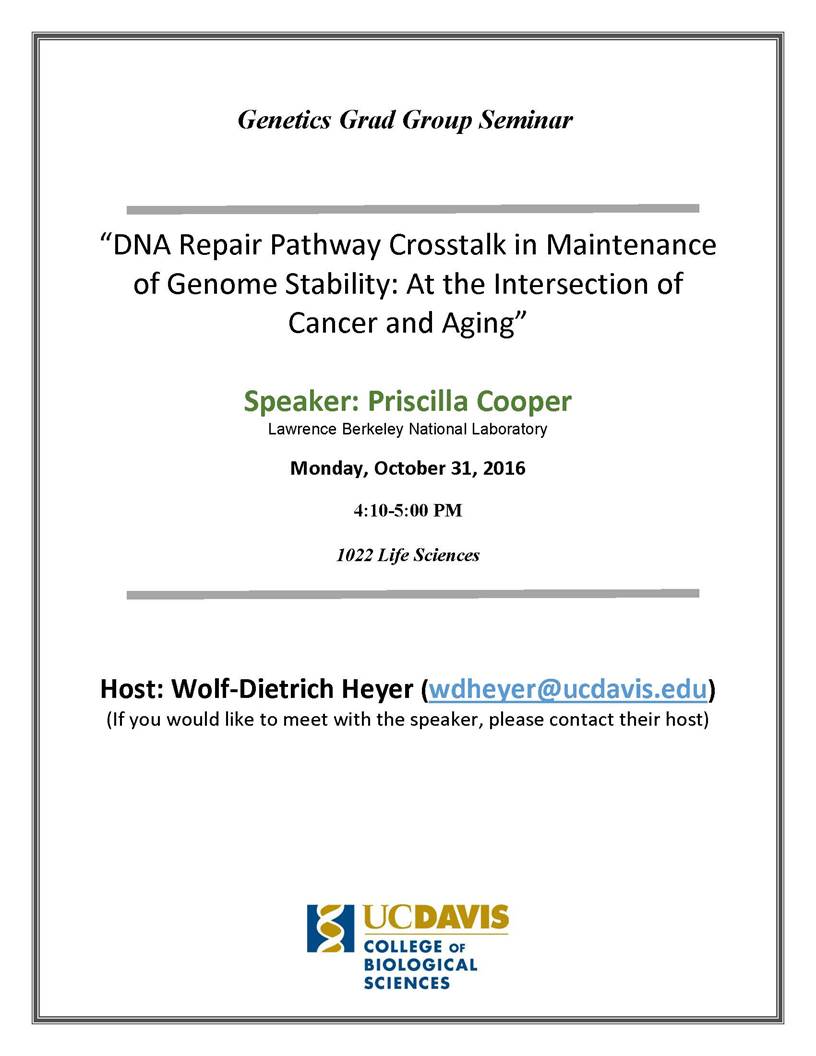
10/31 at #UCDavis – Priscilla Cooper on DNA repair pathway crosstalk in maintenance of genome stability

Cooper 10_31.pdf

Wed Nov 2 at #UCDavis – John Roth on “Mutation, selection, and the tyranny of the obvious”

MIC 291: Selected Topics in Microbiology

Work-in-Progress Seminars

Dr. John Roth

"Mutation, selection, and the tyranny of the obvious"

Wednesday, November 2, 2016

4:10 pm

1022 Life Sciences

*****************************************************************

Roth 11-2-16.doc

Today at #UCDavis: Virginia Walbot “Building a Maize Anther using Cell-Cell Signaling.”

Plant Biology​ ​
Graduate Group​ ​
Seminar Series

Oct 21 – 12: 10 LSA 1022

Virginia Walbot (Stanford University)

“Building a Maize Anther using Cell-Cell Signaling.”