What can Justin Timerblake tell us about evolution?

I read with fascination an article in the New York Times magazine this weekend on Pop Culture entitled “Is Justin Timberlake a Product of Cumulative Advantage?” No, I was not fascinated by the Timerlake part. But what was interesting was Duncan Watt’s argument that it is very difficult to predict the success or failure of entities in pop culture. He presented a model that is summarized as “The cumulative advantage:”


The reason is that when people tend to like what other people like, differences in popularity are subject to what is called “cumulative advantage,” or the “rich get richer” effect. This means that if one object happens to be slightly more popular than another at just the right point, it will tend to become more popular still

He then described an experiment they performed that was published in Science last year where

more than 14,000 participants registered at our Web site, Music Lab (www.musiclab.columbia.edu), and were asked to listen to, rate and, if they chose, download songs by bands they had never heard of. Some of the participants saw only the names of the songs and bands, while others also saw how many times the songs had been downloaded by previous participants. This second group — in what we called the “social influence” condition — was further split into eight parallel “worlds” such that participants could see the prior downloads of people only in their own world. We didn’t manipulate any of these rankings — all the artists in all the worlds started out identically, with zero downloads — but because the different worlds were kept separate, they subsequently evolved independently of one another.

They used this set up to test among two different possibilities.

First, if people know what they like regardless of what they think other people like, the most successful songs should draw about the same amount of the total market share in both the independent and social-influence conditions — that is, hits shouldn’t be any bigger just because the people downloading them know what other people downloaded. And second, the very same songs — the “best” ones — should become hits in all social-influence worlds. What we found, however, was exactly the opposite. In all the social-influence worlds, the most popular songs were much more popular (and the least popular songs were less popular) than in the independent condition. At the same time, however, the particular songs that became hits were different in different worlds, just as cumulative-advantage theory would predict. Introducing social influence into human decision making, in other words, didn’t just make the hits bigger; it also made them more unpredictable.

Why you may ask am I so fascinated by this? Well, what he described is mathematically and conceptually identical to Luria and Delbruck’s fluctuation test (see my earlier blog about L & D), where they were testing the origin of mutants. Luria and Delbruck designed a test where they grew E. coli from the same starting point in different culture tubes. Then they exposed these tubes to selective pressures. If the number of mutants in the tubes were basically the same, this would mean that the mutants arose in response to the selection. If the number of mutants were vastly different (somehting they called a jackpot pattern) this would mean the mutants arose in the growth of the bacteria in the tubes prior to selection.

In the entertainment experiment, the different music “worlds” are the equivalent to the different test tubes. And the preferences of people are the equivalent of the selection. Their result in the music experiment was the jackpot pattern – the same thing seen by Luria and Delbruck. For Luria and Delbruck this meant selection did not guide mutation. For the music, this means the personal preference for the music has less influence than the random history of which music was picked early on.

So – thank you Justin for a modern lesson in evolution.

Metagenomics, a visit to the Moore Foundation HQ, and things not to ask for from your Program Officer

OK – so here is my confession. I posted my blog last week about my brother’s birthday to make up for my ditching him on his 40th birthday to go to a meeting at the Moore Foundation HQ. I really needed to go to this meeting, for many reasons, and so I went just for the day (driving from Davis did not take anywhere near as long as I expected — just ~ 1.5 hours to the Presidio in SF where the Moore HQ is located). But with two kids including a newborn, I could not go to the A’s Yankees game with my brother and so I posted that birthday blog to do something.

Anyway – not a ton to report from the meeting. It was the second California Metagenomics workshop organized by UCSD as part of the CAMERA project. The last one was in Berkeley. There were some good talks but as usual the best thing was a chance to talk to people in person. The two best talks in my opinion were one by Victoria Orphan from Caltech and one by Jessica Green from UC Merced. Orphan talked about a special sorting method they are using to pull out cells of particular organisms from environmental samples for subsequent gene and genome sequencing. Green talked about her work on spatial ecology and biogeography of microbes. I think we desperately need more people like Green in the microbial ecology field — people who are taking methods and concepts used for “big” organisms and applying them to the microbial world (another example is Jen Martiny at Irvine who was not at the meeting but her husband Adam Martiny was there).

The most painful part of the meeting (other than the traffic on the way home) — the lame behavior of many of the scientists in regard to our hosts the Moore Foundation. Despite being told many times that people were expected to bus their own tables — few did. And even better, one of the participants (Adam Godzik) spent serious effort complaining about the coffee not being strong enough to the program officer from the Moore Foundation. And then asking her to get him some stronger coffee. Clearly he likes his coffee. But not really the best way to interact with a program officer.

Michael Eisen’s 40th Birthday

Today is the 40th birthday of Michael Eisen, one of the co-founders of PLOS, an ardent supporter of Open Access in science, a top notch evolutionary and molecular biologist, and my brother. Happy Birthday Michael. In his honor, here are some links with information and stories about him:

  • Wikipedia entry
  • East Bay News story about him convincing me to publish in PLOS
  • His lab link
  • A story about his Wired Rave Award
  • A list of those who, like him, have won Presidential Young Career Awards

So if you know him, or even if you don’t wish him happy birthday (here on the blog, or by sending him email. You can get his email address at his lab web page here).

Symbionts Effects on Host Can be Mediated by a single Point Mutation

ResearchBlogging.org

Just saw the news about an article in PLoS Biology by Nancy Moran and colleagues. In their paper, which studied bacterial symbionts of aphids, they show that mutations in the gene encoding a heat shock protien in the symbiont influence the heat tolerance of the aphid hosts. Inturn this means that these mutations influence aphid geographical range and ecology. It is a relly cool story (Nancy Moran seems to publish a cool story like this every other week — I feel lucky to have worked with her on one symbiont project which I have written about here).

To read more about the Moran work, go to the article, which anyone can read since it is in PLoS Biology. Or go to the press releases such as here.

Dunbar, H., Wilson, A., Ferguson, N., & Moran, N. (2007). Aphid Thermal Tolerance Is Governed by a Point Mutation in Bacterial Symbionts PLoS Biology, 5 (5) DOI: 10.1371/journal.pbio.0050096

Scientist Reveals Secret of the Ocean: It’s Him

Published: April 1, 2007

Maverick scientist J. Craig Venter has done it again. It was just a few years ago that Dr. Venter announced that the human genome sequenced by Celera Genomics was in fact, mostly his own. And now, Venter has revealed a second twist in his genomic self-examination. Venter was discussing his Global Ocean Voyage, in which he used his personal yacht to collect ocean water samples from around the world. He then used large filtration units to collect microbes from the water samples which were then brought back to his high tech lab in Rockville, MD where he used the same methods that were used to sequence the human genome to study the genomes of the 1000s of ocean dwelling microbes found in each sample. In discussing the sampling methods, Venter let slip his latest attack on the standards of science – some of the samples were in fact not from the ocean, but were from microbial habitats in and on his body.

“The human microbiome is the next frontier,” Dr. Venter said. “The ocean voyage was just a cover. My main goal has always been to work on the microbes that live in and on people. And now that my genome is nearly complete, why not use myself as the model for human microbiome studies as well. ”

It is certainly true that in the last few years, the microbes that live in and on people have become a hot research topic. So hot that the same people who were involved in the race to sequence the human genome have been involved in this race too. Francis Collins, Venter main competitor and still the director of the National Human Genome Research Institute (NHGRI), recently testified before Congress regarding this type of work. He said, “There are more bacteria in the human gut than human cells in the entire human body… The human microbiome project represents an exciting new research area for NHGRI.” Other minor players in the public’s human genome effort, such as Eric Lander at the Whitehead Institute and George Weinstock at Baylor College of Medicine are also trying to muscle their way into studies of the human microbiome.

But Venter was not going to have any of this. “This time, I was not going to let them know I was coming. There would be no artificially declared tie. We set up a cutting edge human microbiome sampling system on the yacht, and then headed out to sea. They never knew what hit them. Now I have finished my microbiome.”

Reactions among scientists range from amusement to indifference, most saying that it is unimportant whose microbiome was sequenced. But a few scientists expressed disappointment that Dr. Venter had once again subverted the normal system of anonymity. Recent human microbome studies by other researchers have all involved anonymous donors. Jeff Gordon, at the Washington University in St. Louis expressed astonishment, “I have to fill out about 200 forms for every sample. It takes years to get anything done. And now Venter sails away with the prize. All I can say is, I will never listen to one of my review boards again.”

Venter had hinted at the possibility that something was amiss in an interview he gave last week for the BBC News. He said “Most of the samples we studied were from the ocean but a few were from people.” When the interviewer seemed stunned, Doug Rusch, one of Venter’s collaborators stepped in and said “Collected with the help of other people.”

Venter was apparently spurred to make the admission today that many of the samples were in fact from his own microbiome due to a video that surfaced on YouTube showing Jeff Hoffman, the person responsible for collecting the water samples, performing a tooth scraping of Venter and then replacing the ocean water filter with Venter’s tooth sample.

Venter said the YouTube video was immaterial, “Well, we wanted to wait a few more weeks to have the papers describing the human microbiome published. But in the interest of human health we are deciding to make the announcement today.”

Unlike with the human genome data however, Venter says all of the data from his personal microbiome will be made publicly available with no restrictions. “If there is one lesson I have learned it is that open access is better than closed access. The more people can access my microbiome, the more they will help me understand myself. Plus, unlike Collins and Lander, who publish only in fee-for access journals, we will be publishing our analysis in the inaugural issue of a new Open Access journal that is a joint effort between the Public Library of Science and Nature. It will be called PLoN, the Public Library of Nature.”

In making his microbiome available, Venter has yet again abandoned his genetic privacy as he did when making his own genome available. Interestingly, the microbiome helps explain one of the first findings that was announced regarding his own genome. Venter said that analysis of the samples that came from his intestine reveal that microbes may explain why even though he has an apoE4 allele in his own genome (which is associated with abnormal fat metabolism) he does not need to take fat-lowering drugs. “Apparently, I have some really good fat digesters living in my gut. They make up for what is missing in my own genome.”

Dr. Venter’s reason for having his own microbiome sequenced, he said in the interview was in part scientific curiosity — ”How could one not want to know about one’s own microbes?” As to opening himself to the accusation of egocentricity, he said, ”I’ve been accused of that so many times, I’ve gotten over it.”

The key question that remains is – which of the samples were really from the ocean and which are from Venter. Venter said “Our funding agencies, including the DOE and the Moore Foundation, have agreed that we should not explicitly reveal which samples are which as this will encourage people to develop better methods of analyzing such complex mixtures of different microbes. Next week we will be announcing an X-prize award for the person who can identify which samples are mine and where they came from in me.”

Rob Edwards, a freelance microbial genomics expert says “It won’t be difficult to tell which are which. In fact, we had already identified an anomalous sample from Venter’s previous ocean sampling work, but nobody would listen to us.”

Jonathan Eisen, an evolutionary biologist who used to work for Venter says “I am certain that a few creative evolutionary analyses can reveal which sample is which. In fact, we are starting analyzing the samples already in anticipation of the X-prize announcement.”

Others are not so confident. Ed Delong, an ocean microbiology expert from MIT says “We have spent years carefully selecting our ocean samples to make sure they are not contaminated with sewage from cruise ships or from city drains. And now this – a purposeful mixture of ocean and human. It could take years to clean up the mess.”

Venter does not seem concerned. “If nobody can figure out which sample is from me and which is from the ocean, then we have no hope of making any progress in studies of either human microbiomes or oceans.”

More importantly, many scientists want to know what Venter will do next. Some want to know so that they can make sure to stay out of the way. Others probably relish the potential to go head to head with Venter. In this regard, Venter is not shy. “Biofuels. There is a great future in biofuels.”

American Scientist Article by Alma Swan Strongly Endorses Open Access Publishing

In an article just published in the American Scientist, Alma Swan details a plethora of reasons for the importance of Open Access publishing. Alma says, for example:

The bickering over varied business models, and the side arguments over public access to publicly funded results, obscure a larger, more important question: Can open access—the fundamental change to a system where scientists no longer face barriers to accessing others’ work (or their own)—advance science? My work involves measuring, analyzing and assessing developments in scholarly communication. From that perspective I argue that the answer is yes, and that the advance of science is the prime reason that access is an imperative.

AND

Open access can advance science in another way, by accelerating the speed at which science moves

AND

Open access can advance science in another way, by accelerating the speed at which science moves

AND LOTS MORE GOOD STUFF. Read the article.

Metagenomics makes it to Slashdot

Metagenomics has finally hit the big time. A story on metagenomics is on Slashdot.

Metagenomics studies begin by extracting DNA from all the microbes living in a particular environmental sample; there could be thousands or even millions of organisms in one sample. The extracted genetic material consists of millions of random fragments of DNA that can be cloned into a form capable of being maintained in laboratory bacteria. These bacteria are used to create a “library” that includes the genomes of all the microbes found in a habitat, the natural environment of the organisms. Although the genomes are fragmented, new DNA sequencing technology and more powerful computers are allowing scientists to begin making sense of these metagenomic jigsaw puzzles. They can examine gene sequences from thousands of previously unknown microorganisms, or induce the bacteria to express proteins that are screened for capabilities such as vitamin production or antibiotic resistance.

There is some bizarre stuff in there but hey that is OK. This is linking to a story in Science Daily about metagenomics which in itself is based on a National Academy Report on the field. The NAS report is definitely worth looking at.

The people who ran the committee are a who’s who of the field including the chairs, Jo Handelsman (who coined the term metagenomics) and Jim Tiedje who is one of the grand gurus of environmental microbiology.

PLoS Medicine gets good vibes from Slate

Good to see Slate promoting PLoS Medicine in the “Your Health This Week” column.

They say

Citing this paper allows me to pay tribute to the journal in which it was published: PLoS Medicine, one of several journals published by the Public Library of Science. This is a journal of fine quality founded by people who believe that all readers (you, me, and doctors in poor countries) should have free access to the journal’s entire contents—not just the abstracts. Peer review is just as stringent as in traditional journals that charge for online viewing. The PLoS way is the way every medical and scientific journal should be published. I’d love to persuade colleagues to submit their work first to a Public Library of Science journal and to go the limited-access route only if they must.

Evolution Trumps Money at Smithsonian


Great News from the Smithsonian.

Not only is Lawrence Small finally out (after his issues with expense accounts finally caught up to him) but Cristián Samper is in as the Acting Director. Samper is the current Director of the Smithsonian National Museum of Natural History and is an excellent evolutionary biologist / tropical ecologist. Here is hoping that he becomes the permanent director, although it will be a loss for the Museum of Natural History if he does.

If you want to blame Cristián for something, he was the Teaching Assistant for the course I took as an undergraduate at Harvard that finally convinced me to be a biologist. This was a Tropical Ecology course taught by Peter Ashton and Otto Solbrig that in addition to being a good lecture course, had a field trip to Venezuela for three weeks. On the trip we visited and studied all sorts of tropical ecosystems. The best part was getting advice on birding from Cristián, who pretty much knew every bird in every place we went.

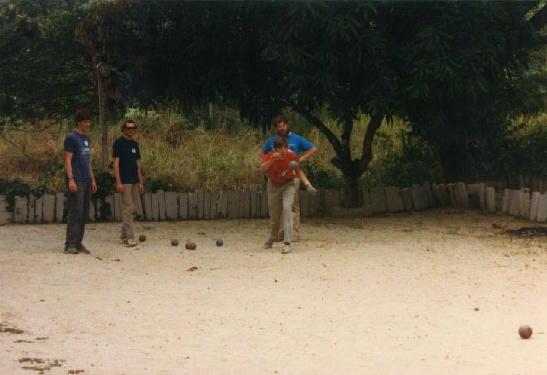
In honor of Cristián I am posting a picture of him working hard in Venezuela as part of the course (that’s him in red).

Let Colbert Decide: Francis Collins vs. Craig Venter

Well, I walked into a coleagues office and saw them watching Craig Venter on the Colbert Report. They asked me if that was what he was really like (I said no) and then they told me something I somehow missed. Francis Collins had also been on Colbert recently.

So – lets continue the public versus private fight right here on my blog.

The interview with Francis Collins is available here (http://www.comedycentral.com/motherload/?lnk=v&ml_video=79238).

The interview with Craig Venter is available here (http://www.comedycentral.com/motherload/?lnk=v&ml_video=82848)

I will refrain from commenting but I would like to solicit comments from others — pretend this was a debate. Who won?

——————————-
In response to Chris G’s comment I am posting pictures of Ned Flanders and Hunt Willard