Monday at #UCDavis Gene Robinson “Me to We: Using Honey Bees to Find the Genetic Roots of Social Life”

Chancellor’s Colloquium Distinguished Speaker Series

Gene E. Robinson (2.22.16)

"Me to We: Using Honey Bees to Find the Genetic Roots of Social Life"

Gene E. Robinson obtained his Ph.D. from Cornell University in 1986 and joined the faculty of the University of Illinois at Urbana-Champaign in 1989. He holds a University Swanlund Chair and is also the director of the Institute for Genomic Biology (IGB) and director of the Bee Research Facility. He is the author or co-author of over 275 publications and pioneered the application of genomics to the study of social behavior, led the effort to gain approval from the National Institutes of Health for sequencing the honey bee genome, and founded the Honey Bee Genome Sequencing Consortium. Monday, February 22, 2016 at 4 p.m. Mondavi Center Studio Theatre.

More information on the series and link to RSVP: http://chancellor.ucdavis.edu/colloquium/

At #UCDavis: Dean’s Global Health Night w/ Shirley Luckhart – Global malaria elimination and eradication

Dean’s Monthly Global Health Night with Shirley Luckhart, PhD

Thursday, March 3rd at 6:30 p.m. Education Building 3202 4610 X Street, Sacramento

Global malaria elimination and eradication – a perspective on the science and challenges behind these efforts

This interactive and informal session with Dr. Luckhart will feature a discussion about the current global impact and status of control measures for malaria. More than 60% of the world’s population is at risk for this mosquito-borne disease and, despite aggressive measures for control, incidence is increasing in some hyperendemic foci. Further, the issue of drug resistance is compounded by multi-drug resistant parasites and mosquito control is limited by insecticide resistance, with few new affordable options. Importantly, however, major international efforts are underway to eliminate malaria region-by-region, with the ultimate goal of worldwide malaria eradication on the global agenda. With these issues, malaria eradication is truly a grand challenge of our time.

About the Speaker

My work for the past 20+ years has focused on malaria. In particular, we have studied malaria parasite development and transmission in laboratory models and transmission of human malaria parasites in the lab and under field conditions in endemic countries. Although the majority of my published work has focused on transmission biology in the mosquito host, we have significantly expanded our work to include pathogenesis of malaria in a variety of model systems. My lab is currently recognized internationally for expertise in the biology of the bloodfeeding interface – that is, how factors in mammalian host blood (drugs, cytokines, parasite factors) influence parasite development and transmission to the mosquito host. Current projects include the study and modeling of cross-species signaling dynamics between mosquitoes and mammals at the bloodfeeding interface, molecular biology of cell signaling pathways that regulate parasite development in the mosquito host, mitochondrial bioenergetics control of tissue homeostasis and immunity in the mosquito host, development of dual anti-malarial therapeutics with transmission blocking activity, pathogenesis of malaria-Salmonella co-infection using both mouse and non-human primate models, and the influence of human HIV co-infection on malaria parasite transmission in Kenya.

GHN 3.3.16 Luckhart.pdf

WHNRC Microbiology Seminars: Feb 17 & Feb 18

Microbes and Infant Intestinal Health – From Development to Disease Prevention

Speaker: Dr. Karen Kalanetra, Microbial Ecologist/Molecular Biologist, UC Davis Departments of Viticulture and Enology, Food Science and Technology

Wednesday, February 17, 2016

1:10PM – 2:00PM; WHNRC Conference Room 121, 430 W. Health Sciences Drive

Simple solution: Template text for "National Interest" aspect of NSF Grants

To be filled in for any NSF grant.

———————————————————–

In order to meet the requirements of the benevolent, wise, and all knowing HR 3293, it is hereby declared in this written declaration that this National Science Foundation grant has been determined to

1) Be eminently worthy of Federal Funding

AND

2) Is without a doubt in the national interest, as indicated by having the incredibly high probability of achieving: [Insert here one or more of the following]

(A) Increased economic competitiveness in the United States;
(B) Advancement of the health and welfare of the American public;
(C) Development of an American STEM workforce that is globally competitive;
(D) Increased public scientific literacy and public engagement with science and technology in the United States;
(E) Increased partnerships between academia and industry in the United States;
(F) Support for the national defense of the United States; or
(G) Promotion of the progress of science for the United States.

Sincerely,

Your humble National Science Foundation Program officer

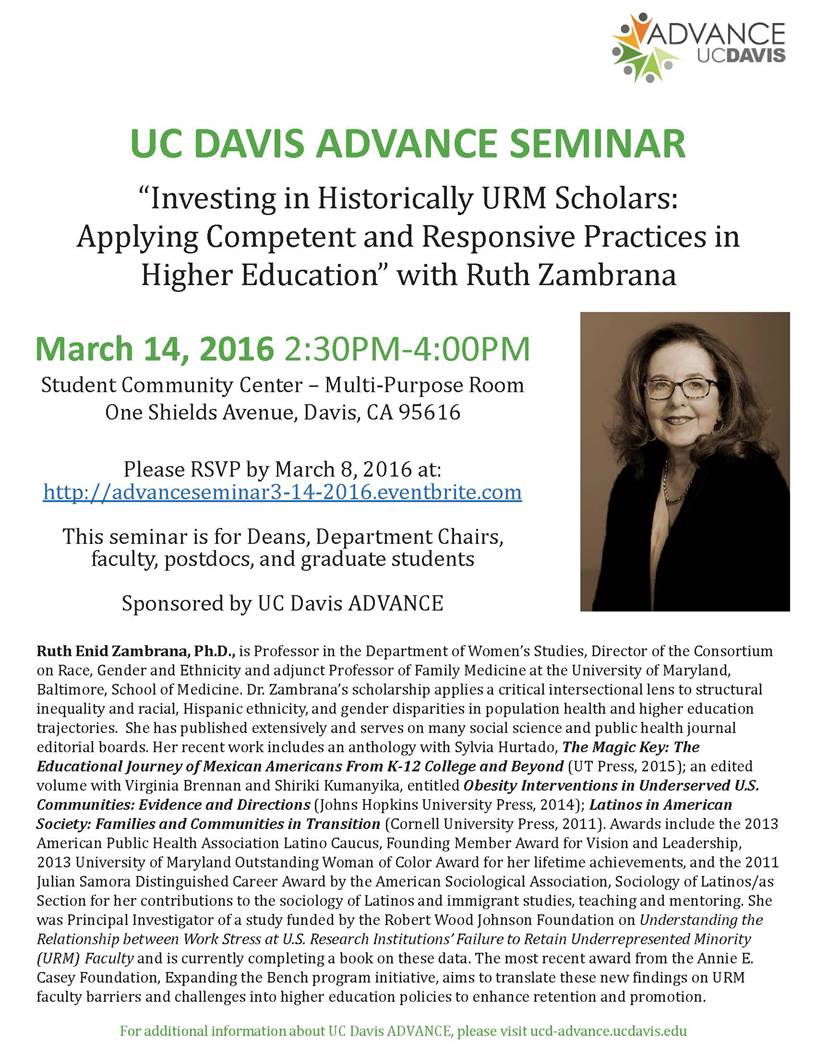
3/14 at #UCDavis: Ruth Zambrana “Investing in Historically URM Scholars: Applying Competent and Responsive Practices in Higher Education”

March 14 ADVANCE Seminar Flyer _Ruth Zambrana.pdf

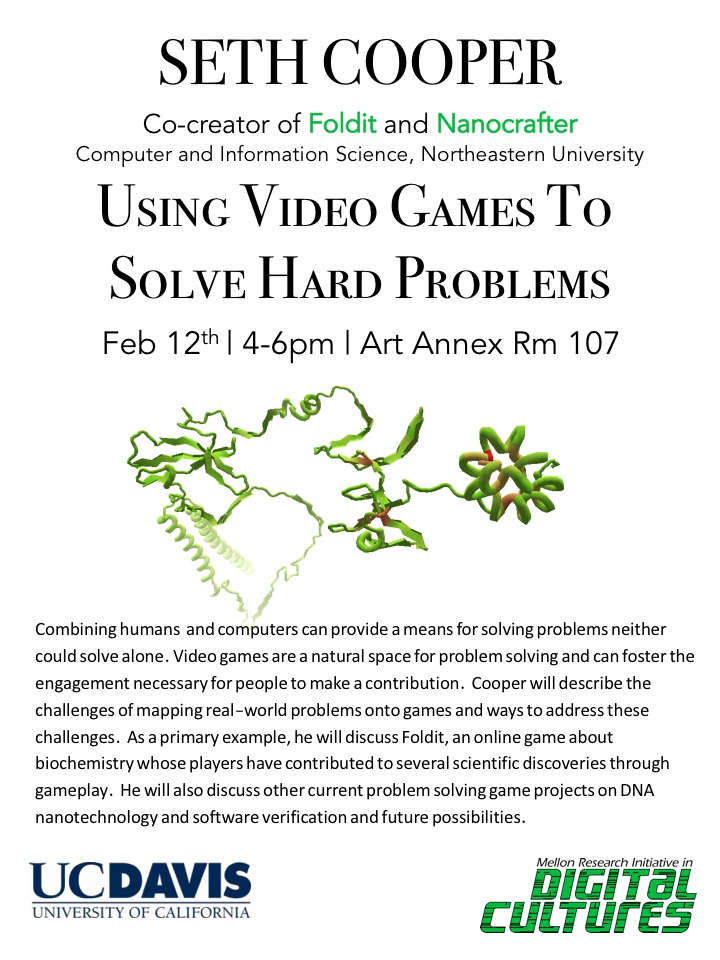
2/12 at #UCDavis: Seth Cooper, “Using Video Games to Solve Hard Problems”

if you can attend, you really should …

SETH COOPER
Using Video Games To Solve Hard Problems
Feb 12th | 4-6pm | Art Annex Rm 107

Seth Cooper is an Assistant Professor in the College of Computer and Information Science at Northeastern University and a member of the Playable Innovative Technologies Lab. His research focuses on using video games to solve difficult scientific problems; he has delivered multiple TED talks on the topic. He is co-creator of the scientific discovery games Foldit and Nanocrafter and early math educational games including Refraction and Treefrog Treasure. He has also researched real-time animation for games, and has previously worked at the Center for Game Science (as Creative Director), Square Enix, Electronic Arts, Pixar Animation Studios and the UC Berkeley Space Sciences Laboratory (on BOINC, the Berkeley Open Infrastructure for Network Computing).

Rather than solving problems with a purely computational approach, combining humans and computers can provide a means for solving problems neither could solve alone. Video games provide a compelling framework for this approach: they are a natural space for problem solving and can foster the engagement necessary for people to make a contribution. Cooper will describe the challenges of mapping real-world problems onto games and ways to address these challenges. As a primary example, he will discuss Foldit, an online game about biochemistry whose players have contributed to several scientific discoveries through gameplay. He will also discuss other current problem solving game projects on DNA nanotechnology and software verification and future possibilities.

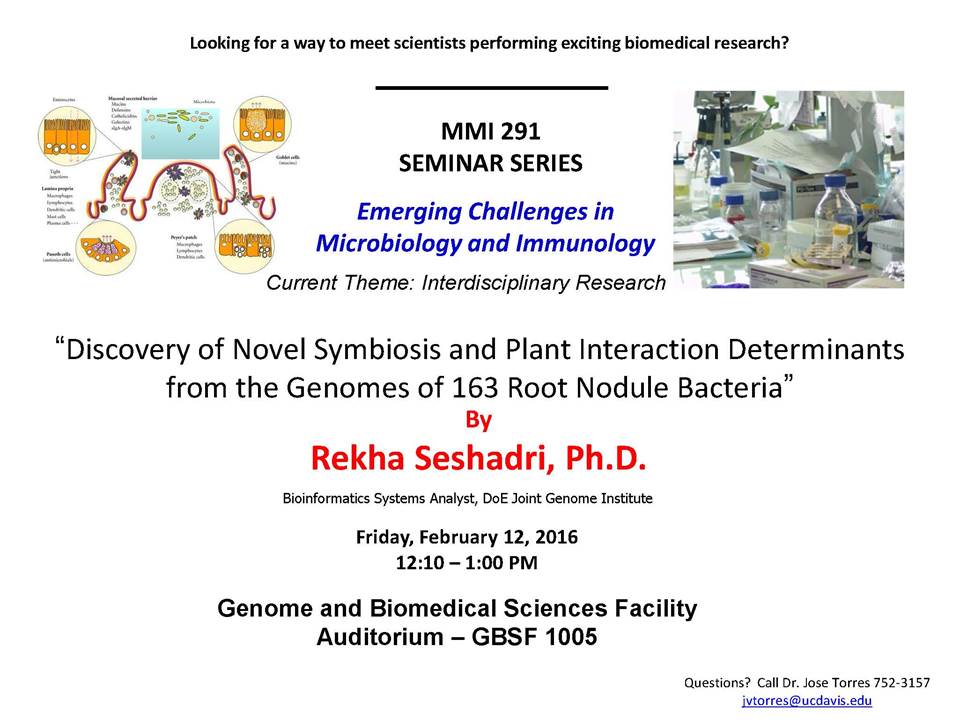
2/12 at #UCDavis: Rehka Seshadri on Discovery of Novel Symbiosis and Plant Interaction Determinants from the Gen omes of 163 Root Nodule Bacteria”

Seshadri.pdf

Caroline Dean Seminar at #UCDavis 2/4

Caroline Dean

John Innes Center, Norwich, U.K. “Epigenetic switching in seasonal timing”

2:10 – 3:00 PM, Thursday, February 4th

1005 Genome and Biological Sciences Facility

Genome Center seminar Caroline Dean.pdf

Women in Science Summit at the California Academy of Sciences #sciwomen16

Collecting together information about the Women in Science summit that was at the California Academy of Sciences 1/28/16.  I was on one of the panels and live Tweeted the event as did an amazing collection of other people.


Storifies of Tweets by Me

Some other information and write ups:

Alberto Roca Storifies

Provost’s Forums Steering Committee | Publicizing Chris Newfield – Monday, Feb. 8th

The Provost’s Forums on the Public University and the Social Good

Monday, February 8thChris Newfield.
Multipurpose Room
Student Community Center
3-5:30 p.m.

Chris Newfield- 2-8-16.pdf