
//storify.com/phylogenomics/tandy-warnow-at-ucdavis-on-gene-trees-vs-species-t/embed?template=slideshow//storify.com/phylogenomics/tandy-warnow-at-ucdavis-on-gene-trees-vs-species-t.js?template=slideshow[View the story “Tandy Warnow at #UCDavis on Gene Trees vs. Species Trees” on Storify]
Category: Misc.

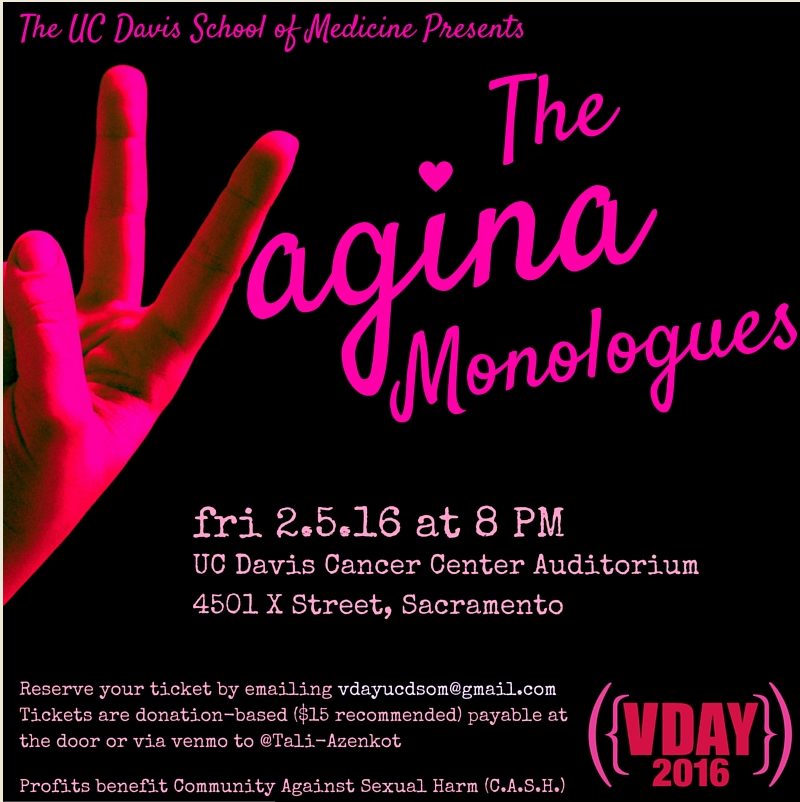
Vagina Monologues Event 2/5 @ #UCDavis Cancer Center Auditorium


Evolution 2016 and art
From Laura Vann via Evoldir
Attention artists! The deadline for submission of evolution-themed works
(or proposed-works) for the ‘Evolution 2016 Art Exhibit’ is quickly
approaching (Jan. 18).
The 2016 Evolution conference (the annual meeting of the Society for
the Study of Evolution, the Society of Systematic Biologists, and
the American Society of Naturalists) will be held from June 17-21 in
beautiful Austin, TX. In conjunction with the meeting, the societies
and a local art gallery (Art.Science.Gallery) are co-sponsoring an
evolution-themed art exhibit. The exhibit will provide an opportunity for
meeting attendees and others to showcase their creative talents, increase
the visibility of the meeting and the societies to the local community,
and provide opportunities for public education about evolutionary
biology through the exciting lens of visual arts. The exhibit will run
at the Art.Science.Gallery leading up to, and during, the conference,
and a selection of the works will be on display at the Austin Convention
Center as a pop-up exhibit during the evening of the opening reception
of the meeting.
Art.Science.Gallery has issued an open call seeking submissions for this
exhibition. Works may explore (but are not limited to) the sub-disciplines
within evolutionary biology, notable evolutionary biologists, current
research topics, important discoveries and concepts, and the history of
evolutionary thought. You need not be a member of any of the societies
to submit something for consideration.
Pass the word along and, if you’re at all artistically inclined, consider
submitting something. Additional details can be found on our permanent
meeting website (www.evolutionmeetings.org) under the ‘News’ heading, or
on Art.Science.Gallery’s website (http://artsciencegallery.com/opencall).
The open call closes on Jan. 18.
Sincerely,
Your Evolution2016 organizers
Share this:
Darwin Day in Sacramento 2/13
Just got this, from NCSE and others …
Dear Sacramento-area friends of NCSE,
I thought that you might like to know that Matthew J. James of Sonoma
State University will be speaking on "Collecting Evolution: The
1905-06 Galápagos Expedition that Vindicated Charles Darwin" at
Sacramento’s Darwin Day, taking place from 2:00 to 5:00 p.m. on
February 13 in the John Smith Hall in the La Sierra Community Center,
5325 Engle Road in Carmichael.
James "will entertain and inform us about the 1905-06 scientific
collecting expedition to the Galápagos Islands conducted by the
California Academy of Sciences. His presentation will include the
history of the expedition’s two-masted schooner Academy (ex-Earnest),
built in 1875 for the U.S. Coast Survey." There will also be
refreshments, entertainment, and displays.
Tickets are $10.00 in advance (before February 6, 2016), $15.00 at the
door; tickets for students with ID are $10.00. For further
information, visit:
http://sacdarwinday.info/
Share this:
Undergraduate Research Opportunity at #UCDavis in Marine Microbial Ecology
From Matthias Hess:
Would you mind to spread the word regarding an Undergraduate Research Opportunity in Marine Microbial Ecology? This is a joint project of Anne Todgham (also Animal Science) and myself that has the objective to enhance our understanding of understand the microbiome associated with marine fishes endemic to Antarctica. I think that this might be of particular interest to students interested in Evolution and Ecology. Candidates can apply at https://www.surveymonkey.com/r/JMBGLKN.
Thank you for helping to spread the word!!!
Matthias
Share this:
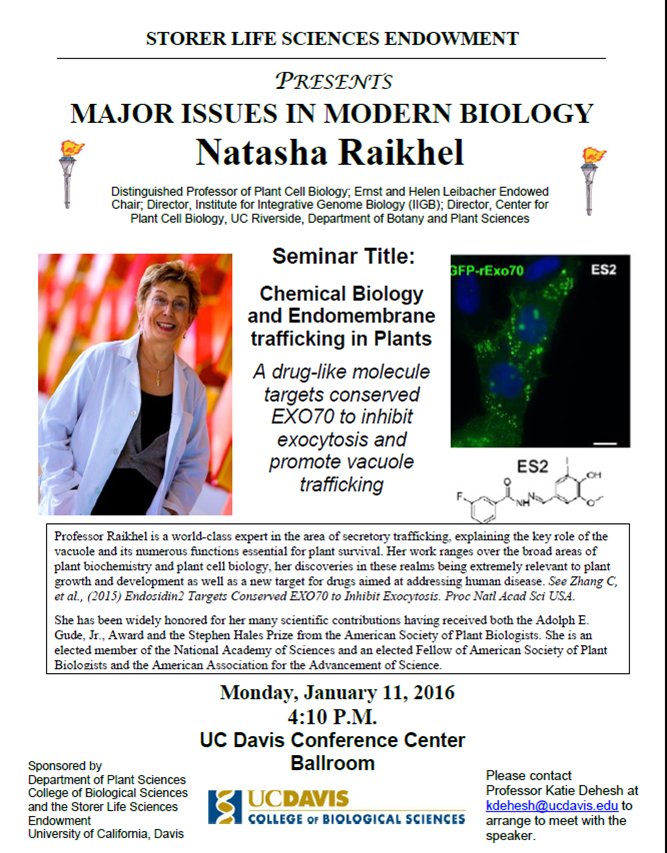
Today at #UCDavis: Dr. Natasha Raikhel: Chemical Biology and Endomembrane trafficking in Plants

1/15 at #UCDavis: Tandy Warnow: New methods for species tree estimation in the presence of gene tree heterogeneity
Special Seminar:
Tandy Warnow
The University of Illinois at Urbana-Champaign
New methods for species tree estimation in the
presence of gene tree heterogeneity
Friday, January 15, 2016
1:30 PM
GBSF 1005
Abstract.
Estimating the Tree of Life will likely involve a two-step procedure, where in the first step trees are estimated on many genes, and then the gene trees are combined into a tree on all the taxa. However, the true gene trees may not agree with the species tree due to biological processes such as deep coalescence, gene duplication and loss, and horizontal gene transfer. Statistically consistent methods based on the multi-species coalescent model have been developed to estimate species trees in the presence of incomplete lineage sorting; however, the relative accuracy of these methods compared to the usual “concatenation” approach is a matter of substantial debate within the research community.
I will present results showing that coalescent-based estimation methods are impacted by gene tree estimation error, so that they can be less accurate than concatenation in many cases. I will also present two new methods, ASTRAL (Mirarab et al., Bioinformatics 2014) and statistical binning (Mirarab et al., Science 2014, Bayzid et al., PLOS One 2015) for estimating species trees in the presence of gene tree conflict due to ILS. Statistical binning and weighted statistical binning are used to improve gene tree estimation, while ASTRAL is a coalescent-based method that is provably statistically consistent and that can construct very accurate large species trees. Finally, I will present theoretical results investigating whether statistically consistent accurate species tree estimation is possible when gene trees have estimation error, and discuss the controversy about statistical binning (Liu and Edwards, Science 2015, Mirarab et al. Science 2015).
See Dr. Warnow’s home page for more information on her work: http://tandy.cs.illinois.edu
Host: Jonathan Eisen
Share this:
Today’s Ecology and Evolution Seminar: Brian Gaylord
Forwarding this:
Dear Colleagues,
A friendly reminder that our first seminar speaker is our own Brian Gaylord from Bodega Marine Lab and the Department of Evolution and Ecology. This talk will be at 4:10pm today in Storer 1322 and is entitled "Marine ecomechanics: Exploring the biology of ocean acidification, intertidal thermal stress, and near shore turbulence." As the title suggests and as many of you know, Brian does really cool work at the interface of biomechanics and marine ecology. In addition to hearing his talk, you can learn more about his work by visiting his website
http://bml.ucdavis.edu/research/faculty/brian-gaylord/
Graduate students please sign up for the seminar as either ECL 296 (CRN 20461) or PBG 292 (CRN 34948). Undergraduates are also welcome to sign up. Please have interested ones contact me.
Share this:
Introducing The Hacker Within – Davis, First meetup is 1/14
From Jason Moore:
I’d like to invite you to the first meetup of the new Hacker Within Davis Chapter [1]. The monthly meetup’s purpose is to build community around scientific computing and data technologies. The meeting is structured as a tutorial or discussion, followed by lightning talks, and a collaborative programming session. It is modeled after the successful chapters at University of Wisconsin-Madison and UC Berkeley.
The first tutorial topic will be "Web Scraping" given by Duncan Temple Lang. See this page for more information on preparing for the tutorial and information about the speaker:
http://www.thehackerwithin.org/davis/posts/web-scraping/
It will be held in the Data Science Initiative Room in Shields Library (Room 360, Third Floor) on Thursday January 14th at 5:10pm.
During this first meeting we will also spend some time getting to know each other and planning the goals and future topics of the group.
Everyone with interest in the group and its future is welcome to attend.
If you’d like to give a lightning talk at the first meetup, let me know or submit a pull request to the website repository [2].
Spread widely!
Jason K. Moore, PhD
Lecturer, Mechanical and Aerospace Engineering Department
University of California, Davis
faculty.engineering.ucdavis.edu/moore
jkm
[1] http://www.thehackerwithin.org/davis/
[2] https://github.com/thehackerwithin/davis
Share this:
“GAMING METRICS: INNOVATION & SURVEILLANCE IN ACADEMIC MISCONDUCT” — UC Davis, February 4-5, 2016
We are pleased to invite you to a conference on:
GAMING METRICS: INNOVATION & SURVEILLANCE IN ACADEMIC MISCONDUCT
UC Davis, February 4-5, 2016
Organized by the Innovating Communication in Scholarship Project (ICIS) with support from the Center for Science and Innovation Studies (CSIS)
DESCRIPTION:
Misconduct has traditionally been tied to the pressures of "publish or perish" and, more recently, to the new opportunities offered by electronic publishing. The conference takes the next step to asks whether the modalities of misconduct are now evolving to adapt themselves to modern metrics-based regimes of academic evaluation. Have we moved from "publish or perish" to "impact or perish"? If so, are metrics of evaluation now creating new incentives for misconduct? And can we still reliably draw a clear separation between gaming the metrics game and engaging in misconduct? Traditional discourses and policies of misconduct were rooted in oppositions between truth and falsehood, right and wrong, honest mistake and fabrication, but new metrics-based misconduct seems to be defined by the extent of the gaming involved. In sum, are new metrics-based forms of misconduct asking us to rethink and redefine misconduct?
PROGRAM:
* DAY 1 (MU II Room, Memorial Union)
9:00-9:15 Welcoming Remarks (Ralph Hexter, Provost, UC Davis)
9:15-9:30 “FROM PUBLISH OR PERISH TO IMPACT OR PERISH”
A brief discussion of the conference themes and working hypothesis concerning the relation between academic metrics and misconduct. Current scenarios exemplify a vast increase of kinds of misconduct compared to traditional definitions (fabrication, falsification, plagiarism), but also point to a shift in the very goals of misconduct. Initially driven by “publish or perish,” misconduct has become geared toward maximizing more complex metrics of academic credit encapsulated in a new imperative: “have impact or perish.”
Mario Biagioli (UC Davis, Science and Technology Studies, Law, & History)
9:30-10:30 “GAMING THE GAME ACROSS THE BOARD”
This session introduces and contextualizes the conference’s subsequent discussions by casting a wider net on metrics-gaming well beyond the specific field academic publishing, looking at how different communities and professions construe the line between acceptable and unacceptable gaming. Mapping a wide range of gaming scenarios will then allow us to contextualize the specific forms of academic misconduct involving metrics gaming concerning academic credit.
Timothy Lenoir (UC Davis, Cinema and Digital Media & Science and Technology Studies) (Chair)
Sally Engle Merry (NYU, Anthropology)
Alex Csiszar (Harvard University, History of Science)
Paul Wouters (Leiden University, Science and Technology Studies)
Karen Levy (NYU, Media, Culture, and Communication)
11:00-12:00 “UNIVERSITY RANKINGS: GAMING OR COOKING?”
As university rankings are gaining increasing importance across the globe, they have been praised as agents of democratization against traditional academic “brands” living off reputational rent, but also criticized for the substantial ranking distortions that their easy gaming allows for. When can these practices be treated as ranking gaming, and when do they cross over into institutional misconduct?
Martin Kenney (UC Davis, Human Ecology) (Chair)
Barbara Kehm (University of Glasgow, School of Education)
Lior Pachter (UC Berkeley, Mathematics)
1:30-3:00 “PERSONAL V. INDUSTRIAL CHEATING”
One conspicuous difference from the days of “traditional” misconduct is the shift between misconduct as the work of individual scientists and scholars to scenarios in which misconduct is a more “collaborative” endeavor, as in the case of citation rings among journals to maximize their impact factors. (The production of fake alternative impact factors may be another example). In addition to these novel conspiracies (which typically involve editors and publishers rather than traditional individual cheats like scientists and scholars), modern misconduct also involves businesses and organizations providing tools, platforms, and opportunities to academics interested in misconducting themselves. These include so-called “predatory” journals, fake conferences, fake prizes, etc., that is, tools that enable and entice academics to meet the demands of their institutions’ evaluation metrics by gaming/cheating them. Also, while these activities concern publications, they are not limited to the production of a fraudulent text (as “traditional” misconduct typically was), but aim at facilitating its publication. They may be perhaps termed “postproduction” misconduct.
MacKenzie Smith (UC Davis, University Librarian) (Chair)
Finn Brunton (NYU, Media, Culture, and Communication)
Sarah de Rijcke (Leiden University, Science and Technology Studies)
Jeffrey Beall (University of Colorado, Denver, Information Science)
Dan Morgan (University of California Press, Collabra Project)
3:15-5:00 “META GAMING, META CHEATING”
This session has a double goal. First, to analyze the kind of gaming that involve not the manipulation of a metric but the construction or adoption of a metrics – not gaming an established game, but the gaming that goes into defining the game itself. Is the competitive market of academic metrics (from faculty performance to university rankings) a form of gaming the game itself? And where/when/how can it become misconduct? Second, this session aims at engaging with Goodhart’s law, which is taken to show not only that the introduction of any kind of metric creates a market for gaming it, but that by so doing it invalidates the significance of that metrics. If so, one could argue that any metrics will create the possibility of misconduct, but that the articulation of forms of misconduct specific to that metric will eventually “crowd” that market, thus creating an incentive to change the metrics, which in turn will usher in the next generation of innovative misconduct. Or can we argue, against Goodhart, that it is possible to find a metrics of academic evaluation that can break the nexus with gaming/misconduct?
Anupam Chander (UC Davis, Law) (Chair)
Johan Bollen (Indiana University, Informatics and Computing)
Carl T. Bergstrom (University of Washington, Biology)
Jennifer Lin (Crossref)
Michael Power (London School of Economics, Accounting)
James Griesemer (UC Davis, Philosophy)
* DAY 2 (Kalmanovitz Appellate Courtroom, King Hall)
9:15-9:30 Welcoming Remarks (Kevin Johnson, Dean, UC Davis School of Law)
9:30-10:30 “MISCONDUCT WATCHDOGS (I)”
The emergence and pervasiveness of new forms of misconduct exceed the reach, resources, and conceptual framework of traditional governmental watchdog organizations typically connected to funding agencies like, in the US, the ORI. This has spawned a new generation and new figures of misconduct surveillance, detection, and prosecution. Among these is a new breed of “watchdogs” — new actors who are often institutionally unaffiliated. These “watchdogs” have assumed an important role and a credible voice, often by creating new “ecologies of support” for themselves — websites, blogs, wikis, social media, etc. Does their somewhat unique role indicate something about the specific nature of modern academic misconduct? Does it suggest that the “battlefield” of misconduct is moving away from governmental agencies (acting according to traditional and possibly outdated definitions of misconduct) and toward journals and the watchdogs who monitor their publications?
Jonathan Eisen (UC Davis, Genome Center) (Chair)
Ivan Oransky (Retraction Watch & NYU)
John Bohannon (Science Magazine)
Elizabeth Wager (Sideview)
10:45-12:00 “MISCONDUCT WATCHDOGS (II)”
Jonathan Eisen (UC Davis, Genome Center) (Chair)
Darren Taichman (Editor, Annals of Internal Medicine)
Debora Weber-Wulff (University of Applied Sciences Berlin, HTW, Media and Computing)
Brandon Stell (The PubPeer Foundation & CNRS)
1:30-2:30 “COUNTERFEITING BRANDS V. FAKING PRODUCTS”
This session looks at a specific form of fakery rooted in “brand appropriation.” While the preceding session considers generally fake journals, conferences, etc., here we want to look more specifically at imaginary journals whose titles (as well as the look and feel of their websites) are made to resemble those of well-known and respectable journals. One could perhaps add to this list certain “academic” conferences that take place in prestigious locations (say, Oxford) but are not actually affiliated with the university, or the appropriation of the names of respected academics that are then listed (without authorization) on editorial boards of fake journals or organizing committees of fake conferences. Similarly, fake universities who sell degrees without any attempt at educating their students (not even online) tend to assume names with an Ivy League ring to them. The common denominator here is an attempt at the mimicry of a “brand” rather than just the copying/pirating of a product.
Madhavi Sunder (UC Davis, Law) (Chair)
Marie-Andree Jacob (Keele University, Law)
Alessandro Delfanti (University of Toronto, Communication, Culture, Information and Technology)
Sergio Sismondo (Queen’s University, Philosophy)
2:30-3:30 CARNIVALESQUE RESPONSES
While the misconduct “watchdogs” (discussed in a previous session) expose through public communication and denunciation, this session focuses on other actors who reveal misconduct and poor oversight through a carnivalesque approach. Humor and absurdity– submitting profane papers and computer-generated gibberish articles that “sound” academic, or whistleblowers using clever anagrams as aliases — become a mode of critique and unmasking. Neither clearly “predatory” journals, “fake” conferences nor “legitimate” journals are immune to being the subject of a joke — a joke that, in some cases, may be more powerful than punishment. In a way, carnivalesque responses to misconduct continue the logic of an older history of art forgery-as-prank in which the forgery reveals through a kind of satire. Are these cases telling us, perhaps, that satire is the best approach to both metrics and the gaming they elicit?
Alexandra Lippman (UC Davis, Innovating Communication in Scholarship Project) (Chair)
Cyril Labbé (Joseph Fourier University – Grenoble I)
Burkhard Morgenstern (Universität Göttingen, Bioinformatics)
Paul Brookes (University of Rochester, Medicine)
Co-organizers: Mario Biagioli and Alexandra Lippman
REGISTRATION:
The conference is open to the public. Please register here. Although attendance will be on first-come first-serve basis, we will reserve seats for out-of-town participants.
LOCATION:
The conference will be held at two different locations on the UC Davis campus. On Thursday, February 4 we will convene at the MUII Hall at the Memorial Union (map here). On Friday, February 5 our proceedings will take place in the Kalmanovitz Appellate Courtroom at King Hall (UC Davis Law School) (located here).
CAMPUS MAP: Can be found at http://campusmap.ucdavis.edu/
ADDITIONAL INFORMATION: Please see our alippman)
 Jonathan Eisen's Lab