PhD Opportunity in Birmingham, UK on the ‘Omics of oil spills w/ @hollybik

Just got this by email from Holly Bik who was a PostDoc in my lab until a few months ago ..
Dear Colleagues,

I wanted to bring to your attention a PhD opportunity in my group at the University of Birmingham, UK – apologies for any cross-posting:

Using ‘omic methods to determine how sediment communities of microbial eukaryotes respond to oil spills and environmental disturbancehttp://www.findaphd.com/search/ProjectDetails.aspx?PJID=59530&LID=124

The focus of the project would span both shallow-water and deep-sea sediments, including natural hydrocarbon seeps and locations impacted by the 2010 Deepwater Horizon oil spill. The project would be ideal for candidates looking to develop skills in bioinformatics and computational biology.

This studentship is available to UK and EU candidates that meet NERC’s requirements for both academic qualifications and residential eligibility (http://www.nerc.ac.uk/funding/application/studentships).

Regards,

Holly

Faculty position – Integrative Genetics – University of Akron

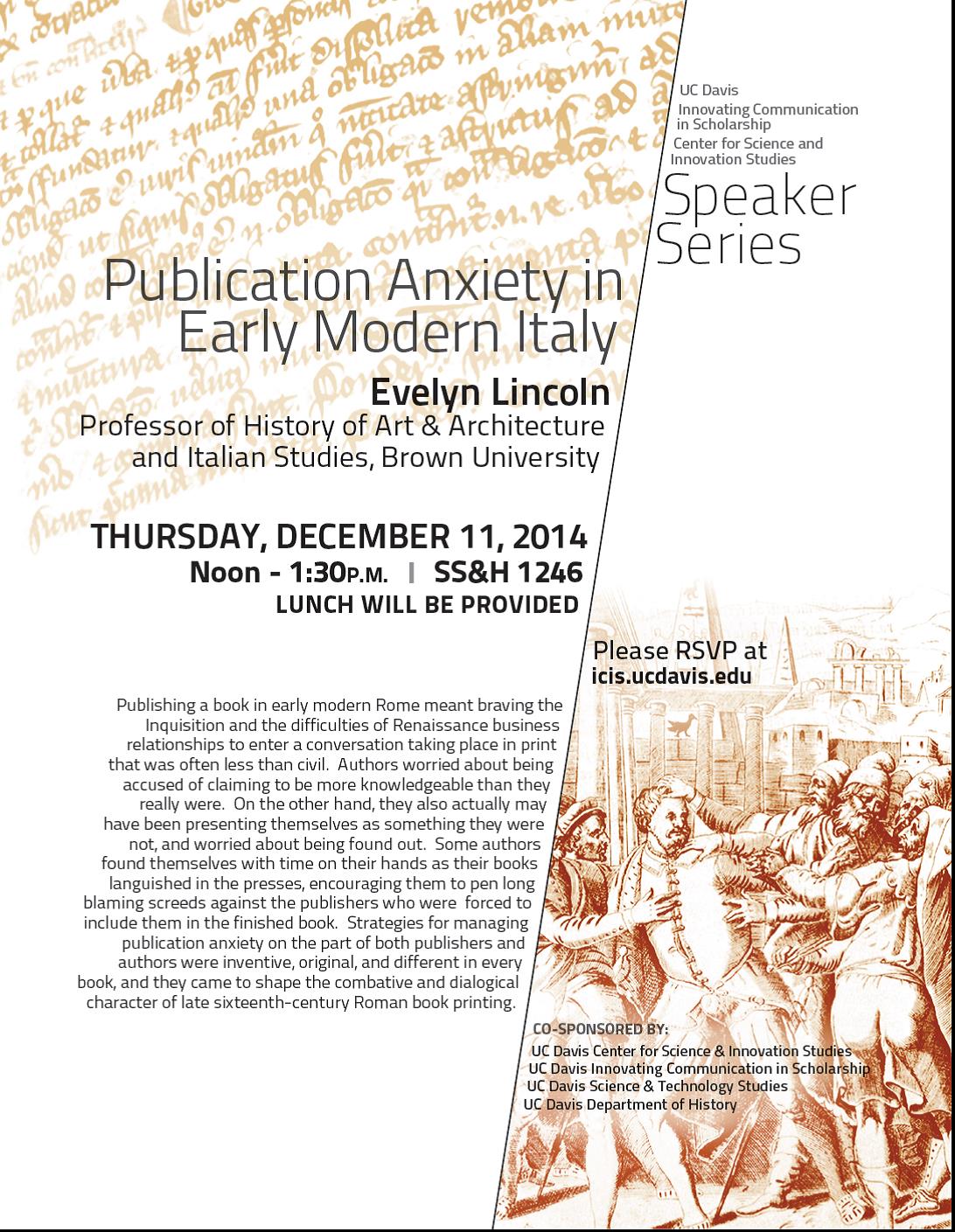
Talk at #UCDavis 12/11 by Evelyn Lincoln “Publication Anxiety in Early Modern Italy”

Please join Innovating Communication and Scholarship (ICIS), the Center for Science and Innovation Studies (CSIS), and Science and Technology Studies for a lunchtime event with Evelyn Lincoln on:

Publication Anxiety in Early Modern Italy

When: Thursday December 11th from 12:10 – 1:30 PM

Where: Room SS&H 1246 (STS /CSIS Room)

Discussant: Alessandro Delfanti

Lunch provided. Please RSVP if you plan to attend.

Abstract: Publishing a book in

early modern Rome meant braving the Inquisition and the difficulties of

Renaissance business relationships to enter a conversation taking place

in print that was often less than civil.

Authors worried about being accused of claiming to be more

knowledgeable than they really were. On the other hand, they also

actually may have been presenting themselves as something they were not,

and worried about being found out. Some authors found themselves

with time on their hands as their books languished in the presses,

encouraging them to pen long blaming screeds against the publishers who

were forced to include them in the finished book. Strategies for

managing publication anxiety on the part of both publishers

and authors were inventive, original, and different in every book, and

they came to shape the combative and dialogical character of late

sixteenth-century Roman book printing.

Evelyn Lincoln is Professor of the History of Art & Architecture and Italian Studies at Brown University. Her first book,

the Invention of the Italian Renaissance Printmaker (Yale, 2000) traced the careers of pictorial printmakers in Italy in the first century of its development. Brilliant Discourse. Pictures and Readers in Early Modern Rome (Yale, 2014) looks at the role played by the publication of

illustrated technical manuals in forming networks of printers,

publishers, artists and patrons, all of whom were also readers. Her

research investigates knowledge networks formed through making

and using pictures in the early modern world.

After you RSVP, you will be emailed with the paper to be discussed.

Talk at #UCDavis 12/2: Parasite manipulation of host phenotype: mechanisms, behavior, ecology, and evolution

Kelly Weinersmith

Exit seminar Tuesday (Dec 2nd) at 9AM in 2120J Wickson Hall.

"Parasite manipulation of host phenotype: mechanisms, behavior, ecology, and evolution."

Exit Seminar Flyer Weinersmith.pdf

At #UCDavis 1/22 Dr. Debra G.B. Leonard on “”Leaning In and Moving Up”

UC Davis Women in Medicine and Health Sciences

WIMHS, in Partnership with the Department of Pathology and Laboratory Medicine

PRESENTS:
Debra G.B. Leonard, MD, PhD Professor and Chair

“Leaning In and Moving Up”

January 22, 2015

12:00 pm – 1:00 pm

(Broadway Café box-lunch provided)

FSSB Building, Room 2030 4800 2nd Avenue, Sacramento

Register Online:

https://somapp.ucdmc.ucdavis.edu/academicaffairs /courses/secure/Courses.cfm?Status=10

Dr. Debra G.B. Leonard served as Chief Diversity Officer at Weill-Cornell Medical School. Dr. Leonard will discuss her experience with best practices and challenges in diversifying faculty from her perspective while at WCU.

Debra G. B. Leonard, MD, PhD Professor and Chair Department of Pathology and Laboratory Medicine University of Vermont Medical Center

WIMHS: http://www.ucdmc.ucdavis.edu/wimhs/index.html WIMHSFacebook: http://www.facebook.com/pages/UC- Davis-Women–in-Medicine-and_Science/218743748158322

Jan_2015_WIMHS_Leonard_Lecture_Flyer.pdf

Gordon & Betty Moore Foundation hiring a Program Officer for the Marine Microbiology Initative

The Gordon and Betty Moore Foundation is hiring a Program Officer for their Marine Microbiology Initative (see attachment). I love the Marine Microbiology Initiative and this could be a very interesting job. See http://www.moore.org/about/careers for more info.

MMI Program Officer job description.pdf

Whole issues of Genome Biology/Genome Medicine on "Genomics of Infectious Disease"

Wow this has really got some nice papers: BioMed Central | Article collections | Genomics of infectious diseases special issue.  I note – this goes well as a follow up to the series I co-coordinated in PLOS a few years back: Genomics of Emerging Infectious Disease – PLOS Collections

From their site:

Infectious diseases are major contributors to global morbidity and mortality, and have a devastating impact on public health. The World Health Organization estimates that 1 in 3 deaths worldwide are due to an infectious disease, with a disproportionate number occurring in developing regions. 

While the completion of the first genome sequence of a pathogen, Haemophilus influenzae, in 1995 took decades of work, in recent years, high-throughput technologies have revolutionized the study of pathogens. Whole-genome sequences are now achievable within days and available for multiple pathogens, including those that cause neglected tropical diseases, which has advanced our understanding of the biology and evolution of pathogens. Crucially, such research has enabled important advances in the clinical management of infectious diseases, and continues to guide public health interventions worldwide. 

In this cross-journal special issue, guest edited by George Weinstock (The Jackson Laboratory for Genomic Medicine, USA) and Sharon Peacock (University of Cambridge, UK), Genome Biology and Genome Medicine take stock of where we are now, with a collection of primary research and commissioned articles that discuss different aspects of the genomics of infectious diseases in human populations, including the progress made towards their eradication, and the remaining challenges in terms of both fundamental science and clinical management.

I have copied the list from their site (I am pretty sure this is OK since these are #OpenAccess journals but not 100% sure):


Editorial   Open Access
Ripudaman K Bains Genome Biology 2014, 15:529 (22 November 2014)
Review   Subscription
Lucy M Li, Nicholas C Grassly, Christophe Fraser Genome Biology 2014, 15:541 (22 November 2014)
Research   Open Access
Hayley M Bennett, Hoi Ping Mok, Effrossyni Gkrania-Klotsas, Eleanor J Stanley,
Isheng J Tsai, Nagui M Antoun, Avril Coghlan, Bhavana Harsha, Alessandra Traini, 
Diogo M Ribeiro, Sascha Steinbass, Sebastian B Lucas, Kieren S.J Allinson, 
Stephen J Price, Thomas S Santarius, Andrew J Carmichael, Peter L Chiodini, 
Nancy Holroyd, Andrew F Dean, Matthew Berriman 
Genome Biology 2014, 15:510 (21 November 2014)
Research highlight   Subscription
Patrick Tang, Jennifer L Gardy Genome Medicine 2014, 6:104 (20 November 2014)
Software   Open Access
Darren Abbey, Jason Funt, Mor N Lurie-Weinberger, Dawn A Thompson, Aviv Regev,
Chad L Myers,
Judith Berman Genome Medicine 2014, 6:100 (20 November 2014)
Comment   Subscription
Jeffrey S McLean, Roger S Lasken Genome Medicine 2014, 6:108 (20 November 2014)
Software   Open Access
Michael Inouye, Harriet Dashnow, Lesley-Ann Raven, Mark B Schultz, Bernard J Pope,
Takehiro Tomita, Justin Zobel, Kathryn E Holt 
Genome Medicine 2014, 6:90 (20 November 2014)
Research   Open Access
Mihail R Halachev, Jacqueline Chan, Chrystala I Constantinidou, Nicola Cumley,
Craig Bradley, Matthew Smith-Banks, Beryl Oppenheim, Mark J Pallen 
Genome Medicine 2014, 6:70 (20 November 2014)
Editorial   Open Access
George M Weinstock, Sharon J Peacock Genome Biology 2014, 15:528 (19 November 2014)
Software   Open Access
Todd J Treangen, Brian D Ondov, Sergey Koren, Adam M Phillippy Genome Biology 2014, 15:524 (19 November 2014)
Method   Open Access
Lewis Z Hong, Shuzhen Hong, Han Teng Wong, Pauline PK Aw, Cheng Yan, Andreas Wilm,
Paola F de Sessions, Seng Gee Lim, Niranjan Nagarajan, Martin L Hibberd, Stephen R Quake,
William F Burkholder Genome Biology 2014, 15:517 (19 November 2014)
Editorial   Open Access
Sharon J Peacock, George M Weinstock Genome Medicine 2014, 6:103 (19 November 2014)
Opinion   Free
Gail Geller, Rachel Dvoskin, Chloe L Thio, Priya Duggal, Michelle H Lewis, Theodore C Bailey,
Andrea Sutherland, Daniel A Salmon, Jeffrey P Kahn Genome Medicine 2014, 6:106 (18 November 2014)
Review   Subscription
Yonatan H Grad, Marc Lipsitch Genome Biology 2014, 15:538 (18 November 2014)
Method   Open Access
Christian B Matranga, Kristian G Andersen, Sarah Winnicki, Michele Busby,
Adrianne D Gladden, Ryan Tewhey, Matthew Stremlau, Aaron Berlin, Stephen K Gire, 
Eleina England, Lina M Moses, Tarjei S Mikkelsen, Ikponmwosa Odia, Philomena E Ehiane, 
Onikepe Folarin, Augustine Goba, S.Humarr Khan, Donald S Grant, Anna Honko, 
Lisa Hensley, Christian Happi, Robert F Garry, Christine M Malboeuf, Bruce W Birren, 
Andreas Gnirke, Joshua Z Levin, Pardis C Sabeti

Genome Biology 2014, 15:519 (18 November 2014)

Research   Open Access
Yanjiao Zhou, Martin J Holland, Pateh Makalo, Hassan Joof, Chrissy h Roberts,
David Maybe, Robin L Bailey, Matthew J Burton, George M Weinstock, Sarah E Burr 
Genome Medicine 2014, 6:99 (15 November 2014)
Research   Open Access
James W Wynne, Brian J Shiell, Glenn A Marsh, Victoria Boyd, Jennifer A Harper,
Kate Heesom, Paul Monaghan, Peng Zhou, Jean Payne, Reuben Klein, Shawn Todd, 
Lawrence Mok, Diane Green, John Bingham, Mary Tachedjian, Michelle L Baker, 
David Matthews, Lin-Fa Wang 
Genome Biology 2014, 15:532 (15 November 2014)
Method   Open Access
Maha R Farhat, B Shapiro, Samuel K Sheppard, Caroline Colijn, Megan Murray Genome Medicine 2014, 6:101 (15 November 2014)
Review   Subscription
Paolo Gabrieli, Andrea Smidler, Flaminia Catteruccia Genome Biology 2014, 15:535 (15 November 2014)
Research   Open Access
Jonathan D Herman, Daniel P Rice, Ulf Ribacke, Jacob Silterra, Amy A Deik, Eli Moss,
Kate M Broadbent, Daniel E Neafsey, Michael M Desai, Clary B Clish, Ralph Mazitschek,
Dyann F Wirth Genome Biology 2014, 15:511 (14 November 2014)
Research highlight   Subscription
Anastasia Koch, Robert Wilkinson Genome Biology 2014, 15:520 (13 November 2014)
Research highlight   Subscription
Chase L Beisel, Ahmed A Gomaa, Rodolphe Barrangou Genome Biology 2014, 15:516 (8 November 2014)
Research   Open Access Highly Accessed
Vegard Eldholm, Gunnstein Norheim, Bent von der Lippe, Wibeke Kinander,
Ulf R Dahle, Dominique A Caugant, Turid Mannsåker, Anne Mengshoel, 
Anne Dyrhol-Riise, Francois Balloux 
Genome Biology 2014, 15:490 (7 November 2014)
Opinion   Open Access
Digby F Warner, Valerie Mizrahi Genome Biology 2014, 15:514 (7 November 2014)
Comment   Open Access Highly Accessed
Onikepe A Folarin, Anise N Happi, Christian T Happi Genome Biology 2014, 15:515 (7 November 2014)
Research highlight   Subscription
Eric J Vallender Genome Biology 2014, 15:507 (7 November 2014)
Research   Open Access
Adam J Ericsen, Gabriel J Starrett, Justin M Greene, Michael Lauck, Muthuswamy Raveendran,
 David Deiros, Mariel S Mohns, Nicolas Vince, Brian T Cain, Ngoc H Pham, Jason T Weinfurter,
Adam L Bailey, Melisa L Budde, Roger W Wiseman, Richard Gibbs, Donna Muzny, T
homas C Friedrich, Jeffrey Rogers, David H O’Connor Genome Biology 2014, 15:478 (7 November 2014)
Research   Open Access
Laura Gomez Valero, Christophe Rusniok, Monica Rolando, Mario Neou,
Delphine Dervins-Ravault, Jasmin Demirtas, Zoe Rouy, Robert J Moore, Honglei Chen, 
Nicola K Petty, Sophie Jarraud, Jerome Etienne, Michael Steinert, Klaus Heuner, 
Simonetta Gribaldo, Claudine Médigue, Gernot Glöckner, Elizabeth L Hartland, 
Carmen Buchrieser 
Genome Biology 2014, 15:505 (3 November 2014)
Research   Open Access
Frank Hanses, Christelle Roux, Paul M Dunman, Bernd Salzberger, Jean C Lee Genome Medicine 2014, 6:93 (3 November 2014)
Research   Open Access Highly Accessed
Paul McAdam, Charles vander broek, Diane Lindsay, Melissa Ward, Mary Hanson,
Michael Gillies, Mike Watson, Joanne Stevens, Giles Edwards, Ross Fitzgerald 
Genome Biology 2014, 15:504 (3 November 2014)
Research   Open Access Highly Accessed
Tige R Rustad, Kyle J Minch, Shuyi Ma, Jessica K Winkler, Samuel Hobbes, Mark J Hickey,
William Brabant, Serdar Turkarslan, Nathan D Price, Nitin S Baliga, David R Sherman Genome Biology 2014, 15:502 (3 November 2014)

Strangest microbial headline of month: Bacteria on Russian ‘sex satellite’ survive reentry

There is really not much to say other than to point everyone to this article: Bacteria on Russian ‘sex satellite’ survive reentry | Science | The Guardian

It defininely wins the strangest microbial headline of the month.  The article restates some of the silly claims about how what they are finding supports panspermia .. but ignore the article and just enjoy the headline.

Post-doc w/ me, Jessica Green, Jay Stachowicz, and Jenna Lang on seagrass microbiomes

Postdoctoral Position in Microbial Ecology and Evolution

Jessica Green at the University of Oregon Green (http://pages.uoregon.edu/green/) is currently seeking a postdoctoral researcher to explore fundamental questions in microbial ecology and evolution. Applicants should have a PhD in a biological, computational, mathematical, or statistical field with extensive training using theory and/or modeling to understand the ecology and evolution of complex biological communities, and strong writing skills. Experience developing and applying quantitative phylogenetic ecological methods is highly desirable, but not explicitly required for candidates who have otherwise demonstrated strong quantitative skills.

The successful candidate will play a key role in the Seagrass Microbiome Project (http://seagrassmicrobiome.org) in collaboration among Jonathan Eisen https://phylogenomics.wordpress.com), Jay Stachowicz http://www-eve.ucdavis.edu/stachowicz/stachowicz.shtml, and Jenna Lang (http://jennomics.com/) at the University of California, Davis. The Seagrass Microbiome Project aims to integrate the long interest in seagrass ecology and ecosystem science with more recent work on microbiomes to produce a deeper, more mechanistic understanding of the ecology and evolution of seagrasses and the ecosystems on which they depend. Our studies of the community of microorganisms that live in and on seagrasses – the seagrass “microbiome” – will contribute to a broader understanding of host-microbe systems biology, and will benefit from ongoing University of Oregon research programs including the Microbial Ecology and Theory of Animals Center for Systems Biology (http://meta.uoregon.edu/) and the Biology and Built Environment Center (http://biobe.uoregon.edu/).

The position is available for 1 year with the possibility for renewal depending on performance. The start date is flexible. Please email questions regarding the position to Jessica Green (jlgreen).

To apply

A complete application will consist of the following materials:

(1) a brief cover letter explaining your background and career interests

(2) CV (including publications)

(3) names and contact information for three references

Submit materials to ie2jobs. Subject: Posting 14431

To ensure consideration, please submit applications by November 1, 2014, but the position will remain open until filled.

Women and minorities encouraged to apply. We invite applications from qualified candidates who share our commitment to diversity.

The University of Oregon is an equal opportunity, affirmative action institution committed to cultural diversity and compliance with the ADA. The University encourages all qualified individuals to apply, and does not discriminate on the basis of any protected status, including veteran and disability status.

Postdoc on HGT & genome evolution – Jeff Palmer & Claude dePamphilis

POSTDOC ON HORIZONTAL GENE TRANSFER AND GENOME EVOLUTION

An NSF-funded

postdoctoral position is available to work on a collaborative project between the labs of Dr. Jeff Palmer (Department of Biology, Indiana University, Bloomington) and Dr. Claude dePamphilis (Department of Biology, Penn State University, University Park). This project is a follow-up to papers on the mitochondrial and nuclear genomes of the basal angiosperm Amborella that were led by our labs and published in the Dec. 20, 2013 issue of Science. The project focuses on evolutionary gene transfer, including transfer of mitochondrial and plastid sequences to the nucleus of Amborella, and the extensive horizontal transfer of foreign mitochondrial sequences to the mitochondrion of Amborella.

This

is a strictly bioinformatic/comparative genomic project involving extensive analysis of genome-scale sequence data. A Ph.D. in computational biology, evolutionary genetics, or a related field is required, and proficiency in computer programming is expected. Competitive candidates will have a strong record of prior publication in genome-scale data analysis, including bioinformatic pipeline construction, phylogenomics, and/or genome evolution. This position is funded for two years, with continued appointment dependent upon availability of funding. Salary will be commensurate with experience, and full benefits are included.

To apply,

please submit, as a single unified PDF, a cover letter detailing research interests and experience, a C.V., and contact information for three professional references to jpalmer) or Claude dePamphilis (cwd3).

Indiana University

is an equal employment and affirmative action employer and a provider of ADA services. All

qualified applicants will receive consideration for employment without regard to age, ethnicity, color, race, religion, sex, sexual orientation or identity, national origin, disability status, or protected veteran status.

Postdoc on HGT & genome evolution in plants – Jeff Palmer & Claude dePamphilis.docx