Story behind the paper: Bonnie Baxter on "A tale of salt and gender" #STEMWomen #Halophiles

After posting A tale of salt and gender: participation of women in halophile research I sent the post to Bonnie Baxter, one of the authors of the article I discussed and I asked if she would be interested in writing a guest post about the “Story Behind the Paper” (for which I have a whole series).  I am so so pleased that she said yes.  I have followed Bonnie’s work for many years but this is her first guest post here.  I hope there will be more.  She is a wonderful and brilliant scientist and educator.


Guest Post by Bonnie Baxter
Salty Sisters: The Women of Halophiles

Bonnie Baxter and Nina Gunde-Cimerman at the north arm of Great Salt Lake (2008)
I was drawn to the western US, the extreme landscapes, and ended up at the only liberal arts college in Utah. I had wanted a career doing science with undergraduates, and I set about exploring the microbiota of Great Salt Lake. Since few had studied this incredible spot, I quickly became the go-to person for studies on the lake, and these collaborations and grant projects eventually evolved into an organization I direct called Great Salt Lake Institute. We are dedicated to research, scholarship and education efforts on Great Salt Lake.
There had been no microbiology done on Great Salt Lake since 1979. This is why there was much excitement concerning our emerging data, and in 2004, I was invited to speak at the triennial International Halophiles conference in Slovenia. Halophiles are microbes that thrive at high-salt, and the people who study them maintain an interesting balance of field-work and lab work. I had been to large meeting on DNA repair, DNA replication, nucleases and the like, but I had never met a group who were centered on a theme that connected them around the planet. 
From my first Halophiles meeting (I’ve since attended 2007 in Colchester UK, 2010 in Beijing and 2013 at University of Connecticut), I felt an unusual level of support from the elders of this group. And I noticed that, unlike the NASA meetings or biochemistry meetings I attended, there seemed to be a nice balance of men and women. There were a group of folks who had participated for a long time, without a membership organization, and these people maintained the notion of mentoring in the field. It is this spirit that drew all of us younger folk to participate. 
At each of the International Halophiles conferences, there is typically a history talk that brings forth work from past scientists from the field. After an evening in Beijing, I lamented to Aharon Oren, who studies microorganisms of the Dead Sea, that I found his history talk very engaging, but he seemed to overlook the contributions of women. So he challenged me to give the next history talk in Connecticut. By the next morning, at our shared 6 am breakfast, Aaron gave me a list of 20 or so women he thought has contributed great things to the halophile field. I had been given a challenge, and I accepted. I invited an accomplice to the project, Nina Gunde-Cimerman, from University of Ljubljana, Slovenia, and we began our research.
Bonnie Baxter says “My daughter thought it was more appropriate if we dressed this way for the talk.  But this is not the way female scientists do their work…”
Given my connection to Great Salt Lake, I’ve been asked to give an unusual number of keynote addresses and special talks (for a professor at a liberal arts college). I have often been the only female speaker at a meeting, or the only woman on a national committee. Since graduate school, I have held an interest in exploring why there are underrepresented groups in science. Why is retention in STEM fields different for men and women? Why are women underrepresented as physics or mathematics professors in the US, but hardly at all in Russia or Italy? This is what drove me to undergraduate science, fixing these problems and better understanding them. 
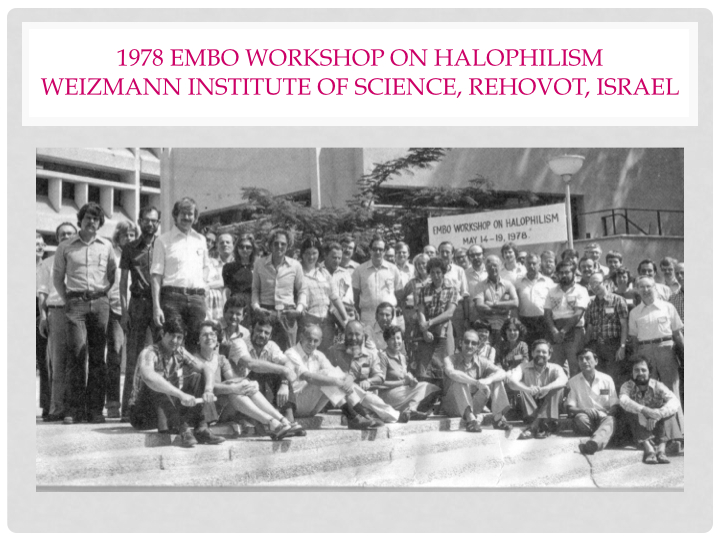
In the summer of 2013, Nina and I gave the opening talk at the International Halophiles conference at UConn, entitled “Salty Sisters: The Women of Halophiles.” The talk included our analysis of the participation of women in these conferences since 1978. 
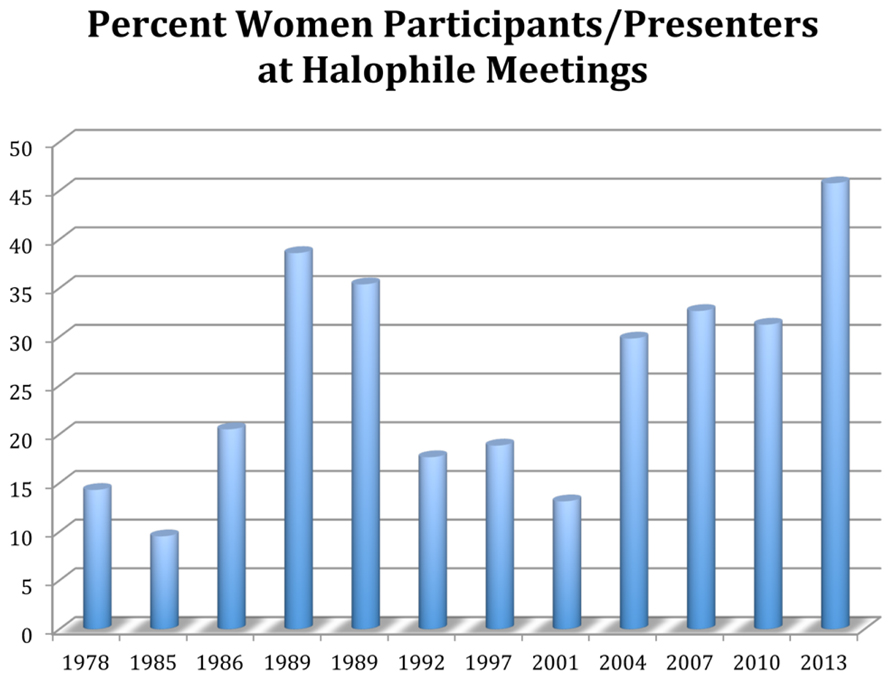
After reading many studies of women underrepresented as speakers, we were shocked that our numbers were very different. It appeared that the halophile organizers had done an excellent job of gender inclusion, relatively speaking. Following the talk, and for weeks afterward, many scientists (male and female) approached us, telling us their experiences as women in the field or discussing how important this topic was.
Nina Nina Gunde-Cimerman and Bonnie Baxter
We were thus inspired to publish a manuscript from the lessons we learned. As we looked at recent comparative studies, we learned more, in particular, the gender bias involved in speaker or author invitation. Please see the manuscript introduction for this important overview. Several publications pointed at the underrepresentation of women in invited speakers or authors for invited reviews. In problem-solving mode, Casadevall and Handelsman (2014) demonstrated that the inclusion of women on the organizing committee is critical to a balanced speaker docket.  
Bonnie, Aharon and Nina, Beijing 2010
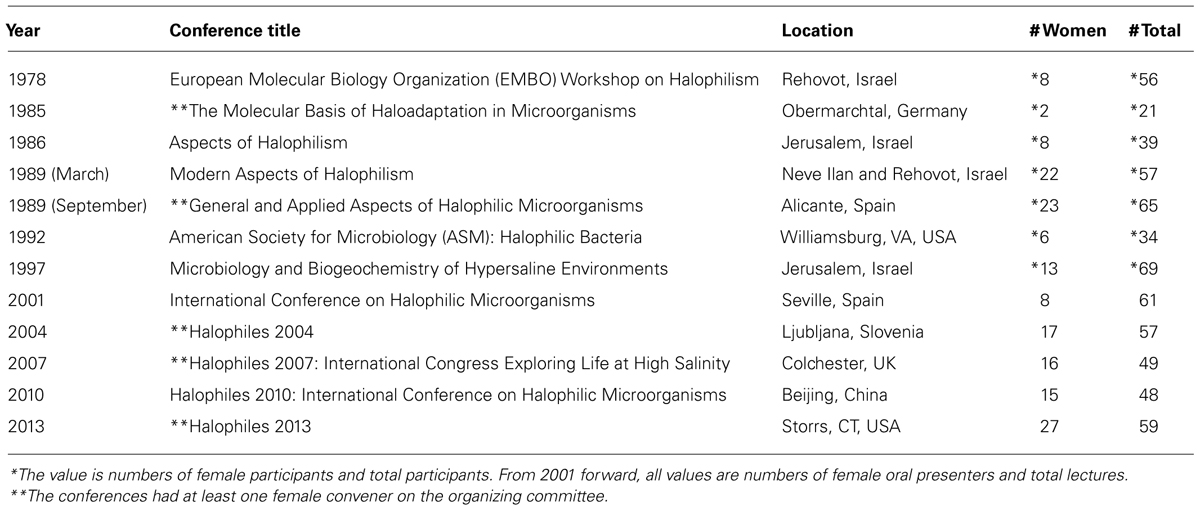
What we learned as we analyzed the conference participation in our field, is that we were doing quite well in gender balance of invited speakers, 36% of the speakers were women since 1978! And indeed, women had been included in many of the organizing committees. We saw a 10-16% increase in female speakers when this was the case. We also came to understand that there was a small group of scientists who were committed to holding this conference with no organizational funding. This led to cooperation, collaboration, avid mentorship and strong friendships. This was a group that welcomed women, young scientists and peoples of all nations. I daresay that this is not always the situation in a particular field as the “village elders” may work by competition, not cooperation. These halophile elders, for example, worked to get external funding at each meeting to bring graduate students and post-docs to the conferences with little cost. 
Recent studies on gender bias in science are focused on numbers we can measure and methods to resolve the problem. Jon Eisen has been a strong proponent for what is becoming a national movement to require organizing committees to have written policies that include gender equity.  Scientists, male and female, should request this document and refuse to participate if it is not produced. 
The co-authors and I were so pleased to report a positive example in a sea of negative ones. I hope that this groupsof salty scientists can inspire others to build communities of inclusion as we learn from each other in exploring the natural world.

Sept 15-16, NCBI Discovery workshops at #UCDavis – Entrez, Blast, Genomes, more

Event: NCBI Discovery Workshops, four 2.5-hour hands-on training sessions emphasizing NCBI resources such as BLAST and Nucleotide.

Presented by NCBI staff at UC Davis on Monday, September 15 & Tuesday, September 16, 2014 at 2205 Haring Hall

Session 1: Navigating NCBI Molecular Data Through the Integrated Entrez System. 9 am – 11:30 am, 9/15
Session 2: NCBI Genomes, Assemblies and Annotation Products: Microbes to Human. 1 pm – 3:30 pm, 9/15
Session 3: Advanced NCBI BLAST. 9 am – 11:30 am, 9/16
Session 4: Gene Expression Resources at NCBI. 1 pm – 3:30 pm, 9/16

For more information or to register:
http://blogs.lib.ucdavis.edu/hsl/2014/08/09/ncbi-2014/

Nice letter to the editor in the Davis Enterprise taking on school district’s anti-science tone

I assume many people heard about the recently released report from the American Academy of Pediatrics where they recommended high school classes start later in the morning than most do right now.  See for example: Let Them Sleep: AAP Recommends Delaying Start Times of Middle and High Schools to Combat Teen Sleep Deprivation.  And this report was covered in all sorts of newsy and bloggy places.   See for example, Amy Graff’s article in SFGate and Deborah Netburn in the LA Times.  Overall, the argument presented by the AAP makes sense and seems supported by scientific fundings.  And they go through a lot of scientific reasons for their recommendations.

Alas, Winfred Roberson, superintendant of the Davis, CA schools (also known as the DJUSD) told the Davis Enterprise that the schools here would not be making any changes in response to this report:

“While DJUSD won’t be modifying start times, our role as an educational institution can be to find ways to support our students by giving them the tools that will help them to think through, make adjustments and prioritize their competing forces that may be cutting into the recommended sleep time,” Roberson said. “These are life skills we are helping to build that will help students to function even after graduation.”

And I had missed out on this quote, thankfully, but became aware of it when my wife showed me this letter by Steve Carlip in the Davis Enterprise today:  Don’t ignore the science Davis Enterprise.   I quote from it below:

The superintendent’s response, as reported in Tuesday’s Enterprise, was to simply ignore the science. Instead, he said, the schools will help student “build life skills” to “prioritize their competing forces that may be cutting into the recommended sleep time.” 

Really? The high school is going to teach students to control their circadian rhythms? It’s going to give them the “life skills” to regulate the timing of their bodies’ secretion of melatonin? It will educate them to overcome biological sleep-wake phase delay by sheer force of will?

He completely nailed it here.  I hope Winfred Roberson and the Davis School district rethink their attitude towards scientific studies.

Funding and Ship-time Opportunities (XPrize, JAMSTEC and Simons)

Just got this email announcement from the Gordon and Betty Moore Foundation and thought the announcements would be of interest.

Dear colleague,

Here are some opportunities that have crossed our radar. We apologize for the spam.

XPrize’s latest innovation competition: Protect ocean pH
Summary: The organization behind Google’s $30 million sponsorship of a Lunar landing effort announced the roster of teams competing for the $2 million Wendy Schmidt Ocean Health XPrize focused on staving off ocean acidification.

Call for Pre-proposals: International Workshop for Large-scale Research Cruises Summary: In order to efficiently achieve the highest possible fulfillment of the research goals of its third medium-term research plans, the Japan Agency for Marine-Earth Science and Technology (JAMSTEC) is planning long-distance, long-term multidisciplinary research cruises (large-scale research cruises) using its vessels that will be open to both Japanese and overseas universities and research institutes.

Simons Early Career Investigator in Marine Microbial Ecology and Evolution Awards Launched
Summary: The awards are intended to help launch and support the careers of outstanding young investigators who use quantitative approaches to advance our understanding of marine microbial ecology and evolution. Supported projects will focus on marine microbes or fundamental problems that are highly relevant to understanding marine microbial ecosystems.

Marine Microbiology Initiative

GORDON AND BETTY MOORE FOUNDATION
1661 Page Mill Road
Palo Alto, CA 94304

http://www.moore.org

Census of Deep Life call for proposals for sequencing metagenomes or 16S rDNA amplicons of communities from the deep subsurface.

Deep Carbon Observatory: Deep Life Community (DLC) Calls for Proposals

The DLC will accept electronic submissions until September 20, 2014 for proposals to the Census of Deep Life to support high throughput sequencing of metagenomes or 16S rDNA amplicons of communities from the deep subsurface. For more information, go to: https://deepcarbon.net/feature/call-proposals-census-deep-life-sequencing-deadline-20-september-2014#.VAZOZ0u5dFw

UC Riverside hiring a faculty member in Evolutionary Genomics

Letter Community Ecology-Biology to send.pdf
Evolutionary_Genomics_ad_v1.pdf

Session on microbial interactions at ASLO 2015 in Spain

Just got a conference announcement that seems of interest:

We would like to invite you to participate in our session “MICROBIAL INTERACTIONS ACROSS THE DOMAINS OF LIFE” (# 058) at the ASLO Aquatic Sciences Meeting in Granada, Spain, 22-27 February 2015. We welcome contributions on diverse types of microbial interactions, as well as evolutionary studies related to understanding microbial ecology. Please find more details in the flyer attached.
Feel free to pass this on to other colleagues who might be interested.

Deadline for Abstract Submissions: October 6, 2014
http://sgmeet.com/aslo/granada2015/
Session058_AquaticSciencesMeeting_Granada_Spain_Feb2015.pdf

The US Postal Service Cares (actually this was kind of a nice gesture)

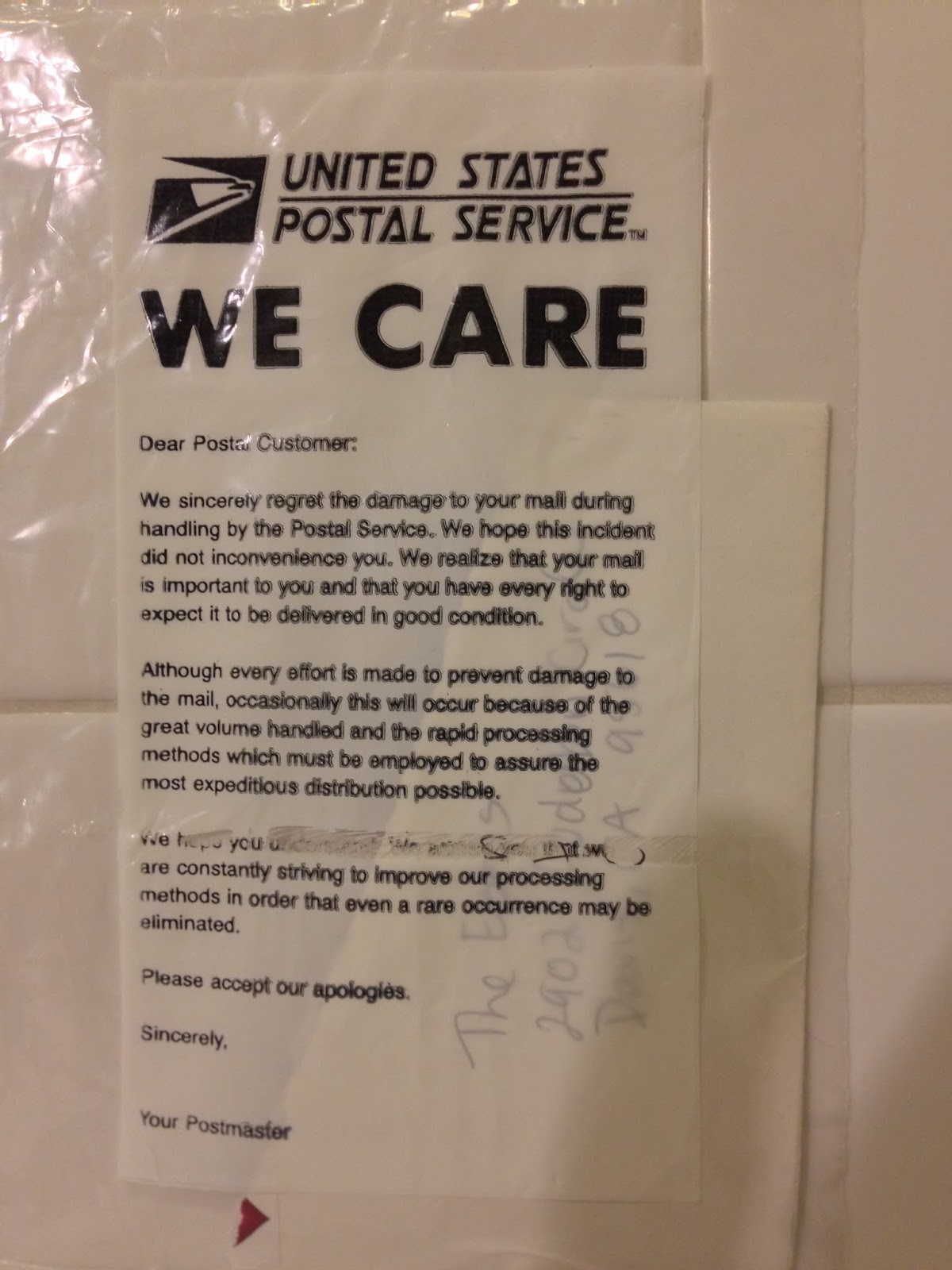
Well, this is a new one for me and my family.  We got some mail today.  My wife called me over this evening to tell me and said “it might make something good for my blog”.  But it was very strange. From the US Postal Service.  In a plastic bag and the bag read “We care …” see below:

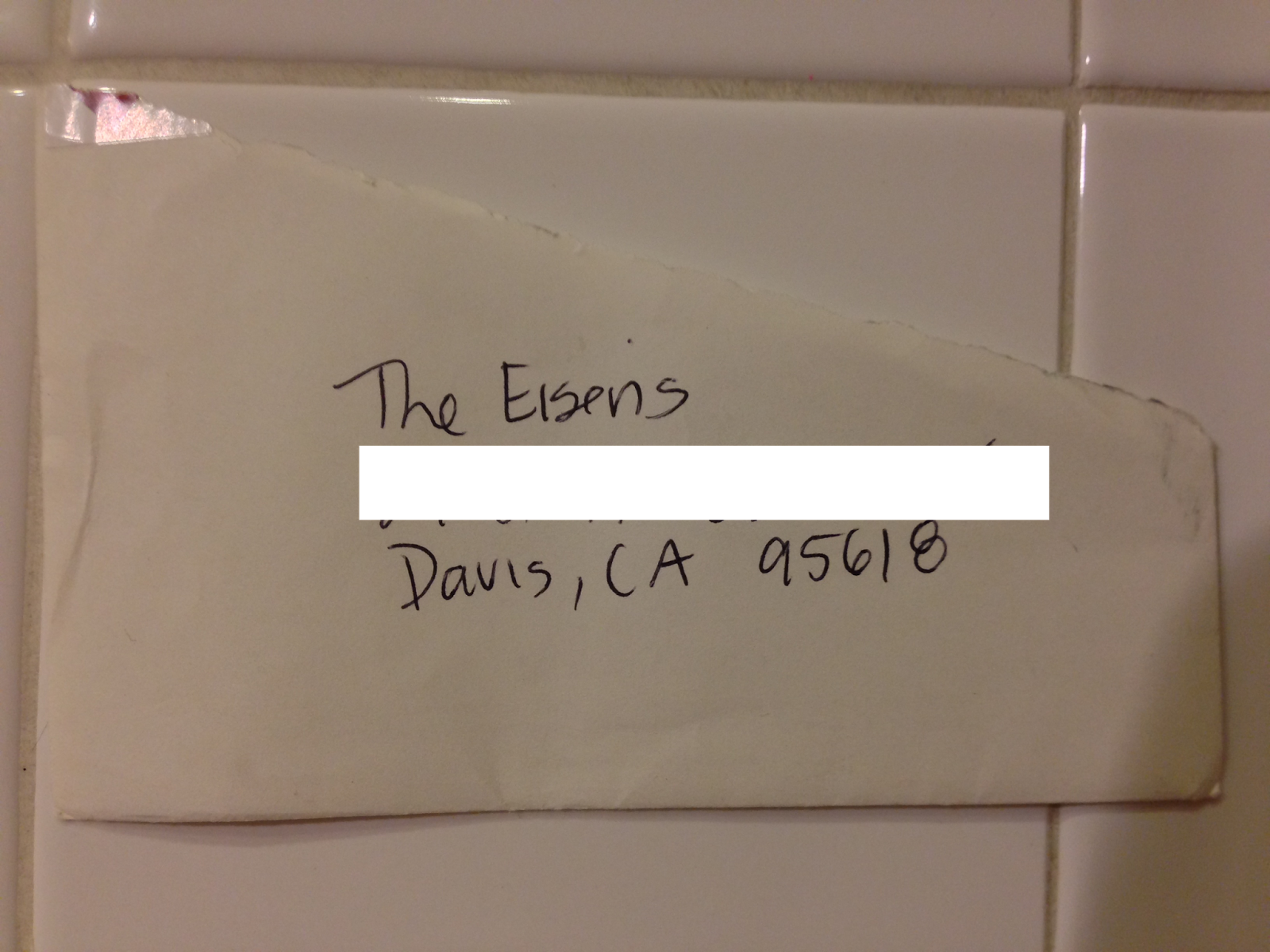
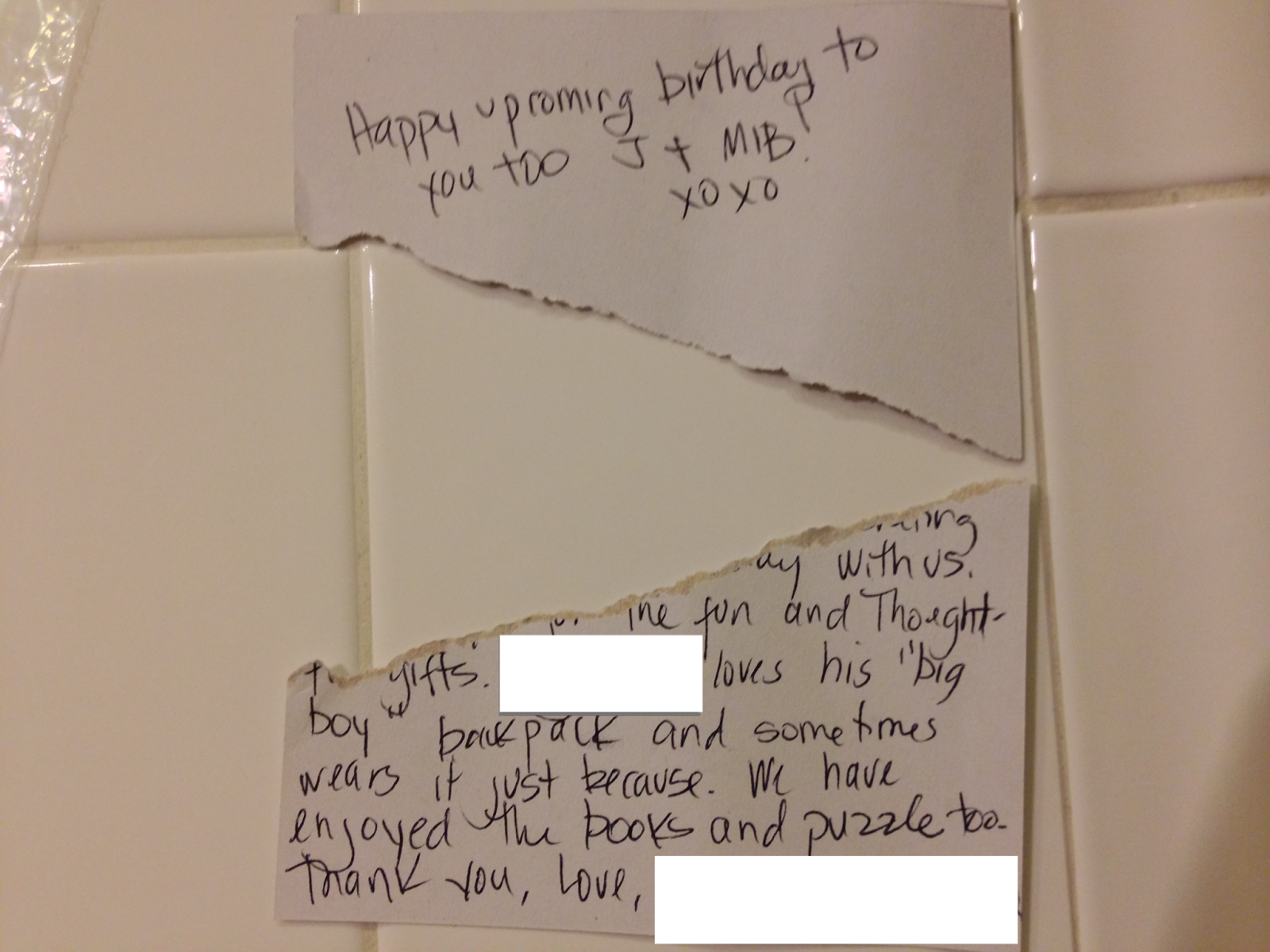
And inside of this was half of a piece of mail.  A card.  It felt very weird.  Like someone was censoring us but most likely some machine just ate the other half.

Front
Back

Add caption
They easily could have just tossed this once it got damaged.  Glad they did this.  Now, mind you, I still detest all their junk mail / bulk mail policies, but this was nice ..

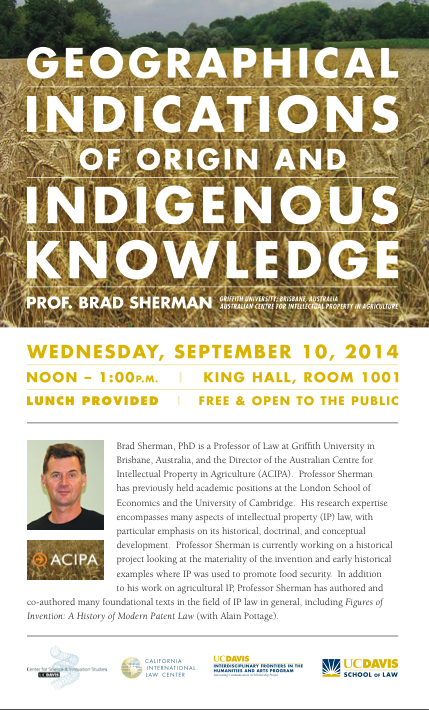
9/10 AT #UCDAVIS – Brad Sherman on “Geographical Indications on Origin and Indigenous Knowledge”

sherman_09-10-14.pdf

A tale of salt and gender: participation of women in halophile research

Interesting paper on women in science of direct relevance to my work: Frontiers | Salty sisters: The women of halophiles | Extreme Microbiology.  I have been working on halophilic archaea for many years (since introduced to them in graduate school) and published papers on this topic (e.g., see The Complete Genome Sequence of Haloferax volcanii DS2, a Model Archaeon and Sequencing of seven haloarchaeal genomes reveals patterns of genomic flux and more coming).  However, I have never been to a meeting dedicated to the topic and confess I have not thought specifically about the gender of scientists in this field and at meetings in the field and such.  Thus I was pleasantly surprised to see this analysis from Bonnie Baxter, Nina Gunde-Cimerman and Ahoren Oren.  Their abstract is below:

A history of halophile research reveals the commitment of scientists to uncovering the secrets of the limits of life, in particular life in high salt concentration and under extreme osmotic pressure. During the last 40 years, halophile scientists have indeed made important contributions to extremophile research, and prior international halophiles congresses have documented both the historical and the current work. During this period of salty discoveries, female scientists, in general, have grown in number worldwide. But those who worked in the field when there were small numbers of women sometimes saw their important contributions overshadowed by their male counterparts. Recent studies suggest that modern female scientists experience gender bias in matters such as conference invitations and even representation among full professors. In the field of halophilic microbiology, what is the impact of gender bias? How has the participation of women changed over time? What do women uniquely contribute to this field? What are factors that impact current female scientists to a greater degree? This essay emphasizes the “her story” (not “history”) of halophile discovery.

As part of their paper they analyze participation of women at conference on halophiles:

This is a useful analysis and compendium and it would be great to see this done for as many fields as possible.