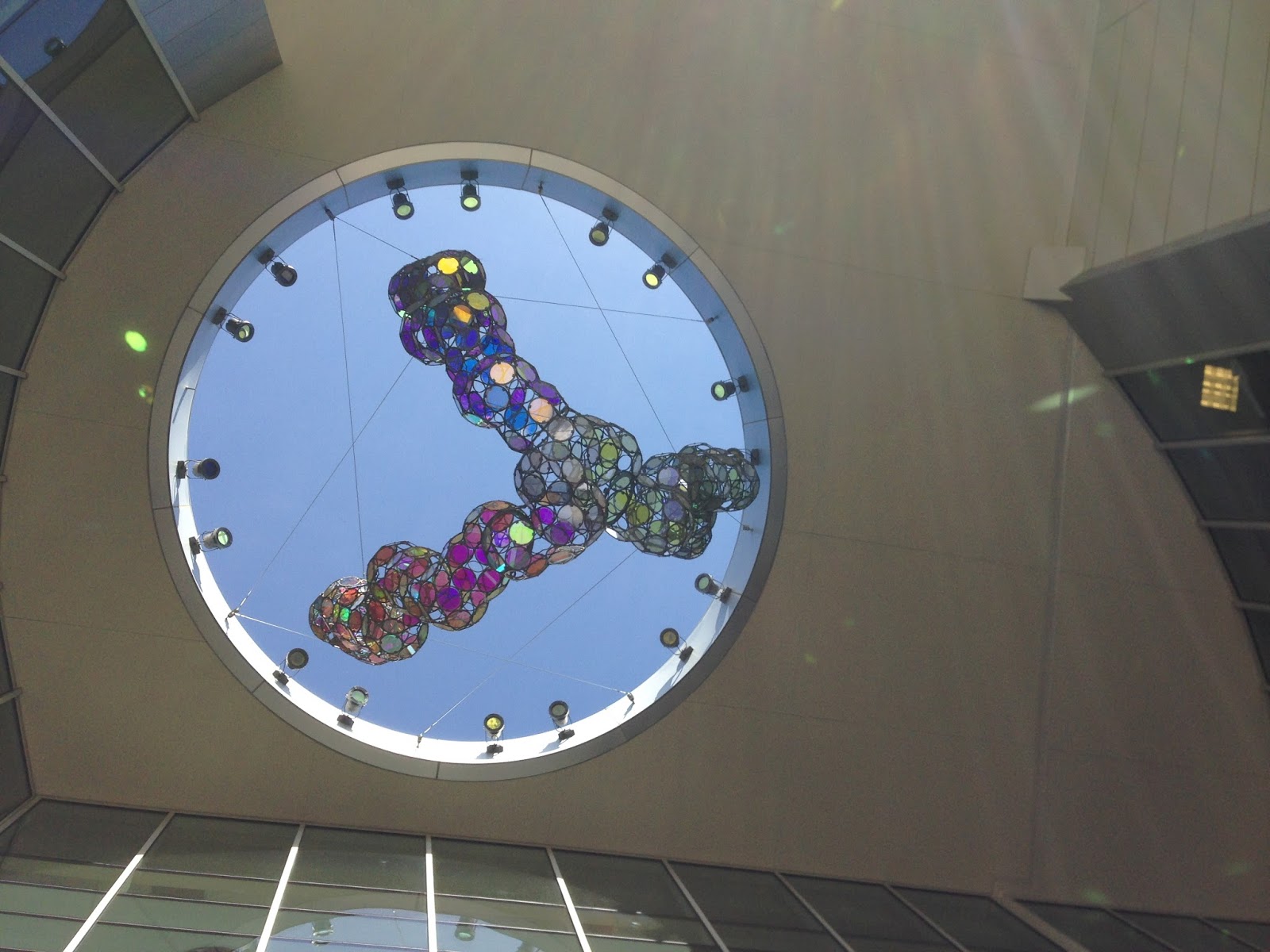
Nice Art and Science example – UC Davis Medical School molecule sculpture

Quikc post here.  A month or so ago I went to the UC Davis Medical School in Sacramento for a meeting and got to see this amazing new sculpture for the first time.

For more about this and the Artist Roger Berry see this article.  It is always inspiring and uplifting to see nice architecture and nice art in a science building. 

Today’s YAMMM (Yet Another Mostly Male Meeting) Brought to You by CIFAR & NAS

Well, just got an invite to this meeting: Symbioses becoming permanent: The origins and evolutionary trajectories of organelles.  The topic seems of direct interest to what I work on.  And, it is relatively close (Irvine is a short hop away).  So this could be a way to go to a meeting without having to travel too far.  And maybe I could see my younger brother Matt who lives in LA and just graduated from UC Irvine’s Masters program in Sound Engineering. Then I looked at the schedule of speakers and organizers.  Many are friends.  Many others are colleagues.  Could be fun to see some people I have not seen in a while.  And then I realized, most – no nearly all of them – are men.  Below I list the people involved in the meeting, highlighting men in yellow and women in blue.

Organizers: W. Ford Doolittle, Patrick Keeling, and John McCutcheon

Distinctive Voices Public Lecture presented by Michael Gray, CIFAR Advisor, Dalhousie University

Session 1: Genomes (evolutionary rates, oddities, and reduction)

  • Introduction and welcome remarks – W. Ford Doolittle, CIFAR Advisor & Patrick Keeling, CIFAR Program Director and Senior Fellow
  • John McCutcheon, CIFAR Associate Fellow, University of Montana
  • John Archibald, CIFAR Senior Fellow, Dalhousie University, Nuclear organelles 
  • Andrew Roger, CIFAR Senior Fellow, Dalhousie University, Organelle reduction 
  • Siv Andersson, Uppsala University, Alphaproteobacterial genome evolution 
  • David Smith, University of Western Ontario, Roots of genomic architecture variation 
  • Daniel Sloan, Colorado State University, Cytonuclear co-evolution under extreme mitochondrial mutation rates
  • John Allen, University College London, Why keep genomes?

Session 2: Integration/Control (trafficking, signaling, transporters)

  • Debash Bhattacharya, Rutgers University, Transporters in organellogenesis 
  • Nancy Moran, University of Texas, Austin, Insect endosymbionts 
  • Geoff McFadden, University of Melbourne, Diversity of protein trafficking
  • Chris Howe, Cambridge University, Why integrate?
  • Steve Perlman, CIFAR Fellow, University of Victoria, Maternal transmission, sex ratio distortion, and mitochondria 
  • William Martin, Düsseldorf University, Endosymbiont and organelle, what’s the difference? 
  • Moriya Okhuma, Riken University, Metabolic integration across endosymbiotic communities

Session 3: Theories and Models

  • Eors Szathmary, Loránd University, A fresh look at cooperation in some major transitions, especially the origin of eukaryotes
  • Marc Ereshefsky, University of Calgary, Evolutionary individuality
  • Peter Godfrey-Smith, City University of New York, Individuality and the egalitarian transitions 
  • Maureen O’Malley, University of Sydney, Philosophical Reflections on Endosymbiosis: Implications for Evolutionary Theory
  • Toby Kiers, University Amsterdam, Bacterial cooperativity

Closing remarks J. McCutcheon


So – that appears to be a ratio of 18 male speakers and 4 female speakers for a whopping 18% female speakers.  No thanks CIFAR and NAS.  I will sign up for a different meeting.  And by the way – WTF?  There are so so many qualified women working on these topics – what let to this 18:4 ratio?  The organizers should really rethink their processes and the sponsors should pull funding from meetings like this.  It is the only way some people will pay attention to diversity.


UPDATE: 8/20

Wrote to the NAS via their Website

To whom it may concern:

I am writing to express my disappointment in the gender ratio of speakers at this meeting (18 males, 4 females).  Due to the skew I am unwilling to participate.  See http://phylogenomics.blogspot.com/2014/08/todays-yammm-yet-another-mostly-male.html for details.

Sincerely,

Jonathan Eisen

Got this response

Dear Dr. Eisen,

The NAS Committee on Scientific Programs, which oversees the Sackler Colloquia most definitely considers gender diversity when approving these programs.  When organizers propose the programs they achieve a good balance on paper. Regrettably, in many fields, women scientists are at a premium and are sometimes overwhelmed with invitations and demands for their participation on programs and committees.  For a variety of reasons, including availability of speakers, the final program is not always as optimally balanced as originally intended.

I have conveyed your message to NAS Vice President and Chair of the Committee on Scientific Programs and will also share your concerns with the colloquium organizers and co-sponsor.

Best regards,

Susan Marty
Program Director
National Academy of Sciences
Sackler Colloquia
http://www.nasonline.org/programs/sackler-colloquia/

So I wrote back

Susan 

Thank you very much for the response.  It is good to hear there is some emphasis on gender diversity when programs and developed.  However, in my experience and based on my readings of the literature on this topic, this is not usually sufficient to produce diverse conferences.  Do you know if the NAS has any additional policies relating to diversity at conferences.  For example, if someone does not accept an invitation, is the organizer of the meeting then free to select whomever they like or are there protocols to help guarantee that the selection of replacements is also diverse?  Also do you know if there are any policies relating to the meetings themselves such as child care that have been shown to impact the attendance of women more than men?   

Any additional information you have would be appreciated.  I think that NAS could and should do more than just review the proposed list of invitees. 

Sincerely
Jonathan Eisen 

If I were applying for post-docs now, I would consider this one w/ Bassler, Stone and Wingreen

Just got this email:

Dear Jonathan,

We are looking for adventurous postdocs to work on bacterial quorum
sensing and biofilms. Our labs combine genetics, biochemistry,
structure, engineering, microfluidics, chemical, computational, and
theoretical approaches. Postdocs that join the group are welcomed into
a nurturing, collaborative, and vibrant atmosphere in which they can
tackle fundamental questions regarding the principles underlying
collective behaviors. They will learn and exploit strategies from a
variety of scientific disciplines. The interdisciplinary training they
receive with us will provide an excellent foundation for a successful
independent career.

Please send this note to your terrific senior graduate students and
encourage them to apply to us. We have attached information on the
position and how to apply.

Yours,

Bonnie Bassler, Howard Stone, and Ned Wingreen
———————


Postdoc ad Molecular Biology Princeton req#1400519.pdf

An important read: Emma Pierson on gender and authorship position in science

This is a fascinating read: In Science, It Matters That Women Come Last | FiveThirtyEight.  By Emma Pierson, who works at 23 and me.  It has all sorts of references of use and details on authorship position in scientific publications and how gender and author position are correlated.  Definitely worth a read.

Antibiotic resistance infocomic

I posted an original “infocomic” about antibiotic resistance over at my group blog – Nothing In Biology Makes Sense! It lays out the basics of why we should all be more than a little worried about over-use of antibiotics!

A.P. Giannini Foundation 2015 Postdoctoral Research Fellowship Program

Posting this that I recevied via email:

Dear Dr. Eisen:

The A.P. Giannini Foundation invites physician-scientists and junior researchers with 6-36 months of postdoctoral research experience to apply to the 2015 Postdoctoral Research Fellowship Program. The Fellowship Program supports innovative research in the basic sciences and applied fields and trains fellows to become established
investigators. The research should advance the translation of biomedical science into treatments, preventions and cures for human diseases.

Since 1951, the A.P. Giannini Foundation has awarded over 750 fellowships to postdoctoral biomedical researchers sponsored by California’s eight accredited medical schools. The Foundation awards new fellowships each year on a competitive, peer-review basis and will fund the fellowship for a maximum of three years based on satisfactory performance.

ELIGIBILITY AND QUALIFICATIONS

§ Candidates are eligible to apply if they have conducted
postdoctoral research for no less than 6 months and no greater than 36 months in the laboratory of their sponsor/mentor at the time of this year’s application deadline, November 3, 2014. The starting date of postdoctoral studies should be well documented and easily verifiable. Applicants with tenure-track research positions or faculty
appointments will not be considered.

§ Candidates must be United States citizens or permanent alien residents. They need to hold or complete an MD; MD/PhD; PhD or equivalent degree before they activate the fellowship.

§ Candidates must perform their research training under the sponsorship of an accredited California medical school and the mentorship of a principal investigator at the sponsoring medical school. They must arrange for their training before applying to the 2015 Fellowship Program. The mentor may supervise a maximum of two A.P. Giannini Foundation fellows in any one year.

FELLOWSHIP STIPENDS

The current fellowship stipend is $46,000 in Year 1, $48,000 in Year 2 and $50,000 in Year 3. Stipend payments are sent directly to the sponsoring medical school and can be used only for salary support of the fellow. No deductions are allowed for benefits, departmental or institutional overhead. The Foundation will announce the 2015 fellowship stipends by December 15, 2014.

Candidates may be eligible to receive additional salary support from their sponsoring institution but cannot hold another full fellowship or a federally funded career development award. Other income will not preclude favorable consideration; however, candidates must state the source and amount of other income they expect to receive in their application.

APPLICATION PROCEDURES

Candidates must use the 2015 Application Form to apply to the 2015 Postdoctoral Research Fellowship Program. The 2015 application form is available at http://www.apgianninifoundation.org. Completed applications for the 2015 Fellowship Program are due no later than Monday, November 3, 2014.

Job ad: Director of Charles Darwin research Station in Galapagos

Well, this could be an interesting job .. (below is an email I just got forwarded).

FROM CDF

We are seeking a new Science Coordinator to oversee and coordinate the scientific program of Charles Darwin Research Station (CDRS), and to direct other CDRS functions.

Please find attached the Terms of Reference. The application deadline is September 15th.

This is an exciting opportunity to play a key role in the biggest and oldest scientific institution on the Galapagos Islands.

The applicants can find more information about the Charles Darwin Foundation http://www.darwinfoundation.org in our website.

It would be appreciated if you shared this with your colleagues.
Science-Coordinator-CDF 2014.pdf

Who are the contaminants in your sequencing project? (crosspost from #microBEnet)

This was originally posted on microBEnet: Who are the contaminants in your sequencing project?

Well, been having many discussions recently about PCR amplification happening from “negative” controls where no sample DNA was added. Such amplification is alas pretty common – due to contamination occurring in some other material added to the PCR reaction.  Obviously it would be best to eliminate all DNA contamination of all reagents and all PCRs.  But if that does not happen, it is possible to try to detect contamination after it has happened.  Below I post some papers related to post-sequencing detection of contamination:

Any other suggestions or comments would be welcome. UPDATE 10:30 AM 7/25 – Was reminded on Twitter of a new, critically relevant publication on this issue: Reagent contamination can critically impact sequence-based microbiome analyses

//platform.twitter.com/widgets.js

At #At #UCDavis 7/28: Rachel Dutton “Cheese Rinds as Model Microbial Communities” cc: @racheljdutton

Rachel Dutton

Harvard University

“Cheese rinds as model microbial communities”

July 28, 2014 12:00 PM

Sensory Theater RMI
UC Davis
Dutton.Flier.pdf

Call for Proposals for using the Advanced Imaging Center at Janelia Farm

Got this in an email from the Gordon and Betty Moore Foundation:

In June of 2014 the Howard Hughes Medical Institute and the Gordon and Betty Moore Foundation announced the establishment of an Advanced Imaging Center at Janelia Farm that will make leading-edge imaging technologies more widely available to the scientific community.

Visualizing and understanding complex biological processes demands the integrated efforts of biologists and physicists. The mission of the Advanced Imaging Center (AIC) is to make cutting-edge imaging technologies developed at Janelia widely accessible, and at no cost, to scientists before the instruments are commercially available.

Operating strategically at the interface of engineering and biological applications, the AIC is positioned to drastically reduce the time between instrument development and widespread use in the increasingly technology-intensive field of biology. The AIC will expand the number and diversity of biologists who have access to the unique, state-of-the-art optical imaging microscopes developed at Janelia years before they become commercially available.

We encourage applications from scientists who are addressing significant scientific questions that require measurements of cellular/molecular behavior at spatial and/or temporal resolutions that would only be possible for them through access to the AIC.

The instruments currently available in the AIC:

· Lattice Light Sheet Microscope

· Interferometric Photoactivation and Localization Microscope (iPALM)

· Single Molecule Total Internal Reflection Fluorescence Microscope (sm-TIRF)

· Aberration-Corrected Multifocus Microscope (acMFM)

· Live Cell Multicolor Structured Illumination Microscope (SIM)

Proposals to use the AIC will be evaluated through a two-tier peer review process. A Call-for-Proposals will be announced several times a year. The Janelia Visitor Program will cover the cost of lodging for the visiting scientist, experiments, technical support from our applications scientists, and scope time for researchers whose proposals are accepted.  The deadline for applications is August 15, 2014. Application material can be found here. Further inquiries can be directed to aic@janelia.hhmi.org

The AIC is generously sponsored by Gordon and Betty Moore Foundation and Howard Hughes Medical Institute at Janelia.