
This is a very very helpful thing to keep up with new genome sequence releases/publications: Genome sequences published outside of Standards in Genomic Sciences, October-mid November 2012 | Nelson | Standards in Genomic Sciences. From Oranmlyan Nelson and George Garrity in the SIGS Journal. It is a bit mind boggling how many genome sequences are being determined and published. Fun. But mind boggling. Anyway – good to have someone trying to keep track. Also see GOLD: Genomes OnLine Database.
Category: Misc.

SMBE Meeting on Eukaryotic -Omics: April 29-May 2 at UC Davis
I’m leading the organization of an SMBE Satellite Meeting focused on Eukaryotic -Omics at UC Davis this spring. The meeting dates have been set as April 29-May 2, 2013, and the meeting description is as follows:
The SMBE Satellite Meeting on Eukaryotic -Omics will bring together an interdisciplinary pool of researchers to discuss current efforts, challenges, and future directions for high-throughput sequencing approaches focused on microbial eukaryotes (environmental studies of non-model organisms). The meeting program will encompass investigations of eukaryote biodiversity, ecology, and evolution, using approaches such as rRNA marker genes, shotgun metagenomics, metatranscriptomics, and computational biology tools and software pipelines.
See the meeting website (http://www.smbe.org/eukaryotes/) for program announcements, registration details, and travel award information. We’re currently in talks to tack on a QIIME workshop at the end of the meeting (tentative dates May 2-4), so keep an eye our for further details. The official conference hashtag will be #SMBEeuks on Twitter.
Our call for travel award applications includes a heavy focus on diversity–encouraging early-career applicants as well as those from underrepresented groups. Please pass on this meeting announcement to anyone who might be interested in attending. Deadline for abstract submission and travel grant applications is Feburary 22, 2013.
Share this:
Done with sampling!
So after a few months and 400+ samples later, we are finally done with sampling and data collection! The results look good, with several unique key points that we will be looking into once we have sequencing data. It will be interesting to see, and hopefully correlate, the appearance or growth of an organism with a change in one of the chemicals we measured.
On Tuesday I went in to do some DNA purifications to refamiliarize myself with the process and going back to lab overall. Hopefully the purifications and DNA isolation goes well, and we get back some interesting data from the sequencing run.
Share this:
Connotea is closing
Just got this email … not sure what the full story is behind it but Connotea is closing ….
Connotea is closing
Connotea, nature.com’s social bookmarking site, is closing on March 12th, 2013. We would like to thank you for your patience with and support for the site.
To enable you to export your bookmarks to an alternative service, we are providing a tool to make the process as easy as possible. Connotea will be available until March 12th, 2013 and you are strongly encouraged to download your bookmarks before this date as your library will not be accessible afterwards.
The Connotea Export Tool will convert your bookmarks into two formats that should be compatible with most common browsers or reference management systems:
- HTML – compatible with most browsers
- RIS – compatible with most reference management systems.
You will be able to log in to the Connotea Export Tool by using your Connotea username and password and following the instructions on screen. Once you have downloaded your HTML and/or RIS file, please refer to the instructions for your browser and/or reference management system to import your bookmarks.
Access the Connotea Export Tool.
As Connotea stores a large amount of data, in some cases it may take over an hour for your bookmarks file to be generated. If you experience any problems with exporting your bookmarks, or have any other questions or queries, please contact Marta Rolak
Share this:
From iSEEM project: Phylogenetic Diversity Theory Sheds Light on the Structure of Microbial Communities
Quick post. Another paper is out based on the Gordon and Betty Moore Foundation funded iSEEM project I co-ran with Jessica Green and Katie Pollard.
O’Dwyer JP, Kembel SW, Green JL (2012) Phylogenetic Diversity Theory Sheds Light on the Structure of Microbial Communities. PLoS Comput Biol 8(12): e1002832. doi:10.1371/journal.pcbi.1002832.
It has one of my favorite paper figures ever.
| Figure 1. The local community and metacommunity framework casts local biodiversity of coexisting species in terms of a sampling process from a larger reference pool, or metacommunity. |
And the paper is definitely worth checking out.
Share this:
Crosspost from PLOS Biologue: Working to increase diversity of PLOS Biology Academic Editors and Advisory Board members
On the PLOS Biologue (the blog for PLOS Biology) I have a post that may be of interest. I discuss our efforts to increase the diversity of the people involved in the various Boards of PLOS Biology. This is my first task I have taken as the Chair of the PLOS Biology Advisory Board. See the post: Working to increase diversity of PLOS Biology Academic Editors and Advisory Board members.
Share this:
Back in business
We’ve been sampling every day for Coral Ponds 1 and 2. We are up to almost 500 samples… which means we have a lot of DNA extractions to do.
I’ve noticed a few things in the last month. The coral used to be white, but now it is covered with a reddish algae. This is good because clearly things are changing, which is what this study is about! If macroscopic things (for example, the visible algae) are changing, then the microscopic things (microbial community) are most definitely changing as well!
On a side note, Matt and I discovered the time it took for a full round of sampling at maximum efficiency. With water filtering being the rate limiting step of our sampling process, we focused on wasting no time with the filtering. By this I mean, we had the next liter of water ready to go instantly after the current liter was done filtering. We also set a timer to remind us to keep adding water to the filter. Out of curiosity, I timed our last filtration and it took 17 minutes and 30 seconds. Overall we were able to complete the sampling in about 1 hour and 50 minutes. Being the mathematician that I am (just kidding), I assumed each filtration (6 total) took about 17 minutes and 30 seconds and calculated the time that water was not being filtered from the time we started to the time we finished: 5 minutes! I’d we were pretty productive.
Share this:
Progress Report
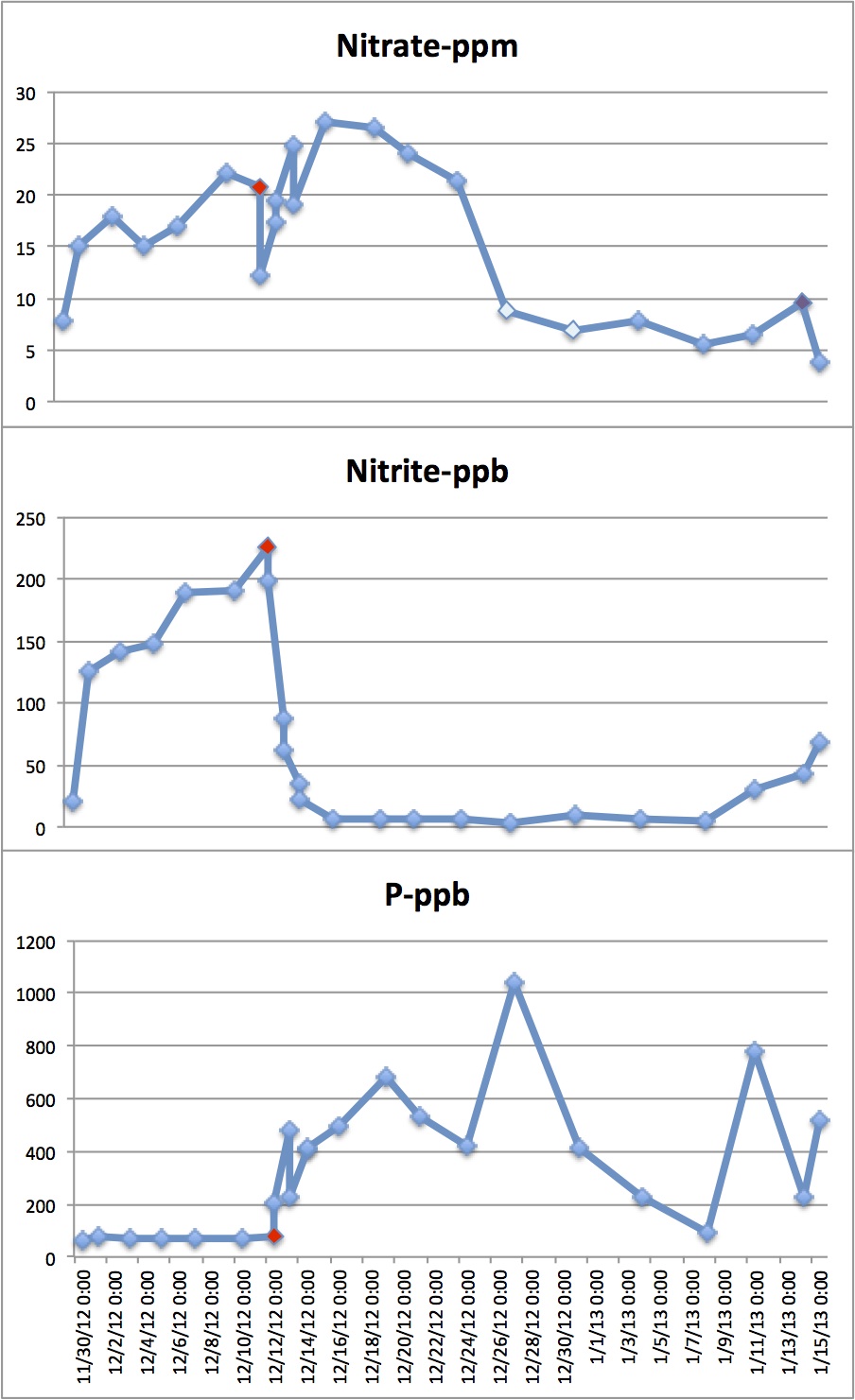 The first coral pond has been running for 49 days now. We have followed them through their initial construction, the inoculation from an established coral tank and now the addition of live rock so that more corals can be added. Our collection of over 400 samples is continuing to grow and we are seeing nice trends in our water chemistry parameters. We are excited to start looking at the DNA and have been extracting a number of samples.
Here is a quick look at coral pond one. I believe David has already shown some of this data. The red dot is the time point when we inoculated the coral ponds with microbes from an established coral reef tank.
Share this:

Evolutionary Biology of the Built Environment Working Group: Call for Participants
Call for participants: Evolutionary Biology of the Built Environment Working Group. Details copied from the announcement pasted below:
The Basics: We need your help. We are organizing the first working group aimed at understanding the evolutionary biology of the built environment—our bedrooms, our houses, our backyards and our cities. This working group will occur June 10 – 14, 2013, in Durham, North Carolina. We are now inviting applications for participants in the working group.
Why: As recently as one hundred thousand years ago the indoor environment did not exist. Yet, this is now where most humans spend the majority of their life. One might imagine that in its relatively short history the built environment might have had time to accumulate very few species. Far from the case, an emerging body of literature shows that hundreds of multicellular species and thousands of unicellular species can be found in houses and buildings more generally. Among the species found in homes are those whose presence (or absence) is likely to have a large impact on human health and well-being, species including beneficial microbiota on the body but also pathogens and potential pathogens or toxic species such as extremophilic fungi. Yet, with the exception of a few deadly pathogens (such as MRSA), the evolutionary history of most of the species with which we most intimately interact in our homes remains unknown. To remedy our lack of knowledge and take advantage of recent advances in disparate fields we will bring together scientists studying both the fauna (microbiologists, entomologists, mammalogists, and any other -ologists you can convince us have some bearing on house biomes) and environment (engineers, architects) along with social scientists (anthropologists) and evolutionary biologists (e.g. theoreticians, bioinformaticians, geneticists) to begin to build a framework for the evolution of the indoor and more generally built biome. Our goal is to develop a framework for a comprehensive understanding of the evolution of the species we most intimately interact with, particularly in the context of considering how to build and design our environments so as to favor beneficial (rather than dangerous) evolutionary trajectories. We aim to understand both how to prevent the extinction of beneficial species and to favor the evolution of lineages and species with beneficial attributes, whether those be ecological functions, health benefits or simply aesthetic value.
Who: We’d like to convene a diverse group of scientists and practitioners at various stages in their careers, from graduate students and post-docs to senior scientists, representing an array of disciplines including the organismal -ologies (e.g. microbiology, entomology, etc.), engineering, architecture, anthropology, evolution, genetics, bioinformatics, art and design. We want to be inclusive of any field that you can convince us has something to bear on studying evolution in the built environment.
How: We are currently accepting applications to be part of this working group. If you are interested, you can apply online apply online here, but do so soon. We will select a group of 30 scholars and practitioners from the applicant pool who will meet in Durham with the goal of producing a series of general audience and peer-reviewed publications about the evolutionary biology of the built environment.
Sponsored by a partnership between the Sloan Foundation and the National Evolutionary Synthesis Center.
Have questions? Drop us a note at yourwildlife@gmail.com.
Share this:
10 things you can do to REALLY support #OpenAccess #PDFTribute
I wrote a post earlier today in relation to the #PDFTribute movement: Ten simple ways to share PDFs of your papers #PDFtribute. I wrote it largely to give people an outlet and information and ideas about how to better share PDFs of their academic work. I think the more people share the better.
However, I also got shit from my brother Michael – co founder of PLoS on Twitter about how this is partly a “feel good” action. I do think he underestimates the surge of anger over the death of Aaron Swartz and the momentum right now in the semi-civil disobedience being seen in the #PDFTribute movement. But I also think he is right in part. So, I thought I would follow up with suggestions for what people should do in the future to really support full and open access to the academic literature.
- Only publish in fully open access journals. See DOAJ — Directory of Open Access Journals.
- Do not do ANY work for non open access journals. That includes reviewing, suggesting reviewers, etc.
- Cancel all subscriptions to closed access journals. The subscription model is part of the problem.
- Work for open access journals.
- Embrace openness in other aspects of your academic work. See for example Open science – Wikipedia, the free encyclopedia and Open Humanities Alliance
- Learn the difference between “open” and “freely available.” See Peter Suber, Open Access Overview (definition, introduction) and Open Access | PLOS
- Reward people in job hiring, merits and promotions for their level of openness. Do not reward them for closed activities.
- Lobby for more open access requirements at the Federal, State, and Institutional level. Make sure they are not mealy mouthed or mediocre. See What the UC “open access” policy should say for example.
- Embrace other changes in scientific publishing such as post-publication review that enable more rapid sharing of publications (see The Glacial Pace of Change in Scientific Publishing).
- Read up on what else you can do (e.g., Peter Suber, What you can do to promote open access) and come up with your own ideas. Oh and share them. Openly.
Related posts from The Tree of Life
Other ideas? Please post in comments.


