
Department of Microbiology & Molecular Genetics Recruitment Seminar
Kimberley Seed, Ph.D.
(Tufts University School of Medicine)
"Microbial warfare: Evolutionary dynamics between epidemic Vibrio cholerae and a predatory phage"
Monday, December 9, 2013
10:00 am
1022 Life SciencesHost: Prof. Rebecca Parales, Dept. of Microbiology & Molecular Genetics
*********************************
Category: Seminars and Talks

Exit Seminar today at 2 PM at #UCDavis Determinants of tropical vertebrate community composition – Lydia Beaudrot
Exit seminar today at 2:10pm in Wickson 2124.
Title: Determinants of tropical vertebrate community composition
Lydia Beaudrot
http://lydiabeaudrot.weebly.com/

Share this:

Seminar at #UCDavis 11/20 Bacterial sensing and degradation of aromatic compounds – Prof. Rebecca Parales
MIC 291: Selected Topics in Microbiology
Work-in-Progress Seminars
Prof. Rebecca Parales
(Department of Microbiology & Molecular Genetics)"Bacterial sensing and degradation of aromatic compounds"
Wednesday, November 20, 2013
4:10 pm
1022 Life Sciences
Share this:
Seminar at #UCDavis 10/17: Mark Schwartz 4 pm CLIMATE CHANGE ADAPTATION AND FIRE MANAGEMENT
Seminar:
MARK SCHWARTZ
Candidate for the
John B. Orr Endowed Chair in Environmental Plant Sciences
will present a seminar
CLIMATE CHANGE ADAPTATION AND FIRE MANAGEMENT IN THE SOUTHERN SIERRA NEVADA: TRANSLATING SCIENCE INTO MANAGEMENT
Thursday, October 17, 2013
4:10 p.m.
1322 Storer Hall
SUMMARY: Federal land management agencies are currently developing climate change adaptation strategies. Within the Sierra Nevada, 20th century land management practices, climate change and fire interact, creating an environment where modeling of climate change impacts on biological features may play a strong role in this adaptation planning. Research ecologists continue to develop more sophisticated species distribution, vegetation and fire models projecting future change. But is more sophisticated modeling what these managers want or need? Integrating ecological projection models into resource management decisions continues to be a challenge. I report on a multi-year, multi-institution collaborative effort with Sequoia-Kings Canyon National Parks to develop regional resource management priorities that integrate future vegetation and fire projections into resource planning. My proposed Orr Chair activities focus on developing venues for student training resource management decision making and activities that integrate students into resource management decision processes.
Share this:
Seminar 10/8 “Plant population responses to climate and fire in South Africa’s Cape Floristic Region”
October 8: 1022 LSA: Andrew Latimer
Associate Professor, Plant Sciences, UC Davis
Updated Title: “Plant population responses to climate and fire in South Africa’s Cape Floristic Region”
Host: Jay Stachowicz
Share this:
Seminar at #UCDavis, 9/26 4 PM, Mary Maxon: “Scientists, Sciences & Science Policy: From the Bench to the White House”
“Scientists, Sciences & Science Policy: From the Bench to the White House“
Mary Maxon, Ph.D.
4:00 – 5:00 p.m.
The Genome & Biomedical Science Facility (GBSF) – Auditorium, Room 1005
Mary Maxon is:
- Current Head of Strategic Planning and Development for the Biosciences Area at the Lawrence Berkeley National Laboratory
- Former Assistant Director for Biological Research, The White House Office of Science and Technology Policy, Washington DC
- Former Deputy Executive Director, President’s Council of Advisors on Science and Technology, Washington DC
- Former Marine Microbiology Initiative Lead, The Gordon and Betty Moore Foundation
- Completely brilliant and awesome
MaxonSeminarFlyer_9-26-13_2.pdf
Share this:
Phyloseminar June 27: Carl Woese’s grand view of life that just keeps getting grander” by Phil Hugenholtz June 27
Next phyloseminar (see http://phyloseminar.org for more information)
Next talk: Carl Woese’s grand view of life that just keeps getting grander"
Phil Hugenholtz (University of Queensland)
Most microorganisms cannot be grown in pure culture (or at least not
easily). This has been apparent for decades by comparing the number of
cells seen under a microscope to the fraction of those cells that will
grow into colony forming units (typically <1%). The objective
classification of cellular life by comparative rRNA analysis pioneered
by Carl Woese provided the first grand view of the tree of life and
also provided the reference framework upon which his friend and
colleague, Norman Pace, developed ways to directly survey microbial
communities via their rRNA sequences without the need to grow them.
This put our degree of ignorance of the microbial world into
perspective: dozens of major microbial lineages have emerged over the
last 20 years that lack even a single cultured representative. New
approaches, such as deep metagenomics and single cell genomics, are
now transforming the rRNA-based phylogenetic outlines of the tree of
life into a fully-fledged genome-based view of the tree. I will
present a recent snapshot overview of the genome tree of the bacterial
and archaeal domains and examples of functional insights in the
context of a more complete view of microbial evolution.
West Coast USA: 16:00 (04:00 PM) on Thursday, June 27
East Coast USA: 19:00 (07:00 PM) on Thursday, June 27
UK: 00:00 (12:00 AM) on Friday, June 28
France: 01:00 (01:00 AM) on Friday, June 28
Japan: 08:00 (08:00 AM) on Friday, June 28
New Zealand: 11:00 (11:00 AM) on Friday, June 28
–
Share this:
Seminar at #UCDavis: Michelle Smith, Wash U, “From the clinic to the bench: Using gnotobiotic mouse models uncovers a role for the gut microbiota in malnutrition”
Michelle Smith from Wash U in St. Louis
Meyer Hall, Room 1138. Noon. 5/16/2013
"From the clinic to the bench: Using gnotobiotic mouse models uncovers
a role for the gut microbiota in malnutrition"Abstract from recent Science paper:
Kwashiorkor, an enigmatic form of severe acute malnutrition, is the
consequence of inadequate nutrient intake plus additional
environmental insults. To investigate the role of the gut microbiome,
we studied 317 Malawian twin pairs during the first 3 years of life.
During this time, half of the twin pairs remained well nourished,
whereas 43% became discordant, and 7% manifested concordance for acute
malnutrition. Both children in twin pairs discordant for kwashiorkor
were treated with a peanut-based, ready-to-use therapeutic food
(RUTF). Time-series metagenomic studies revealed that RUTF produced a
transient maturation of metabolic functions in kwashiorkor gut
microbiomes that regressed when administration of RUTF was stopped.
Previously frozen fecal communities from several discordant pairs were
each transplanted into gnotobiotic mice. The combination of Malawian
diet and kwashiorkor microbiome produced marked weight loss in
recipient mice, accompanied by perturbations in amino acid,
carbohydrate, and intermediary metabolism that were only transiently
ameliorated with RUTF. These findings implicate the gut microbiome as
a causal factor in kwashiorkor.
Share this:
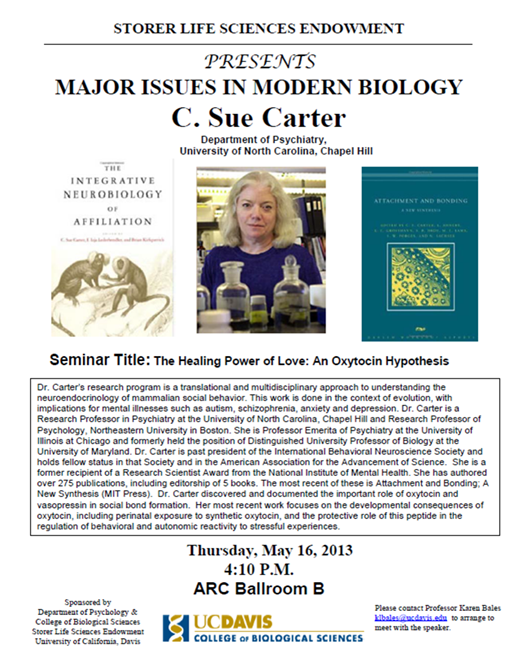
Seminar at #UCDavis: C. Sue Carter “The healing power of love: an oxycontin hypothesis”

Seminar 5/14 4PM: Gideon Bradburd Disentangling effects of geographic & ecological isolation on genetic differentiation
CPB Seminar Series: Spring 2013
When: Tuesdays, 4:10 – 5:30PM
Where: 1022 Life Sciences Building
May 14: Gideon Bradburd, Graduate Student
Center for Population Biology, UC Davis
Title: “Disentangling the effects of geographic and ecological isolation on genetic differentiation”
 Jonathan Eisen's Lab