Eisen Lab Blog

The White Men’s Microbiome Congress #YAMMM #Manel #Boycott

So I got this email this morning inviting me to attend a conference: the Second Annual Human Microbiome Congress in San Diego. (also called the North American Microbiome Congress).

And it struck me that all the featured speakers were men.
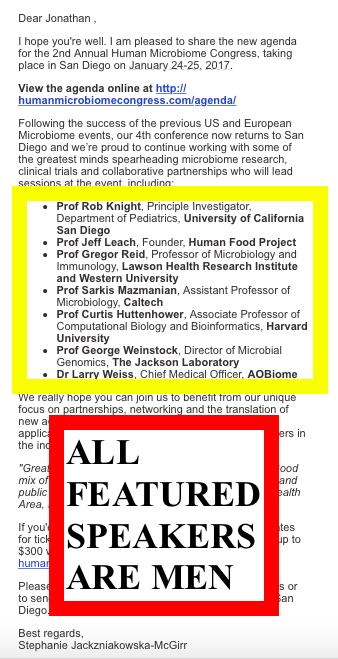
 Great.  So I decided to give them the benefit of the doubt, hoping that maybe if I looked at the rest of the speakers it would be better.

So I had to register on some web site to download the full agenda for the meeting.  And there were the featured speakers, rippling with diversity

So then I went to scroll through the document looking for the other speakers.

OMFG – what a joke.

27 speakers featured.  25 of them male.  That comes to a whopping 93% male lineup.  In a field where there are a massive number of well known, well regarded female researchers.  What a f$&(#()@ joke.  This meeting should be boycotted.  I am going to write to all the speakers I know and ask them to cancel participating.


Update 10/6 1 PM

Got an email from a meeting representative asking me what I thought about the program.  I guess I got this because of my signing up to get the program.

And I wrote back

I guess we will see where this goes.


Update 10/6 1:10 PM

I also have begin writing to people I know who are speaking at the meeting.

I am hoping many of them cancel participating.  I will update when I get more answers but so far the two people who have responded have now withdrawn from the meeting.

UPDATE 10/11

The meeting organizers have responded and appear committed to improving / fixing their diversity issue.  See comments here and also the meeting web site.

That’s the good news.

Now the bad news.  A commenter pointed me to the same Group’s European Microbiome Congress.  It is a bit better than the US one but not much.

I think this group needs to make a broader statement about diversity than just focusing on one meeting.


For other posts on STEM Diversity see here.

Swimming Upstream: Lessons Learned about Managing Career Challenges – Dr. Susan L Rosenthal

There are still seats available and this event is open to all.
Register online at: Register Here

WIMHS-Rosenthal-Flier.FINAL.pdf

US Culture Collection Network Internships

2016 US Culture Collection Network Internship Program

The US Culture Collection Network is pleased to present a new activity for living microbe collection stakeholders.

Beginning immediately we will accept applications for a collection internship at one of the USCCN participating collections.

US Students and researchers interested in learning how to preserve, store, and document living microbe specimens are invited to apply to the US Culture Collection Network for 2 – 12 day internships at some of the country’s leading microbial repositories.

To be considered for an internship please send a brief essay describing your reason for wanting to participate in the internship along with a CV/resume and a statement from your major professor/sponsor stating why this is important for your education to any member of the USCCN Steering Committee. The duration of lab visits will be decided by the applicant in discussion with the hosting laboratory. All applications will be reviewed by the USCCN Steering Committee. The deadline for applications is November 30, 2016 and internships should be completed by March 31, 2017. Support will include economy air-travel, local transportation and accommodations as well as a modest per diem. These internships should be educational in nature and not as a means to establish or conduct a research collaboration.

All participant expenses are to be compatible with the NSF recommendations: https://www.nsf.gov/pubs/manuals/gpm05_131/gpm6.jsp#618

Participant support allowances may not be paid to trainees who are receiving compensation, either directly or indirectly, from other Federal government sources while participating in the project. A non-NSF Federal employee may receive participant support allowances from grant funds provided there is no duplication of funding of items and provided no single item of participant cost is divided between his/her parent agency and NSF grant funds.

The USCCN does not discriminate on the basis of on the basis of race, color, ethnicity, national origin, gender, sexual orientation, gender identity, religion, age, ancestry, disability, genetic information, military status, or veteran status, in this internship program or in any the networks programs and activities as required by applicable laws and regulations.

At #UCDavis Tue 10/4 – Andrew Moeller on The evolution of the human gut microbiome

CPB Seminar Reminder for Tuesday, October 4, 2016, 4:10pm in 1022 Life Sciences

Speaker: Andrew Moeller
Miller Postdoctoral Fellow, Nachman Lab, UC Berkeley
Title: “The evolution of the human gut microbiome ”

Seminar today at #UCDavis: Xavier Darzacq

Quantitative Ecologist – Cornell University

QUANTITATIVE ECOLOGIST

DEPARTMENT OF ECOLOGY AND EVOLUTIONARY BIOLOGY

Cornell University

We invite applications for a tenure track position in quantitative ecology, at the level of Assistant or early Associate Professor. We seek candidates with expertise in analyzing large data sets or modeling of processes from the ecosystem to regional or larger scales, with an emphasis on the interactions of human-accelerated environmental change with ecological structure and function and sustainability. We will consider applicants with a strong theoretical, statistical, and/or computational background studying the interactions between organisms (including humans) and the environment as this influences biogeochemistry, ecological function, climate change, community assembly, or broad-scale patterns in biodiversity. The area of expertise could be in any ecosystem. We are particularly interested in individuals who are developing and applying quantitative methods, who are interested in understanding underlying ecological processes, who work at various scales, and who will collaborate with ecologists and evolutionary biologists as well as scientists in related disciplines across Cornell.

Faculty Position: Assistant or early Associate Professor, College of Agriculture and Life Sciences, in the Department of Ecology and Evolutionary Biology. Tenure track, academic-year (9-month) appointment with 50% research and 50% teaching.

Qualifications: Applicants should have a Ph.D., demonstrated excellence in research in some aspect of quantitative ecology, such as analyzing big data sets, remote sensing, ecological observation systems, or ecosystem-scale, regional-scale, or Earth system modeling. Candidates should have a strong interest in collaborative research, and a dedication to excellence in teaching. Post-doctoral experience is highly desirable.

Responsibilities: The successful candidate will be expected to develop a well-funded, innovative research program with a national and international reputation, to teach in an introductory ecology course, and to develop an advanced course in quantitative methods in his or her specialty area.

Salary: Competitive, commensurate with background and experience.

Start Date: July 2017

Application Procedure: Applications should be submitted via the website https://academicjobsonline.org/ajo/jobs/8040. Candidates should submit a short cover letter, curriculum vitae, a research statement, and a statement of teaching interests and experience. Candidates should also arrange for three letters of reference. Inquiries can be directed to Search Committee Chair, Christine Goodale, at quantecolsearch@cornell.edu. Applications from women and minority candidates are actively encouraged. Review of applications will begin Nov. 1, 2016, and continue until the position is filled.

Cornell University is an Affirmative Action, Equal Opportunity Employer.

Diversity and Inclusion are a part of Cornell University’s heritage. We are a recognized employer and educator valuing AA/EEO, Protected Veterans, and Individuals with Disabilities.

Center for the Advancement of Multicultural Perspectives on Science (CAMPOS) Presents: 2016-2017 CAMPOS Cafecito /Coffee Breaks – Oct. 26, Dec. 1, 2016 & Feb. 16, Apr. 6, Jun. 1, 2017

Please circulate widely

Center for the Advancement of Multicultural Perspectives on Science (CAMPOS) Presents: 2016-2017 CAMPOS Cafecito/Coffee Breaks

Oct. 26, Dec. 1, 2016

Feb. 16, Apr. 6, Jun. 1, 2017

All Cafecitos/Coffee Breaks: 12:30 – 2:30 p.m. | UC Davis ADVANCE Office 1100 Surge III “The Grove”

Pre-registration suggested.

For more information, visit edu/related-conferences-events or call 530-752-4792

Audience: Faculty members, postdoctoral scholars, graduate students

Topics:

Exploring the Relationship between Stereotype Threat and an Inclusive Environment

· This presentation should benefit educators, students and staff interested in deepening their understanding of the experiences of health professions students related to stereotype threat. Our research findings suggest that faculty and peers have a big impact (positive or negative) on the climate of inclusivity as experienced by underrepresented students. Through this presentation and discussion we will explore inter-relational best practices that foster inclusion and student success.

Improving Equity, Diversity, and Workplace Climate Among Faculty at UC Davis

· This presentation will provide an overview of the two main activities of the Inclusive Campus Climate Initiative of the Advance Program: The STEAD workshops for members of faculty recruitment committees and the COACHE faculty job satisfaction survey. These activities aim to increase equity and diversity in faculty recruitment and to assess (and thereby help to improve) faculty members’ satisfaction with the many aspects of their work at UC Davis. The goals, approach, and outcomes of each effort will be presented and offered for discussion.

Mentorship: Its Role and Importance for Latinas in STEM

· Our interviews with Latina President Postdoctoral Fellows and other STEM scholars yielded powerful narratives of the importance of mentorship within and outside the academic context for the development of a scientist identity and academic success i. This presentation will discuss our preliminary analysis of these findings.

Institutionalizing Inclusion: Policies and Practices that Sustain and Enable Inclusive Climates

· The policy and practices initiative has been reviewing polices as well as practices related to faculty recruitment, advancement and retention with the goal of breaking down barriers to inclusion in the faculty ranks. Some suggested changes have already been implemented and others will be presented in our final report to the campus. Come to the cafecito to discuss the draft of the findings and recommendations of this final report.

Capital Resource Network-Helping to Attract and Retain the Best and the Brightest

· The Capital Resource Network is a program created at UC Davis that serves as a collaborative regional resource to recruit and retain highly competitive, educated, skilled and diverse talent, both academic and staff appointees. The fee-for-service program uses a proactive and intentional approach to welcome, introduce, and integrate top talent and their families to the region. Seeking to attract and retain the best and the brightest, the program’s dual career support efforts strategically recognize the importance of employment opportunities for the accompanying spouse or partner, who is critical to the decision-making process.

2016-2017 ADVANCE CAMPOS Cafecitos-Coffee Breaks Flyer FINAL.pdf

Yet another biased meeting from Oxford Global – their meetings should be shunned #YAMMM #GenderBias

Well, Oxford Global has done it again.  They have found a way to be one of the most extremely gender biased conferences around.  Their 2016 Genome Editing Congress Speakers. Their web site lists 20 speakers, 19 of which are men.  (One of the men is listed twice – I am not sure if that is due to giving two talks or a mistake.  So this may be 19 speakers~ 95, 18 of which are men).  Regardless that comes to ~ 95% male speakers.

  • Andre Choulika, CEO Cellectis
  • Guna Rajagopal, VP – Global Head, Computational Sciences, Discovery Sciences Janssen
  • Lorenz Mayr, VP & Global Head, Reagents & Assay Development Astrazeneca
  • Zheng-Yi Chen, Associate Professor Harvard Medical School
  • Daniel Anderson, Associate Professor MIT
  • Marcello Maresca, Associate Principal Scientist Astrazeneca
  • John Doench, Director; Associate Director, Genetic Perturbation Platform Broad Institute
  • Chad Cowan, Associate Professor  Harvard
  • Pablo Perez Pinera, Associate Professor University of Illinois
  • Jim Collins, Professor MIT
  • Channabasavaiah Gurumurthy, Director, Transgenic Core Facility University of Nebraska Medical School
  • Danilo Maddalo, Senior Scientist and Lab Head Novartis Institutes for BioMedical Research
  • Rodolphe Barrangou, Associate Professor North Carolina State University
  • Stephanie Mohr, DRSC Director Harvard Medical School
  • Robert Howes, Associate Director MedImmune
  • Channabasavaiah Gurumurthy, Director, Transgenic Core Facility University of Nebraska Medical Center
  • James Carothers, Assistant Professor University of Washington
  • William Theodorus Hendriks, Instructor in Neurology Harvard Medical School
  • Mark Osborn, Assistant Professor University of Minnesota
  • Jeff Chamberlain, Professor University of Washington
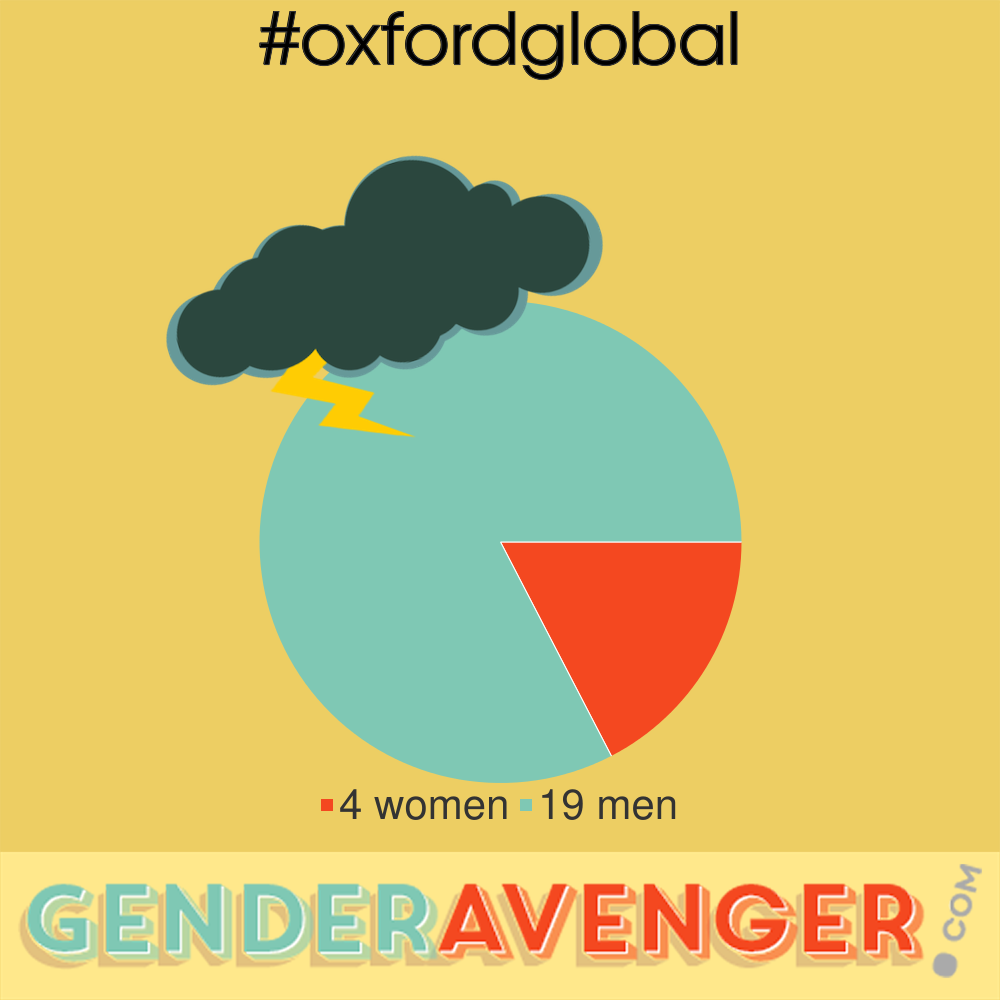
1 and 19 were counted at Genome Editing USA Congress #OxfordGlobal. Learn more at GenderAvenger Tally


Sponsors of the meeting should be contacted about this:

Sadly this is a consistent pattern for Oxford Global. See for example Oxford Global Sequencing Meetings: Where MEN Tell You About Sequencing #YAMMM and also Time to boycott Oxford Global meetings due to blatant sexism

Really – we need as a community to stand up to these types of meetings.  Oxford Global meetings should be boycotted.  And the companies that sponsor their meetings are complicit in their gender bias.

———————————————
UPDATE  10/2 12:56 PM – decided to look at another one of their meetings that is linked from this one

2nd Annual Next Generation Sequencing USA Congress
3-4 October 2016, Boston, USA

83 % male speakers.  Grand.

  • James Knight, Director of Bioinformatics Yale University
  • John Quackenbush, Professor Dana-Farber Cancer Institute
  • Shanrong Zhao, Director Pfizer Inc.
  • Nazneen Aziz, Research Professor Arizona State University
  • George Weinstock, Director and Professor Jackson Laboratory for Genomic Medicine
  • Alexander Wait Zaranek, Director Informatics Harvard Medical School
  • Rong Mao, Medical Director, Molecular Genetics and Genomics, ARUP Laboratories; Associate Professor, Pathology University of Utah School of Medicine
  • Mark Gerstein, Albert L Williams Professor of Biomedical Informatics, Molecular Biophysics & Biochemistry, and Computer Science Co-Director of the Yale Program in Computational Biology & Bioinformatics
  • James Willey, Professor of Medicine and Pathology University of Toledo
  • Neil R. Smalheiser, Associate Professor in Psychiatry University of Illinois College of Medicine
  • Mark Borodovsky, Regents’ Professor Georgia Tech
  • Scott J. Tebbutt, Associate Professor & Chief Scientific Officer University of British Columbia & PROOF Centre of Excellence
  • Michael Fraser, Program Director, Cancer Genomics, Radiation Medicine Program Princess Margaret Cancer Centre
  • Justin Johnson, Associate Director and Principal Scientist AstraZeneca
  • Leonora Balaj, Instructor in Neurology Massachusetts General Hospital Harvard Medical School
  • Aleksandra Markovets, Senior Scientist AstraZeneca
  • Baohong Zhang, Director of Clinical Bioinformatics Pfizer, Inc.
  • Steven Hart, Assistant Professor of Biomedical Informatics Mayo Clinic
  • Manolis Kellis, Professor and Head, MIT Computational Biology Group MIT
  • John Methot, Head of Scientific Computing Biogen
  • Andrew Hollinger, Associate Director: Scientific Communications Broad Institute
  • Yingtao Bi, Senior Manager in Statistics Abbvie Bioresearch Center
  • Paul Blainey, Assistant Professor of Biological Engineering, MIT and Core Faculty Member Broad Institute of MIT & Harvard

4 and 19 were counted at #oxfordglobal. Learn more at GenderAvenger Tally!function(d,s,id){var e,f=d.getElementsByTagName(s)[0],p=/^http:/.test(d.location)?’http’:’http’;if(!d.getElementById(id)){e=d.createElement(s);e.id=id; e.src=p + “://app.genderavenger.com/js/lib/embed.js”;f.parentNode.insertBefore(e,f);}}(document,”script”,”genderavenger-embed”);


For other posts on STEM Diversity see here.

UC President’s Postdoctoral Fellowship Program, 2017-18

University of California
PRESIDENT’S POSTDOCTORAL FELLOWSHIP PROGRAM
2017–2018 CALL FOR APPLICATIONS

THE PROGRAM. The University of California President’s Postdoctoral Fellowship Program was established in 1984 to encourage outstanding women and minority Ph.D. recipients to pursue academic careers at the University of California. The current program offers postdoctoral research fellowships and faculty mentoring to outstanding scholars in all fields whose research, teaching, and service will contribute to the diversity and equal opportunity at the University of California. The contributions to diversity may include public service towards increasing equitable access in fields where women and minorities are under-represented. In some fields, the contributions may include research focusing on underserved populations or understanding inequalities related to race, gender, disability or LGBT. The program is seeking applicants with the potential to bring to their academic and research careers the critical perspective that comes from their non-traditional educational background or understanding of the experiences of members of groups historically underrepresented in higher education in the United States.

AWARDS AND APPOINTMENTS. Fellowships are awarded for research conducted at any one of the University of California’s ten campuses. The award includes a salary starting at $47,844 depending on field and experience, benefits including health insurance and paid vacation/sick leave, and up to $5,000 for research-related and program travel expenses. Each award is for a minimum of 12-months and may be renewable for an additional term upon demonstration of academic/research productivity.

ELIGIBILITY. Applicants must receive a Ph.D. from an accredited university before the start of their fellowship. Successful applicants must present documents demonstrating that they are legally authorized to work in the United States. Individuals granted deferred action status under the Deferred Action for Childhood Arrivals program are encouraged to apply.

APPLICATION.
Apply online at: ppfp.ucop.edu

DEADLINE: November 1, 2016

Berkeley Davis
Irvine
Los Angeles Merced
Riverside San Diego
San Francisco Santa Barbara
Santa Cruz

More information:
President’s Postdoctoral Fellowship Program
University of California
visit online: ppfpinfo

University Partnerships for Faculty Diversity – Partner Programs with University of Colorado, Boulder, University of Maryland, University of Michigan, The California Alliance,UC Chancellor’s Postdoctoral Fellowship Programs, and the UC-affiliated National Labs. Please visit: http://ppfp.ucop.edu/info/about-ppfp/partnerships.html

2017-18 Call for Applications.pdf

EMBO Practical Course on Plant Microbiota 26 March–7 April 2017

Of interest:

Dear colleague,

We are happy to inform you that we are organizing an EMBO Practical Course on the Plant Microbiota (26 March – 7 April 2017), a rapidly advancing research field. This Practical Course will cover a mix of lectures and hands-on training, including advanced bioinformatic analysis.

We would be pleased if you could encourage interested PhD students or post-docs to submit application documents at http://events.embo.org/17-plant-microbiota/

Please find the EMBO practical course poster attached. We kindly ask you to post it in your institution.

17-plant-microbiota.pdf