Eisen Lab Blog

Wanted – input on topics for "open access" publishing discussion at #scio10

To all

I am posting this because I will be chairing a session this up coming weekend at Science Online 2010 on “Open Access” publishing.

And I would love input from everyone/anyone out there on what might be worth discussion at this session.  Possible topics include

  • why open and free are not the same thing
  • open access mandates
  • financial aspects of OA
  • educational uses of OA literature 
  • things that are slowing the inevitable spread of OA publishing

I am perhaps most interested these days in the last two on that list.  For example – it seems that OA publishing would spread even faster if we did not have some very conservative styles of tenure, promotion, hiring and grant review processes.

If anyone has some pressing topics that you think are worth bringing up in a discussion of OA publishing, please post them here.

Gmail account deletion phishing attempt …

Just got this in my inbox – have never received any phishing directed at my gmail account before – maybe this is a follow up to google’s issues with China?

Gmail Alert
reply-to
infotechcrewacess@gmail.com

to

date
Wed, Jan 13, 2010 at 12:34 PM
subject
Verify Your Gmail

hide details 12:34 PM (5 minutes ago)

We are shutting down some email accounts and your account was automatically chosen to be deleted. If you are still interested in using our email service please fill in the space below for verification purpose by clicking the reply button and fill the form below. Learn more

Account: Password: Birth date: Country:

Warning!!! Account owner that refuses to update his or her account within Seven days of receiving this warning will lose his or her account permanently.Thank you for using Gmail !

The Gmail Team
G MAI L BETA

Ooh – my first Epernicus spam

Just got this via Epernicus –  is it a sign that Epernicus is attracted more attention? (For those who do not know, Epernicus is a professional networking system for scientists)

Nice To Meet You,
How are you today ?,My name is (deleted) Hight,fair in completion ,i saw your profile today on (www.epernicus.com) and after going true it i was moved with the quality i found in
your profile,which makes me to became interested in knowing you the more. but i will like you to no that distance ,age or color dose not matter but what maters is love and understanding and being honest to each other. i will like you contact me true my direct mailing address so that i will give you my picture and tell you more about me. (email deleted)i have SOMETHING VERY IMPORTANT to tell you.Good to hear from you,
(email deleted)
Yours dream love. And Happy New Year,
(deleted)

UC Pres. Yudof (@mark_yudof) statement regarding California budget

Just got this in an email from UC President Mark Yudof


Statement by President Mark G. Yudof

University of California

January 8, 2010

With his proposed restoration of $370 million in funding for UC, including $305 million cut last year, the Governor has taken another important step toward putting California’s commitment to higher education back on track. These restorations, in addition to the Governor’s proposed constitutional amendment earlier this week, are clear evidence that the Governor understands the vital role public higher education plays in California.

We are pleased that the Governor’s budget provides $51.3 million to fund enrollments – an important step in light of the fact that UC currently enrolls 14,000 students for whom the state provides no funding. These funds will support student access at a time when we have overwhelming demand by UC-qualified students. We are also deeply grateful that the Governor’s proposal sustains funding for the Cal Grants program for UC students, which will enable us to continue to provide financial aid to our most needy students. The Governor’s proposal ensures that UC’s Blue and Gold Opportunity Plan will continue to cover the system-wide fees of students who qualify for financial aid and have family incomes of less than $70,000.

While we deeply appreciate the Governor’s actions, notwithstanding the crisis in the state budget, there is still a significant gap as we seek to repair a budget that has been severely cut. The University requested $913 million to address this critical issue. We now turn to the Legislature to adopt the Governor’s proposals and to find every opportunity possible to fulfill the $913 million needed to restore UC’s funding. This money is vital if UC is to avoid declining educational quality, access and research.

Achieving a full restoration of the budget will be a challenge, given the magnitude of the State’s budget gap and the cuts being proposed for other State services. But reinvestment in public higher education is critical. We will be asking our advocates to be very active in making the case for the University. It is important that UC be able to maintain its tradition of excellence, thereby ensuring a brighter future for all Californians.

Nice "Tree of life" video from Peabody Museum


I think I have written about this before but here goes again.  There is a nice “Tree of Life” video from the Peabody Museum that is now on Youtube and also their web site that is definitely worth a look for people interested in phylogenetics and the tree of life. It includes Michael Donoghue, Scott Edwards, David Hillis, Tandy Warnow and Charles Davis.

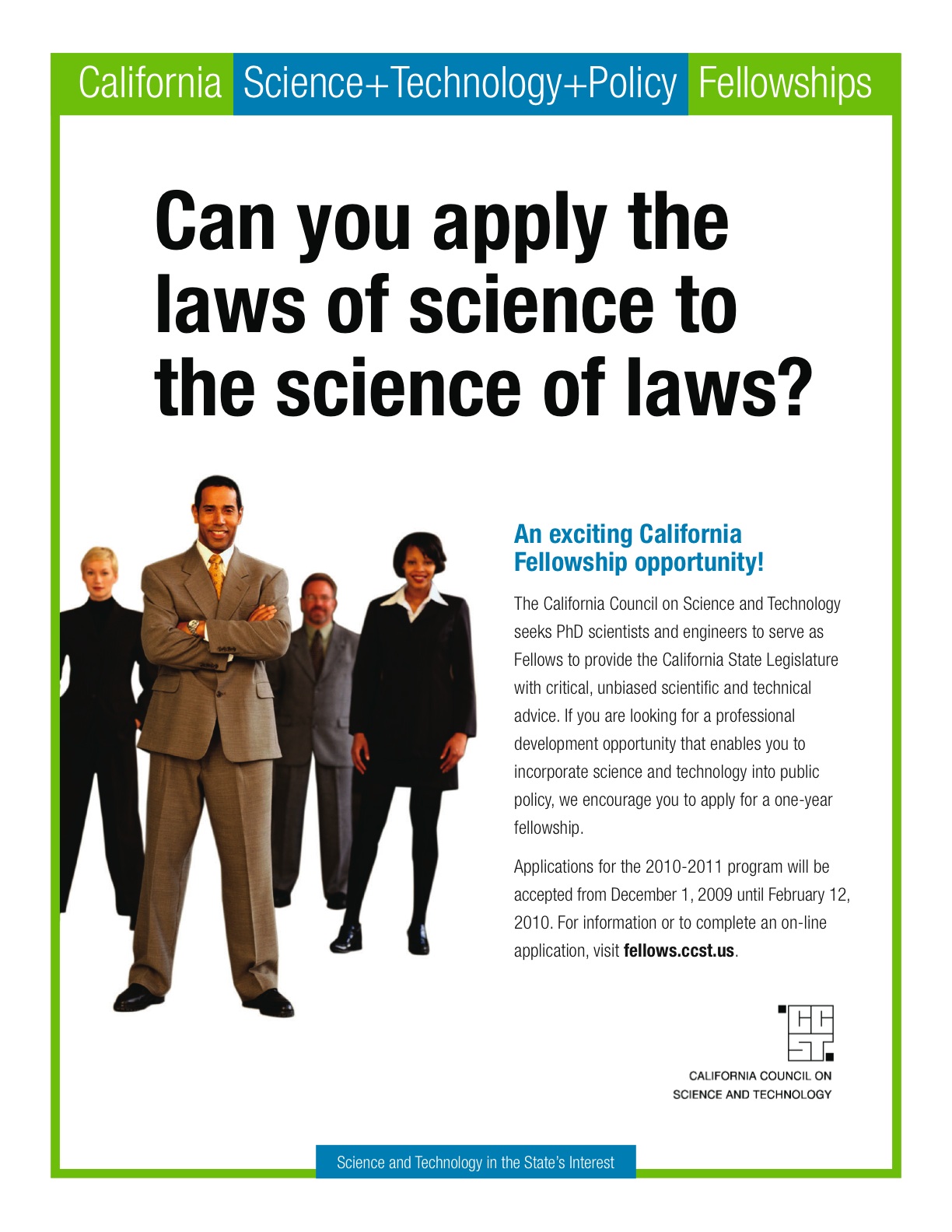
Can you apply the laws of science to the science of laws? try this CCST fellowship

Just got this announcement for this important Fellowship program.  A student who got her PhD in my lab just started in this program for this years group (see the SJ Mercury News Story about this program here). Love the flyer by the way “Can you apply the laws of science to the science of laws?”. Email announcement is below:

“The California Council on Science and Technology (CCST) is pleased to announce that applications are now being accepted for the 2010-2011 California Science and Technology Policy Fellowships based in Sacramento.

The S&T Policy Fellowship, a unique one-year professional development opportunity, provides the selected fellows with hands-on experience working with the California Legislature to incorporate science and technology into public policy. Eligible applicants will be PhD-level (or equivalent) scientists and engineers who have a sincere interest in California current events, the state legislative process, and a strong desire to learn how policy decisions are made.

Please forward this announcement to any individuals or group listservs that may be interested in this exciting opportunity. Deadline for submission of applications is February 12, 2010 at 5:00 p.m. PST. More information is available at http://www.fellows.ccst.us.”

#PLoSOne paper keywords revealing: (#Penis #Microbiome #Circumcision #HIV); press release misleading

UPDATE – READ COMMENTS – LEAD AUTHOR HAS GOTTEN PRESS RELEASE CHANGED

A new paper just showed up on PLoS One and it has some serious potential to be important The paper (PLoS ONE: The Effects of Circumcision on the Penis Microbiome) reports on analyses that show differences in the microbiota (which they call the microbiome – basically what bacterial species were present) in men before and after circumcision. And they found some significant differences. It is a nice study of a relatively poorly examined subject – the bacteria found on the penis w/ and w/o circumcision. This is a particularly important topic in light of other studies that have shown that circumcision may provide some protection against HIV infection.

In summary here is what they did – take samples from men before and after circumcision. Isolate DNA. Run PCR amplification reactions to amplify variable regions of rRNA genes from these samples. Then conduct 454 sequencing of these amplified products. And then analyze the sequences to look at the types and #s of different kinds of bacteria.

What they found is basically summarized in their last paragraph

“This study is the first molecular assessment of the bacterial diversity in the male genital mucosa. The observed decrease in anaerobic bacteria after circumcision may be related to the elimination of anoxic microenvironments under the foreskin. Detection of these anaerobic genera in other human infectious and inflammatory pathologies suggests that they may mediate genital mucosal inflammation or co-infections in the uncircumcised state. Hence, the decrease in these anaerobic bacteria after circumcision may complement the loss of the foreskin inner mucosa to reduce the number of activated Langerhans cells near the genital mucosal surface and possibly the risk of HIV acquisition in circumcised men.”

And this all sounds interesting and the work seems solid. I note that some friends / colleagues of mine were involved in this including Jacques Ravel who used to be at TIGR and now is at U MD and Paul Kiem who is associated with TGen in Arizona. For anyone interested in HIV, the human microbiome, circumcision, etc, it is probably worth looking at.

However, the press release I just saw from TGen really ticked me off. The title alone did me in “Study suggests why circumcised men are less likely to become infected with HIV”. Sure the study did suggest a possible explanation for why circumcised men are less likely to get HIV infections – the paper was justifiably VERY cautious about this inference. They basically state that there are some correlations worth following up.

The press release goes on to say “The study … could lead to new non-surgical HIV preventative strategies for the estimated 70 percent of men worldwide (more than 2 billion) who, because of religious or cultural beliefs, or logistic or financial barriers, are not likely to become circumcised.” Well sure, I guess you could say that. I think they are iplying you could change the microbiome somehow and therefore protect from HIV but that implies (1) that there really is a causal relationship between the microbial differences in HIV protection and (2) that one could change the microbiome easily, which is a big big stretch given how little we know right now.

Anyway – the science seems fine and not over-reaching. But the press release is annoying and misleading. Shocking I know. But this one got to me.

UPDATE – SEE COMMENTS HERE AND IN FRIENDFEED. LEAD AUTHOR GOT PRESS RELEASE CHANGED.

ResearchBlogging.org

Price, L., Liu, C., Johnson, K., Aziz, M., Lau, M., Bowers, J., Ravel, J., Keim, P., Serwadda, D., Wawer, M., & Gray, R. (2010). The Effects of Circumcision on the Penis Microbiome PLoS ONE, 5 (1) DOI: 10.1371/journal.pone.0008422

Story behind the science: #PLoS Biology paper on cichlid vision evolution

I am continuing on a new theme here in trying to get author feedback on recent PLOS publications.  Today I write about a recent paper on PLoS Biology “The Eyes Have It: Regulatory and Structural Changes Both Underlie Cichlid Visual Pigment Diversity” by Christopher Hofmann, Kelly O’Quin, N. Justin Marshall, Thomas Cronin, Ole Seehausen and Karen L. Carleton

This paper discusses “how changes in gene regulation and coding sequence contribute to sensory diversification in two replicate radiations of cichlid fishes.” A good overview of the paper is in an accompanying article “Visual Tuning May Boost African Cichlid Diversity” by Robin Meadows:

“African cichlid fish form new species faster than any other vertebrates, with hundreds of species evolving within the last 2 million years in Lake Malawi and within the last 120,000 years in Lake Victoria. This rapid speciation makes cichlids good models for elucidating the genetic mechanisms behind biodiversity. Vision may play a key role in cichlid evolution, adapting them to forage for new foods or colonize new habitats. Vertebrate retinas have two groups of light-sensitive proteins called opsins: those in rod photoreceptors, which are sensitive to dim light, and those in cone photoreceptors, which are sensitive to color. Changes in the visual system could be due to differences either in the expression of opsin genes or in their DNA sequences. A Research Article in this issue of PLoS Biology by Christopher Hofmann and colleagues suggests that both mechanisms underlie changes in visual sensitivity in cichlids.”

For more on the science, see her summary and see the article itself. Additional information can be found in the press release from U. MD

But what I wanted to cover here was some of the story behind the science.  So I emailed the authors some questions which they were kind enough to answer and I post the details here. There are some really interesting tidbits in these answers in my opinion, including how they dealt with merging two papers into one, and how difficult (but fun) it is to do this field work in Lake Malawi.

1. What led you to do the study reported in the paper?

From Karen Carlton:

This study was a long time in the making.  We started studying the visual system of cichlids in the 1990’s.  We learned quickly that there was a lot of variation in opsin expression within the Lake Malawi species.  However, we had only examined a few species.  In 2005, Tom Cronin and Justin Marshall (world experts on aquatic visual systems) agree to come to Lake Malawi with us and help examine a greater number of species.  Justin brought his underwater spectrometer and characterized the light environment.  Tom and I measured fish colors (that paper is under review) and I extracted retina for quantifying gene expression.

Because Lake Malawi and Lake Victoria both contain large cichlid radiations and had such different light environments, Ole Seehausen and I started working together in 2000 to compare visual systems in Malawi and Victoria.  (Ole is the world expert on Lake Victoria cichlids, having helped discover the large rock dwelling species flock that escaped the devastation of the Nile perch). We concentrated on opsin sequences in our previous publications.  However, we wanted to look at gene expression as well.

I was fortunate in 2006 to move to U Maryland where Chris Hofmann and Kelly O’Quin joined in our efforts.  Chris took on the Victoria cichlid gene expression based on samples that Ole had collected.  Kelly became our statistical wizard and analyzed the Malawi data we had gathered.  (He has also been working on the visual system of Tanganyikan cichlids, which are the ancestors of the Malawi and Victoria flock.  This work has recently been submitted).

From Kelly:

I see Karen gave you a nice review of how this paper was started.  As she said, the work was started before I joined her lab.  At that time, we were primarily concerned with moving into the new lab at UMCP, so no one was actively working on the data set.  I initially analyzed the data to practice for a similar study of Tanganyikan cichlids.  But, as I learned more about the power (and pitfalls) of the comparative analysis, I became more and more involved with the actual analysis and discussions, and after about 6 months Karen asked me to write up the paper for the Lake Malawi data set.  At the same time Chris was working on a manuscript for the Victorian data.  After seeing the overlap in the two papers — really the similarities and differences — Karen and Chris and I decided it would be useful to put the two together.

2. How did this group come together, with people from Australia, Switzerland and Maryland?

From Karen:

Vision science is a small international community that is wonderfully supportive.  The cichlid community is also small and makes for excellent collaborations.  This is what makes research great – combining expertise from such a diverse group of people.  This enables us to think across many disciplines from physics to biology and integrate light measurements, ecology, molecular biology and genetics to try and understand what drives cichlid visual communication and determine how it plays a role in speciation.

From Christopher

I would add that both Europe and Australia have some top people in the field of visual ecology.  Also, I don’t think we could have had a paper with such a broad scope without our collaborators.  Once we all got together things just kept building and was very exciting.

3. A question for Kelly — how do you feel about the “joint contribution” statement.  Do you think there needs to be a system to truly list two first authors or do you think this statement will suffice? 

From Karen

I feel like I should chime in here.  We originally had written two separate papers with Chris as lead author on the Victoria data and Kelly on the Malawi data.  However, we all felt a combined paper could be more powerful.  I asked Kelly and Chris to combine these papers, though that was a very difficult thing to ask, particularly in these times of first author is best.  However, this paper is truly the joint effort of these two as well as the rest of the authors and would not be the paper that it is without everyone’s contributions and perspectives.

From Kelly

It is nice to be recognized for the work and effort given, and presumably this is accomplished in the ‘Author Contributions’ statement as well as the order in which authors are listed in.  For this paper, Chris and I each authored manuscripts that Chris had to painstakingly combine.  After a lot of debate over the meaning and limits of our comparative results, we each wrote a new drafts of the combined study that Karen then resolved into a single manuscript.  Tom, Justin, and Ole provided lots of  comments and additional text throughout this process as well.  This truly was a collaborative effort, with plenty of contribution and compromise on everyone’s part.  Although the order in which the author’s are listed cannot possibly communicate all of the nuances involved (though I am certainly happy with the order given), I hope we were able to addressed them with the ‘joint contribution’ statement you mention, as well as our ‘Author contributions’ statement (which lists just about every author under each category).

In short, I don’t think a simple change to the way that we list authors will ever capture all of the individual and combined efforts that go into a study.  Instead, I think we need to change the way we read and interpret that list.

4. How did you end up choosing PLoS Biology as a place to submit the paper to? Were there any debates among the group about publishing there?

From Karen:

Online journals, such as PLoS Biology, give us a lot of flexibility to include all the supporting data without limiting the length of the paper.

From Kelly:

Since we had essentially two large studies here, the generous space and supplemental information limits allowed by PLoS made it a natural choice to publish in.

5. Do you have any good stories about the field work?  

From Karen:

Field work in Malawi is never dull.  Getting there is the first problem.  It is a 24 hr plane ride if all goes well (which it never does) plus a 5 hr drive down to the lake, partly on Malawi dirt roads.  Once you get there, however, the lake is a beautiful place.  The diving is about the best in the world and it is wonderful to immerse yourself in your organism’s habitat.  Underwater, it is wall to wall fish, with 50 or more species in a single location so it is perfect for observing and collecting a wide diversity of species.

The field station is run by the University of Malawi. It is right next to Chembe village and the people there are incredibly warm and friendly.  The research station has electricity and cold running water.  This is very high living for the village and makes for an interesting dichotomy.  Several of the villagers are experts on cichlid fish, including Richard Zatha, and they dive with us.  They can catch fish far faster than we can. There is considerable wildlife including the baboons which like to come into the house and steal bread off the table.  We were fortunate in not having to deal with hippos or crocodiles on either of our recent trips.

It is quite expensive to take a group to Malawi.  However, it is essential for everyone to see their organism in its natural habitat.  It also takes a lot of preparation as well to get a group of scuba divers certified and ready to do this kind of field work.

I’m sure Ole has comparable stories for his work in Lake Victoria.

From Christopher:

To build on what Karen said.  Going to Lake Malawi and actually diving with the fish is an incredible experience.  When we work in our aquaculture facility we have maybe a handful of fish from a few different species in a single tank.  In the field, once you drop below the surface it is an entirely different world.  There are literally hundreds if not thousands of fish from many different species all doing their own thing.  Some are eating algae, others plankton and even other fish.  Many of these species are ones that are impossible to keep or breed in captivity, which makes the challenges of getting there worthwhile.

From Kelly:

Not really other than to say that it is a lot of hard work.  But if you like SCUBA diving in remarkably clear water with beautiful, colorful fish, I can’t think of a better place to work than Lake Malawi.

6. Can you provide links to web sites of the authors and or other links of interest such as videos of the fish, twitter pages, etc?
7. Anything else you want to add:
From Christopher:

I would also add that its not easy to catch fish in Malawi.  There is a definite art to scuba diving and handling a net.  Having local cichlid experts was invaluable.

———————–
Cichlid picture by Christopher Hofmann doi:10.1371/journal.pbio.1000267.g001

ResearchBlogging.org

Meadows, R. (2009). Visual Tuning May Boost African Cichlid Diversity PLoS Biology, 7 (12) DOI: 10.1371/journal.pbio.1000267

Hofmann, C., O’Quin, K., Marshall, N., Cronin, T., Seehausen, O., & Carleton, K. (2009). The Eyes Have It: Regulatory and Structural Changes Both Underlie Cichlid Visual Pigment Diversity PLoS Biology, 7 (12) DOI: 10.1371/journal.pbio.1000266

Barcoding, taxonomy and citizen CSI

I just love the continued coverage of the story of the students from Trinity School in New York (a high school) who do investigative DNA barcoding projects. (There is a good new story about this on the LA Times blogs at:Think that sheep’s mik cheese comes from a sheep? DNA doesn’t lie | Booster Shots | Los Angeles Times)

In the most recent example, two students, Brenda Tan and Matt Cost, did some home barcoding in collaboration with people from the AMNH and Rockefeller University.

Among their findings:

  • “an invasive species of insect in a box of grapefruit from Texas”
  • “what could be a new species or subspecies of New York cockroach”
  • multiple mislabelled food products including (quoted from the press release, I note)
    • An expensive specialty “sheep’s milk” cheese made in fact from cow’s milk;
    • “Venison” dog treats made of beef;
    • “Sturgeon caviar” that was really Mississippi paddlefish;
    • A delicacy called “dried shark,” which proved to be freshwater Nile perch from Africa;
    • A label of “frozen yellow catfish” on walking catfish, an invasive species;
    • “Dried olidus” (smelt) that proved to be Japanese anchovy, an unrelated fish;
    • “Caribbean red snapper” that turned out to be Malabar blood snapper, a fish from Southeast Asia.
And what I find most interesting, is this built upon work of other students from Trinity Kate Stoeckle and Louisa Strauss who had done a restaurant based barcoding study last year. 
This type of work is cool in so many ways.  It gets students into science.  It is an applied us of taxonomy (though I note, barcoding is not without controversy in the taxonomy community). It is a useful form of citizen science — and may eventually provide a way to keep dishonest sellers on their toes … Kudos to all involved in this 
More on this story can be found at

Evolutionary classification applied to soups & meals

Written by Saul Jacobson – I think to mock me but you never know with him:

Molecular comparisons show that soup on this planet divides into three primary groupings, commonly known as the stews, the broths, and the chowders. The three are very dissimilar, the differences that separate them being of a more profound nature than the differences that separate typical meals, such as steaks and salads. Unfortunately, neither of the conventionally accepted views of the natural relationships among meals -i.e., the five-kingdom taxonomy or the appetizer/dinner dichotomy–reflects this primary tripartite division of the eating world. To remedy this situation we propose that a formal system of meals be established in which, above the level of eating, there exists a new taxon called a “course.” Meals on this planet would then be seen as comprising three courses, the appetizer, the main course, and the dessert, each containing two or more plates