Eisen Lab Blog

Wall Street Journal on Open Access

There is a nice essay (Information Liberation) by Daniel Akst in the Wall Street Journal on Open Access to scientific publications (thanks to Bora for pointing this out). He leads of the essay saying

If your child has a life-threatening disease and you’re desperate to read the latest research, you’ll be dismayed to learn that you can’t — at least not without hugely expensive subscriptions to a bevy of specialized journals or access to a major research library.

Your dismay might turn to anger when you realize that you paid for this research.

Go to the WSJ site to read the rest but he has some useful points about OA including:

  • That academic societies and their journals should be able to survive even if they provide the publications for free
  • That “barriers to the spread of information are bad for capitalism”
  • That open access can help limit plagiarism (by allowing anyone to search for copied text as has been done recently for a variety of literary works)
  • That open access to information can help speed development in impoverished nations
  • And his final point: “The challenge, in the coming new world of open access, will be keeping the best of the current system while jettisoning the rest. Maybe some scholar would like to study the question — and publish his findings for all to see.”

Open Evolution

I am starting a new blog theme here on Open Evolution. By that I mean, evolutionary biology studies that are in some form of open science format. This would include Open Access evolution publications, open source evolution programs, open data on evolution projects, etc.

Today I am focusing on Open Access publications with interesting Evolution themes.

First, there are some fully Open Access journals with a specific focus on Evolution (I found some of these through the Lund Univeristy’s Directory of Open Access Journals). These include

There are of course other fully OA journals that have a decent chunk of the papers on some evolution related topic:

If anyone knows of any other Open Access evolution journals, please let me know.

Genomics Blogger Dissed by the New York Times

Well, the New York Times has an article today on Knome, a company that is charging people $350,000 to have their genome sequenced. They have two people signed up so far. Amy Harmon, the author of the Times article, interviewed me by email for her article, mostly because I had blogged extensively about the recent AGBT meeting where many of these sequencing companies had presented their latest goodies. But alas, being a genomics blogger apparently does not carry as much weight as being (1) Jim Watson (2) someone who pays 350,000 to have their genome sequenced (3) running a genome center (Richard Gibbs) or (4) starting Knome (George Church). And so my quotes got left on the proverbial cutting room floor. Go figure.

Too bad for the Times, as I think I my quotes were pretty good. Although in all honesty, they would not have gone too well with the final article, which has some nice cohesion to it.

I should note that, other than the lack of my quotes, one thing that got left out of the Times article is any discussion of the quality of the genome sequence that will be provided by Knome. One would hope that 350K would buy a high quality genome sequence but it is unclear how good it will be. I note they claim they will provide analysis of the genome too, but as with other companies that cater to the rich and famous, details are limited on their web site.

This reminds me of a funny scene I witnessed involving Craig Venter and a wealthy friend of his. This was the day before Craig’s personal genome was set to come out in PLoS Biology and the friend was asking Craig what it cost to sequence his genome. Craig said something to the effect of “man millions of dollars” and then Craig said, “but now it would cost only about 300K.” The friend was intrigued. And Craig asked if he was interested and the friend, without seeming in any way to be joking, said, “sure sign me up.” I guess, when money is abundant, why not get your genome sequenced? Maybe I should have told Harmon this story — then I might have gotten in the Times.

Cool new tool to help decide where to submit a scientific paper and what scientists are working on

Just found out about a freaky and cool new tool called Jane – the Journal/Author Name Estimator. For more on the approach see this paper in Bioinformatics.

Here is how it works — you paste some text into a box and you can get the tool to suggest a journal that is most suitable for your work. Or you can have the tool search for an author who is doing work similar to what is in the text (this is useful to find reviewers or papers to look at)

One thing I like about the journal tool is that it highlights which journals are Open Access and which are deposited in Pubmed Central. I have tried it out in a few different ways and it seems pretty useful. So if you want guidance on where to submit a paper or who might make a good reviewer of a paper, check it out. It seems like it would make a good tool to help reporters find someone to interview too.

The iPlant Collaborative – a new (and seemingly cool) collaborative informatics project

Just found out (from Steve Rounsley) about what seems to be a cool collaborative computational project on plants – the Iplant Collaborative. From their site:

The iPlant Collaborative (iPC) is a distributed, cyberinfrastructure-centered, international community of plant and computing researchers enabling new conceptual advances through computational thinking, and addressing an evolving array of the most compelling grand challenges in the plant sciences and associated, cutting-edge research challenges in the computing sciences.

For more info got to their web site. Also – they are having their 1st conference which apparently will be webcasted. So apparently anyone can watch.

iSEEM Wants You — We are Recruiting Post Docs in Metagenomics Informatics

I am pleased to announce that a new project on “Integrating Statistical Evolutionary, and Ecological Approaches to Metagenomics (iSEEM)” is getting up and running. The iSEEM Project, funded by the Gordon and Betty Moore Foundation, takes an integrated, interdisciplinary approach to metagenomic analysis.

The project spans three labs (mine and those of Katherine Pollard (who is in the Davis Genome Center where I am) and Jessica Green (who is at U. Oregon)), each with different areas of focus. Overall, the plan is to develop and apply novel methods for analyzing metagenomic data with a focus on three main topics: phylogenetic characterization of organisms, ecological diversity, and population genomics. We will be posting more detail about the project at http://iseem.org.

We are seeking five post-doctoral scientists and a bioinformatics engineer to work on methodology for analysis of metagenomic data as part of this collaborative project. Each position will be associated with one of the PIs at their home institution. If you are interested in microbial diversity, metagenomics, or genome evolution, and are looking for a post doc and want to be part of a interdisciplinary collaborative project, please apply.

More detail on the jobs is below:

Qualifications

  • We are looking for people with a demonstrated interest in working at the interface between the quantitative and biological sciences. We will offer a generous salary and benefits commensurate with experience.
  • Postdocs: Applicants should have a PhD in a biological, computational, mathematical, or statistical field. Programming skills are highly desirable.
  • Bioinformatics Engineer: Applicants should have substantial experience with database programming (e.g. SQL), scripting (e.g. Perl or Python), and bioinformatics tools.

Term: Appointments will last 2 years beginning in Summer 2008.

To Apply: Please apply using our online application system. You will be asked for:

  1. a brief cover letter explaining your background, career interests, and preferred geographical location for work (if any),
  2. CV (including publications),
  3. names and contact information for three references.

Online Application System:

Punctuated equilibrium of my blog … and a look at an old science rap

Well, with my new role in PLoS Biology as Academic Editor in Chief, I had planned to start blogging more about PLoS and PLoS Biology. And I will. However, I am going to have to do a half effort on this for at least a week or two as I have a lovely ailment called trigger finger which is making typing rather awkward. So in lieu of a detailed blog I simply have to make a brief comment on one of the articles in this months issue

The article in which I am interested is a nice primer on mutational meltdown in mammalian mitochondrial genomes by Dave Rand. This is in relation to a paper by Stewart et al. in this issue. But enough about science. For those who do not know, Dave Rand published what I believe was the first rap in a scientific article. In an article in Genetics he presented a rap about repeat induced point mutation (something known as RIPPING). This RAP about RIPPING I think was presented at the Evolution meeting in Berkeley (I think I was at the talk where he did the RAP but I am not sure — I could have, like Andy Pettite, misremembered the whole thing).

And well, here it is:

Yo! you’ve got my DNA and you think it is a-RIPping,
Your dog is so excited her saliva is a-dripping,
She seems to think the polymerase is doing some a-skipping,
But then again, you never know, she might just be a-quipping.
Are you sure induction by repeats did make it happen?
If it’s just associated, why not call it RAPpin’?
What motifs are necessary to keep the strands a-snappin’?
I don’t know and I don’t care, but something did some zappin’.

A really good day at work

Overall, I like being a scientist. But some of the days can be quite dreary. As a grad. student you slog through days that resemble the reliving of events in Groundhog Day. Except that they are actually different days – they just seem the same. As a post doc you struggle to get work done to then get a job (OK, I skipped a post doc, but I heard about what it is like from others). And as a faculty member you spend an absurd amount of time wasted on useless administrative activities. And I sometimes seem to be stuck in these days a lot.

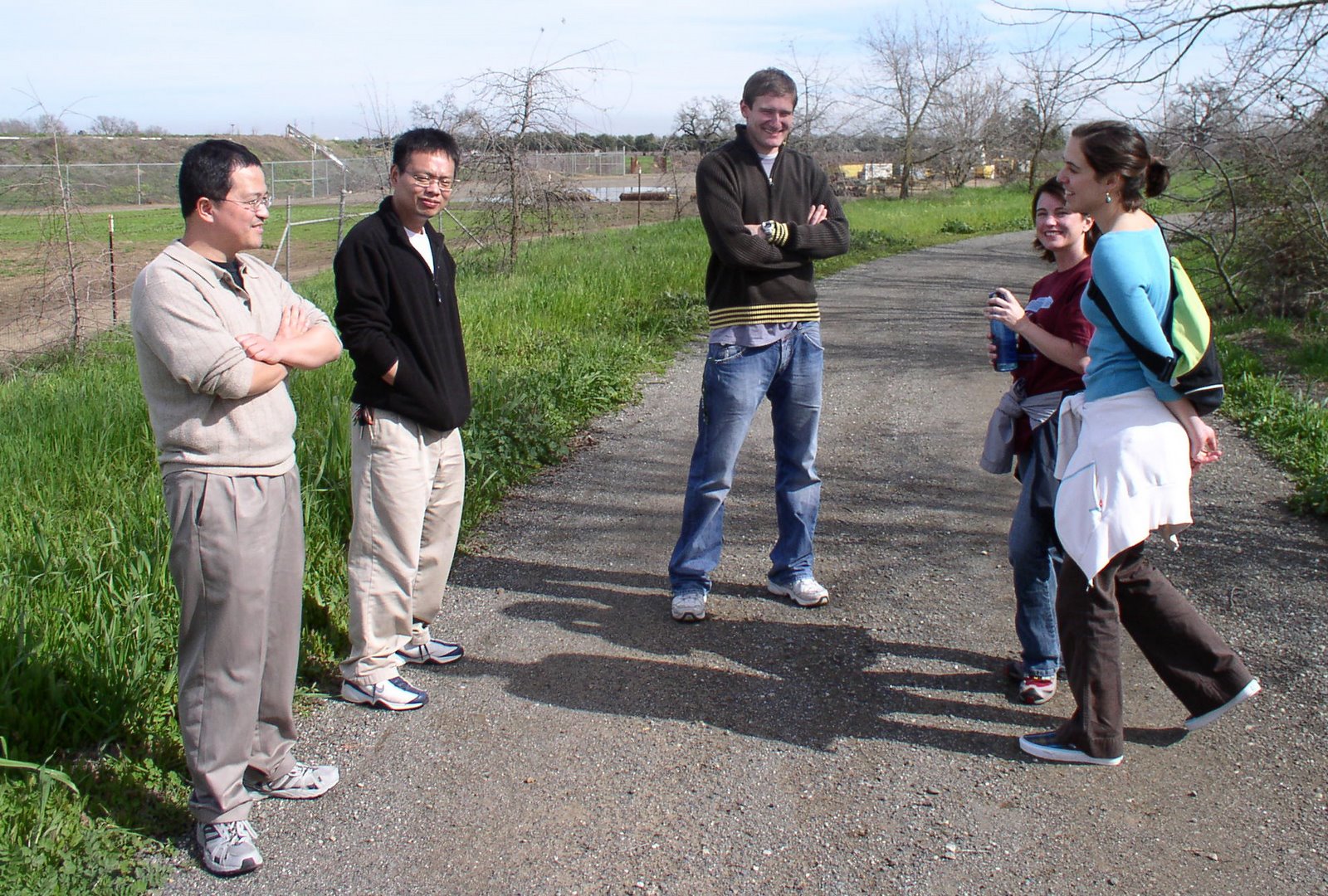
But today was a really good day. It was my first day after it was announced that I was the new Academic Editor in Chief of PLoS Biology. And I got lots of positive feedback from friends, colleagues and even strangers. And then we had “lab meeting” which I decided to turn into a picnic/hike. We went to a little spot only 2 miles from the UC Davis Genome Center, that was as close to wilderness as you can find in Davis. And I think everyone had fun, getting away from the grind AND I brought my 3 year old daughter too.

And this reminds me to say – in the past I have avoided talking about people in my lab in my blog because it seemed like it would be nice to give them some space from my blabbing. But today I was reminded of just how much I owe them. They of course do all the work that I end up getting credit for. So today I thank the current lab members specifically (Jenna Morgan, Amber Hartman, Marcel Huntemann, Dongying Wu, Martin Wu, and Sourav Chatterji) and with their permission you will probably be hearing more about them later.

PLoS Biology 2.0

PLoS Biology - www.plosbiology.org

Well, I guess it is official now so I should post about it here. As for this afternoon, I am now the new Academic Editor in Chief of PLoS Biology. To read more about this new role of mine go to the source. I will probably cross post the editorial here at some later point.

Also see other blogs/notes about this

For more on what I think about Open Access publishing see some of my other blogs on the issue.

Join the Public Library of Science

See Evolgen for a field guide to seminar audiences

EVOLGEN has a great post on the people at your department seminar. It is worth checking out and bringing with you next time you go to a seminar. Even better than looking around — choose which one fits you the best. Up until a few years ago, I was definitely the pre-schooler

The pre-schooler: This dude uses the departmental seminar as his nap-time. He sits in the back, and when the lights go out, he’s nodding off faster than River Phoenix in My Own Private Idaho. Someone get this guy a good-night’s sleep.

I simply could not stay awake in any seminar so I would have to sit at the back. Now that I have kids, I am used to sleep deprivation and only rarely nod off in a seminar. I am no longer sure which one I am …