Eisen Lab Blog

Can openness stop wars?


Thanks to Doug Rusch for pointing me to this video of a talk by Michael Shermer. It is a bit over the top, but I like the bit at the end suggesting that open access to information can basically stop wars.

Not sure I buy into the whole argument, but I do think that keeping scientific information behind closed walls is generally a bad idea ….

PCR Humor

Not much to say – other than thanks to Jenna Morgan for sending this …

Oakley Keeping his Eye on Evolution

I saw an interesting talk today and thought I would post on it. I was not expecting to be able to go to the talk as I was supposed to be at a workshop in San Francisco but had to bail on it because my kids have been sick. But I did go in to Davis for a brief spell to go to a seminar by Todd Oakley who gave a talk here today.

It was a generally insightful phylogenomic tour of the evolution of opsins and eyes in animals. He also mentioned a paper he had recently in PLoS One on Animal Opsin evolution. This is from the work of his graduate student David Plachetzki and it does a nice job of doing “phylogenomic” analysis in the way I think of phylogenomics — that is — a integration of evolutionary and genomic analyses. (NOTE – I think it is kind of lame that people use the term phylogenomics, which I coined by the way, to refer to “using genomes to infer evolutionary trees). It is a paper worth checking out if you are interested in the origin of novelty.

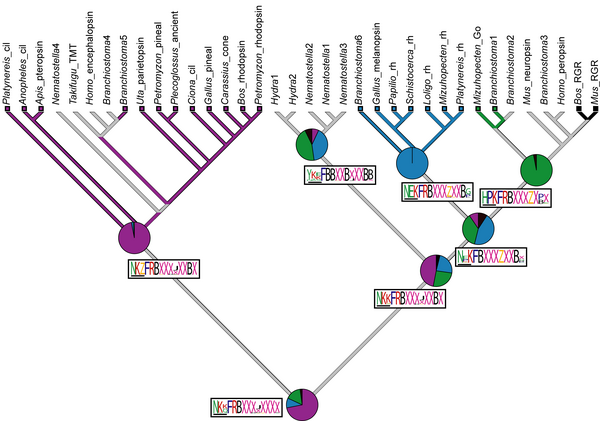
I am putting links here to some of their figures and embedding them in this blog because, well, I can since PLoS One uses a broad Creative Commons license. For example – see Figure 6 from their paper below (the citation is Plachetzki DC, Degnan BM, Oakley TH (2007) The Origins of Novel Protein Interactions during Animal Opsin Evolution. PLoS ONE 2(10): e1054. doi:10.1371/journal.pone.000105).

Figure 6. Ancestral state reconstruction of G protein-binding interactions for each metazoan opsin-mediated phototransduction cascade obtained by simulated mutational mapping [64] (see methods).For each class of opsin, the P value of the reconstructed ancestral G α interactions is represented in pie graphs. Ancestral G protein interactions in phototransduction cascades mediated by ciliary, rhabdomeric and Go opsins can be significantly resolved (P>0.95) but the ancestral states of the rhabdomeric+Go, and cnidops clades are equivocal. ML state reconstructions shown for each node as colored branches. Red, Gi/t; Blue, Gq; Green, Go; Black, no G protein interaction (as is the case for RGR/Retinochrome opsins); Grey, equivocal reconstruction from ML. Reconstructed ancestral amino acid motifs of the 4th cytoplasmic loop region of opsin are shown along branches in logos. Maximum vertical height scales to P = 1.0. We obtained clear reconstructed states for most of the residues in a conserved tripeptide motif (residues 310, 311 and 312, horizontal bar) for the ciliary, rhabdomeric and Go /RGR nodes. For the most part, the remainder of the residues in can be unequivocally reconstructed to the level of Dayhoff classes. B = HRK, X = LIVM, J = GATSP, Z = DENQ..
See also Figure 2

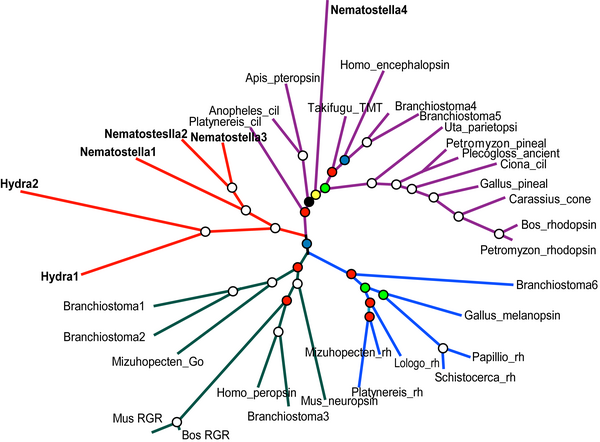
Figure 2. Unrooted metazoan-wide phylogeny of opsins, new cnidarian genes in bold, branches proportional to substitutions per site. Circles at nodes indicate Bayesian posterior probabilities (White = 1.0, Red>0.90, Blue>0.80, Green>0.70, Yellow>0.60, Black>0.50). cil = ciliary, rh = rhabdomeric.”
Science and the presidential election

Nothing really new from me here but saw some good blogs on the topic of science and the presidential election.

Steve Salzberg has summary information and some comments here.
Popular Mechanics has some info here
The ever active Bora has some comments here
Wired has a bit here

My little bit …. I think science is clearly not strongly supported by the current administration. However, scientists need to be careful about how they word things, since in the end, we are asking for money from taxpayers to, well, pay our salaries and pay for our work. This is one of the reasons I am very strongly in support of “open science.” The more open we scientists are, I think, the easier it is to justify to the “public” that we deserve some of their/our money. That is not to say that lots of taxpayer money is not completely wasted on other things. And even not completely open science is frequently good for the world. But openness should help make scientists not seem so ivory toweresque and would show that we want to give back in exchange for what we are given.

More fun at Long’s

OK. Just had to post something because this is getting comical. I went in to Long’s in E. Davis the other day to pick up some prescription refills. I had requested the refills online through the Long’s web site and received an email saying they were reads. When I got in to the store, they told me that the refills were not ready. This is funny because this was about the 15th or so time in a row that my prescriptions were not ready when I was told they would be. One time it was problems with the online system. Another time it was that they needed a new prescription from my Doctor. Sure prescriptions expire and that is not really Long’s fault. But apparently, when my prescriptions expire they decide to send faxes to a doctor I used to have in Maryland, even though I moved over two years ago. I came in like four times once over two weeks and every time they person at the counter would say “We faxed a request to Dr. So and So’ and I would say “That person has not been my doctor for years. My new doctor is Dr. So and So in Davis.” and they would sit there and click away at the keyboard supposedly fixing things and then they would say “OK, we will send it to the new doctor” And then I would come back and the person would say “We faxed your doctor in Maryland but he has not responded”. This happened over and over and over. I began to view it as a game. How many times could I come to the pharmacy and could they get something wrong? The good things was, the people at the Long’s pharmacy were very very nice. The bad thing was, something always seemed to go wrong. For a while I tried to use their automated prescription refill system, but that always went wrong too. So instead now, since I live near Long’s and go to the Nugget all the time, I view my trips to the Long’s Pharmacy as kind of an experiment in how many different ways my prescriptions can get screwed up.

Shameless Self Promotion —- Another Good Review on my New Evolution Textbook

Well, again, here is another shameless self promotion. We got another good review of the new Evolution Textbook on which I am a co-author. This one is by Dan Hartl and was in Nature OK, it is not an Open Access review, but as I have said before, I am obsessed about open access to research articles, not book reviews, etc.

In the review Hartl tells a story about an encounter with Max Delbrück at Cold Spring Harbor where Delbruck implied that molecular aspects of evolution were uninteresting. Hartl goes on to say many nice things about our book (he does get on our case about having problems on the web and not in the book – but hey nobody is perfect). My favorite from the review is the following

Textbooks in evolutionary biology have gen-
erally kept pace with these changes and several
excellent books are available. This new one by
Barton and colleagues is among the best. The
production quality is superb in layout, compo-
sition, typesetting, colour palette, illustrations
and gorgeous half-tones; and the writing is
excellent, as one might expect from such a stel
lar cast of experts in population genetics, palae
ontology, human genetics, bacterial genomics
and developmental biology (respectively).

Thanks Dr. Hartl. And a much belated thanks for a personal encounter that I had with you many years ago where you were MUCH more encouraging to me about working on bacterial genomes than Delbruck was to you about molecular evolution.

Microbial communities highlighted by MIT Technology Review: The Year in Biotech

The MIT Technology review has an interesting piece on the “Year in Biotech”. See Technology Review: The Year in Biotech

The selected key items that they discuss:

  • Personal genomics
  • Microbial communities
  • Stem cells without embryos
  • Brain repair
  • Human genetic variation

Good to see microbial communities getting selected for this type of thing — they are after all the next big thing.

In memory of Sam Karlin

I just got an email telling me that Sam Karlin had passed away. Sam, for those who do not know, was one of the luminaries in bioinformatics and mathematical biology. You can learn a bit more about him by going to this site which relates to a workshop that was help in honor of his 80th birthday.

His passing saddens me greatly. Sam was a curmudgeony guy at times, but also a great scientist and teacher. He was one of my mentors when I was in graduate school at Stanford. I was kind of a fish out of water — trying to learn boinformatics in a lab that studies the cell biology of DNA repair processes. So I took a course from Sam Karlin and Volker Brendel and then spent three years meeting on and off with Sam in his office discussing various aspects of genome and gene sequence analysis. We did not always agree. But I think I learned more about bioinformatics from those meetings with Sam than from anything else I have done in my career.

Sam reminded me a lot of my grandfather (who was a physicist). We would meet to ostensibly talk about RecA (my favorite protein) or DNA composition (Sam’s favorite thing at the time) or evolution or something or other. But Sam turned every meeting into some type of lesson about bioinformatics. We rarely got to our end goal, but that did not really matter.

So – in his honor I am going to start a new section of this blog — the Something about Math in Biology or the SAM in Biology section … stay tuned.

NOTE Lee Altenberg has a memorial page to him, consisting of his doctoral advisor genealogy:

Why "neglected tropical diseases" are going to bite us in the *$&#

Malaria. Chagas. Filariasis. Dengue fever. Onchocerchiasis. Trachoma. Cholera. Leishmaniasis. Yaws. Leprosy.

Neglected tropical diseases. You certainly don’t want to get them (I have had at least one). And they are not as neglected as they used to be with some money being dedicated to them (e.g. from the Gates Foundation) and their own PLoS journal dedicated to them and even famous people blogging about them. The World Health Organization pushes for them to get more attention.

But given that these diseases kill and injure BILLIONS of people and cause untold amounts of economic damage, they clearly still do not get what they deserve, in terms of research dollars and drug development efforts, etc.

Well, listen up people in the non-tropical (a.k.a. developed) world. Even if the “let’s help others” line does not light your fire, you better start worrying about these diseases. That is because many of these diseases are on the march in part due to global warming and will likely soon be a bigger part of our life in the developed world.

There has been lots in the press and web about this but it still seems to get ignored which is why I am blogging about it here. For example see

The thing that reminded me of this issue was a 12/23/07 New York Times article discussing the spread of the tropical virus that causes chikungunya into Europe for the first time.

So, next time you are lingering in Berlin or New York or Moscow and you feel a weird itch. Or have a fever that just won’t go away. Or have strange swellings where you never had them before. Don’t just look for diseases that were once common wherever you are. Start to think about things like Dengue (my favorite, since I have had it). And maybe just maybe, you should start to worry about these things BEFORE you get them. And support efforts to make these diseases not so neglected.

Happy Hollidays Open Access Movement

Well there is damn good news on the Open Access to scientific literature front. President Bush signed the big spending bill today that includes a provision requiring all papers coming from NIH funded work to be made freely available after 1 year. From the Washington Post:

Under the bill’s terms, scientists getting grant money from the National Institutes of Health would now have to submit to the NIH a final copy of their research papers when those papers are accepted for publication in a journal. An NIH database would then post those papers, free to the public, within 12 months after publication.

I am giddy with excitement about this. Congratulations to all who lobbied so hard for this, such as Heather Joseph from SPARC. Her quote from the Post article is helpful here:

“The basic reason we went to bat so hard for this was because we thought it was the right thing to do with taxpayers’ science,” Joseph said. “Now there will be $29 billion in taxpayer investments freely available to the public,” she said, referring to the NIH medical research budget