Eisen Lab Blog

advisor-mmi291 REMINDER: MMI Faculty Recruitment Seminar on Friday, 10/23 at 12:10 PM in GBSF 1005

Medical Microbiology and Immunology

Faculty Recruitment Seminar

Laura Hertel, Ph.D.

Associate Scientist

Center of Immunobiology and Vaccine Development

Children’s Hospital Oakland Research Institute

Oakland, California

Friday, October 23, 2015

Genome and Biomedical Sciences Facility, Auditorium Room 1005

12:10 – 1:00 pm

“Watch your mouth: human cytomegalovirus infection and reactivation in Langerhans-type dendritic cells

Dr. Hertel will be presenting some new, unpublished data on the effects of different maturation stimuli on Langerhans cells’ susceptibility to direct CMV infection and on their ability to support viral reactivation from latency.

Please contact Karryn Doyle for additional information at kddoyle: 530.752.9401

LHertel Seminar Announcement.pdf

The story behind the paper by @JeremyJBarr on phage using mucus to hunt prey

This is a guest post by Jeremy Barr about a new paper of his. Also see his previous post from 2013: Story behind the paper: from Jeremy Barr on “Bacteriophage and mucus. Two unlikely entities, or an exceptional symbiosis? “

———————————————————
The story behind the paper “Subdiffusive motion of bacteriophage in mucosal surfaces increases the frequency of bacterial encounters
Here’s the story behind our recent publication on the subdiffusive motion of bacteriophage in mucus published in PNAS – a manuscript that builds on our Bacteriophage Adherence to Mucus (BAM) model of phage-derived immunity. You can also find a recent write up on the work by San Diego State University (SDSU) News Center here.
Inception
In early 2013, I attended my first Keystone Symposia conference on “Emerging Topics in Immune System Plasticity” in Santa Fe, New Mexico. Apart from the excellent snow conditions, I was beginning to question my decision to attend an immunity conference as an experimental microbiologist, but one of the last presentations at the conference, given by Christopher Hunter from UPenn, stuck with me. The Hunter lab was investigating the ability of CD8+ T cells to control the parasite Toxoplasma gondii in the brains of mice. Using a powerful microscopy system, they were able to watch T cell movement in real time while they were searching the brain for the sparsely distributed parasites. They found the T cells moved in a specific pattern, characterized by many short-distance movements interspersed with occasional longer-distance flight to a new area. This search strategy is known as a Lévy flight, and it allowed the T cells to more effectively search an area of the brain for hiding Toxoplasma than if they searched by directed or random motion (see paper here). Once I saw this talk, the idea behind our paper was planted. I knew that by adhering to mucus, bacteriophage could also use this strategy to hunt bacteria, but it wasn’t until a couple of years later that I was able to test this hypothesis.
The makings of a microfluidic mucus layer.
During this time, I had been reading a number of papers that were reconstituting organ-level functions on microfluidic devices, making simulated lung or gut environments.

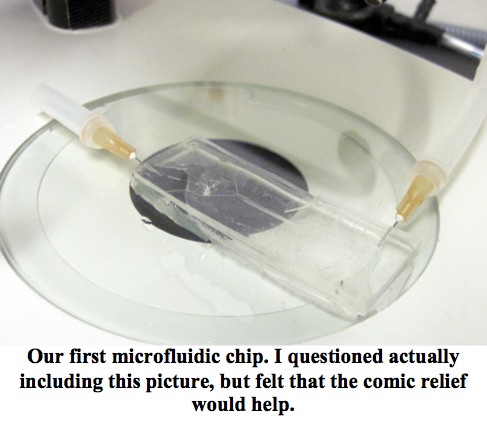
Recognizing the potential of these systems, I began working with Samuel Kassegne and his Masters student Nicholas Sam-Soon in the Department of Mechanical Engineering at San Diego State University (SDSU) to develop our own microfluidic ‘chip’ aimed to simulate a mucus layer with fluid flow and secretion dynamics. I had no idea how difficult this endeavor would be. Our first chip was as close to a complete failure as one could get. The device leaked, it was dirty, and I had the bright idea that we could simple poke a syringe into the chip to set up fluid flow.

But we persevered. We continually solved problem after problem, with every solution leading to new problems, be it leaks, growths, or cracks in the chip. Two years and a Masters thesis later, the system was finally working at a useful throughput for us to experimentally test. We could now run up to nine chips simultaneously and immediately set out to recapitulate our prior results – that mucus-adherent phage protected mucosal epithelium from bacterial infections.
What we found from these experiments was quite surprising. Firstly, I should explain that the model system we were using was phage T4, a strictly lytic phage that infects and kills Escherichia coli that we previously showed was capable of adhering to mucus, and a T4∆hoc phage that is equally capable of killing E. coli but lacks the capsid proteins required to adhere to mucus. When we infected the chips with E. coli bacterium and the non-mucus adherent T4∆hoc phage, we found that these phage-treated chips were no better at reducing bacterial abundance in the mucus layer compared to control chips where no phage had been added at all. Meanwhile, the mucus-adherent T4 phage was capable of reducing bacterial colonization in the mucus by over 4000-fold. We next investigated whether differences in phage accumulation or persistence in the mucus could explain this stark difference, but we found no effect. The question remained, why were the mucus-adherent phage better suited at finding and reducing bacteria in mucus than the same phage that could not stick?

Weekly math meetings to the rescue
For the last four and a half years I have been extremely fortunate to have the opportunity to work as both a post-doc and now an adjunct faculty in Forest Rohwer’s lab at SDSU. During that time, one of Forest’s many punishments for me was compulsory, weekly Bio-Math meetings, which are still being run here at SDSU. These meetings were something that I initially rebelled against – what good could math do me? But as I unwillingly persisted, I came to realize the value in using math to describe biological systems. This is especially true for phages that play the game of life at a speed and scale that is at times incomprehensible.
Over time, I came to have my own weekly math meetings with a group of SDSU mathematicians, statisticians, and physicists. I owe a big thanks to Peter Salamon, Arlette Baljon, Jim Nulton, and Ben Felts, who all took countless hours out of their days to meet with me and discuss the complexities of diffusion. During these meetings we analyzed hundreds of thousands of data points detailing phage diffusivity in mucus, and eventually we answered the question as to why mucus-adherent phage were better at reducing bacterial numbers – the phage were employing a search strategy to hunt bacteria in mucus. But this search strategy was not the same as the Lévy flights I had seen the T cells use at the conference talk years earlier. This was something different, something that no predator had been shown to utilize before. Our phage were using a type of motion know as subdiffusion.
Phage are like ticks in a grass field
We found that phage that adhere weakly to mucus, through reversible binding interactions to one or more mucin strand, exhibit subdiffusive motion, not normal diffusion, in mucosal surfaces. The question now was what that means for the phages. What benefit could subdiffusive motion provide?
Subdiffusion is a very abstract concept that is difficult to explain without mathematical formula, and we spent many hours discussing the possible biological implications. Subdiffusive particles move slower and slower over time, remaining in their original positions longer, and in certain models the chance of finding a nearby target is significantly increased. Using similar logic, we hypothesized that mucus-adherent phage moved slower in specific regions of the mucus layer, remained nearby sites of productive bacterial infections, and concentrated in regions of the mucus that overlapped the niche of their bacterial host – all resulting in a greater chance for the phage to encounter a bacterium. Now we just had to prove it.

One of the beautiful things about phage biology is the detailed and expansive literature published over the last 100 years. Going back through these papers, we found a classical phage experiment that was first published in 1932 by Martin Schlesinger. This experiment measured the adsorption rate of a specific phage to its bacterial host. Using this assay, we showed that phage adsorption rate was increased in mucin solutions at low, but not high, bacterial concentrations. The logic here is that when bacterial hosts are abundant, the chance of a random phage-host encounter is high, and any improvement in the search strategy employed doesn’t provide a noticeable benefit. But when bacterial abundance is low and chance phage-host encounters are comparatively low, performing a more efficient search can greatly improve the chances of a successful infection.
The implications here become apparent when we consider that phages are typically quite specific and that mucosal surfaces harbor a large diversity of bacterial hosts – dynamics that reduce the chance of any successful phage-host encounter. From the perspective of the phage subdiffusing within a mucus layer, the world is a three-dimensional web, and like ticks in a grass field, the phage are holding onto the mucus network, awaiting a bacterial host.
The publication process
I presented this work at another Keystone Symposia on “Gut Microbiota Modulation of Host Physiology” earlier this year. During one of the conference dinners, an editor for Science happened to join the table where I was seated. We started speaking and they suggested that I submit the work for review at Science. At the time, I was reading Steven Pinker’s The Sense of Style and wanted to write the paper in ‘Classic Style’ to simply explain phage subdiffusion and appeal to a broader audience. I was very fortunate to be able to work once again with Merry Youle. We wrote a very stylized paper for Science, but after a two-week internal review we were told that although the work would likely be of great interest to the field, it was not broad enough for their general readershipSo we quickly edited the paper and sent it to PNAS for review.
Our reviewers from PNAS were very helpful and suggested a number of experiments that strengthened the work, but they all hated the writing style and asked us to cut out many of the phage anthropomorphisms we had used (e.g., phage hunting bacteria). We spent another three months collecting and analyzing additional data and rewriting the paper, now with a more serious tone (e.g., search strategies instead of hunting). Overall, I felt our resubmitted paper was much stronger scientifically, even though it lost some readability. But the paper was still not accepted, and we had to go through a third revision. The final reviewer insisted on us including in vivo experiments (not something we could easily do for this paper, but we’re working on it) and continued to argue that the use of ‘search strategy’ obfuscated phage subdiffusion in mucus. Although we disagreed with this final point, the thought of going through another review was enough for us to concede, and we removed the use of this term from the paper. The rest of the editorial process was handled extremely well and we were in press at PNAS just three weeks later.

At #UCDavis today: Vance Vredenburg: ‘Amphibians at the forefront of the Sixth Mass Extinction’

Dr. Vance Vredenburg will be speaking on ‘Amphibians at the forefront of the Sixth Mass Extinction’ at 4:10pm in 176 Everson Hall today, Thursday Oct 22.

Dr. Vredenburg is a leading amphibian conservation ecologist, and an Associate Professor at San Francisco State University. He earned his doctorate at U.C. Berkeley.

All are welcome to attend his ‘no-host dinner’ at 5:30 (location to be announced at the seminar). Also, grad students/postdocs who responded to the lunch invitation are reminded to attend, 12 noon in 1017 Wickson.

Here is a copy of the information from his website: http://biology.sfsu.edu/people/vance-vredenburg

“ Vance Vredenburg was raised in Mexico and the United States. His scientific training began as an undergraduate at the University of California Santa Barbara where he worked on ecological research projects in coastal California, Alaska, the Caribbean and Antarctica. His Ph.D. from the University of California at Berkeley (2002) included whole-lake experiments that showed recovery of declining frogs in the Sierra Nevada, California after removal of introduced trout. His current research focuses on the impacts of emerging infectious amphibian disease (e.g. chytridiomycosis), the phylogeography of amphibians (using genetics, morphology, and mating behavior), and climate change impacts on aquatic food webs using stable isotopes. Vredenburg is the co-founder of AmphibiaWeb (www.AmphibiaWeb.org), an online conservation resource for the world’s amphibians. His research is currently funded by the National Science Foundation and seeks to understand how some populations of frogs survive epidemics. Vance Vredenburg is a research associate at the California Academy of Sciences and the Museum of Vertebrate Zoology.”

Asst. Prof. in Quantitative Ecology at UCSB h/t @seb_schreiber

Posting this which I got from Sebastian Schreiber

Assistant Professor Quantitative Ecology, UCSB

The Department of Ecology, Evolution and Marine Biology (EEMB; www.eemb.ucsb.edu) at the University of California, Santa Barbara invites applications for a tenure-track faculty position in Quantitative Ecology, at the rank of Assistant Professor. We are searching for a highly creative and interactive scholar who fits into our multidisciplinary department. The area and system of study are open, although we are most interested in candidates who will address fundamental topics in ecological theory through the use of modeling and analytical approaches. We encourage applications from candidates who adopt an integrative approach in their research.

The candidate is expected to have or develop an internationally recognized research program, mentor graduate and undergraduate students in the candidate’s area of expertise, and teach both graduate and undergraduate courses. This position requires a PhD at the time of appointment.

Applicants should submit: 1) a cover letter, 2) a curriculum vitae, 3) a statement of research that covers research accomplishments and future plans, 4) a statement of teaching experience and interests, 5) three selected publications, and 6) letters of recommendation from three to four persons with the ability to evaluate the candidate.
EEMB is especially interested in candidates who can contribute to the diversity and excellence of the academic community through research, teaching and service.
Submit applications electronically at: https://recruit.ap.ucsb.edu/apply/JPF00583
Review of applicants will begin November 25, 2015 and will continue until the position has been filled.

The University of California is an Equal Opportunity/Affirmative Action Employer and all qualified applicants will receive consideration for employment without regard to race, color, religion, sex, sexual orientation, gender identity, national origin, disability status, protected veteran status, or any other characteristic protected by law.

Beware of mimicry in #OpenAccess journals

Wow – just got this email from a new journal soliciting papers:

Dear colleagues,
we are pleased to announce that the call for papers for the Special Issue “Molecular Phylogenetics 2016” is now open with the BioMed Research International
journal.
The scope of the Special Issue covers:
•  Evolutionary genomics
•  Molecular phylogenetics and systematics
•  Molecular dating, inferring complex scenarios of coevolution, reconstruction of complex ancestral traits and events in genome evolution
•  Development and phylogeny (evo-devo)
•  Models and algorithms for molecular evolution
•  Applied phylogenetics: genotyping and barcoding of biological objects, molecular anthropology, molecular epidemiology, forensic science, etc.
•  Molecular ecology, biodiversity, and biogeography
All submissions go through the peer-review process. The journal publishes research and review articles with no page limit. It is an Open Access journal, and
fixed article processing charges apply to accepted manuscripts (www.hindawi.com/journals/bmri/apc). The journal is indexed by all major abstracting and
citation systems.
Important deadlines:
Manuscript due: 26 February 2016
First round of reviews: 20 May 2016
Publication date: 15 July 2016
Earlier manuscripts will be processed for review upon submission date. The Editors team is making all effort to provide for a fast and friendly review
process.
Detailed information on the Call-for-Papers is available online at http://www.hindawi.com/journals/bmri/si/295862/cfp.
Contents of the Special Issues 2013 and 2014 are available online at http://www.hindawi.com/journals/bmri/si/585782 and
http://www.hindawi.com/journals/bmri/si/392635.
We welcome all contributors interested in submitting their research.

With best regards,
the Editors team of “Molecular Phylogenetics 2016”

Whatever you think of Hindawi as a publisher (I am skeptical) the name “BioMed Research International journal.” struck me as very strange.  It seems like a mimic of Biomed Central.  So I googled around and found others who also think it is a mimic (and not in a good way).  For example see Jeffrey Beale from Sept 2014: New Predatory Publisher Copies Look and Feel of BioMed Central.

Yuck.  The name appears to be a clear attempt to confuse authors that they are affiliated with Biomed Central.  And the format and look appears to be doing the same too.  So thus Hindawi has moved from my “maybe a spammy predatory publisher” to “definitely a spammy predatory publisher” list.

#UCDavis Provost’s Forum 10/21 “Universities, Hospitals and the Social Good” w/ Julie A. Freischlag & Glenn Richard Olds

Dear UC Davis Faculty, Staff, Students and Community Members,

We are delighted to announce that the first lecture in the 2015–16 season of the Provost’s Forums on the Public University and the Social Good will take place on Wednesday, October 21, 2015.

The first lecture of the season, titled “Universities, Hospitals and the Social Good,” features Julie A. Freischlag, Vice Chancellor for Human Health Sciences and Dean of UC Davis School of Medicine, and Glenn Richard Olds, founding Dean of UC Riverside School of Medicine and President of St. George’s University. Our speakers will talk about the complex and interconnected relationship between medical schools and the hospitals and other clinical settings that they rely on to train medical students. Dean Freischlag will discuss the benefits and challenges of partnerships between universities and hospitals, as well as share insights on opportunities for mutual success during a time of intense change in health care and health education. Dr. Olds will discuss how the new medical school at UC Riverside was built around community needs, using the community’s resources as a teaching platform. He also will discuss his work on replicating this model on a national scale in his new position as the President of St. George’s University in Grenada.

The event will take place at the Kalmanovitz Appellate Courtroom in King Hall (UC Davis School of Law) from 3 to 4:30 p.m. with a reception to follow until 5 p.m. Light refreshments will be served.

For more details about this event, please see the attached flyer or contact Francis Santos​.​

In addition, please forward this information to any interested parties, as all events are free and open to the public.

Freischlag & Olds_10-21-15.pdf

Wrap up of #WiSTEMspotlight: How Men Can BE Allies for Women in STEM: Bridging the Gender Gap.

Thanks to Digital Science and Laura Wheeler for inviting me to participate in this amazing forum yesterday on Ada Lovelace Day on “How Men Can BE Allies for Women in STEM: Bridging the Gender Gap.” I participated via Google Hangout (everyone else was in London).  It was an inspiring conversation … see more about the event in the Storify made by Digital Science below:

I cannot wait: Rachel Whitaker is coming to #UCDavis 10/29 to talk about viruses in microbial populations

Dr. Rachel Whitaker

Associate Professor of Microbiology

University of Illinois at Urbana-Champaign

“What Won’t Kill Me Makes Me Stronger: Expanding the Role of Viruses in Natural Microbial Populations”

Thursday, October 29, 2015

4:10 p.m.

1022 Life Sciences

Host: Scott Dawson

(scdawson)

(If you wish an appointment with the invited speaker, please contact the host.)

Today at #UCDavis: Claudia Schmidt-Dannert on Natural Products from Fungi

Just got sent this … looks like it should be good (although am annoyed at the use of the term "higher")

Tuesday, October 13, 2015 4:10 PM

179 Chemistry

Host: Justin Siegel

refreshments in Room 172 before the seminar

Prof. Claudia Schmidt-

Dannert
Dept. of Biochemistry University of Minnesota

“Uncovering the Natural Products Potential of Higher Fungi (Basidiomycota)”

CSchmidt-Dannert10.13.2015Siegel.pdf

Genome Engineering #GESB16 in Gent – for Men Only #YAMMM

So I just got an invite to this meeting:

Looks interesting.  Not that I work in the field.  But I decided to check it out.

So I went to the website.

Blech.

Here are screenshots of the “Top Speakers”

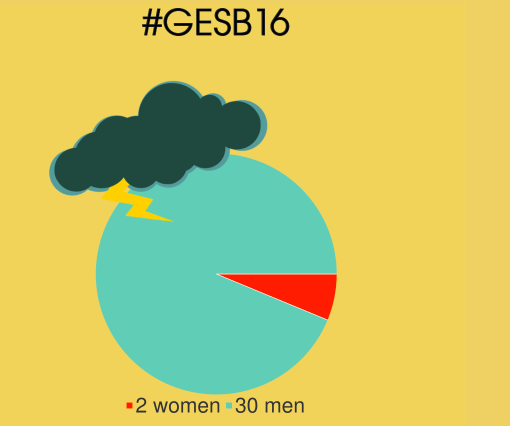
32 speakers.  30 of which are men. *

That comes to 6% female, 94% male.  Not a good thing.  Shame on VIB Conferences and shame on the sponsors

I plan to send complaints to these sponsors to let them know I do not believe they should be sponsoring a meeting with such a clear gender bias.  
I also am going to register the meeting at Gender Avenger.

* I realize it is not always possible ot identify people’s gender from names and appearances.  I looked up.  I looked at all the more detailed descriptions of the speakers to see how they were described (as in, what pronouns were used).

UPDATE 11-28-2015