We introduce ourselves asARC Publications PVT LTD(Academician’s Research Center) is a premier international, open access, publisher with Hyderabad, India as its head quarters diffusing across the globe covering European, Western and Asian nations. Our primary objective is to publish quality research that undergoes a thorough scrutiny process while giving creative freedom to the researcher.
This is to bring to your kind notice that we are in the process of recruiting eminent people as Editorial Board Members for our ARC Journals of Immunology and Vaccines (AJIV). It is an Open Access, Academic, Peer-reviewed, quality journal that publishes unbiased original research in the field of Immunology and Vaccination. We cordially invite you to take the role as Editorial Board Member to be part of our Journal.
We would request you to submit a manuscript or a two page Editorial article to encourage our journal as we would like to release our first issue with our Journal Editorial Board Member’s articles. We request you to invite your colleagues/ Expertises/ Students to publish your the scientific/ research work with us.
Kindly send us your Resume, Bio data and Photograph for our Editorial office purpose. Your Resumes and Manuscripts could be submitted at editor_ajiv@arcjournals.org.
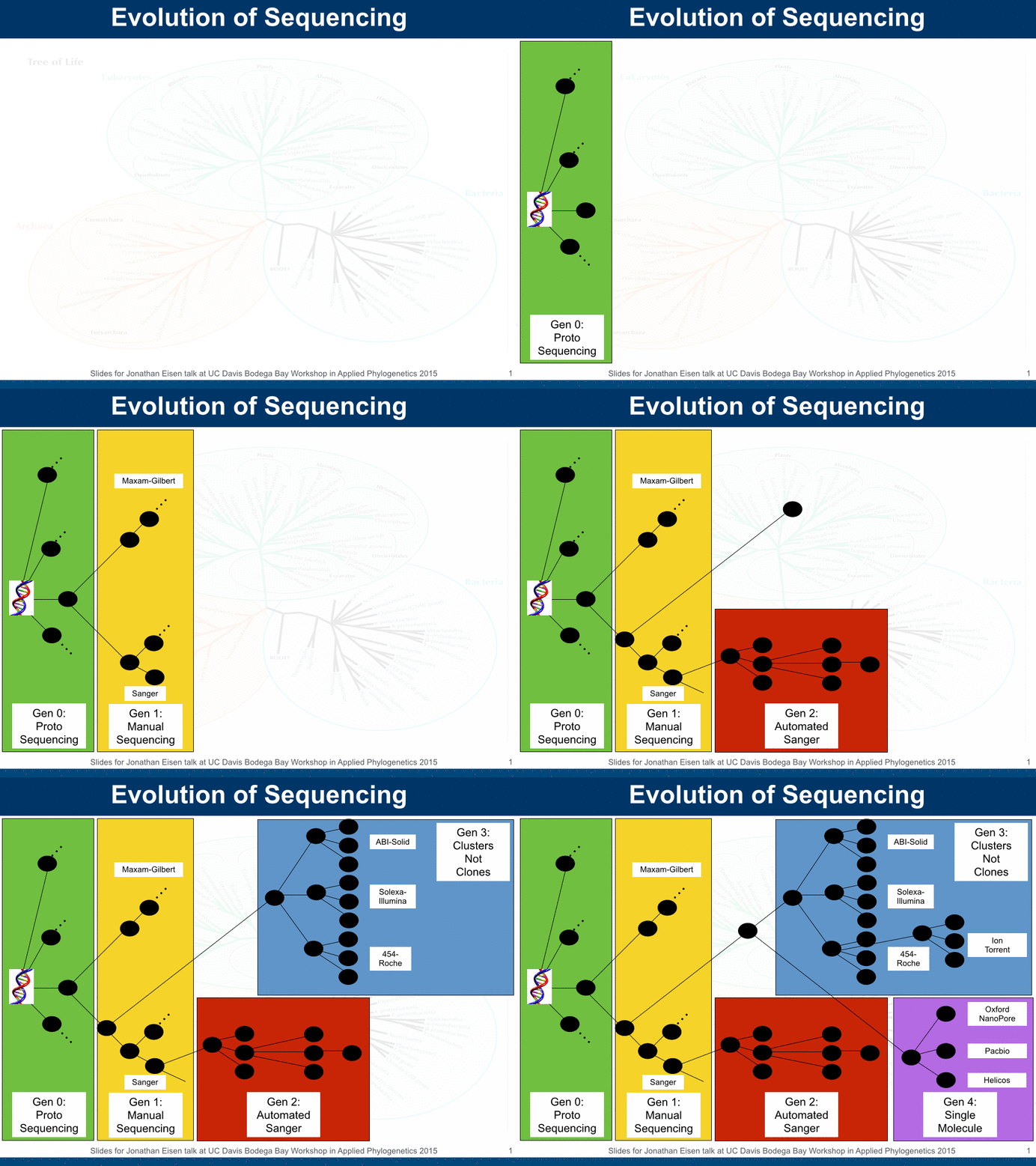
Every year for the last few years I have given a talk on the “Evolution of DNA Sequencing” at the “Workshop in Applied Phylogenetics” at Bodega Bay Marine Lab. I just did the talk and thought I would post the slides here. I note – I also added an evolutionary tree of sequencing methods which I include here as a separate animated gif too.
I note I posted a request to Twitter the day before the talk pointing to last years slides and I got lots of helpful suggestions from people about what to add or change. I included links to Tweets in the talk and thanked those people on the slides. But I would like to thank everyone here too. Published originally on March 10, 2015. Updated 10/20/15 with information below and republished. Finally posted the video of the talk (recorded using Camtasia) to Youtube. It is imperfect (there are a few things I said that came out wrong .. it was late at night). But since it may be helpful to people I am posting it.
This Thursday’s EVE seminar speaker will be Megan Frederickson from the University of Toronto. Megan studies the evolution of cooperation and cheating in mutualisms, and the consequences of diversity for cooperation. To tackle these topics, Megan uses interactions between insects, ants, and microbes. See her website for more info.
Megan’s talk is titled "Mutualism ecology and evolution: moving beyond cheating," and will be at 4:10 in Everson 176.
If you would like to meet with Megan, please email me (amobrien) to coordinate a time.
There will also be a graduate student lunch at 12:10 in 1017 Wickson Hall, please RSVP (amobrien) if you plan to attend.
Also, as a "trailer" for the talk, check out Megan’s work on Devil’s Gardens featured in BBC’a Life in the Undergrowth, narrated by David Attenborough (first segment of: Intimate Relations).
A landmark study has illuminated the presence of specific microbes on the ISS strongly suggesting that humans might be on board the spacecraft. In a routine survey of one air filter and more than one (two) of the vacuum bags used to clean the station, the researchers arrived at unexpected results – the amount and type of microbes found on the ISS are in stark contrast to those found on the meticulously scrubbed and disinfected NASA clean rooms* back on Earth. Furthermore, these microbes on the ISS seem to resemble those found in association with humans.
Experts say that if these microbes came from a human, it is entirely possible that they could live on another human. A major worry is that the astronauts and cosmonauts expected to continue living and working now on the ISS might be living with bacteria, which have been known to cause disease in the past. It is therefore now the topmost priority to figure out which pathogens are there and how on (from?) Earth they arrived.
Microbial forensic experts are being called in to analyze the unique “fingerprint” signatures of the microbes left behind, in the hope of identifying the suspects these potential pathogens came from. Preliminary findings have urged officials to focus their search on anyone who has recently eaten space-grown lettuce. Next steps to understanding what is influencing the microbes on the ISS include analyzing the effect of a human breathing, eating, washing hair, sneezing, farting, playing the guitar or performing any other act as might be expected of these hypothesized ISS inhabitants. Due to the limited knowledge of the on-goings of the station, the public is being asked for any information they might know of regarding such activities.
*Designed to eliminate the spread and survival of microorganisms.




 Jonathan Eisen's Lab