Eisen Lab Blog

Center for Population Biology Fall 2015 Seminar Series

Please find attached the Fall Quarter 2015 CPB Tuesday Seminar Schedule.

Seminars will be held as usual, 4:10pm in 1022 Life Sciences.

Please note that the series starts just prior to the actual first day of Fall Quarter ’15 instruction. So the first seminar is this coming Tuesday, September 22nd with Alisa Sedghifar’s PhD Exit Seminar.

CPB Seminar Series FALL 2015.pdf

Roundup of microBEnet posts of (possible) interest

I spend a decent amount of my blogging time these days writing posts for microBEnet (the microbiology of the built environment network) which is part of a project funded in my lab by the Sloan Foundation.

Some recent posts that may be of interest are listed below:

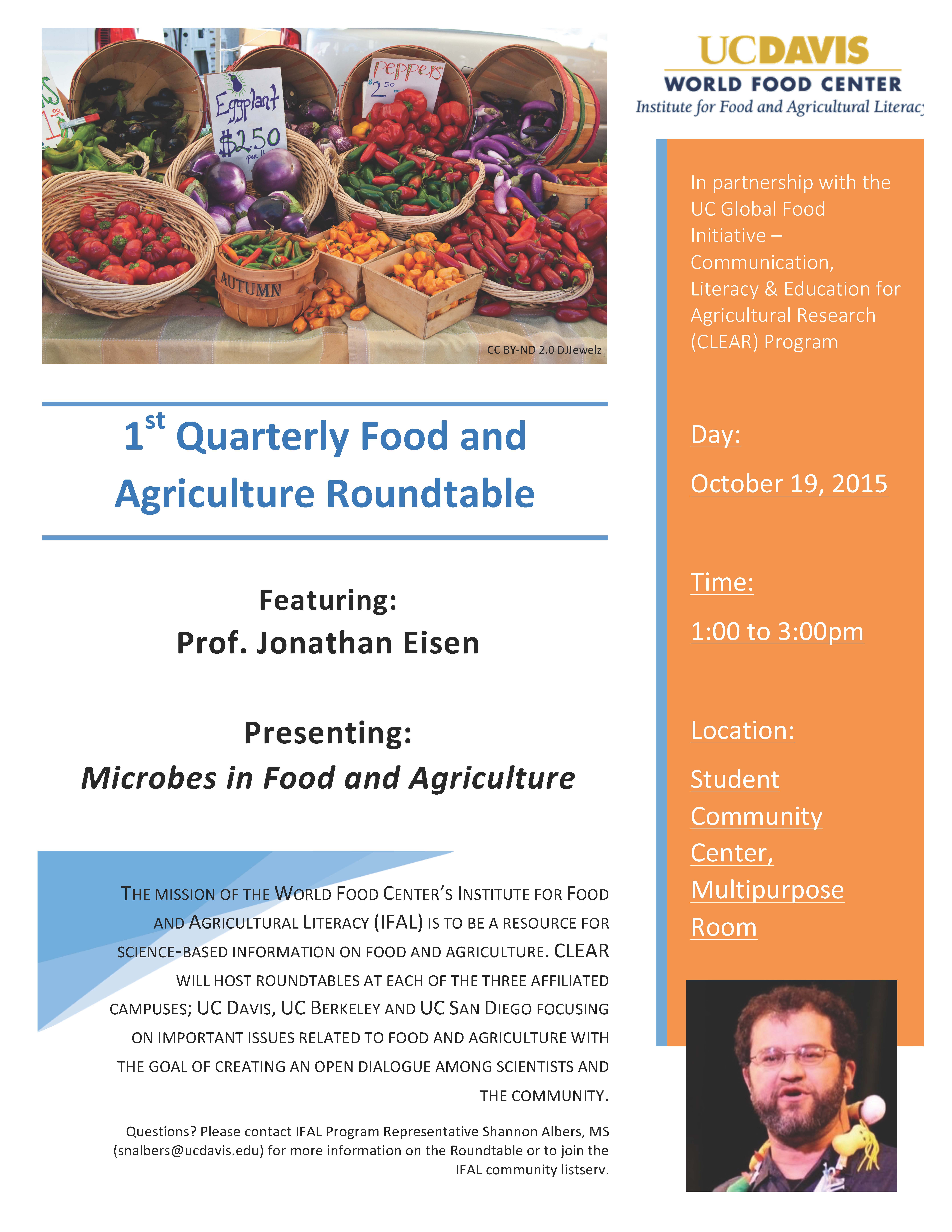
10/19 in #DavisCA: 1st Quarterly Food and Agriculture Roundtable

For those in or near Davis, CA

Block the date – this will be awesome

October 19, 2015

1:00 to 3:00pm

Student Community Center, Multipurpose Room

Jonathan Eisen

1st Quarterly Food and Agriculture Roundtable

Discussion of Microbes in Food and Agriculture
including a discussion of glyphosate and microbiomes

Eisen Roundtable Flyer .pdf

Free workshop at #UCDavis: “Microbial genomics and transcriptomics hands-on”, Sep 24-25

Was informed of this by Titus Brown, one of the instructors.  Info copied from here.

Microbial genomics and transcriptomics hands-on, Sep 24-25

Who: Ben Johnson (Michigan State University); Tracy Teal (Data Carpentry); C. Titus Brown (UC Davis).

Host: C. Titus Brown

When: Sep 24 and 25, 2015

Times: 9am-3pm on both days

Where: TBD (UC Davis campus).

Cost: there is no fee.

This workshop is open to everyone, including graduate students, postdocs, staff, faculty, and community members. We have extra space for UC Davis VetMed affiliates; contact the host if you are an SVM affiliate.

> Register here <

Description

This two-day hands-on workshop will introduce biologists to microbial genomics and transcriptomics. The primary focus will be on genome assembly and annotation, and subsequent transcriptome analysis, of bacteria.

We will be analyzing a stock data set, and we will be using the Amazon cloud.

Topics overview

  • Logging into the Amazon Cloud
  • Short read quality and trimming
  • Genome assembly (with SPAdes or MEGAHIT)
  • Genome annotation (with Prokka)
  • RNAseq analysis
  • Differential expression analysis

Computer requirements

Attendees will need to bring a computer with a Web browser, an Internet connection, and an ssh client; Windows users should install MobaXterm before the workshop.

LICENSE: This documentation and all textual/graphic site content is licensed under the Creative Commons – 0 License (CC0)fork @ github. Presentations (PPT/PDF) and PDFs are the property of their respective owners and are under the terms indicated within the presentation.

Temporary lecturer postion for “Introduction to Evolution” at @UCDavis

LECTURER

Introduction to Evolution

(EVE 100)

WINTER 2016 (January 4-March 19, 2016)

Responsibilities: A 60% position teaching EVE 100 – Introduction to Evolution (4 units). Lecture–3 hours, Discussion–1 hour. The course subject provides a general survey of the origins of biological diversity and evolutionary mechanisms. Estimated enrollment: 200

Requirements: Ph.D. and demonstrated effective teaching in the subject course or equivalent course.

Salary: Commensurate upon qualifications.

Please submit letter of application, including summary of qualifications, CV, two letters of recommendation, any applicable teaching evaluation summaries, and a statement of contributions to diversity via the link below link which contains additional information about the position.

https://recruit.ucdavis.edu/apply/JPF00709

OPEN UNTIL FILLED. FOR FULL CONSIDERATION APPLICATION MUST BE RECEIVED BY OCTOBER 12, 2015.

This position may be covered by a collective bargaining unit.

The University of California is an Equal Opportunity/Affirmative Action Employer with a strong institutional commitment to the development of a climate that supports equality of opportunity and respect for diversity.

09/08/2015

Winter 2016 EVE 100 Lecturer Ad.pdf

Today’s awful overselling of the microbiome – Robynne Chutkan on libido

Well, this is just plain awful Are Antibiotics Ruining Your Libido? – The Daily Beast.  In this article, Robynne Chutkan argues that people’s sex drives may be being ruined by antibiotics.  And she presents zero evidence for this other than handwaving.

Some things in this article that are inaccurate:

We’ve spent most of the last century figuring out how to eradicate our microbes, and we’re just now realizing that the vast majority are friends rather than foes that actually play a vital role in keeping us healthy.

No – the “vast majority” of microbes are not known to be our friends or to play a vital role in keeping us healthy.  Certainly, microbes and microbiomes do contribute to our health and well being.  But to say the “vast majority” are beneficial is, well, just silly.

How about this section:

Most of the patients I see suffer from manifestations of an imbalanced microbiome—a condition known as dysbiosis. Some of the signs and symptoms are localized to the GI tract, like bloating and gas; but others, including yeast infections, brain fog, fatigue, rashes, joint pain, anxiety, food cravings, allergies, and autoimmune disorders, reflect the universal role our microbes play in preventing disease

Well, based on this statement I would certainly recommend nobody see Dr. Chutkan for any of their medical treatment.  What exactly is the evidence “brain fog” is caused by dysbiosis?  Or fatigue?  Or anxiety?  Or food cravings?  (Yes, I agree that some of the other things listed have been shown to be affected by the microbiome, but each of these (e.g., allergies) is influenced by many many factors and as far as I know there are no scientific studies that show that one can look at people suffering from any of these ailments and determine if their microbiome has caused their problems or not.

And then there is the discussion of microbiomes, antibiotics and sex life:

And what’s more, a healthy, balanced microbiome is essential for a healthy, satisfying sex life.

and

But there’s another alarming, but hidden epidemic of dysbiosis that’s occurring, and it may be wreaking havoc on your sex life. It’s the common practice of taking antibiotics after intercourse to prevent urinary tract infections (UTIs).

She then goes on to discuss issues in cystitis and UTIs and infections and the vaginal microbiome.  Yes, the vaginal microbiome is important.  And yes, antibiotics and affects the vaginal microbiome, both in positive and negative ways.  So – I do think we should be concerned with overuse of antibiotics and how that affects microbiomes.  And we should be concerned with overuse in the context of UTIs.  But does that concern allow us to oversell the science?  I don’t think so.  The worst part of this whole story relates to this issue:

If you’ve been using antibiotics to prevent post-coital UTIs and you’re finding that sex is less enjoyable than it should be, your vaginal microbes might be in need of some rehab. I recommend a three-pronged approach of avoidance, encouragement and repopulation

and

It may take some time before you see meaningful results, but this approach offers the possibility of real and lasting relief, rather than an antibiotic quick fix that ultimately ends up being ruinous to your sex life. 

The problem with this is that she presents no evidence that alterations int he microbiome affect libido or sex life and no evidence that her recommended solutions (e.g., probiotics and prebiotics) help with such symptoms.  So, yes, overusing antibiotics is a risk we should limit as much as possible.  But no, lets not glorify microbiomes and overcritique antibiotics by making people worry about their sex drive and sex life without evidence.  That is not helpful and could be harmful.  For this I am giving Robynne Chutkan a coveted overselling the microbiome award.

For more on this award see here.

From 1988 to 2015 – how Jennifer Doudna shaped my career (and now science and society)

Well, yesterday was really fun.

In college, I switched from being an East Asian Studies major to being a Biology major in my sophomore year but had no idea what aspect of biology I might focus on.

Then I took a course that changed my life. The course was taught by a PhD student at Harvard and it was a kind of supervised reading class. The course was a full year class with weekly meetings to discuss various papers and news stories and such.  The topic was “The Origin of Life: Catalysis in Evolution” and it covered things like chemical evolution, catalytic RNA, the RNA world, introns, Lamarck vs. Darwin, and more.   The course syllabus is posted below:

 
This course changed my life in multiple ways.

First, in the course I learned how to critically read scientific papers. A very important skill. And also I got introduced to the world of catalytic RNA and also the world of “Cairnsian Mutation” which became the topic of my grad. school applications, my NSF predoctoral fellowship application, and the first two years of my PhD work. And I also got introduced to the work of Norm Pace.

This led me to seek out ways to combine my interest in ecology and evolution with molecular biology, which in turn led me to joining the lab of Colleen Cavanaugh and starting work on culture independent DNA studies of microbes.

Anyway, I could go on and on. But this course was transformative. Over the years I had heard about the student who had taught the course and her work, but had not actually seen her in person until yesterday.

The course instructor was Jennifer Doudna. And yesterday I got to see her talk about her work on CRIPSR and CAS9 systems. She has already won a large number of prizes for her work on this, and likely more to come. I cannot say I am surprised. Though I had many teachers at Harvard who were famous, and some of whom were also great teachers and researchers, I can say without a doubt that the one who impressed me most was Doudna. Her passion for science, for biology, for teaching, for being critical while reading articles, and for just wild things that organisms do, was contagious. So cool to see what she is doing now.

Anyway – I made a Storify of the Tweets (mostly mine) from her talk. Check them out below:

Postdoc in Ecological Plant Transcriptomics and Microbiome Analysis

DearColleague_Postdoc_2015.pdf

A worthy cause: Help fund a "Patient Centered Probiotics Reference"

UPDATE 8/27/15 – May have had a brain cramp on this.  See comment from Richard Jefferson.  Not sure this is in fact a worthy cause.

As many know I expend a lot of energy railing against overselling of the microbiome. And one aspect of this is the misinformation that is out there regarding probiotics. Well, this looks like it might help provide an antidote to some of the BS that is out there: (function() { var d = document, fr = d.createElement(‘script’); fr.type = ‘text/javascript’; fr.async = true; fr.src = ((d.location.protocol.indexOf(‘https’) == 0)? ‘https://s-&#8216; : ‘http://&#8217;) + ‘static.fundrazr.com/widgets/loader.js’; var s = d.getElementsByTagName(‘script’)[0]; s.parentNode.insertBefore(fr, s);})(); This is a crowdfunding effort to create a curated resource with information on scientific studies of probiotics.

Powered by FundRazr

From their site:

In his book, “Follow Your Gut”, Dr. Rob Knight cited several examples of how your gut microbes can affect your mood, the functioning of your immune system and inflammatory diseases. He suggests that you consult your physician or pharmacist to recommend probiotics that have randomized, placebo controlled trials backing them or failing that, you can survey the latest research published in scientific journals yourself. I know this is not a simple task for the regular consumer. A master reference of probiotics that you can refer to when making decisions on what products to purchase would be a handy thing. Dr. Knight notes in his book, that “…no patient centered resource exists that compiles this data.” If someone were to go ahead and do a google search for this information, you’d have to wade through a lot of marketing material from companies trying to sell you stuff. By focusing on the peer reviewed scientific literature, we eliminate all the marketing material. The research reports are then read and summarized by our scientists (curators) who put it in our reference database in a language you don’t need to be an expert to undestand. My colleague, Dr. Stephan Schurer, of the University of Miami Medical School, and I have built databases as tools for researchers to search for new drugs. We built these by extracting & summarizing research published in scientific journals. We propose to use a similar approach to build the probiotics reference. The money we raise will go to purchasing subscriptions to the scientific journals (like Journal of Gastroenterology and Gut Pathology) so that we can download the relevant research articles. It also goes to pay the part time curators who will read the journals and enter the key information into the database and lastly it goes to the costs of hosting a website and licensing of necessary softwares. Please help us in any way you can. We greatly appreciate monetary pledges, but also we need you to tell your friends and spread the word about our project.

Definitely seems like a worth project

Seminar at #ucdavis 12/26 – Dr. Rebecca Hernandez on Global Change in Aridlands

RHernandez-SeminarAnnouncement-landscape.pdf