Eisen Lab Blog

New NSF funding opportunity: Cracking the Olfactory Code – An Ideas Lab Activity

Not that I do anything related to olfaction … but this NSF Ideas Lab system at least seems interesting … though not sure how well it actually works. See email I just received from NSF below:
Dear Colleagues,

A new NSF program solicitation (NSF 15-547) is now available:

Cracking the Olfactory Code
— An Ideas Lab Activity

Please see

http://www.nsf.gov/funding/pgm_summ.jsp?pims_id=504773&org=DMS

for details.

Due Date for Preliminary Proposals (required): May 1, 2015

Harold Varmus stepping down from the National Cncer Institute

Begin forwarded message:

From: "Exec Sec1 (NIH/OD)" <EXECSEC1>
To: List NIH-ALL-STAFF <NIH-ALL-STAFF>
Subject: Important Announcement from the Director, NIH – Dr. Varmus to Step Down as NCI Director
Date: March 4, 2015 at 4:41:23 PM EST

Dear Staff,

After nearly five years as director of the National Cancer Institute (NCI), Harold Varmus, M.D., has announced plans to step down from his post at the end of this month. I am deeply indebted to Harold for returning to the National Institutes of Health (NIH) to run the NCI, after having previously served as both the NIH director and president of Memorial Sloan-Kettering Cancer Center.

For the last five years, we at the NIH have had the distinct good fortune of having one of the world’s best minds focused on how to use science to fight cancer. Who better than Harold Varmus, who won the Nobel prize for discovering oncogenes, to lead the charge as we leap forward in our knowledge about the disease? And it’s not just about cancer. Few people in history have had as much influence and impact as Harold in shaping the course of modern biomedical science. Harold, indisputably, is a true giant, and we have been lucky to have him here not once, but twice, to help lead this great agency.

Douglas Lowy, M.D., the current Deputy Director, will serve as acting director for NCI, beginning on April 1.

I ask you to join me in congratulating Harold on a job extraordinarily well done, and wishing him the best for the next chapter of his distinguished scientific career. For more about his plans, please go to http://www.cancer.gov/aboutnci/director/messages/harold-varmus-resignation.

Sincerely yours,

Francis S. Collins, M.D., Ph.D.
Director

Another day, another microbiome journal … alas not as "open access" as claimed

Just got this email

Dear Doctor Jonathan Eisen,

I would like to invite you to consider submitting a paper to our recently launched Open Access journal Microbiome Science and Medicine (http://www.degruyter.com/view/j/micsm).
As can be seen from the titles of articles published in our first volume, MICSM reflects the full breadth of research in the diverse areas of microbiome-related science, from molecules to ecosystems:
Newton ILG, Sheehan KB, Lee FJ, Horton MA, Hicks RD “Invertebrate systems for hypothesis-driven microbiome research”
Amato KR “Co-evolution in context: The importance of studying gut microbiomes in wild animals”
Nelson DR, Tu ZJ, Lefebvre PA “Heterococcus sp. DN1 draft genome: focus on cold tolerance and lipid production”
Rudlaff RM, Waters CM “What is the role of cyclic di-GMP signaling within the human gut microbiome?”
Fang Y, Chia N, Mazur M, Pettigrew J, Schook LB, White BA “Genetically identical co-housed pigs as models for dietary studies of gut microbiomes”
MICSM is a broad-spectrum platform for the rapid publication of works of broad significance, originality and relevance in all areas related to the study of microbiomes, their components, and their roles in health and disease. We solicit research and review articles, as well as communications and vision papers. The manuscripts submitted in response to this invitation will be processed with the highest priority and all accepted papers will be immediately available on-line.

Authors are offered a variety of benefits:
– transparent, comprehensive and fast peer review;
– language assistance for authors from non-English speaking regions;
– convenient, web-based manuscript submission and tracking system;
– efficient route to fast-track publication and full advantage of De Gruyter Open’s e-technology;
– no publication charge in the first two annual volumes.

I look forward to your manuscript!
Please forward this invitation to any interested colleagues and associates.

Seemed right up my alley – an open access microbiome journal.  Alas, when I clicked on the journal link and then browsed around I found out that articles will be published using some pretty restrictive conditions. Some key parts of the text from this page is below:

1. License
The non-commercial use of the article will be governed by the Creative Commons Attribution-NonCommercial-NoDerivs license as currently displayed on http://creativecommons.org/licenses/by-nc-nd/3.0/., except that sections 2 through 8 below will apply in this respect and prevail over all conflicting provisions of such license model. Without prejudice to the foregoing, the author hereby grants the Journal Owner the exclusive license for commercial use of the article (for U.S. government employees: to the extent transferable) according to section 2 below, and sections 4 through 9 below, throughout the world, in any form, in any language, for the full term of copyright, effective upon acceptance for publication.

Other than being, well, painfully legalesy, this is just too restrictive for me and does not really seem like “open access”.  The no derivatives part drives me batty.  Also they write:

9. Scope of the Commercial License
The exclusive right and license granted under this agreement to the Journal Owner for commercial use is as follows:
 to prepare, reproduce, manufacture, publish, distribute, exhibit, advertise, promote, license and sub-license printed and electronic copies of the article, through the Internet and other means of data transmission now known or later to be developed; the foregoing will include abstracts, bibliographic information, illustrations, pictures, indexes and subject headings and other proprietary materials contained in the article,
 to exercise, license, and sub-license others to exercise subsidiary and other rights in the article, including the right to photocopy, scan or reproduce copies thereof, to reproduce excerpts from the article in other works, and to reproduce copies of the article as part of compilations with other works, including collections of materials made for use in classes for instructional purposes, customized works, electronic databases, document delivery, and other information services, and publish, distribute, exhibit and license the same.
Where this agreement refers to a license granted to Journal Owner in this agreement as exclusive, the author commits not only to refrain from granting such license to a third party but also to refrain from exercising the right that is the subject of such license otherwise than by performing this agreement.

Well, no thanks.  Too many restrictions and not open access in my view.  If I had to choose a “microbiome” journal to publish in, I would choose “Microbiome” an actually open access journal, where papers have the following info on them:

This is an Open Access article distributed under the terms of the Creative Commons Attribution License (http://creativecommons.org/licenses/by/4.0), which permits unrestricted use, distribution, and reproduction in any medium, provided the original work is properly credited. The Creative Commons Public Domain Dedication waiver (http://creativecommons.org/publicdomain/zero/1.0/) applies to the data made available in this article, unless otherwise stated.

Go Microbiome …

Talk at #UCDavis: Big Names: Attribution, Tribute and Technology in Brazilian Funk

Big Names: Attribution, Tribute and Technology in Brazilian Funk

When: Wednesday, March 11 from 12:00 – 1:30 PM
Where: Room SS&H 1246 (STS /CSIS Room)

Lunch provided. Please RSVP if you plan to attend.

Funk carioca, funk from Rio de Janeiro,becomes possible through extensive networks of people, sounds, payola, gifts, tribute, and technologies. I explore various economies of reciprocity in the music genreand how they relate to attribution of authorship and ownership. Names—of DJs, MCs, sound systems, and websites—become important as they are associated with, dubbed over, or erased from songs or sound samples to either expand or control their circulation. Furthermore, historically Brazilian patterns of patronage and personalismo shape how musicians utilize new technologies to extend their personal networks, build their names, and appeal to DJs to be played. The logics of intellectual property and authorship are inverted—musicians often pay to play and the song’s destination (the DJ) rather than its origin (the composer) is named and credited in the lyrics.

Alexandra Lippman is a Postdoctoral Fellow with the Innovating Communication in Scholarship project at the University of California, Davis and is affiliated with Science and Technology Studies. She holds a Ph.D. in Anthropology from the University of California, Irvine. Her primary research explores how globalizing alternative intellectual property practices impact digital media, access to knowledge, and music in Brazil. She has published in Norient and Anthropology Today and is the founder of the Sound Ethnography Project.

Note this is our Food for Thought format where everyone is asked to read a paper ahead of time. After you RSVP, you will be emailed with the paper to be discussed.

CPB Seminar today “Comparing taxonomic and genetic diversity in metagenomic samples”

Tuesday, March 3, 2015 – 4:10pm – 1022 Life Sciences *****

Sarah Hird

Postdoctoral Scholar, Department of Evolution and Ecology, UC Davis

Title: “Comparing taxonomic and genetic diversity in metagenomic samples”

Seminar at #UCDavis: Predicting Carriers of Ongoing Selective Sweeps without knowledge of the favored allele

Colloquium Speaker: Dr. Vineet Bafna

Title: Predicting Carriers of Ongoing Selective Sweeps without knowledge of the favored allele

Host: Dr. Ilias Tagkopoulos


When: Thursday, February 26th at 3:10pm

Where: 1127 Kemper Hall

Dr. Bafna is a Professor at the Department of Computer Science and Engineering at UC San Diego. For more information on Dr. Bafna, visit his website at: http://proteomics.ucsd.edu/vbafna

Abstract:

Methods for detecting the genomic signatures of natural selection are heavily studied, and have been successful in identifying many selective sweeps. For the vast majority of these sweeps, the adaptive allele remains unknown, making it difficult to distinguish carriers of the sweep from non-carriers. Because carriers of ongoing selective sweeps are likely to contain a future most recent common ancestor, identifying them may prove useful in predicting the evolutionary trajectory — for example, in contexts involving drug-resistant pathogen strains or cancer sub-clones. The main contribution of this paper is the development and analysis of a new statistic, the Haplotype Allele Frequency (HAF) score, assigned to individual haplotypes in a sample. The HAF score naturally captures many of the properties shared by haplotypes carrying an adaptive allele. We provide a theoretical model for the behavior of the HAF score under different evolutionary scenarios, including neutral Wright-Fischer evolution, exponential growth, and the trajectory of HAF-scores during a selective sweep.

We validate the theoretical analysis using extensive simulations, and demonstrate how the HAF-scores change dynamically with the progression of selective sweep, and are different for carriers and non-carriers of a favorable allele. We use this observation to design an algorithm, PreCIOSS (Predicting Carriers of Ongoing Selective Sweeps) to identify carriers of the adaptive allele in selective sweeps, and we demonstrate its power on simulations of both hard and soft selective sweeps, as well as on data from well-known sweeps in human populations.

Today’s all male genomics meeting brought to you by Oxford Nanopores

The Tweets about this really say it all so I am just going to embed them here:

//platform.twitter.com/widgets.js

//platform.twitter.com/widgets.js

//platform.twitter.com/widgets.js

//platform.twitter.com/widgets.js

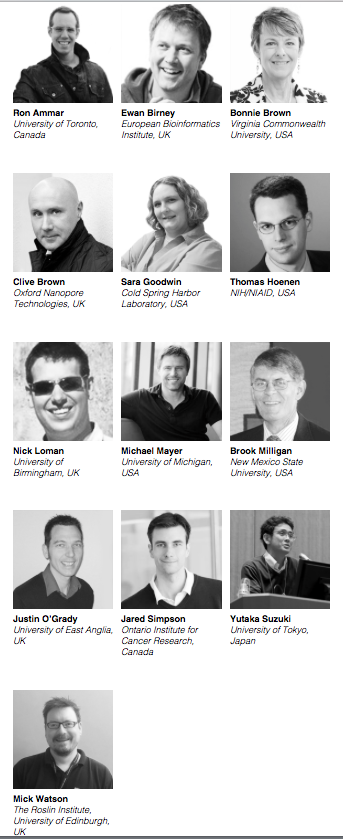
Really disappointed in Oxford Nanopores.  Perhaps we can get some of the speakers to cancel on them unless they fix things.

  • Ron Ammar, University of Toronto, Canada
  • Ewan Birney, European Bioinformatics Institute, UK
  • Thomas Hoenen, NIH/NIAID, USA
  • Nick Loman, University of Birmingham, UK
  • Brook Milligan, New Mexico State University, USA
  • Justin O’Grady, University of East Anglia, UK
  • Jared Simpson, Ontario Institute for Cancer Research, Canada
  • Yutaka Suzuki, University of Tokyo, Japan
  • Mick Watson, The Roslin Institute, University of Edinburgh, UK
Update 3/8/15 
Well, after I posted about the Nanopore meeting there were some responses on Twitter. So I made a Storify

So I decided to check the meeting today to see whether they “fixed” anything.

Right now they list 11 male and two female speakers.  So that added two males and two females.  Better ratio.  Still pretty bad.  They really could do better …

#UCDavis student diagnosed with meningococcal disease

Aggie Alert: UC Davis student diagnosed with meningococcal disease

Feb. 23, 2015

A student who attends the University of California, Davis, has been diagnosed with meningococcal disease, a bacterial infection that can cause bloodstream infections and meningitis, the university and public health officials said today (Feb. 23).

The student is receiving medical care and treatment at a local hospital.

UC Davis and Yolo County Public Health teams are investigating the case, providing preventive antibiotics to contacts where indicated, and educating the university community about meningococcal disease. Close contacts of meningococcal cases who are recommended to receive preventive antibiotics include people who were exposed to the ill person’s respiratory and throat secretions through living in close quarters, or kissing or other prolonged close contact.

University and county health officials are identifying people who had close contact with the student and recommending antibiotics to protect them from becoming ill. Officials are not recommending antibiotic prophylaxis for community members or UC Davis students in general. Prophylaxis is recommended for people specifically identified as close contacts of the ill student.

Meningococcal disease signs and symptoms, which are sometimes mistaken for those of flu early in the course of illness, can include:

•       High fever
•       Severe headache
•       Rash
•       Body aches/joint pain
•       Nausea/vomiting
•       Increased sensitivity to light
•       Confusion

Anyone with the signs or symptoms of meningococcal disease should seek medical care immediately. Early treatment of meningococcal disease is critical as the infection can quickly become life threatening.

Students with questions or any of the above symptoms, contact: UC Davis Student Health and Counseling Services’ Advice Nurse Line, (530) 752-2349.

Parents, family members and the general public with questions or concerns, contact: Student Health and Counseling Services’ Directors Office, (530) 752-2333.

Covering coughs, keeping hands clean and being up to date with recommended vaccines, especially flu vaccine this time of year, are actions everyone can take to stay healthy, protect themselves from illness and prevent the spread of infections to others.

More information:
* CDC information on meningitis http://www.cdc.gov/meningococcal/index.html
* UC Davis Student Health and Counseling Services https://shcs.ucdavis.edu/

Media contacts:
* Beth Gabor, Yolo County PIO, (530) 666-8042beth.gabor@yolocounty.org
* Andy Fell, UC Davis News & Media Relations, (530) 752-4533ahfell@ucdavis.edu

At #UCDavis today: Katherine Amato “Variation and its consequences: Exploring host-gut microbe dynamics in nonhuman primates”

DEPARTMENT OF NEUROBIOLOGY, PHYSIOLOGY & BEHAVIOR

ORGANISM-ENVIRONMENT INTERACTION RECRUITMENT SEMINAR

Katherine Amato, Ph.D.

Postdoctoral Research Associate

University of Colorado Boulder

“Variation and its consequences: Exploring host-gut microbe dynamics in nonhuman primates"

Thursday, February 19, 2015

1:30pm

1022 Life Sciences Building

Amato Seminar February 19.pdf

Oxford Global Sequencing Meetings: Where MEN Tell You About Sequencing #YAMMM

Well, got an email invite to one of these Oxford Global Meetings. Sadly the gender ratio of listed speakers is awful. I highlighted the list below (men in yellow, women in green).  Ratio of 17:3.  (See below).  No thanks Oxford Global.

Dear Professor Jonathan Eisen ,
 We hope you are well and we would like to invite you to speak at our forthcoming Next Generation Sequencing (NGS) USA congress (www.nextgenerationsequencingusa-congress.com) or co-located  Single Cell Analysis USA congress (www.singlecellusa-congress.comto be held on 27th –28th October 2015 at Harvard Medical School, Boston, USA.
 Over the two days, the NGS USA congress aims to cover updates and application of NGS technologies in genomics and genetics research in the US and UK, Europe. Topics are comprised of NGS & NGS Data Analysis Technologies and Platforms, NGS for Cancer Drug Development, Microbiology and Immunotherapy as well as Clinical Applications & Diagnostics. Novel updates in Gene Synthesis, Protein Sequencing and Targeted Sequencing will also be explored The Single Cell Analysis USA congress looks at new methods in DNA sequencing, epigenomic DNA sequencing and RNA sequencing, informatics, data handling as well as application of single cell genomics in understanding cancer  other areas of cancer research such as cancer stem cells and immunotherapy. The presentations are also comprised of novel techniques in imaging and cytometry, isolation and processing of single cells. The congress also covers the applications in translational medicine and the clinic for therapeutic targeting.
 The combination of carefully researched topics and high-level networking opportunities creates a unique discussion platform for over 250 senior scientists we are expecting in attendance from research institutions and pharmaceutical companies. Confirmed Speakers for 2015 include:NGS·          Sreekumar Kodangattil, Senior Principal Scientist, Pfizer       
·          Shrikant M. Mane, Senior Research Scientist in Genetics; Director, MBB Keck Biotech laboratory; Director, Yale Center for Genome Analysis
·          Stephan Schuster, Professor of Biochemistry and Molecular Biology, Penn State University
·          Richard  McCombie, Professor, Human Genetics, Cold Spring Harbor Laboratory
·          Jingyue  Ju, Director, Center for Genome Technology and Biomolecular Engineering, Professor of Chemical Engineering and Pharmacology, Columbia University            
·          Christopher Mason, Chair, ABRF NGS Consortium, Assistant Professor, Weill Cornell Medical College. Dept. of Physiology & Biophysics; The Brain & Mind Research Institute
·          Michaela Bowden, Associate Director, Center for Molecular Oncologic Pathology, Dana Farber Cancer Institute      
·          Yuan Gao, Director, Associate Professor, Lieber Institute/Johns Hopkins University
·          Sheng Li, Instructor in Bioinformatics, Department of Neurological Surgery, Weill Cornell Medical College
·          Michael  Fraser, Associate Director, CPC-GENE Prostate Cancer Genomics Program, Princess Margaret Cancer Centre    
 Single Cell·          Daniel Chiu, Professor, University of Washington    
·          Steve Potter, Professor, Division of Developmental Biology, Cincinnati Children’s Medical Center
·          Norman Dovichi, Professor, University Notre Dame 
·          Zaida Luthey-Schulten, Professor of Chemistry, University of Illinois
·          Paul Bohn, Professor of Chemical and Biomolecular Engineering, University of Notre Dame       
·          Navin Varadarajan, Assistant Professor, University of Houston
·          Alexander R., Ivanov, Director of the HSPH Proteomics Resource, Research Scientist
Harvard School of Public Health·          Viktor Adalsteinsson, Researcher, Researcher, Koch Institute at MIT, Broad Institute of MIT and Harvard Medical School
·          Xinghua Victor Pan, Research Scientist, Single Cell Genomics Group, Sherman Weissman Laboratory, Department of Genetics, Yale University School of Medicine
·          Cheng-Zhong Zhang, Computational Biologist, Department of Medical Oncology, Dana-Farber Cancer Institute