MUTATOR: The perfect “vanity” plates for me, to pay homage to some key people

Well, so I got a new car a little while ago. And though I had had personalized plates for my previous vehicle (“PLOS ORG”), I was not planning to get ones for this vehicle. And then I had a conversation in the hall about personalized plates that a colleague of mine has, and I was intrigued.

So I went to the California site where you can search for whether or not specific personalized plates are available, and I searched for a variety of possibilities. Some were available. Some were not. And then I decided to try one that I just figured would not be available. But amazingly, it was.

This personalized plate, which some call “vanity” plates, is a perfect way for me to acknowledge some people who have played very very important roles in my life and career.

The plate reads “MUTATOR”. And this is really quite good for me to pay tribute to many people including
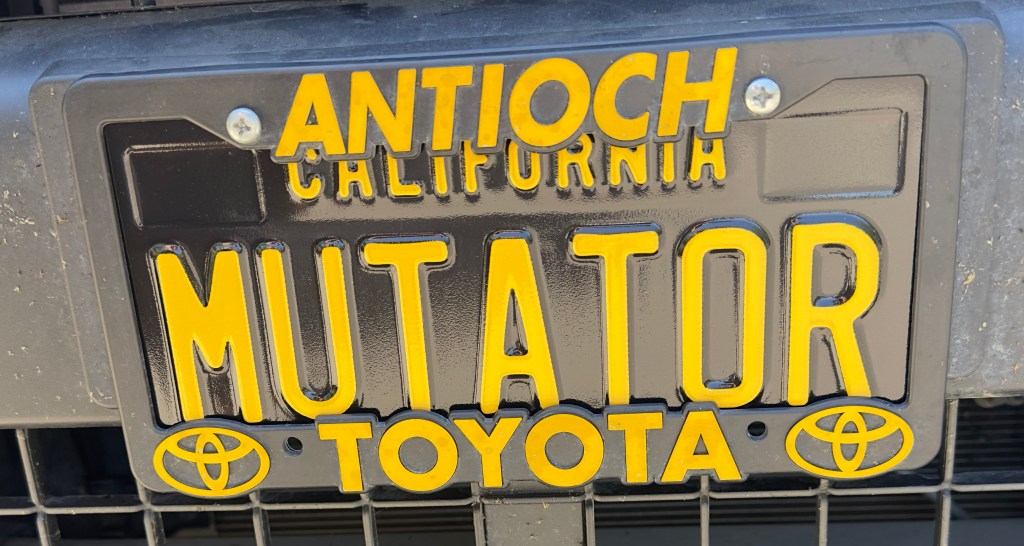
California license plate reading "MUTATOR"

1. My wife, Dr. Maria-Ines Benito who worked on the Mutator transposable element in corn for her PhD. (e.g. see Characterization of the maize Mutator transposable element MURA transposase as a DNA-binding protein). I note – I even ended up co-authoring a paper with her and Ginny Walbot (see below) on Mutator, defining the Mutator family of transposable elements, so the MUTATOR plate works for me too. See Sequence similarity of putative transposases links the maize Mutator autonomous element and a group of bacterial insertion sequences.

2. My wife’s PhD advisor Ginny Walbot, who is one of the grand gurus of studies of the Mutator transposable element (see more here).

3. My PhD Advisor Phil Hanawalt who introduced me to DNA repair and mutation processes and mutator genes supported me as I worked extensively on evolution of “mutator” genes including MutS and MutL. See for example A phylogenomic study of the MutS family of proteins and A phylogenomic study of DNA repair genes, proteins, and processes.

4. Jeffrey H. Miller who did pioneering work on mutator genes in E. coli and other organisms (see some detail here) and who also helped build my career in various ways including by organizing and then eventually inviting me to co-organize the Lake Arrowhead Microbial Genomes meeting.

5. Richard Lenski who has done spectacular work on microbial evolution and on the role that mutator strains / mutations play in such evolution. In addition to being a great colleague over the years, he helped transform my PhD work via an interaction at a Gordon Conference when I was working on adaptive mutation in E. coli.

So, yes, the “MUTATOR” license plate is a bit about vanity for me. I think it is cool. I like to think of myself as a “MUTATOR” in various ways and I also have done work on and off again on mutation processes and mutator strains and genes. But really, the best part for me is that it pays tribute to my wife and a collection of great scientists who helped shape my career.

6/12 at #UCDavis: Stephen Scherer on “Detection of Clinically Relevant Genetic Variants in Autism Spectrum”

UC Davis MIND Institute’s 2012-2013 Distinguished Lecturer Series

SPEAKER: Stephen Scherer, PhD, DSc
TOPIC:
Detection of Clinically Relevant Genetic Variants in Autism Spectrum Disorder
DATE:
Wednesday, June 12, 2013
TIME: 4:30 pm – 6:00 pm
LOCATION:
MIND Institute Auditorium (2825 50th Street, Sacramento)

Background Information ( see attached and below)

Bio Info: Stephen Scherer, PhD, DSc, FRSC, holds the GlaxoSmithKline-Canadian Institutes of Health Research Endowed Chair in Genome Sciences at The Hospital for Sick Children and University of Toronto. Dr. Scherer is director of the University of Toronto’s McLaughlin Centre and The Centre for Applied Genomics. He has made numerous contributions to medical genetics including mapping, sequencing and disease gene studies of human chromosome 7. In 2004, his team co-discovered global gene copy number variation (CNV) and has since shown that CNV is the most abundant type of genetic variation of human DNA. His group then identified CNV that contribute to the etiology of autism and many other disorders. The Database of Genomic Variants that he founded facilitates hundreds of thousands of clinical diagnoses each year. His work is documented in over 300 publications and patents and cited more than 20,000 times, ranking him as one of the top cited scientists over the past decade worldwide. Dr. Scherer has won numerous honors such as the 2004 Steacie Prize, an International Howard Hughes Medical Institute Scholarship, and the Premiers Summit Award for Medical Research. He is a distinguished Fellow of the Canadian Institute for Advanced Research, the American Association for the Advancement of Science, and the Royal Society of Canada.

Presentation: (Detection of Clinically Relevant Genetic Variants in Autism Spectrum Disorder )
Autism Spectrum Disorder (ASD) demonstrates high heritability, familial clustering and ~4:1 male to female bias, yet the causes are only partially understood, due to extensive clinical and genetic heterogeneity. Whole genome sequencing (WGS) promises added value to identify novel ASD risk genes, as well as new mutations in known loci, but an assessment of its full utility in an ASD group has not been performed. In a pilot study, we used WGS to examine 32 families with ASD to detect de novo or rare inherited genetic variants predicted to be deleterious (loss-of-function and damaging missense mutations). Among ASD probands, we identified deleterious de novo mutations in 6 of 32 (19%) and X-linked or autosomal inherited alterations in 10 of 32 (31%) families (some had combinations of mutations). The proportion of families identified with such mutations was larger than has been previously reported, a yield that is in part due to the more comprehensive coverage afforded by WGS. Deleterious mutations were found in four novel, 9 known, and 8 candidate ASD risk genes. Examples include CAPRIN1 and AFF2 (both linked to the FMR1 gene that is involved in fragile X syndrome), VIP (involved in social-cognitive deficits), and other genes such as SCN2A and KCNQ2 (also linked to epilepsy), NRXN1, and CHD7, which causes ASD-associated CHARGE syndrome. Taken together, these results suggest that WGS and thorough informatic analyses may improve the detection of genetic variants likely associated with ASD or its associated clinical symptoms

Scherer_ Bioabstract_05282013.pdf

Evolution in action – Dog Breed Hybrids in NY Times

Excellent article in the NY Times Magazine this weekend on hybrids of purebred dogs.

It is basically a lesson in microevolution, inbreeding, and modern genetics. Some great lines are found throughout including

Havens moved on, like some strange Noah touring his ark — in which every tidy two-by-two had been split apart, jumbled and recombined into a single animal: “That’s a Chihuahua-bichon . . . here’s a half-American Eskimo and half-Lhasa apso” — his voice lifting each time as if to ask, What will they think of next? But he had dreamed up a lot of these things himself.

AND

Dogs with separation anxiety are now commonly treated with psycho-pharmaceuticals. Maybe re-engineering the dog itself, hybridizing newer models, represents “the last piece of the puzzle,” Bob Vetere says. “Will they reach a level of convenience where you have a postage-stamp-size dog that makes you dinner when you come home and reads the paper to you before you go to bed? I’m not sure that’s going to happen. But certainly someone’s going to try it.” After all, the dog, which we’ve molded into one of the most physically diverse mammalian species on earth, has so far been uncommonly obliging to our needs. Why shouldn’t we be capable of driving the entire species toward its inevitable end, down a millennia-long trajectory from wolf to stuffed animal?

The blade runner future is nearly with us … what is to stop more and more twisted projects from happening? Nothing really. I mean, dog breeds are already freakish. With a little extra push, they will just get more bizarre. The really bad part of this is that the breed dogs and then kill the puppies that don’t cut it for whatever their goals were. That has been happening for ages but it still saddens me.

Despite some depressing aspects of the article, it is a good read.