“Brachypodium genomics: The pan-genome, polyploidy and epigenetics of cold responses”
John Vogel
DOE Joint Genome Institute
Monday, March 13, 2017
4:10-5:00 PM
1022 Life Sciences
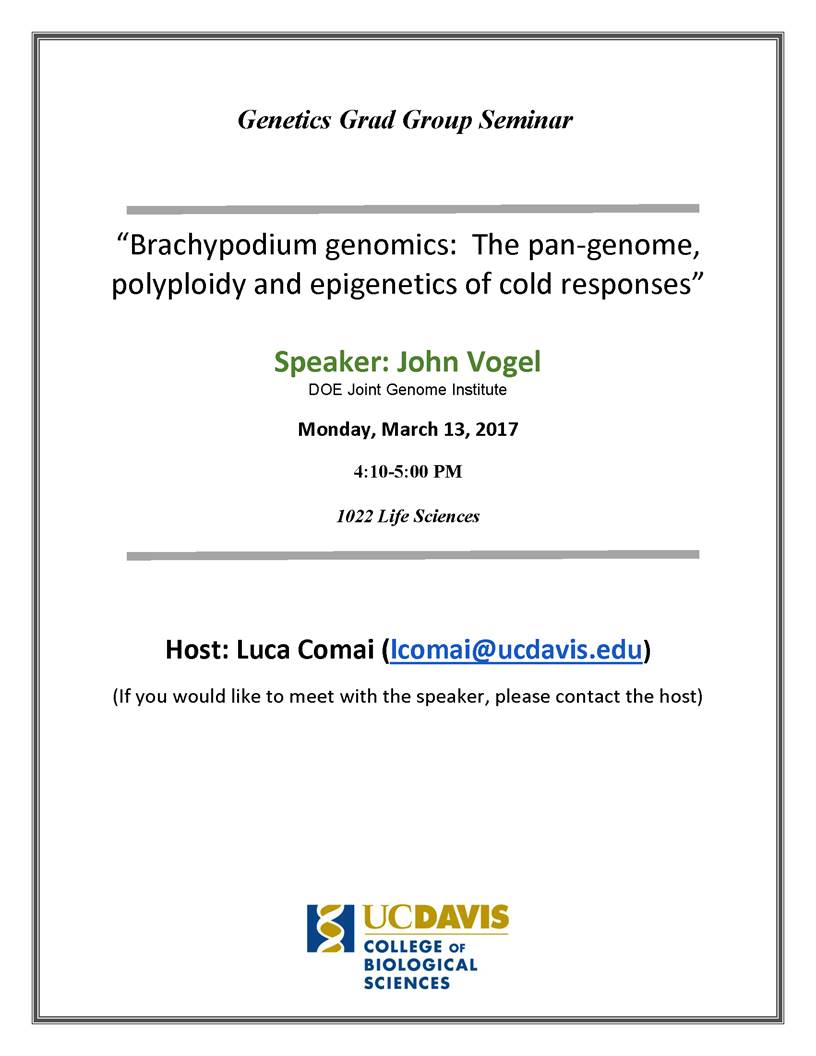

“Brachypodium genomics: The pan-genome, polyploidy and epigenetics of cold responses”
John Vogel
DOE Joint Genome Institute
Monday, March 13, 2017
4:10-5:00 PM
1022 Life Sciences
Of possible interest – was just forwarded this
Dear Colleagues,
I am pleased to share that Howard Hughes Medical Institute (HHMI) has launched a national competition to select new HHMI investigators. We invite researchers to apply who bring original and innovative approaches to the investigation of biological problems in biomedical disciplines, plant biology, evolutionary biology, biophysics, chemical biology, biomedical engineering, and computational biology. Physician scientists are encouraged to participate in the competition. We expect to appoint up to 20 new investigators.
We ask that you encourage appropriate scientists to participate in this open competition. Eligible candidates apply directly without an institutional nomination, and there are no limits on the number of applicants or awardees from any of the over 200 eligible institutions. More information about the HHMI Investigator Program and this competition may be found on our website: http://www.hhmi.org/inv2018.
In brief, candidates must meet the following eligibility criteria at the time of the application deadline:
The deadline for submission of all application materials is June 27, 2017, at 3:00 p.m., Eastern Time.
The HHMI review process will include evaluation of applications by distinguished scientists, leading to the selection of semifinalists by early 2018. Following further review, finalists will be selected in the spring of 2018, with appointments to begin as early as September 1, 2018. Institutions with finalists who have not previously hosted an HHMI investigator will be required to enter into a collaborative agreement with HHMI.
HHMI welcomes a diverse and broad applicant pool. Individuals from gender, racial and ethnic groups underrepresented in biomedical research at the career stages targeted by this program are encouraged to apply. As an equal opportunity employer, HHMI does not discriminate on the basis of race, color, sex, religion, national origin, disability, age or any other characteristic protected under applicable law.
We appreciate your help in distributing this announcement to colleagues at your institution.
With best regards,
Erin
Erin K O’Shea PhD
President
Howard Hughes Medical Institute

Nipam Patel from UC Berkeley
The Evolution of Animal Diversity: Insights from Emerging Model Systems
4:10 in 100 Hunt Hall.
was forwarded this announcement
Postdoctoral Fellowship in Marine Biodiversity
Application review begins March 27, 2017
The Hakai Institute and the Smithsonian Institution’s MarineGEO program seek candidates for a Postdoctoral Fellow based at the University of British Columbia to lead a detailed assessment and analysis of biodiversity in coastal benthic habitats of the Calvert Island Marine Station on the Central Coast of British Columbia. Details below and here: https://www.hakai.org/marinegeopostdoc
The position is part of an ongoing research program aiming to understand nearshore biodiversity of this unique region. We seek a Postdoctoral Fellow to lead a detailed biological inventory of this region (‘BioBlitz’), and develop research that takes advantage of this inventory and existing biological datasets to advance our comparative understanding and quantitative estimates of biodiversity in the North Pacific region.
The Fellow’s time will be split equally between leading the “BioBlitz” and complementary biodiversity research, with data analysis/manuscript preparation stemming from these two activities.
BioBlitz
The Fellow will lead the BioBlitz in the summer of 2017, an intensive field characterization and analysis of biodiversity along Calvert Island’s shorelines and representative habitats of British Columbia’ Central Coast region. The BioBlitz will be conducted in collaboration with the Hakai Institute’s group of researchers (Nearshore Marine Ecology, Oceanography, Geospatial groups) and with a team of experts from the BC region, Smithsonian Institution, and around the world. There are two key components of the BioBlitz:
• A two-week, detailed inventory of representative nearshore habitats: seagrass meadows, soft sediment substrates, intertidal rocky reef and kelp forests. These inventories will complement and add taxonomic resolution to on-going interannual and seasonal monitoring of indicator species and functional diversity in these habitats. The Fellow will have the opportunity to specialize in particular methods or habitats of their interest, but will work with a much larger team of taxonomic generalists and specialists to broadly cover the nearshore environment.
• Analysis and comparison of benthic subtidal rocky reef biodiversity using standardized settlement plates (Autonomous Reef Monitoring Structures, ARMS). ARMS have been deployed to sample differences in community structure between kelp forests (dominated by both Nereocystis and Macrocystis kelps) and de-forested urchin barrens in near proximity to the Calvert Island Research Station.
Together, these BioBlitz components aim to integrate taxonomic descriptions of species with genetic analyses and community-level data. Ultimately, this will produce an unprecedented level of understanding and baseline of habitat-associated marine biodiversity in the Northeast Pacific.
Proposed Research
In conjunction with the BioBlitz, there is considerable scope for independent research employing the BioBlitz collections data, and taking advantage of existing nearshore habitat monitoring datasets (seagrass, kelp, soft sediment, rocky intertidal datasets) and oceanographic/atmospheric data.
Using this diverse dataset and collaboration, applicants will propose research questions (1-page document) pertaining to, but not limited to:
• spatial scaling of biodiversity
• habitat connectivity and complexity
• functional and taxonomic diversity; relationships to ecosystem services
• drivers of change in benthic diversity
Research may focus on either specific habitats or taxa, or address comparative, cross-habitat questions. The proposed research should contribute to biodiversity knowledge of the Northeast Pacific region, with global context and comparative relevance through Smithsonian’s MarineGEO global network.
The Fellowship
The Fellow will be supervised by Margot Hessing-Lewis (Hakai Institute), Patrick Martone (UBC Botany) and Mary O’Connor (UBC Zoology), with residency at the University of British Columbia (UBC). They will collaborate closely with other scientists from the Hakai Institute, the Smithsonian Institution (Washington D.C.) and UBC (Biodiversity Research Center and Beatty Biodiversity Museum, Institute for Oceans and Fisheries).
The candidate must have a Ph.D. in biology, marine science, or other appropriate field, experience in marine field ecology, and clear evidence of research achievement and promise. Because the project involves a collaborative partnership, strong organizational, communication, writing, and people skills are essential. Advanced quantitative skills, including analysis of genomic datasets and taxonomic expertise, or community biodiversity data are also a plus.
To Apply
Applications should include (1) a current Curriculum Vitae; (2) a one-page summary of relevant career goals, interests, experience and publications; (3) a one-page proposal of research questions relevant to the stated goals of the research program; and (4) names and full contact information (postal address, email address, and phone number) for two references (we will contact them directly to request letters of recommendation).
Please submit your application electronically as a single PDF document to the three supervisors listed below with the file name and email subject heading ‘Hakai MarineGEO Postdoc application – SURNAME’ with your surname in capital letters.
The position is a Mitacs Accelerate Post Doc, available immediately for up to two years, contingent on satisfactory progress. The stipend is $55,000 per year, plus Mandatory Employment Related Benefits. Additional funds for research and travel related to the BioBlitz will also be provided.
Review of applications will begin on March 27, 2017 and will continue until the position is filled.
The two-year position will start in Spring 2017. Specific start dates will be negotiated with the successful candidate. The BioBlitz is planned for August 2017.
Project supervisors
Dr. Margot Hessing-Lewis
margot
Hakai Institute: https://www.hakai.org/
Dr. Patrick Martone
Patrick.martone
http://www3.botany.ubc.ca/martone/
Dr. Mary O’Connor
oconnor
http://oconnorlab.weebly.com/people.htm
2017_Hakai-MarineGEO_postdoc_ad_final.pdf
Just got this by email. Could be of interest to some.
|
MIC 291: Selected Topics in Microbiology
Work-in-Progress Seminars
Dr. Miriam Martin
(Dept. of Microbiology & Molecular Genetics)
"Improving student learning in microbiology through peer-to-peer instruction and a collaboratively-designed introductory course"
Wednesday, March 8, 2017
4:10 pm
1022 Life Sciences
Just got this by email:
Looks possibly very interesting but "Evolutionary Connectomics" — that is a #Badomics Word / phrase
https://phylogenomics.blogspot.com/p/my-writings-on-badomics-words.html
Reminder next week…
Ted Jones History of Neuroscience Lecture announcement…
Dr. Harvey Karten will be presenting “Evolutionary Connectomics”
Thursday, March 9th at 4pm at the Center for Neuroscience, Rm 113.

OK it is only 15 years after the fact but am posting some videos from the 2002 Galapagos Rift Expedition I went on May 24 – June 4, 2002. It was the cruise honoring the 25th Anniversary of the discovery of deep sea hydrothermal vent ecosystems.
For more information see the web site from Dive and Discover
Here is a playlist with all my videos, some from the cruise and some from the Galapagos Islands where the cruise started / stopped. I have not edited any of the videos – just digitized everything from the tapes and posted them. Apologies if anything is, well, inappropriate for any reason.
Received this by email:
Plant Sciences Seminar Speaker
March 1, 2017
Dr. Elena Bray Speth
Associate Professor
Department of Biology
Saint Louis University, Missouri
12:10 – 1:00pm ~ Seminar (3001 PES)
“Learning biology – and learning how to learn: challenges and strategies for introductory science students”
Elena’s research program focus on teaching and learning about complex biological systems in introductory biology. Her program at St. Louis University is funded by NSF. Please visit her webpage at http://www.slu.edu/~espeth/index.html. She will present two aspect of her research: (a) how to promote development of competencies such as modeling and crafting explanations in large introductory biology courses, and (b) what we know about students’ self-regulated learning and study habits, and their relationship to academic achievement. Before moving on to science education, Elena received her PhD from Michigan State University, where she studied molecular biology of plant-microbe interactions.
A friendly Reminder! 
Please join us for Human Genomics Seminar Series with Luis Carvajal-Carmona, PhD presenting: “An Update on the Genetics and Genomics of Gastric Cancer”
Date: Wednesday, March 1, 2017
Time: 12:00 PM
Location: Center for Health and Technology Building, Rm# 1341
Please see attached Flyer for more details.
This activity is approved for 1.0 AMA PRA Category One Credit.
Lunch will be provided.
| For those viewing from offsite, copy this link into your web browser:- http://uc-d.adobeconnect.com/hu-gen-seminar/ |
Please also see attached schedule for a complete list of speakers for the 2016-2017 Seminar Series below.


HGSS Schedule 2016 – 2017 FINAL.PDF
HGSS Flyer-L Carvajal-Carmona NEW_3-1-17.pdf


 Jonathan Eisen's Lab