#OpenAccess help needed – best way to publish conference proceedings in an OA manner?

To all Open Access fans or gurus out there.  I am writing at the request of a colleague who is looking into ways that one might switch from publishing papers for a conference from a closed access way to a more Open Access way.

Does anyone out there know if there are good Open Access publishing services that would enable one to do this?  Any information about possible publishers, costs associated with doing this, etc would be helpful.  Thanks in advance.

NOTE ADDED: Perhaps most importantly – we are looking for systems that would include the possibility of publishing printed versions of the proceedings …

So cool – CoPI/colleague of mine Jessica Green picked for TED2010

I am so incredibly psyched that my colleague, collaborator and friend Jessica Green was picked for the TED2010 conference. See the press release here.

Jessica is a Microbial Ecologist at U. Orgeon and has a diverse background in engineering, biology, physics and other things.

And she is both brilliant and cool.  They could not have picked better.  Way to go Jessica.

Want to know more about her work.  Watch this video:

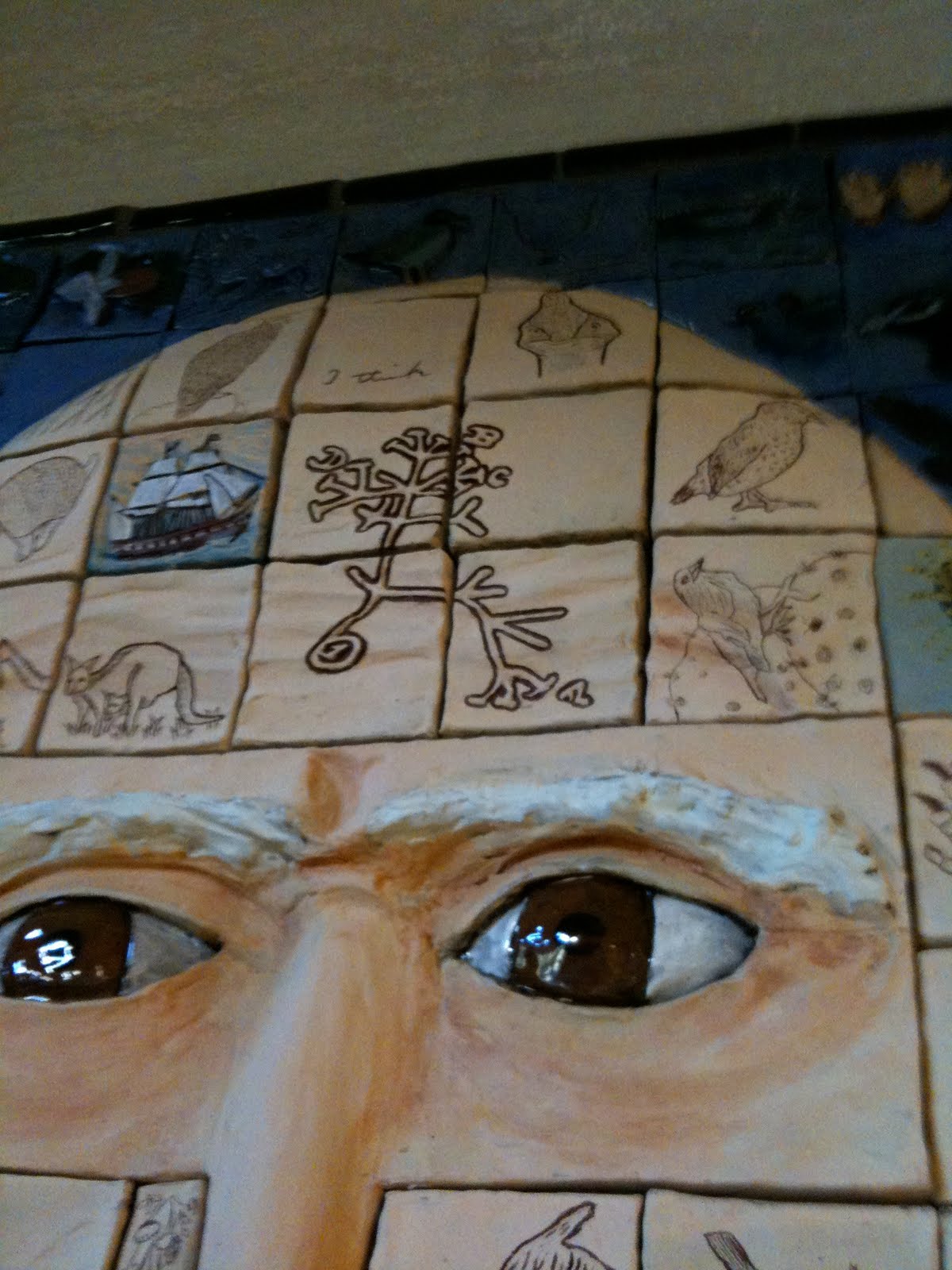
Nice Darwin Art at #UCDavis Evolution/Ecology Dept.

For more on this see The Face of Darwin where K. Garvey explains the history of the mural in more detail. 

Great call for more openness in biology discussions by Steven Wiley in the Scientist

An article after my own heart … Steven Wiley has written a column in the Scientist (Speak Your Mind :The Scientist [2009-12-01]) that speaks both to me and for me. In it he discusses the need for biologists to be more public about their opinions about their work and that of others.

He says, for example

Recently, I attended a conference on biofuel development that included a discussion of the feasibility of deriving fuels from algae. In the open meeting, only a few biologists voiced an opinion, all stated very politely. In private, however, the opinions that I heard were invariably strong and contentious, and few people agreed with what appeared to be the general consensus. It seemed that most of the meeting participants were unwilling to let their viewpoints be publicly known.

I have witnessed the exact same phenomenon and find it disheartening. To help build science and biology we need to be more open about discussing ideas. This pattern of whispering behind the scenes or standing behind anonymity drives me a bit crazy and it is one of the reasons I have become a science blogger and tweeter and such.

Wiley wraps up his discussion by saying

However, a comment is only really useful when the author is identified, because it allows you to evaluate its credibility. Besides, why should anyone respect an opinion that even the author is not willing to claim? And being honest does not mean being insulting or nasty. Open and honest debate has always been necessary for the best science, but mutual respect between the participants is necessary to make it work.

I agree with this too. I have slipped occasionally in being too nasty in comments but am trying to get that under control. But overall, the importance of openness far outweighs the risk of sometimes being offensive. So I am calling for others in biology – start a blog – start tweeting – ask more questions at meetings – get up and say you what you think – sign your name to reviews – sign your name to comments on the web – be more open. It will be good for all of us.


Amazing post-doc fellowship opportunity: Center for population biology at #UCDavis

No bias here — but this really is an incredible post doc opportunity in population biology here at U. C. Davis. See below:


EFFECTIVE: December 7, 2009
DEADLINE: January 20, 2010
POSTDOCTORAL FELLOW IN POPULATION BIOLOGY–The Center for Population Biology at UC Davis invites applications for a Postdoctoral Fellowship in Population Biology, broadly defined to include ecology, phylogenetics, comparative biology, population genetics, and evolution. We particularly encourage applications from candidates that have recently completed, or will soon complete, their PhD. The position is for TWO YEARS, subject to review after one year, and can begin as early as 1 July 2010. It has an annual salary of $38,000 plus benefits, and $6,000 per annum in research support. The Fellow will be a fully participating member in the Center for Population Biology and will be expected to have an independent research program that bridges the interests of two or more CPB research groups. We strongly encourage candidates to contact appropriate faculty sponsors before applying. We also ask that each Fellow teach a multi-day workshop, discussion or lecture series that is of broad interest to the community of population biologists at UC Davis; faculty sponsors or the Director of CPB, Jay Stachowicz, can provide additional input on this aspect of the fellowship. For samples of past workshop abstracts and more information about UC Davis programs in population biology, see http://cpb.ucdavis.edu/jobs.htm.
ONLINE APPLICATION: Interested candidates should submit a cover letter, CV, a short (1-2 page) description of research accomplishments, a short (1-2
page) description of proposed research including potential faculty mentors, a brief description of their proposed workshop/minicourse, and copies of two publications at http://www2.eve.ucdavis.edu/jobs/ all as PDFs. We require 3 letters of recommendation. The referees you list in the online application will receive an automatic notification from our system instructing them how to directly upload letters to our website. Refer to the on-line instructions for further information. For full consideration, applications should be received by January 20. 2010. The University of California is an affirmative action/equal opportunity employer with a strong institutional commitment to the development of a climate that supports equality of opportunity and respect for differences. E-mail questions to gradcoordinator@ucdavis.edu.
DEADLINE: January 20, 2010

HHMI Biodiversity Talks 12/3, 12/4 reminder

Reminder – – UC Davis Alumni and brilliant microbiologist Bonnie Bassler will be giving one of the HHMI Holiday Lectures on Science as a WebCast. Anyone can watch Dec 3 and 4th. She will be talking with Baldomero Olivera and the topic(s) will be “Exploring Biodiversity: The Search for New Medicines”. See HHMI’s BioInteractive – Holiday Lectures on Science for more detail.

Single cell genomics gets its own Center at the Bigelow Lab

Just got this email announcement:

Dear colleagues,

We are pleased to announce the establishment of the Single Cell Genomics Center (SCGC) at the Bigelow Laboratory for Ocean Sciences. The goal of SCGC is to make single cell genomics more accessible to the broad scientific community and to serve as an engine of discoveries in the areas of microbial ecology, evolution, and bioprospecting. The SCGC works as a shared user facility, available to scientists at Bigelow and other institutions, with user fees charged to cover SCGC operational costs. For more information, please see our website:

http://www.bigelow.org/research/facilities/single_cell_genomics_center/

We also want to draw your attention to the upcoming second Microbial Single Cell Genomics Workshop, scheduled for September 19-24, 2010:

http://www.bigelow.org/research/facilities/single_cell_genomics_center/workshop2010

With best regards,

Ramunas Stepanauskas and Michael Sieracki 

Single cell genomics is clearly moving up in the world and this is further proof — a whole core facility dedicated to providing single cell genomics to the world.  I note, I have collaborated with Ramunas and others on a recent PLoS One paper on single cell genomics (see Woyke T, Xie G, Copeland A, González JM, Han C, et al. (2009) Assembling the Marine Metagenome, One Cell at a Time. PLoS ONE 4(4): e5299. doi:10.1371/journal.pone.0005299). 


Basically the idea is, that sequencing and/or characterizing the genomic content of single cells is going to be a powerful tool in many areas of biology research … including studies of microbial communities, interpreting metagenomic data, studies of mutation processes, population genetics, etc …

Bay Area Biosystematists: 12/8, John Carlos Garza on Genetics & mgmt of California fishes

The Bay Area Biosystematists present:
 
“The use of genetic data to delineate management units for California fishes”

John Carlos Garza
Southwest Fisheries Science Center, NOAA
and
Dept. of Ocean Sciences, UC Santa Cruz

As lead of the Molecular Ecology and Genetic Analysis (MEGA) Team, Dr. Garza and his lab
use population genetic data and analytical techniques to address a broad array of questions in ecology,
evolution, behavior, conservation, and management of marine and anadromous organisms. This talk will focus on identifying management units for California fishes and their relationship to taxonomic units

For more about Dr. Garza’s work, visit his website:
http://swfsc.noaa.gov/textblock.aspx?Division=FED&id=902

Tuesday, December 8th, 2009
At the California Academy of Sciences
Golden Gate Park

Dinner and social hour begin at 5:30 pm              Delicious food!!      Thirst quenching beers and healthy sodas!!

Evening presentation begins at 7:00 pm

RSVP REQUIRED FOR DINNER OR TALK
Please rsvp to Healy Hamilton hhamilton — at —- calacademy.org

My favorite evolution stuff 2. Charles Darwin Tobacco Card


In honor of Charlie D. I am posting one of my favorite Darwin items.  I got this from Ebay years ago.  It is a Darwin card – about 3 x 5 cm.  From Ogden’s Cigarettes, much like baseball cards.


Also see my previous “Favorite Darwin thing” – a post card from 1900 or so. 

Going on pump is like going back to school

OK – been on the pump now for about 1.5 weeks. Been OK. A huge learning curve here after 25 years of taking insulin shots. It feels a bit like I am going back to school. So much to learn. So much to unlearn.

Anyway. I am getting to know a few people on pumps too and they are an invaluable resource. What I find most amazing so far is how my kids, 4.5 and 2.5 years old, take this completely in stride. My 4.5 year old daughter now asks which pocket I am carrying the pump in so she can sit on the other leg. And she has asked if it is nice to not be taking shots anymore. Completely casual. Completely normal.
So far – my biggest challenges have been figuring out how to carry the pump and inserting the infusion sets. Getting the hang of the infusion sets (I am using a Medtronic pump currently with the Silhouette infusion system). Still no clue about how to carry the pump in diverse situations, like riding my bike in the rain … but I guess I will learn.