
Kudos to mBio the recently announced new open access journal from ASM. I posted a little bit about it a few days ago. There was some back and forth in the comments w/ people involved in the journal and, impressively, they have already modified some sections of the web site to clarify some of the things I and others felt were unclear. A pretty rare thing in the world of journals as far as I know, to make changes quickly. Normally there would be some sort of deliberative, painfully slow, and annoyingly conservative process in response to comments/feedback. Good job Barbara Goldman and ASM. And happy to have ASM moving a bit more towards an Open Access future.
Tag: Misc.

Biologists rally to sequence ‘neglected’ microbes : Nature News
UPDATE: Our paper on this topic is out and there has been a bit of news here and there about it (e.g., NyTimes). For more see
- More coverage of the GEBA “Phylogeny Driven Genomic Encyclopedia”
- Story Behind the Nature Paper on ‘A phylogeny driven genomic encyclopedia of bacteria & archaea’ #genomics #evolution
—————————-
Nice little story in Nature News about the need to sequence “neglected” microbes.
Biologists rally to sequence ‘neglected’ microbes : Nature News
Quotes me and a few others. Love the fact that it quotes Steven Giovannoni in support of this notion:
“The broad brush strokes of microbial diversity are not adequately represented in that first thousand,” says Stephen Giovannoni, a microbiologist at Oregon State University in Corvallis. “It’s absolutely important that we sequence more.”
I like this because Steve gave me enormous grief about this project at a conference last year. Though I argued with him and disagreed with him, his critiques helped guide much of our work on this project that helped make our paper on the work (which is in press) much better. Glad he generally is now in support of this type of project, though not sure what he thinks about our work in this area …
Here are some of my quotes:
“There’s no doubt to us that filling in the branches of the tree is going to be useful to lots of scientific studies that use genomic data,” says Eisen. “There have been four billion years of evolution and we can really benefit from having some of that information in our databases.”
All these new genomes should improve researchers’ understanding of the evolution, physiology and metabolic capacity of microbes, says Eisen. They will also help match DNA sequences to their proper species from large-scale, high-throughput metagenomic studies from environmental samples, and ultimately contribute in the fields of synthetic biology and genetic engineering.
Share this:
And the sling jaw wrasse makes it to ESPN
OK – now this is really going viral. The slingjaw wrasse video from Peter Wainwright’s lab at UC Davis (which I wrote about here) has now made it to ESPN.
See the SportsNation web site:
Weird Web Stories: Monday, Nov. 16 – SportsNation – ESPN
And on Twitter SportsNation says
The slingjaw wrasse has officially replaced the waiter monkeys as our favorite animals: http://bit.ly/34mMzE
Share this:
ASM – launches new Open Access journal – w/ some aspects of #PLoS One and PNAS
Just got this in an email announcement from the President of ASM
ASM’s first broad-scope, online-only, open access journal, mBio™ will begin accepting submissions in January 2010 in preparation for launch in May 2010. mBio™ will offer rapid review and publication of the best research in microbiology and allied fields. The scope of mBio™ will reflect the enormity of the microbial world, highly interconnected biosphere where microbes interact with living and non-living matter to produce outcomes that range from mutualism to parasitism, energy acquisition and conversion, climate change, geologic change, food and drug production, and behavioral change. “We will encourage authors to explain how their findings fit into the larger picture,” says Editor in Chief Arturo Casadevall. Find out more at http://mbio.asm.org.
Seems like they are trying to become a PLoS One for Microbiology. Actually, they are going one interpretation of their description is that they are going even further than PLoS One in terms of making review more streamlined (see below).
mBio™ will offer authors streamlined decisions. mBio™ editors will either accept or reject manuscripts, and will request only minor revisions; editors generally will not require authors to make extensive modifications or perform additional experiments. The philosophy behind this decision is a desire to break away from the current publication model where authors are often uncertain of whether their work will ultimately be acceptable when additional work is required. Authors of a manuscript rejected by mBio™ who choose to do additional experiments will have the option of resubmitting the paper to mBio™ or another ASM journal one additional time. The resubmission must be accompanied by a response to the prior decision letter. A rejection from mBio™ does not disqualify a manuscript from subsequent submission to another ASM journal.
NOTE – THERE ARE MULTIPLE INTERPRETATIONS OF THIS STATEMENT – COULD MEAN THAT EVERYTHING WILL BE SENT OUT FOR REVIEW AND THEN EDITORS WILL MAKE SIMPLE DECISIONS. ALTERNATIVELY EDITORS COULD JUST ACCEPT OR REJECT PAPERS WITHOUT SENDING THEM OUT. THE LATTER IS HOW I INTERPRETED THE ANNOUNCEMENT.
Not sure everyone is going to like the policy here of allowing editors to just accept papers. Also – seems like they are adopting a policy like PNAS where Fellows can submit their own papers. I note PNAS just ditched this policy, in part due to the problems with peer review of some such papers.
AAM Fellows also will be entitled to submit one paper per calendar year via a special, accelerated submission path. This path will require Fellows to obtain two reviews (from reviewers who are not recent collaborators, trainees, etc.) prior to submission, make any necessary modifications in response to the reviewers’ comments, and communicate the paper plus reviewer feedback and author responses to mBio™. After the manuscript is received by the journal it will be assigned to a member of the Editorial Board (EB) for disposition. Although we anticipate that most manuscripts submitted by Fellows will be approved, the EB member will have the option of recommending modification, additional review, or rejection.
One other things to note – which I do not like by the way – ASM has created their own version of Open Access that they call ASM Access
The term “open access” can mean different things depending on the publisher. ASM has coined the term “ASM Access™” to describe the specific form of open access that applies to mBio™. Full text of mBio™ articles and supplemental materials will be freely available on the mBio™ website immediately upon publication. Full text of mBio™ articles also will be deposited in PubMed Central and will be freely available upon publication.
Authors of accepted papers will be asked to sign a license that grants ASM publishing rights and permits unrestricted non-commercial reuse. ASM will continue to require permission for commercial reuse of mBio™ content.
“ASM Access™” publications will fully meet the open access requirements of funding agencies such as NIH, HHMI, and the Wellcome Trust.
Share this:
Day 2 on the pump
Well, Day 2 on the pump was better than Day 1. The night went well — was a little weird to have a thing attached to me all night but not so bad – slept in some nice big Livestrong sweatpants with big pockets where I put the pump.
Earl AM went fine – had some issues with the pump in mid day – not sure what exactly was going on but still fine tuning the dosing and all the parameters with trying to make the pump mimic a pancreas.
Anyway – enough about me. Most important thing to post today is that tomorrow is World Diabetes Day. Lots of events and activities and other things going on in the real and cyber world.
Share this:
Holy Slingjaw Wrasse and the power of twitter
OK I am now a bit blown away by twitter.
Last week I posted a tiny teeny itsy bitty entry on twitter:
“Peter Wainwright showed this crazy slingjaw wrasse video in our class at#UCDavis yesterday:http://tinyurl.com/ybqv429“
The video indeed is awesome:
And then a few others retweeted/commented on this.
Then Carl Zimmer blogged about it on “The Loom” in a post “The last thing the mosquitofish saw“.
And that is really when the fish hit that fan.
On Tuesday, Tom Chivers at the Telegraph wrote about it “Weird feeding habits of the slingjaw wrasse” saying
“Almost 6,000 people have watched the YouTube footage of Epibulus insidiator, a strange predator found in tropical waters in the Pacific and Indian Oceans.”
Little did he know what would happen next. It seems to have then gotten picked up by all sorts of web news sites around the world and KABOOM, like the fishes jaw, this video went crazy.
See for example
Now there have been 165,000 views. Completely deserving I must say. But pretty surprising too …
———————————–
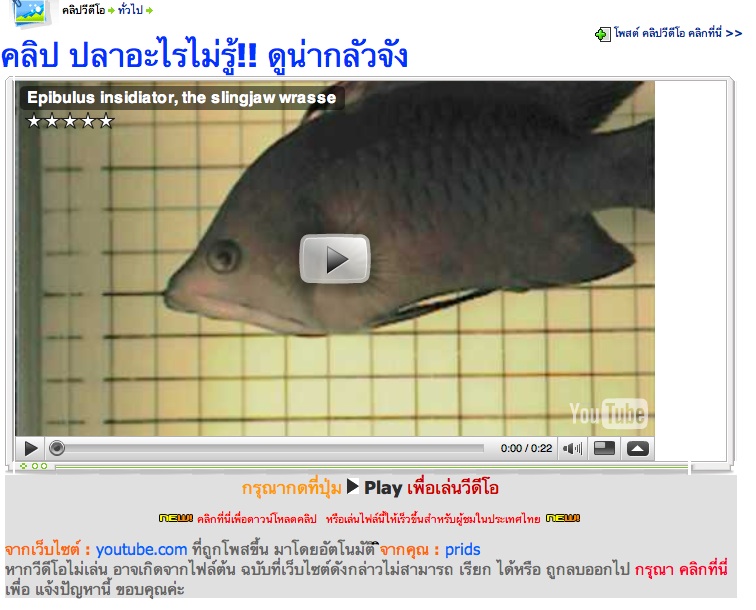
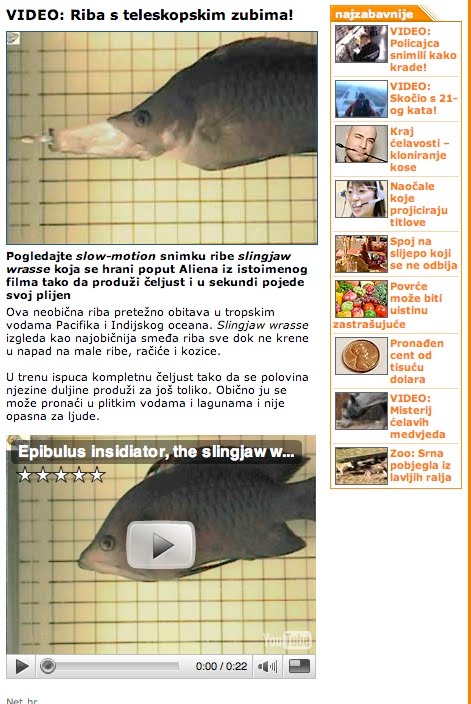
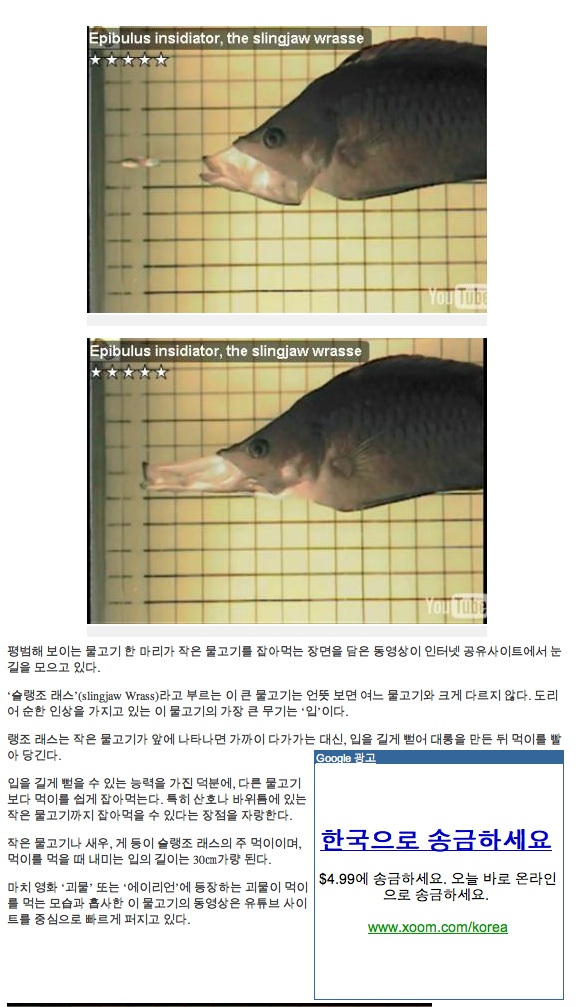
And here are some more links:
- Bizarre Eating Habits of the Slingjaw Wrasse « The Friggin Loon
- High Speed Video of Sling Jaw Wrasse Suction Feeding | glassbox …
- The Slingjaw Wrasse, Epibulus Insidiator | WTFoodge
- Bizarre Eating Habits Of The Slingjaw Wrasse Fish
- Weird feeding habits of the slingjaw wrasse
- Was This Fish the Inspiration for Alien? | Discoblog …
- Epibulus insidiator, the slingjaw wrasse
- Fish with telescopic jaws caught on camera | Zoogle News
- World Kaleidoscope — 世界萬花筒» Blog Archive » Weird feeding …
- Dept of WTF: Wierd fish.
- Fishies from Outer Space
- Friday Videos – Nov 13th, 2009
- critter biology
Share this:

Day 1 – Pumping Again
I was torn about whether to blog about this whole thing or not, but inspired by Lance Armstrong’s openness about this cancer treatments, I have decided that it might be useful to some people — so here goes….
Well, after a HORRENDOUS experience with the Insulin Pump last summer, I am trying it again. Last summer, I spent 2.5 weeks on the pump. Week 1 was freaky – getting used to the whole concept after 25 years on insulin. Week 2 was pretty nice – getting used to the whole thing. Week 3 was the worst – got a very bad infection at the pump insertion site. After a few days went off the pump and then spent 1.5 months dealing with something akin to MRSA. Never got the organism typed (which was really really dumb in retrospect) but when the third antibiotic I went on started to work it seemed like MRSA.
Anyway – more on the disaster later.
Today is for new beginnings. Starting on the Insulin Pump again. Got trained by the Medtronic specialist, which went much better this time than last time. And was up and running in ~ 2 hours. And then I went off with the pump connected, a cyborg again for the first time in over a year.
I went to work for a bit for my lab meeting (a student was presenting and I already delayed her presentation last week so could not ditch her again this week). And after talking to people a bit after lab meeting, I went home.
This time around, with a year to think about things, I feel much better being on the pump Of course I could still get an infection but hopefully that will not happen and things will go better this time.
Share this:
1000 Complete Bacterial and Archaea Genomes -wow

1000 Complete Bacterial and Archaeal Genomes in Genbank. Big MileStone. Good day for a microbial genome party. This whole thing is amazing to me. I moved to TIGR in 1998 in order to get in early on the “genome sequencing revolution” as we called it then. We were amazed when the 10th genome came out. We were then thrilled when TIGR sequenced its 20th genome. And now, there are 1000. Amazing.
And as Nikos Kyrpides just told me (he is sitting next to me right now) – actually if you go to GOLD (Genomes Online) (Nikos runs this DB) you can see there are actually a few more than 1K there. Even more amazing.
Posted using ShareThis
Share this:

Bay Area Bioinformatics Group
OK – so in the era of H1N1 it is definitely yucky to have REAL meetings with people, but this “Bay Area Bioinformatics” meetup group seems like a good idea. They have a meetup in Berkeley 11/14 at Cafe Strada. Folks can sign up here: BayBIFX (El Cerrito, CA) – Meetup.com
Seems like they are focused on East Bay but want to get Davis, and other people involved …
Share this:
Bay Area Biosystematists Mtg 11/10, #UCDavis, on Community Phylogenetics
Bay Area Biosystematists Meeting: Tuesday, 10 November, 2009
at UC Davis, 1022 Life Sciences (LSA)
“Community Phylogenetics”
Featuring Jean H. Burns of the Center for Population Biology, UC Davis
Plus contributions from panel discussants:
Paul Fine, Integrative Biology, UC Berkeley
William Cornwell, Integrative Biology, UC Berkeley
Come and hear about this emerging synthesis of systematics and ecology that promises to transform the way we do both!
Schedule and venue:
5:30 – social gathering with beverages and informal pizza dinner:
cost ca. $12, to be collected at door, 1022 Life Sciences Bldg. (LSA),
UC Davis campus.
7:00 – talks followed by discussion, in same room.
Please email reservations to your host, Kristy Deiner, at alpinedna@gmail.com by Monday, Nov. 9th
All are welcome, members or not. If you want to join the Biosystematists, a venerable yet exceptionally lively group that provides the only inter-institutional seminar/discussion forum addressing evolutionary topics in the Bay Area, sign up for our mailing list at: https://calmail.berkeley.edu/manage/list/listinfo/babs-l@lists.berkeley.edu
For a map of this region of the UCD campus, use the link below.
http://www.cevs.ucdavis.edu/map/map_detail.cfm?centerTile=7_6

