So – in the interest of showing the power of science and the power of microbiome science, I have decided to tackle (so to speak) the topic. If you are not familiar with the power of microbiome science in addressing Tom Brady related controversies then you must check out the use of microbial forensics to solve the #deflategate controversy.
So given this prior record of the value of mofofospoomics (microbiome forensics for sports) I decided to see what we could learn about Tom Brady’s injury.
I started, as any goo microbiome study does, with collecting all the relevant hypotheses to test and not in any way doing an exploratory analysis. So I surveyed the internet by Googling, and searched around Twitter for 3-4 minutes and I found the following plausible hypothesis:
A: Brady was really injured in practice and got a cut that was then treated with stitches and topical antibiotics.
B. Brady had surgery to add an additional finger to hold a future Super Bowl championship ring. In addition, one would assume that oral or IV antibiotics were given as part of the post surgery treatment.
C. Brady and Bill Belichick are faking it to force Jacksonville to alter practice plans.
All three seem completely plausible. I would give them each equal wait in a Bayesian prior sense. So the key question was – could one develop some ways to use a mofofospoomics approach to test for which of these three hypothesis was most likely to be correct.
The first thing to do was to make some mofofospoomics related predictions based on each hypothesis. This actually was relatively easy.
Under hypothesis A, I would expect one key mofofospoomics related signature. Assuming the topical antibiotics were only applied to his right hand then one would expect his right hand to have a different microbiome than his left and to look abnormal like all antibiotic treated skin samples do. So to test for this hypothesis A all we would need would be some hand microbiome samples from him.
Under hypothesis B, I would expect two mofofospoomics related signatures. First, one would expect Brady’s hand to show the typical signature of post surgical changes in the microbiome (see for example Grice 2014). In addition, one would expect there to be affects of the antibiotics used. The oral or IV antibiotics would be expected to affect all of his microbiome – skin and gut for example. Thus both his hands should look like apocalypse happened relative to the microbiome. Also we might expect the new finger to look different from the other fingers since translated parts look more like the donor than the recipient. So to test for this hypothesis B all we would need would be some hand microbiome samples from him and also possibly a fecal sample.
Under hypothesis C, I would expect no mofofospoomics related signatures. That his, his hands should look normal. Or maybe they should look normal for a superstar athlete. So one would need to compare to other well known athlete microbiome signatures.
So – from examination of the possible tests for the three hypothesis it seemed that getting hand microbiome samples for Brady would allow us to use a mofofospoomic approach to determine which of the three was best.
Thus the next issue was – how to get hand microbiome samples from Mr. Brady. First, we tried to get the gloves he has been wearing since the “injury” assuming we could turn them inside out and do all sorts of cool things. Alas, apparently, he has not taken them off at all.
So all we would need would be to get his latest phone. To do this, we placed fake garbage cans on the path from the parking area to their training facility yesterday and .. voila .. Brady walked by and tossed something into the can. Using our patented SmartGarbage sample collector, what he threw in was sealed inside sterile, DNA free plastic. And later in the evening we collected it and … voila voila .. we had a smashed phone itself in a plastic bag (I guess Brady does not want people to get exposed to the cell phone dust). Thanks Tom.
So we took the phone back to our private lab and we asked one key question that was critical to whether we could proceed. Will it blend? And it did.
So then we took the cell phone dust and did standard mofofospoomic analysis on it (DNA isolation, both rRNA gene PCR and sequencing and shotgun metagenomic sequencing, de multiplexing, QC). Kit and other controls were included in every step. And we also downloaded and added sequences from studies of human skin, hands, antibiotic treated or not, cell phones, and also some controls like sports objects.
And then we we fed all the data into the new integrated MAQDADDY pipeline (a combination of Mothur, Anvi’o, QIIME, and DADA). And we used it to test the three hypotheses. Amazingly none of them showed a good match to the data.
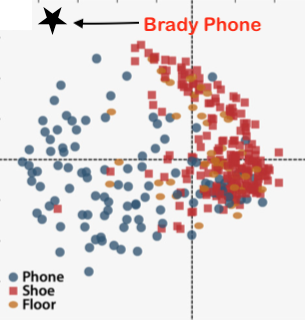
For example, the Brady phone sample did not really even resemble a phone well
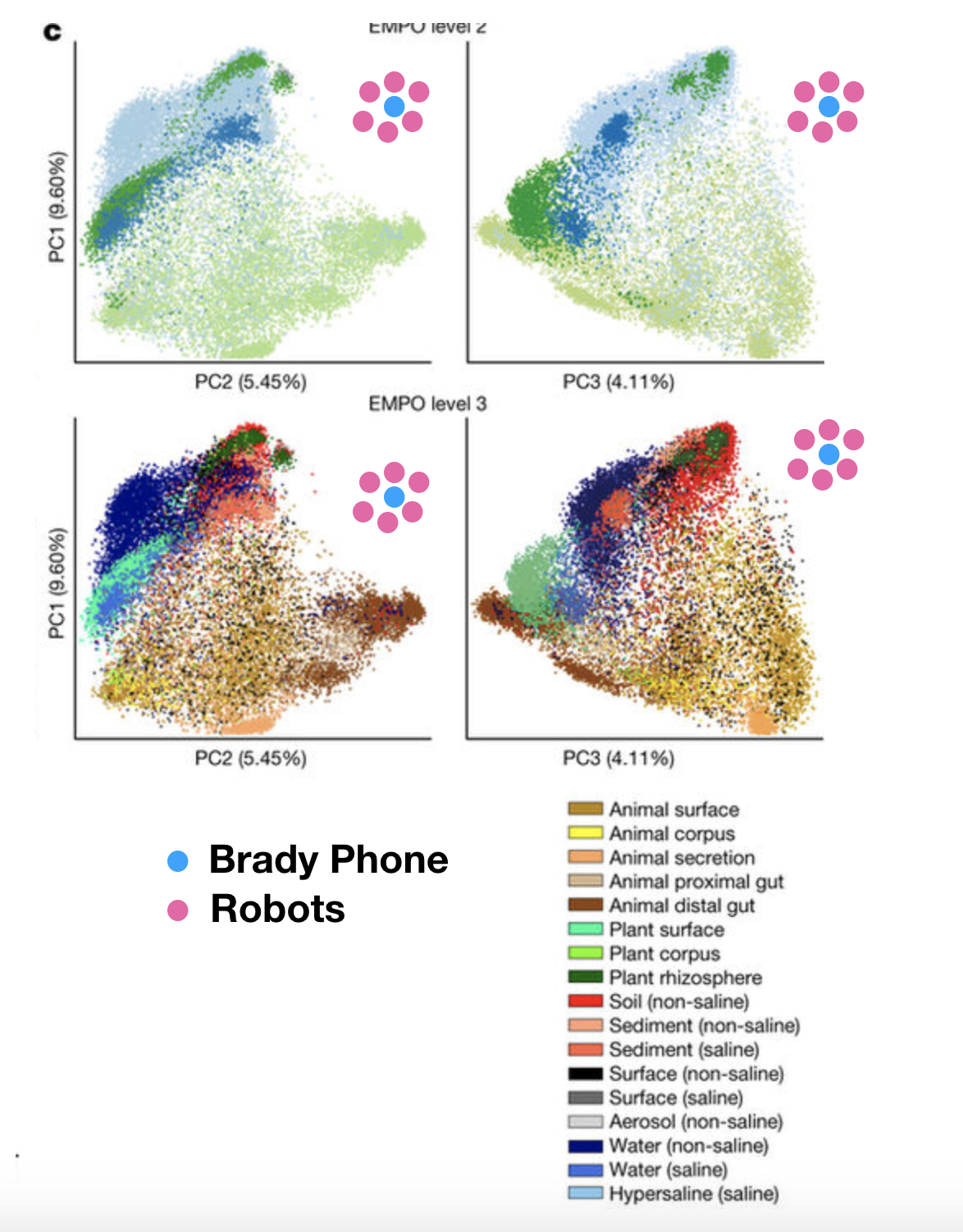
So this was really disappointing. But as one last ditch effort, we decided to download all of the available microbiome data from any sample on the planet. Like all of it. We then reran the MAQDADDY pipeline and found an amazing result.
What I think this means is that Tom Brady had a Luke Skywalker operation. That is, his hand is robotic. So cool.
This week’s Animal Behavior Graduate Group seminar:
More than food: how hormones in mother’s milk organize infant behavior
Dr. Katie Hinde
Associate Professor, Arizona State University
Friday, January 19th, 12:10 pm in Young Hall 194 Coffee and cookies will be available
"Dr. Hinde’s research focuses on how mother’s milk contributes to infant development and behavior in socially complex taxa, particularly humans and monkeys. This includes not only provision of energy and materials for growth, but also milk constituents that shape immunological, neurobiological, and behavior development. She investigates how variation in mother’s milk and behavioral care influences infant outcomes from post-natal life and into adulthood, and subsequent generations.” – The Evolution Institute
This week’s Animal Behavior Graduate Group seminar: **please note that the location will be announced prior to Friday’s seminar**
More than food: how hormones in mother’s milk organize infant behavior
Dr. Katie Hinde
Associate Professor, Arizona State University
Friday, January 19th, 12:10 pm – LOCATION TO BE DETERMINED Coffee and cookies will be available
"Dr. Hinde’s research focuses on how mother’s milk contributes to infant development and behavior in socially complex taxa, particularly humans and monkeys. This includes not only provision of energy and materials for growth, but also milk constituents that shape immunological, neurobiological, and behavior development. She investigates how variation in mother’s milk and behavioral care influences infant outcomes from post-natal life and into adulthood, and subsequent generations.” – The Evolution Institute
We are pleased to announce that Peter Mumby, Professor of Marine Spatial Ecology Laboratory from the University of Queensland in Australia, will be presenting two lectures in the Storer Lectureship in Life Sciences Series, “The Future of Coral Reefs,” at 4:10 p.m. on Wednesday, January 24, 2018 in the Alumni and Visitors Center and “The Connectivity, Ecosystem Overfishing and Rebuilding of Coral Reef Fisheries” at 4:10pm on Thursday January 25, 2018 in Haring Hall. Please see the attached flyer for additional information.
Philip Campbell of @nature talk at @ucdavis met w/ some skepticism …
Sir Philip Campbell gave a talk at UC Davis on “Challenges for Research Group Leaders”. A few people Tweeted during his talk. Here is a recap. I threaded all my Tweets with my first one below so it might be better / easier to follow the discussion if you just go directly to that Tweet.
@ucdavis@nature Sir Philip Campbell at @ucdavis: demands on PIs have never been greater and set to grow – and system is doing less than justice to grad students, PIs, post docs, etc
@ucdavis@nature Sir Philip Campbell at @ucdavis: thinks that we need to shift how we evaluate academics away from impact factor towards personal narratives and selection of key products
@ucdavis@nature Sir Philip Campbell at @ucdavis: going through list of many of the new @nature journals (though I am not sure what the point of this list is)
@ucdavis@nature Sir Philip Campbell at @ucdavis: says he thinks @nature adds value to publications (peer review, editing, distributions, visibility, amplification, permanence, etc)
@ucdavis@nature Campbell at @ucdavis: making claims about the editorial process at @nature and says they have a strict focus on the significance of the research not other values (though I don’t believe this ..)
Editor in Chief of Nature: editors don’t consider who author is, “authorship is not the point” (See pic) But double-blind review is optional pic.twitter.com/jWuIm9VN77
@ucdavis@nature Campbell at @ucdavis still spending a lot of time praising the @nature review system and nothing about research groups and the support they need …
Only someone who hasn’t read Anderson, or tried to argue in good faith with him, could say that. Than again, Nature is a for-profit anti-science scam so perhaps ol’ Phil believes his own bullshit. https://twitter.com/phylogenomics/status/935210038594912257…
@ucdavis@nature Campbell at @ucdavis: now discussing other demands on PIs including refereeing papers (note – I recommend nobody review for @nature doe to their #closedaccess policies)
Editor in chief of Nature: survey results, what would improve reproducibility? “Journals enforcing standards” towards the bottom 🤔 pic.twitter.com/tcE4yCUNU3
@siminevazire@ucdavis@phylogenomics You should make it interesting. They are notoriously anti-female, beat down on trainees and driven by money not science.
@ucdavis@nature At @ucdavis Campbell says should ask who is setting the pathological incentives for publishing in @nature – implies @nautre has 0 to do with this
@sennoma@siminevazire@ucdavis@phylogenomics I’m an assistant professor. You never have enough power, money or friends. I don’t get paid enough to not have an opinion when people are being punched down on.
@McLNeuro@siminevazire@ucdavis@phylogenomics I may have misread and/or miscommunicated. I meant that I didn’t feel right telling someone they should stir shit, when it’s them not me who’s going to live with the fallout. But I’m 100% pro-shit stirring!
@phylogenomics My favorite quote so far: every year we give a mentor award in a different country, last year was in the west coast. CA, OR, WA. Ha! The #bluewall has begun.
@ucdavis@nature At @ucdavis: Philip Campbell says people can apply pressure to make change (e.g., refs using Athena SWAN system for awarding grants but then says Nature would not use such information to decide on papers
@phylogenomics@ucdavis@nature If decisions abt promotion, tenure, & funding continue to be at least in part “outsourced” to high impact journals, that means @nature is in a powerful position as a change agent.
How is @nature going to use that power to the benefit of scientists & science? Help us.
@ucdavis@nature Now @siminevazire following up my question saying that there almost certainly is status bias and other biases in review and suggests they should address that
Mindless data-crunching made bearable with 2nd monitor showing live tweet commentary by @phylogenomics during Nature’s editor-in-chief talk at @ucdavis. I feel like I should pay for this entertainment.
@phylogenomics@ucdavis@nature Q re: overhyped writing style you sometimes see in Nature. How do you keep editors from rejecting papers that are conservatively written?
@phylogenomics@ucdavis@nature As a former Nature imprint interviewee I LOL hard at this. It was obvious from the interview what they were looking for (not that it isn’t blatantly obvious…)
Hanna Kokko will be visiting next week and giving two talks, sponsored by the Storer endowment.
——————-
Public Lecture:
Wednesday December 6, 2017 “Males Exist. Does It Matter?”
4:10 p.m.
Student Community Center, Multipurpose Room
——————–
Scientific Lecture:
Thursday December 7, 2017
“Bet-Hedging in Evolutionary Biology”
4:10 p.m. Kleiber Hall
Some detail about Dr. Kokko:
Dr. Kokko is a professor in of Evolutionary Biology and Environmental Studies at the University of Zürich. She started her career studying engineering and applied mathematics, but later became fascinated by the mathematical logic and foundation that underlies biological phenomena. Her work is at the interface between evolution and ecology. In particular, she is interested in studying the evolution and ecology of reproductive strategies and behavior in animals.
She was awarded the 2010 Per Brinck Oikos Award and the British Ecological Society’s Founder’s Prize. Prior to her appointment at the University of Zürich, she was a professor of Evolutionary Ecology at the Australian National University. While in Australia, she was named an Australian Laureate Fellow. She was made a Fellow of the Australian Academy of Science in 2014.




 Jonathan Eisen's Lab