Draft of a Proposal for a UC #OpenAccess policy – comments wanted

Just got sent this email

Dear Colleagues, 

On behalf of the Academic Senate Library Committee (ASLC), I am asking for your comments on the attached proposed Open Access Publishing Policy for the University of California.. All faculty, including Academic Federation members are invited to post their comments on the Academic Senate web-forum site at http://academicsenate.ucdavis.edu/Forums/index.cfm?Forum_ID=67. Please go to this site to submit your feedback. 

Briefly, the issue is this: the faculty of the University of California, in conjunction with the University Committee on Libraries and Scholarly Communication (UCOLASC), is proposing a new OPEN ACCESS PUBLISHING POLICY that will apply to the dissemination of all scholarly work. UCOLASC is seeking feedback from all campuses on this issue in order to inform a final version of the policy which will be presented to the Universitywide Academic Senate sometime this calendar year. 

The ASLC would appreciate your comments by Wednesday, May 9, 2012. Your ideas will then be shared with UCOLASC in time for its May 25th meeting. The web-forum will remain open substantially past May 9, and we will endeavor to include as many comments up to May 25 as possible. 

Sincerely, 

Brian H. Kolner 

Academic Senate Library Committee

The relate to a draft of a proposal for a new Open Access Publishing Policy being circulated at the University of California. The draft of the proposal can be found here.

UC Davis (and I presume other UCs) are now soliciting comments on the proposal. I would love to here / read comments from anyone. Personally, I think the policy is way to weak as it allows exceptions to be granted …

Social Networks and Scientists: Chronicle for Higher Education Article

Quick post here.

There is a new article in the Chronicle for Higher Education in which I am quoted: Social Networks for Academics Proliferate, Despite Some Scholars’ Doubts

The article discusses many connected topics relating to the use of social media by scientists – though it does not make clear how everything is connected perhaps.  Anyway the author talked to me about Mendeley and various uses of Mendeley and I told her about an effort to create a Mendeley collection of my father’s papers.  The article also discussed LinkedIn, Academia.Edu, Twitter and other social media systems.

Some quotes

Jonathan A. Eisen, a professor of medical microbiology and immunology at the University of California at Davis, used Mendeley to distribute the research papers that his father, Howard J. Eisen, a researcher at the National Institutes of Health, published before he died, in 1987. After struggling to free papers locked behind pay walls, Jonathan Eisen compiled the articles and posted nearly all of them on a Mendeley page he had created for his father. 

Mr. Eisen, a self-described “obsessed open-access advocate,” described the impact in a blog post last year: “Thanks to the social features of Mendeley, more and more people will see and have access to those papers, thus ensuring that they do not wallow in never-never land but continue to have some potential impact on science and society.”

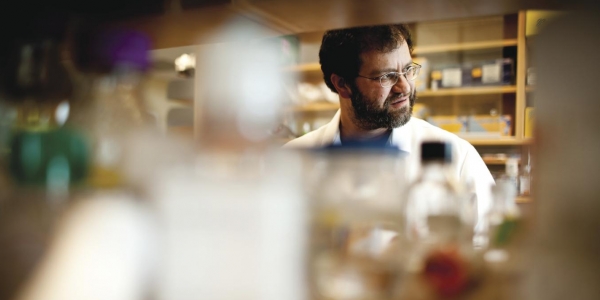
Perhaps most important from my point of view – I love the picture of me taken by Max Whittaker.

Summary of responses to question about metrics for density in phylogenetic trees

I posted a question to Twitter and Facebook about metrics for assessing density in a phylogenetic tree. Here is a “Storification” of the responses. Thanks for the help all.
Any other suggestions welcome in comments … http://storify.com/phylogenomics/metrics-to-quantify-density-of-taxa-sampling-in-a.js?template=slideshow[View the story “Metrics to quantify density of taxa/sampling in a phylogenetic tree” on Storify]

Phylogenetic analysis of metagenomic data – Mendeley group …

Just a little plug for a Mendeley reference collection I have been helping make on “Phylogenetic and related analyses of metagenomic data.” If you want to know more about such studies you can find a growing list of publications at they group collection. http://www.mendeley.com/groups/1152921/_/widget/29/10/

Phylogenetic and related analyses of metagenomic data is a group in Biological Sciences on Mendeley.

Nice use of PacBio sequencing to characterize methyltransferase specificity

Figure 1.


Rich Roberts just pointed me to this cool paper on which he is a co-author: Characterization of DNA methyltransferase specificities using single-molecule, real-time DNA sequencing.  The paper was published in Nucleic Acids Research and is from Robert’s group at New England Biolabs and Jonas Korlach’s and others at Pacific Biosciences. What is cool is that they used the timing of the real time DNA sequencing to identify bases in particular DNA fragments that were methylated.  And this then allowed them to determine the specificity of particular methyltransferases (first tested on ones with known activity and then on ones with unknown activity).  This highlights one of the unique features of PacBio sequencing – because the method watches DNA replication in real time – if something alters the timing of the replication process – this can possibly be leveraged to detect alterations in DNA chemistry (e.g., methylation, DNA damage, etc).  Folks at PacBio have been promoting the methylation detection capabilities of their system for some time but I guess I did not get that interested in it because I viewed it is analogous to many other tools to quantify methylation.  But with this paper I now realize that the PacBio approach (and perhaps those of other methylation detection systems) are not just about quantifying methylation status on average across a set of DNA pieces, but can also be very specific as to exactly which bases are methylated.  And this in turn can be used to define specificity for a variety of unknown methyltransferases. ResearchBlogging.org Clark, T., Murray, I., Morgan, R., Kislyuk, A., Spittle, K., Boitano, M., Fomenkov, A., Roberts, R., & Korlach, J. (2011). Characterization of DNA methyltransferase specificities using single-molecule, real-time DNA sequencing Nucleic Acids Research, 40 (4) DOI: 10.1093/nar/gkr1146

Twisted tree of Life Award #13: Press release from U. Oslo on new protozoan

Wow.  Just got pointed to this press release Rare protozoan from sludge in Norwegian lake does not fit on main branches of tree of life (hat tip to Bill Hooker).  It is a long PR.  And it is riddled with many examples of evolutionary mumbo jumbo – each of which on their own could win a Twisted Tree of Life Award here.  And together, well, I am just going to give it one award – the Twisted Tree of Life Award #14.

Here are some statements that are, well, dubious, and/or painful.

  • Biologists all over the world have been eagerly awaiting the results of the genetic analysis of one of the world’s smallest known species, hereafter called the protozoan, from a little lake 30 kilometer south of Oslo in Norway.
    • Wow – really?  All over the world?
    • And why not tell us what the F#&$# it is?  Where is the name of the organism?  WTF?
  • When researchers from the University of Oslo, Norway compared its genes with all other known species in the world, they saw that the protozoan did not fit on any of the main branches of the tree of life. The protozoan is not a fungus, alga, parasite, plant or animal.
    • That is right.  There are five main branches on the tree of life.  Fungi.  Alga.  Parasites.  Plants. And animals.  Uggh.
  • His research group studies tiny organisms hoping to find answers to large, biological questions within ecology and evolutionary biology, and works across such different fields as biology, genetics, bioinformatics, molecular biology and statistics
    • Yes, and I study tiny organisms to answer small questions.
  • Life on Earth can be divided up into two main groups of species, prokaryotes and eukaryotes. The prokaryote species, such as bacteria, are the simplest form of living organisms on Earth. 
    • Yup, two main groups.  As of 40 f3$*@# years ago.
  • The micro-organism is among the oldest, currently living eukaryote organisms we know of. It evolved around one billion years ago, plus or minus a few hundred million years.
    • OMG.  This is a MODERN ORGANISM.  It did not evolve a billion years ago.  It is no older than ANYTHING ELSE ON THE PLANET.  AAAAAARRRGH.
  • The tree of life can be divided into organisms with one or two flagella
    • What?
    • The tree of life can also be divided into organisms with one or two penises.  
  • Just like all other mammals, human sperm cells have only one flagellum. Therefore, humankind belongs to the same single flagellum group as fungi and amoebae.
    • I don’t even know what to say here.
  • The protozoan from Ås has four flagella. The family it belongs to is somewhere between excavates, the oldest group with two flagella, and some amoebae, which is the oldest group with only one flagellum.
    • Wow – no prior description of the major groups of eukaryotes and now we use excavates (kind of technical) and amoebae (not technical).  Translation error?
    • But even w/ translation issues still very strange.
  • Were we to reconstruct the oldest, eukaryote cell in the world, we believe it would resemble our species. To calculate how much our species has changed since primordial times, we have to compare its genes with its nearest relatives, amoebae and excavates,” says Shalchian-Tabrizi.
    • What?  Their species has been around since primordial times?  What?  That is one really old cell. 
  • The protozoan lives off algae, but the researchers still do not know what eats the protozoan. 
    • Why does something have to eat it?
  • The protozoan was discovered as early as 1865, but it is only now that, thanks to very advanced genetic analyses, researchers understand how important the species is to the history of life on Earth
    • Very advanced?  Like, what? Sequencing?  
  • The problem is that DNA sequences change a lot over time. Parts of the DNA may have been wiped away during the passing of the years. Since the protozoan is a very old species, an extra large amount of gene information is required
    • What?  Since it is old they need more DNA? What?
I could go on and on.  I won’t.  But I will say one last thing that drives me crazy.  There is no paper attached to the press release in any way I can tell.  So all we are left with is this very very very very bad PR.  Ugh.

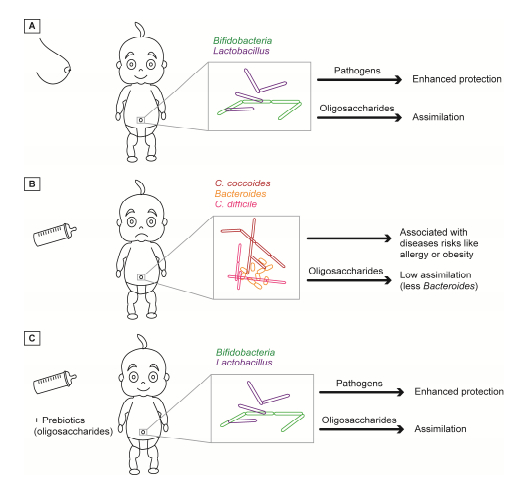
Best #openaccess figures: happy baby, sad baby

From J. Integrated Omics. DOI: 10.5584/jiomics.v2012i2012.76

One of the greatest things about open access papers in my mind is the ability to use the figures for blogs, classes, etc, without having to consult lawyers and other paper pushers. So I am starting a new series here where I highlight some fun/good figures from various open access papers.

The one shown above is from “How has the recent high-throughput sequencing revolution improved our knowledge of infant microbial colonization and health. J. Integrated Omics. DOI: 10.5584/jiomics.v2012i2012.76. By Adrien Fischer, Katrine Whiteson, Vladimir Lazarevic, Jonathan Hibbs, Patrice Francois, Jacques Schrenzel

Happy birthday brother Mike

Visual Notes for Jill Soble’s song about drugs at #TedMed

Jills

Visual Notes for Rebecca Onie’s talk at #TedMed

Onie